10 Persistent Social Media Myths Debunked With Data
SchedulifyX Team · July 6, 2026
Stop falling for common social media mistakes! We debunk 10 persistent social media myths with data, from posting frequency to algorithm shadow bans.
In the fast-paced world of digital marketing, everyone seems to have a secret formula for going viral. However, the internet is flooded with outdated advice, anecdotal evidence, and flat-out social media myths. Following these falsehoods doesn't just waste your time—it can actively harm your brand's online presence, tank your engagement rates, and drain your marketing budget.
As algorithms evolve and user behavior shifts, it is crucial to separate social media facts vs fiction. What worked in 2022 might be a one-way ticket to algorithmic obscurity today. In this comprehensive guide, we are looking at the hard numbers. We have analyzed the latest industry reports and platform updates to bring you the truth.
It is time to leave those common social media mistakes behind. Let's get these marketing myths debunked once and for all, backed by data, so you can build a strategy that actually drives results.
Myth 1: You Must Post Every Single Day

One of the most persistent social media misconceptions is the idea that volume trumps everything. The myth suggests that if you aren't posting on your feed 24/7, the algorithm will forget about you and your audience will move on to your competitors.
The Data
Recent studies by major social media analytics firms have shown that accounts posting 3 to 4 times a week with high-quality, highly relevant content actually see a 40% higher overall engagement rate compared to those churning out mediocre daily posts. On platforms like LinkedIn, posting more than once a day can actually decrease the reach of your previous posts by up to 30%.
The Reality
Algorithms have evolved from chronological feeds to interest-based recommendation engines. They prioritize watch time, saves, shares, and meaningful interactions. If you post every day but your content is uninspired, users will scroll past. The algorithm registers this as a negative signal, lowering the reach of your future posts.
Actionable Tip
Focus on quality over quantity. Create a sustainable content calendar. Use an AI-powered scheduling platform like SchedulifyX to plan out 3-4 highly engaging posts per week rather than stressing over daily filler content.
Myth 2: Maxing Out Hashtags Looks Spammy
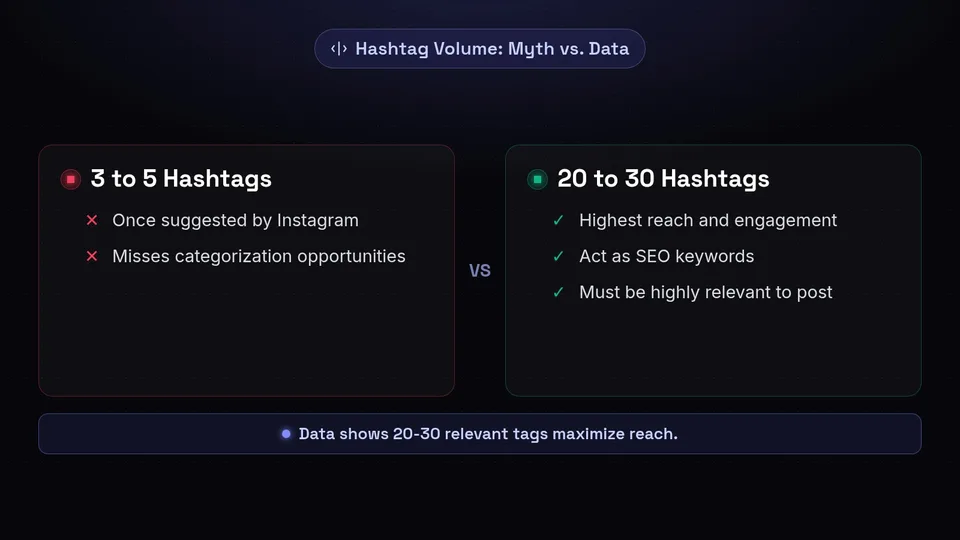
For years, marketers have whispered that using all 30 allowed hashtags on Instagram will make your account look spammy to users and desperate to the algorithm. We've all heard the advice to stick strictly to 3 to 5 hashtags.
The Data
While Instagram's creators account once suggested using 3-5 hashtags, independent data studies analyzing over 100 million posts revealed a different story. Posts using 20-30 highly relevant, targeted hashtags consistently generated the highest reach and engagement rates. The drop-off in performance only occurred when the hashtags were completely irrelevant to the image or video.
The Reality
Hashtags act as SEO keywords for social media platforms. They help categorize your content. While stuffing your post with generic tags like #love or #instagood won't help, using 20 niche-specific tags gives the algorithm more context about who should see your content.
Actionable Tip
Do not be afraid to use the maximum limit if—and only if—every single hashtag is directly relevant to your post, your industry, or your target audience. Mix broad, niche, and location-based tags.
Myth 3: The Algorithm is Actively Shadowbanning You

Whenever a creator's reach suddenly drops, the immediate culprit blamed is the dreaded shadowban. This is one of those social media myths that refuses to die: the idea that the platform's developers have secretly flicked a switch to hide your content from the world without telling you.
The Data
Executives at Instagram, YouTube, and X have repeatedly stated that shadowbanning (in the sense of maliciously hiding content for no reason) does not exist. However, data shows that over 60% of sudden reach drops are tied to a change in user behavior, a shift in the platform's core algorithm (like prioritizing Reels over photos), or a direct violation of community guidelines.
The Reality
If your reach has tanked, you aren't being shadowbanned; you are likely experiencing algorithmic deprioritization. This happens when your recent posts have low engagement, causing the algorithm to test your new posts on a smaller initial audience. It can also happen if you use banned hashtags or post watermarked content from other apps.
Actionable Tip
Instead of panicking about a shadowban, audit your content. Are you providing value? Have you checked your account status in the app settings to ensure you haven't violated guidelines? Pivot your content format to match what the platform is currently pushing.
Myth 4: There is a Universal Best Time to Post
Search online, and you will find hundreds of infographics claiming that Thursday at 2 PM is the absolute best time to post on social media. This leads to millions of brands scheduling their content at the exact same minute, fighting for the same sliver of attention.
The Data
When analyzing engagement metrics across different industries, the best time to post varies wildly. A B2B software company might see peak engagement at 8 AM on a Tuesday, while a local nightclub sees its best numbers at 9 PM on a Friday. Furthermore, 70% of users check social media multiple times a day, meaning content lifespan is longer than a single hour.
The Reality
There is no universal best time to post. The ideal time depends entirely on your specific audience's time zones, work schedules, and app usage habits.
Actionable Tip
Stop relying on generic infographics. Let data drive your decisions. SchedulifyX uses advanced AI to analyze your unique audience's historical engagement patterns, automatically suggesting the optimal posting times for your specific account.
Myth 5: Follower Count is the Ultimate Success Metric
Many brands still treat their follower count as the ultimate KPI. They believe that having 100,000 followers automatically equates to business success, leading to strategies focused purely on top-of-funnel viral growth.
The Data
Industry benchmarks reveal a harsh reality: average engagement rates often drop as follower counts rise. An account with 10,000 highly engaged followers frequently generates more website clicks, leads, and sales than an account with 100,000 passive followers. Micro-influencers (10k-50k followers) boast up to a 60% higher campaign engagement rate than mega-influencers.
The Reality
Follower count is a vanity metric. What matters is community and conversion. If your followers do not care about your product, do not engage with your posts, and never click your links, they are essentially useless to your bottom line.
Actionable Tip
Shift your KPI focus from follower growth to engagement rate, click-through rate (CTR), and conversion rate. Build a loyal community by responding to comments and creating content tailored to your core buyers, not the general masses.
Myth 6: Buying Followers Jumpstarts Organic Growth
In a desperate bid for social proof, some brands fall for one of the most dangerous common social media mistakes: buying followers. The logic is that a high follower count makes the brand look reputable, which will then attract real followers.
The Data
Buying followers destroys your account health. Social media algorithms test your content by showing it to a small percentage of your followers first. If you have 10,000 bought bot followers, the algorithm shows your post to them. Bots don't engage. The algorithm sees a 0% engagement rate and immediately kills the post's reach. Furthermore, platforms purge millions of fake accounts monthly, meaning your purchased numbers will eventually vanish.
The Reality
Buying followers is the fastest way to ruin your organic reach. It tells the algorithm your content is terrible, and it risks getting your account permanently suspended for violating terms of service.
Actionable Tip
Never buy followers. Period. Focus on slow, steady, organic growth. Use targeted advertising if you want to pay to reach new, legitimate users who actually have an interest in your brand.
Myth 7: You Need to Be on Every Single Social Platform
When a new platform launches, there is a mad rush to claim usernames and start posting. The myth is that to be a successful brand, you must have an active presence on Facebook, Instagram, X, LinkedIn, TikTok, Pinterest, Snapchat, and Threads.
The Data
Brands that spread themselves too thin see a massive drop in content quality. A survey of marketing professionals found that teams focusing on just 2 to 3 core platforms generate a 55% higher ROI than teams trying to maintain a presence on 5 or more platforms without a massive enterprise budget.
The Reality
Every platform requires a unique content strategy. TikTok demands raw, short-form video. LinkedIn requires professional, text-heavy insights. Copy-pasting the exact same content across eight platforms looks lazy and performs poorly. Your audience isn't everywhere—they have preferred platforms.
Actionable Tip
Identify where your target demographic spends their time. If you are a B2B SaaS company, dominate LinkedIn and X. If you sell cosmetics, focus heavily on TikTok and Instagram. Master two platforms before even thinking about expanding to a third.
Myth 8: Social Media is Only Effective for B2C Brands
There is a lingering belief in the corporate world that social media is just for fashion brands, restaurants, and consumer goods. Many B2B (Business to Business) companies think their clients aren't influenced by social media when making purchasing decisions.
The Data
This is completely false. Data shows that 75% of B2B buyers and 84% of C-level executives use social media to make purchasing decisions. Furthermore, B2B companies with a strong social selling strategy are 72% more likely to exceed their sales quotas.
The Reality
B2B buyers are still human beings who consume content. They want to work with brands they trust, and social media is the ultimate trust-building tool. Platforms like LinkedIn have become goldmines for B2B lead generation, while educational TikToks and YouTube Shorts are proving incredibly effective for SaaS tutorials and brand awareness.
Actionable Tip
If you are a B2B brand, humanize your company. Share behind-the-scenes content, employee spotlights, and educational thought leadership. Position your executives as industry experts.
Myth 9: Organic Reach is Completely Dead
Because legacy platforms like Facebook drastically reduced organic reach for business pages years ago, a myth formed that social media is strictly pay-to-play. Many believe that without a massive ad budget, you cannot reach new audiences.
The Data
While organic reach on Facebook feed posts is notoriously low (often hovering around 2-5%), the rise of short-form video has completely revitalized organic discovery. TikTok, Instagram Reels, and YouTube Shorts operate on interest graphs, not social graphs. This means content is shown to users based on what they like, not who they follow. Accounts with zero followers routinely get millions of views on well-crafted short-form videos.
The Reality
Organic reach isn't dead; it has just changed formats. If you are only posting static graphics and links, your organic reach will suffer. If you adapt to the era of recommendation media and short-form video, organic reach has actually never been higher.
Actionable Tip
Incorporate short-form video into your strategy immediately. Focus on the first 3 seconds to hook the viewer. You don't need high production value; authenticity and a smartphone are often enough to go viral.
Myth 10: AI Tools Make Your Content Sound Robotic
With the explosion of generative AI, a new myth has emerged: using AI for social media will strip your brand of its unique voice, making your content sound like a soulless robot.
The Data
According to recent marketing surveys, over 60% of top-performing social media managers now use AI in their daily workflows. When used correctly, AI doesn't replace human creativity; it enhances it. Brands leveraging AI for ideation, scheduling, and first drafts report a 30% increase in content output without a drop in engagement rates.
The Reality
AI is a tool, much like a camera or a word processor. If you ask an AI to write a generic post and publish it without editing, it will sound robotic. But if you use AI to analyze data, suggest optimal posting times, generate content frameworks, and refine your copy, it becomes a superpower that frees up your time for high-level strategy.
Actionable Tip
Embrace AI as a collaborative assistant. Use platforms like SchedulifyX to harness AI-powered insights, generate creative captions, and automate the tedious aspects of social media management. Always add your human touch and brand voice before hitting publish.
Conclusion
Navigating the digital landscape is challenging enough without being weighed down by outdated social media myths. By looking at the data, we can clearly see the social media facts vs fiction. Success today doesn't come from buying followers, posting every hour, or fearing the imaginary shadowban. It comes from understanding your audience, creating high-quality, platform-specific content, and using the right tools to optimize your workflow.
Now that we've got these marketing myths debunked, it is time to upgrade your strategy. Stop guessing and start growing. SchedulifyX is an AI-powered social media scheduling platform designed to help you post at the perfect times, craft engaging content, and analyze your real data. Say goodbye to common social media mistakes and let SchedulifyX take your brand to the next level. Try it today and see what data-driven social media management can do for you!