AI Content Ethics: Regulations & Best Practices Explored
SchedulifyX Team · April 5, 2026
Dive into the evolving landscape of AI-generated content ethics, exploring emerging regulations, crucial best practices, and how to maintain trust in the digital age.
Introduction: The AI Content Revolution and its Ethical Imperative
The digital world is undergoing a seismic shift, driven by the rapid advancement of Artificial Intelligence (AI). What once seemed like science fiction is now commonplace, as AI algorithms generate text, images, audio, and video with unprecedented speed and sophistication. From crafting compelling marketing copy to automating customer service responses and even composing music, AI-generated content is becoming an integral part of our daily lives and business operations. This explosion of generative AI, while offering immense potential for efficiency, creativity, and personalization, also brings forth a complex web of ethical considerations that demand immediate attention.
The ability of AI to produce content at scale raises fundamental questions about authenticity, transparency, bias, copyright, and the very nature of human creativity. As AI tools become more accessible and powerful, the line between human-created and machine-created content blurs, necessitating clear guidelines and regulations to prevent misuse and ensure public trust. This article delves into the burgeoning field of AI-generated content ethics, exploring the challenges, examining the emerging regulatory landscape, and outlining essential best practices for responsible creation and deployment.
The AI Content Revolution: A Double-Edged Sword
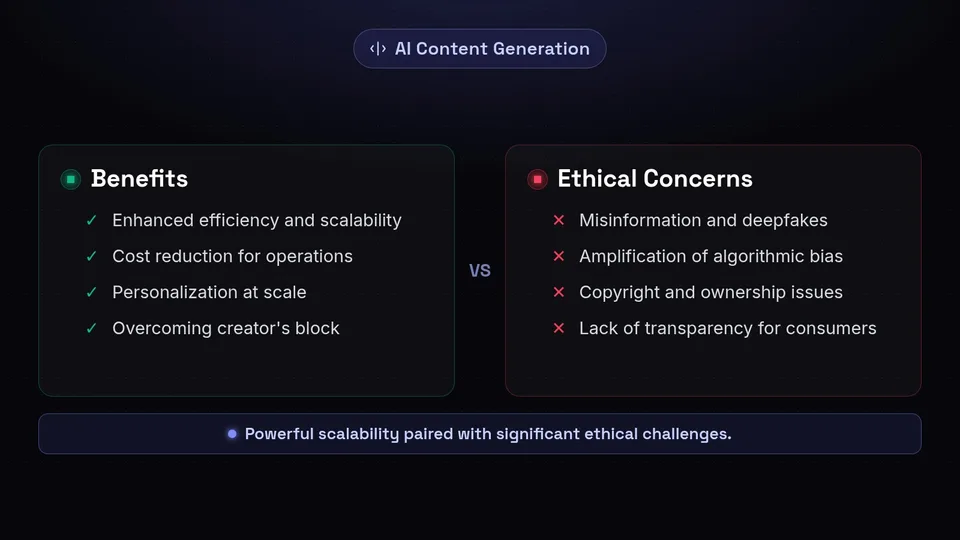
The rise of AI in content creation is undeniably transformative, offering a suite of benefits that businesses and individuals are eager to harness. However, these advantages come hand-in-hand with significant ethical challenges.
Benefits of AI-Generated Content:
- Enhanced Efficiency and Scalability: AI can produce vast quantities of content—articles, social media posts, product descriptions—in a fraction of the time it would take a human, allowing businesses to scale their content efforts dramatically.
- Cost Reduction: Automating content generation can significantly lower operational costs associated with content creation, freeing up resources for other strategic initiatives.
- Personalization at Scale: AI can tailor content to individual user preferences, delivering highly relevant and engaging experiences, from personalized ad copy to customized news feeds.
- Overcoming Creator's Block: AI can serve as a powerful brainstorming partner, generating ideas, outlines, and drafts to kickstart the creative process and overcome mental hurdles.
- Accessibility Improvements: AI can help translate and adapt content for diverse audiences, improving global accessibility.
Challenges and Ethical Concerns:
- Misinformation and Disinformation: AI's ability to generate realistic but fabricated content poses a serious threat, making it harder to distinguish truth from falsehood, especially with deepfakes and AI-generated news.
- Algorithmic Bias: AI models are trained on vast datasets, and if these datasets contain biases (e.g., racial, gender, cultural), the AI will perpetuate and amplify those biases in its generated content.
- Copyright and Ownership: Who owns the copyright to AI-generated content? What about the original works used to train the AI? These are complex legal questions with no clear answers yet.
- Lack of Transparency: Often, consumers are unaware when content is AI-generated, leading to a potential erosion of trust and authenticity.
- Job Displacement: As AI becomes more capable, there are concerns about its impact on human jobs in creative and content-related industries.
- Environmental Impact: Training large AI models requires significant computational power, leading to a substantial carbon footprint.
Understanding the Ethical Landscape of AI Content
Navigating the ethical implications of AI-generated content requires a deep understanding of several core areas. These are the pillars upon which responsible AI content strategies must be built.
Transparency and Disclosure: Why It Matters
Perhaps the most immediate ethical concern is the lack of transparency. When users are unaware that content is AI-generated, it can manipulate perceptions, undermine trust, and even spread propaganda. Clear disclosure, whether through explicit labels or subtle watermarks, is crucial for maintaining an honest digital environment. This isn't just about preventing deception; it's about respecting the audience's right to know the origin of the information they consume.
Accuracy and Fact-Checking: Combating Misinformation
AI models, while impressive, are not infallible. They can 'hallucinate' facts, generate plausible-sounding but incorrect information, or synthesize existing biases into new narratives. The sheer volume of AI-generated content makes manual fact-checking difficult. Establishing robust fact-checking protocols, human oversight, and leveraging AI tools specifically designed for veracity checks are becoming essential to combat the spread of misinformation.
Bias in AI: Origins and Mitigation
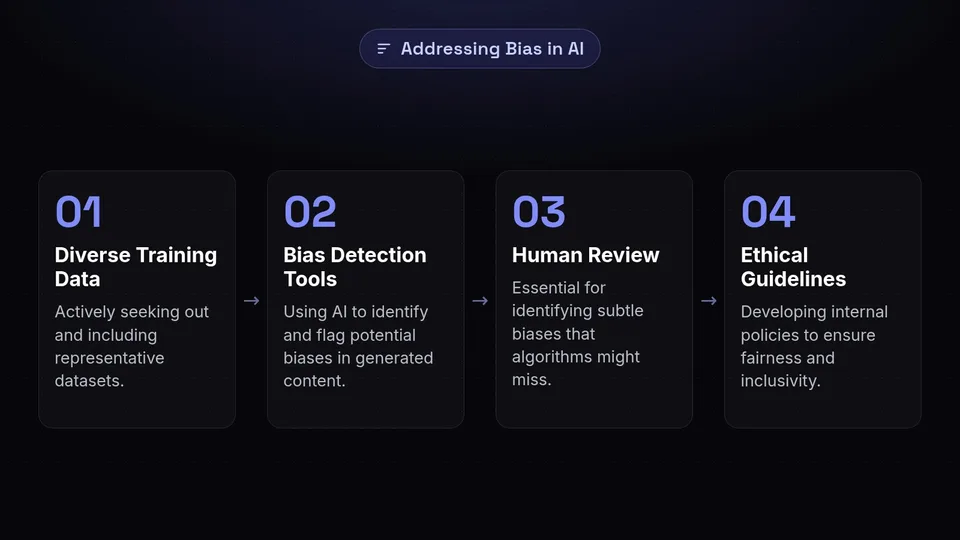
AI models learn from the data they're fed. If that data reflects societal biases, stereotypes, or underrepresentation, the AI will inevitably reproduce and even amplify those biases. This can lead to content that is discriminatory, unfair, or exclusive. Addressing bias requires:
- Diverse Training Data: Actively seeking out and including representative datasets.
- Bias Detection Tools: Using AI to identify and flag potential biases in generated content.
- Human Review: Essential for identifying subtle biases that algorithms might miss.
- Ethical Guidelines: Developing internal policies to ensure fairness and inclusivity.
Copyright and Ownership: Who Owns AI-Generated Work?
The legal framework for copyright, developed in an era of human creativity, is struggling to adapt to AI. Key questions include:
- Can AI itself be considered an author?
- Does the human who prompts the AI own the copyright?
- What about the original creators whose works were used to train the AI model?
- Are AI models infringing copyright by ingesting vast amounts of copyrighted material?
These are complex issues currently being debated in courts and legislative bodies worldwide.
Deepfakes and Authenticity: The Erosion of Trust
The ability of AI to create hyper-realistic images, audio, and video of individuals saying or doing things they never did, known as 'deepfakes,' poses a profound threat to authenticity and trust. While deepfakes have legitimate creative applications, their malicious use for defamation, fraud, or political manipulation is a grave concern. Developing effective detection methods and legal frameworks to combat malicious deepfakes is paramount.
Data Privacy and Security: Training Data Implications
The massive datasets used to train generative AI models often contain personal information. Ensuring the privacy and security of this data, both during training and in the outputs, is a critical ethical consideration. Companies developing and deploying AI must adhere to data protection regulations like GDPR and CCPA, and implement strong safeguards to prevent data breaches or the inadvertent exposure of sensitive information.
Emerging Regulations and Guidelines for AI Content
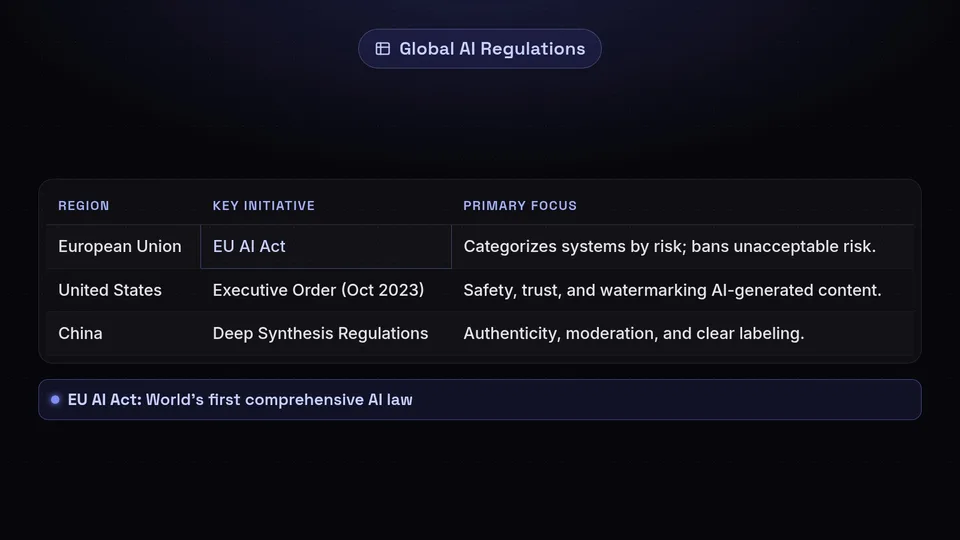
As the ethical challenges become more apparent, governments and industry bodies worldwide are scrambling to develop frameworks to govern AI. While a unified global approach is still nascent, several key initiatives are taking shape.
Global Landscape: EU AI Act, US Efforts, China's Regulations
- The EU AI Act: This landmark legislation is set to be the world's first comprehensive law on AI. It categorizes AI systems based on their risk level, with 'unacceptable risk' systems (e.g., social scoring) banned, 'high-risk' systems (e.g., in critical infrastructure, employment) subject to stringent requirements for data quality, transparency, human oversight, and accuracy, and 'limited risk' systems (e.g., chatbots) requiring transparency. For AI-generated content, the Act emphasizes transparency requirements, especially for deepfakes and systems generating manipulative content.
- United States: The US approach has been more fragmented, with executive orders, NIST frameworks, and ongoing legislative discussions. President Biden's Executive Order on AI (October 2023) introduced broad directives for AI safety, security, and trust, including mandates for watermarking AI-generated content and establishing standards for content provenance. Various agencies (FTC, Copyright Office) are also issuing guidance and exploring regulations specific to their domains.
- China: China has been proactive in regulating AI, particularly concerning content. Regulations target deep synthesis technologies, requiring providers to ensure the authenticity of information, implement content moderation, and clearly label AI-generated content. There's a strong emphasis on preventing AI from undermining national security or social stability.
Industry Self-Regulation: Tech Giants, Content Platforms
Beyond government mandates, many tech companies and content platforms are developing their own ethical AI guidelines and policies. Companies like Google, Microsoft, and OpenAI have published principles emphasizing fairness, accountability, and transparency. Social media platforms are beginning to experiment with labeling AI-generated content, particularly deepfakes, to combat misinformation. These self-regulatory efforts are crucial for rapid response to evolving AI capabilities, even as they face scrutiny for effectiveness and potential conflicts of interest.
The Role of Watermarking and Provenance Tools
A promising area of development is technologies for watermarking and tracking the provenance of AI-generated content. Digital watermarks, often invisible to the naked eye, can embed metadata indicating that content was AI-generated. Blockchain-based provenance systems can create an immutable record of a piece of content's creation, modification, and distribution, helping to verify its authenticity and origin. These tools are seen as vital for enhancing transparency and combating the spread of malicious content.
Best Practices for Ethical AI Content Creation
While regulations evolve, businesses and individuals utilizing AI for content creation must proactively adopt ethical best practices. These principles ensure responsible deployment, build trust, and mitigate potential risks.
1. Always Disclose AI Usage
- Clear Labeling: Explicitly state when content has been generated or significantly assisted by AI. This can be a simple disclaimer at the beginning or end of an article, a specific badge on an image, or an audible notification for AI-generated audio.
- Contextual Transparency: Go beyond mere disclosure; explain the role AI played. Was it for brainstorming, drafting, or full generation?
- Educate Your Audience: Help your audience understand what AI-generated content means and why transparency is important.
2. Prioritize Human Oversight and Editing
- AI as an Assistant, Not an Autocrat: AI should augment human capabilities, not replace critical human judgment. Every piece of AI-generated content, especially for public consumption, should undergo thorough human review.
- Quality Control: Humans are essential for ensuring content aligns with brand voice, resonates with the target audience, and maintains accuracy and nuance that AI might miss.
- Ethical Vetting: A human editor can catch subtle biases, inappropriate language, or potential ethical missteps that an AI might overlook.
3. Implement Robust Fact-Checking Protocols
- Verify AI Outputs: Never assume AI-generated facts are correct. Treat them as suggestions that require independent verification from reliable sources.
- Cross-Referencing: Use multiple trusted sources to confirm information generated by AI.
- Human Expertise: Rely on subject matter experts to validate complex or sensitive information.
4. Actively Mitigate Bias
- Audit Training Data: If you're building or fine-tuning AI models, rigorously audit the training data for biases.
- Test for Bias: Regularly test AI outputs for biased language, stereotypes, or discriminatory content.
- Diverse Review Teams: Ensure your content review teams are diverse to catch biases that might be invisible to a homogenous group.
5. Respect Copyright and Intellectual Property
- Understand Your AI Model's Training: Be aware of how the AI model you use was trained and its stance on intellectual property.
- Attribute Sources: If AI synthesizes information from specific sources, and those sources are identifiable, consider appropriate attribution.
- Originality Checks: Use plagiarism checkers on AI-generated content to ensure it doesn't inadvertently reproduce existing copyrighted material without permission.
6. Ensure Data Privacy in Training and Output
- Secure Data Handling: If using proprietary data for AI training, ensure it's handled securely and in compliance with privacy regulations.
- Anonymization: Anonymize or de-identify personal data where possible before using it for AI training.
- Output Scrutiny: Carefully review AI outputs to ensure they do not inadvertently reveal sensitive personal or proprietary information.
7. Use AI as an Assistant, Not a Replacement for Critical Thinking
- Enhance, Don't Supplant: Leverage AI to enhance productivity, generate ideas, and automate mundane tasks, but always maintain critical human thought and decision-making.
- Develop AI Literacy: Encourage teams to understand both the capabilities and limitations of AI tools.
8. Foster Critical Thinking in Audiences
- Media Literacy: Support initiatives that educate the public on how to identify AI-generated content and critically evaluate information in the digital age.
- Transparency as Education: Use disclosure not just as a legal requirement, but as an opportunity to inform users about the evolving nature of content creation.
AI Ethics in Social Media Management with SchedulifyX
For social media managers, the ethical considerations of AI content are particularly salient. Platforms like SchedulifyX, designed to streamline and enhance social media strategies with AI power, play a crucial role in enabling responsible AI adoption.
SchedulifyX, with its advanced AI capabilities for content generation, scheduling, and analytics, empowers users to amplify their reach and efficiency. However, this power comes with responsibility. When using SchedulifyX's AI to craft social media posts, captions, or even respond to comments, adhering to ethical best practices is paramount:
- Transparency in AI-Assisted Content: If SchedulifyX's AI helps draft a post, consider how you might disclose this to your audience, especially for sensitive topics. While every short tweet might not need a disclaimer, a nuanced blog post summary generated by AI for a LinkedIn update might benefit from a clear indication of AI assistance.
- Human Review is Non-Negotiable: Always use SchedulifyX's scheduling features to allow for a human review step before any AI-generated content goes live. This ensures brand consistency, accuracy, and ethical alignment.
- Bias Checks: Before scheduling AI-generated content via SchedulifyX, ensure it has been checked for any unintended biases. Your brand's reputation depends on inclusive and fair communication.
- Data Privacy: Be mindful of the data you feed into AI tools within platforms like SchedulifyX. Ensure compliance with data privacy regulations and protect sensitive information.
- Authenticity and Trust: Leverage SchedulifyX to schedule genuine, human-vetted content that builds and maintains trust with your audience. AI should enhance your ability to connect, not create a facade.
SchedulifyX is built to give you control, allowing you to harness AI's power while maintaining ethical oversight. By integrating these best practices into your social media workflow, you can ensure your brand leverages AI responsibly, fostering engagement and loyalty without compromising integrity.
Conclusion: Navigating the Future of AI Content Responsibly
The rapid ascent of AI-generated content marks a pivotal moment in the digital age. It promises unprecedented levels of creativity, efficiency, and personalization, but simultaneously introduces a complex array of ethical dilemmas that demand our collective attention. From the critical need for transparency and the fight against misinformation to addressing algorithmic bias and resolving copyright ambiguities, the landscape is constantly evolving.
As governments globally work to establish regulatory frameworks, and industry leaders strive for self-governance, the onus also falls on every content creator and business to adopt a proactive and responsible approach. By embracing best practices such as clear disclosure, diligent human oversight, robust fact-checking, and active bias mitigation, we can harness the transformative power of AI while safeguarding trust, authenticity, and ethical integrity.
The future of AI content is not just about what technology can create, but about how we, as humans, choose to guide its development and deployment responsibly. Platforms like SchedulifyX offer powerful tools to streamline content creation and scheduling. By integrating ethical considerations into every step of your content workflow, you can leverage AI effectively to build a stronger, more trustworthy brand presence. The journey is ongoing, and continuous learning and adaptation will be key to navigating this exciting, yet challenging, new frontier.