AI Regulations 2026: Impact on Social Media Marketing
SchedulifyX Team · May 21, 2026
Discover how the new AI law 2026 impacts your strategy. Learn actionable steps for social media marketing compliance and how to navigate AI regulations.
The landscape of digital marketing is undergoing a seismic shift. For years, artificial intelligence has been the wild west of content creation, enabling marketers to generate text, images, and videos at unprecedented speeds. However, the era of unregulated algorithmic power has officially come to a close. As we navigate through the year, understanding the profound impact of AI regulations is no longer optional—it is a critical survival skill for brands and agencies alike.
With the global rollout of the comprehensive AI law 2026, governments and regulatory bodies have established strict frameworks to ensure transparency, protect intellectual property, and safeguard consumer data. For digital marketers, this means that the tools and tactics relied upon just a few years ago must be re-evaluated. Achieving social media marketing compliance in this new era requires a deep understanding of these legal changes and a proactive approach to auditing your tech stack.
In this comprehensive guide, we will explore exactly how the new AI regulations impact your daily social media operations, what you need to do to stay compliant, and how platforms like SchedulifyX are leading the charge in ethical, compliant AI marketing.
Understanding AI Law 2026: A Global Perspective
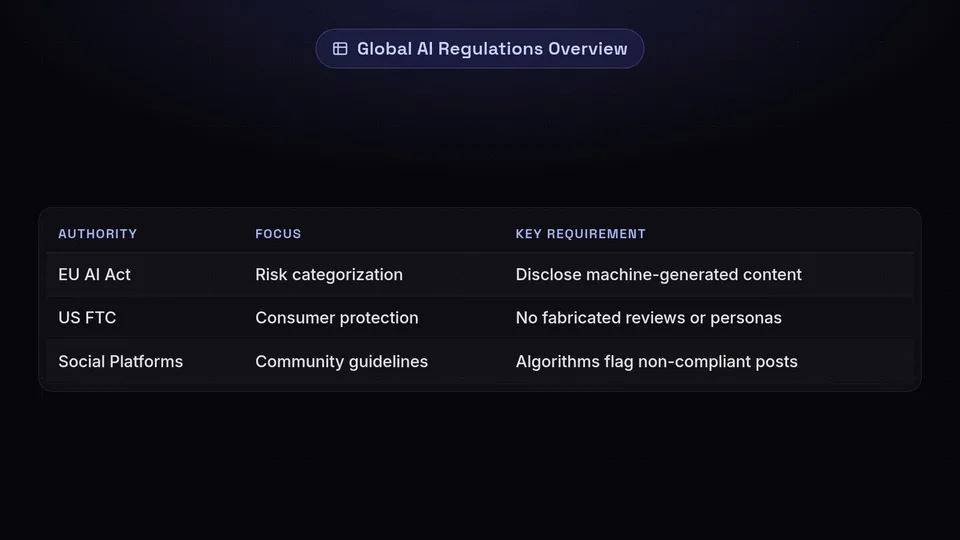
To fully grasp how your social media strategy must evolve, we must first look at the legal landscape. The term AI law 2026 refers to the culmination of several international legislative efforts that have finally gone into full enforcement this year. Following the explosive growth of generative AI between 2023 and 2025, regulatory bodies worldwide recognized the urgent need for guardrails.
The European Union AI Act Enforcement
The EU has historically been a trailblazer in digital regulation (as seen with GDPR), and their AI Act is no exception. Now in full enforcement, the act categorizes AI systems by risk. For social media marketers, generative AI tools fall under specific transparency obligations. If you are using AI to generate images, deepfakes, or even automated text responses, you are legally required to disclose that the content is machine-generated.
United States FTC Guidelines and Federal Directives
In the United States, the Federal Trade Commission (FTC) has cracked down on deceptive AI practices. The 2026 federal directives focus heavily on consumer protection. Marketers can no longer use AI to fabricate customer reviews, create misleading influencer personas (virtual influencers), or generate synthetic media that misrepresents a product's capabilities without explicit, prominent disclosures.
The Global Ripple Effect
Even if your business is based outside of the EU or US, the global nature of social media means these regulations affect you. Platforms like Meta, X, LinkedIn, and TikTok have updated their own community guidelines to reflect these international laws, meaning that non-compliant content will be swiftly flagged, deprioritized, or removed entirely. Compliance is now baked into the very algorithms that dictate your reach.
Core Pillars of the New AI Regulations
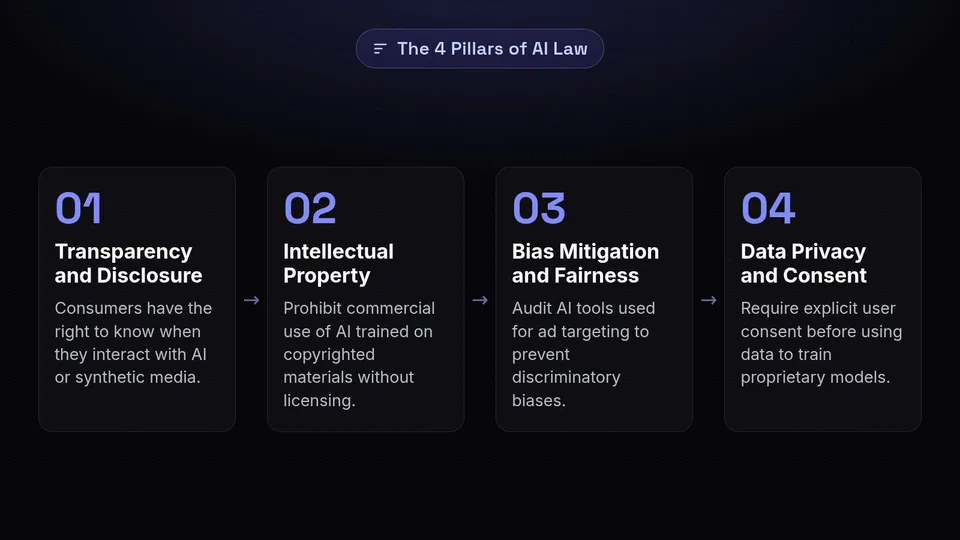
To maintain social media marketing compliance, marketers must understand the foundational pillars upon which these new AI regulations are built. These pillars dictate everything from how you source your content to how you interact with your audience.
1. Transparency and Disclosure
The days of passing off AI-generated content as human-made are over. Transparency is the cornerstone of the AI law 2026. Regulatory bodies demand that consumers have the right to know when they are interacting with an AI or consuming synthetic media. This applies to AI-generated images, videos, and even long-form copy used in advertising.
2. Intellectual Property and Copyright
One of the most fiercely debated topics over the last few years has been the data used to train AI models. The new AI regulations strictly prohibit the commercial use of AI tools that have been trained on copyrighted materials without proper licensing or compensation to the original creators. Marketers must now prove the provenance of their AI-generated assets.
3. Bias Mitigation and Fairness
AI algorithms are only as unbiased as the data they are trained on. New regulations mandate that AI tools used for ad targeting, audience segmentation, and content distribution must be audited for discriminatory biases. If an AI tool disproportionately excludes certain demographics from seeing a housing or employment ad, the brand using that tool can be held legally liable.
4. Data Privacy and Consent
Building upon existing privacy laws, the new AI regulations require explicit user consent before their data can be used to train proprietary AI models or hyper-personalize content feeds. This drastically changes how marketers gather zero-party and first-party data for AI-driven campaigns.
The Impact on Content Creation and Curation
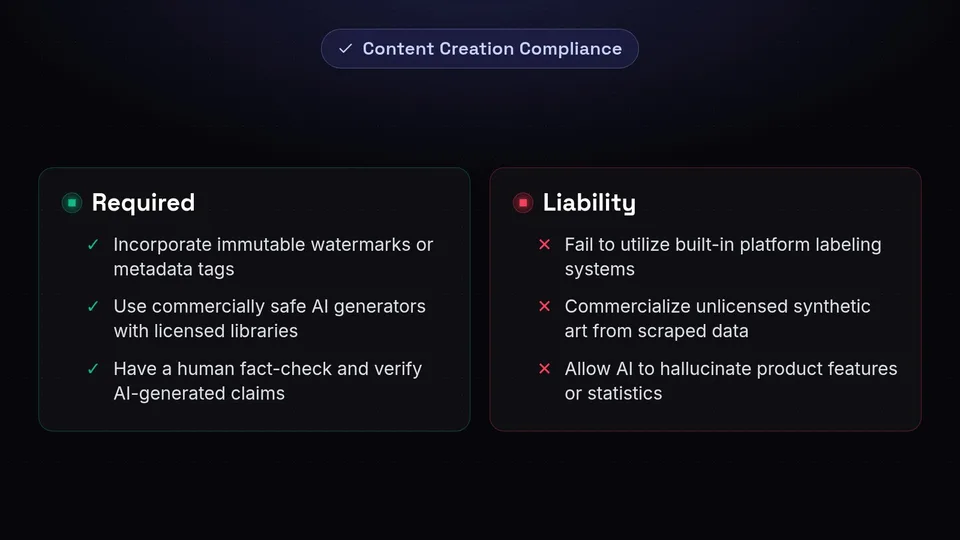
Content is the lifeblood of social media marketing. With AI regulations tightening, how you create, curate, and publish that content must fundamentally change.
Mandatory Watermarking and Labeling
Under the new AI law 2026, any synthetic media (images, audio, or video) must contain a clear, immutable watermark or metadata tag indicating its AI origins. Social media platforms have introduced built-in labeling systems to support this. Failing to utilize these labels can result in your content being shadowbanned. Marketers must adapt their visual strategies to incorporate these disclosures elegantly without disrupting the user experience.
The End of Unlicensed Generative Art
Many marketers previously relied on open-source image generators to create quick, eye-catching graphics for their posts. However, due to strict copyright enforcement, using an AI image generator that scraped the internet without creator consent is now a massive legal liability. Brands are facing hefty fines for commercializing unlicensed synthetic art. The shift is now toward commercially safe AI generators that are trained exclusively on licensed or public domain stock libraries.
Ignorance of your AI tool's training data is no longer a valid legal defense. Brands must demand transparency from their software vendors regarding how their AI models were developed.
Automated Copywriting Restrictions
While generating captions and blog posts with AI is still legal, the FTC requires that any claims made by an AI-generated piece of copy must be fact-checked and verified by a human. If an AI hallucinates a product feature or fabricates a statistic in a social media post, the brand is fully liable for false advertising.
Achieving Social Media Marketing Compliance

So, how do you navigate this complex web of rules? Social media marketing compliance in 2026 requires a proactive, structured approach. It is no longer enough to just tell your team to be careful; you need systemic safeguards.
Establishing an Internal AI Policy
Every marketing team, regardless of size, must have a documented AI usage policy. This document should clearly outline:
- Which AI tools are approved for use by the company.
- The mandatory human-in-the-loop review process for all AI-generated content.
- Guidelines on how to properly label synthetic media across different social platforms.
- Protocols for handling customer data in AI-driven CRM and scheduling tools.
Vendor Compliance Audits
Your compliance is only as strong as your weakest vendor. You must ensure that every third-party tool you use—from social media schedulers to analytics dashboards—complies with AI regulations. Request documentation from your vendors proving that their AI models are unbiased, their training data is legally sourced, and they offer built-in compliance features like metadata watermarking.
Human-in-the-Loop (HITL) Workflows
Complete automation is a compliance risk. The gold standard for social media marketing compliance is the Human-in-the-Loop (HITL) workflow. This means that while AI can draft, suggest, and optimize content, a human marketer must review, edit, and approve the final output before it goes live. This ensures that brand voice is maintained, hallucinations are caught, and legal disclosures are properly applied.
Navigating Data Privacy and Algorithmic Targeting
Beyond content creation, AI regulations heavily impact how marketers target their audiences and analyze data.
The Restriction of Algorithmic Micro-Targeting
Historically, AI algorithms could process vast amounts of user data to create hyper-specific micro-targeted ad campaigns. The AI law 2026 restricts the use of sensitive personal data (such as emotional state, political affiliation, or biometric data) by AI systems to manipulate consumer behavior. Marketers must pivot back to contextual targeting and broad demographic advertising, relying more on the strength of their creative content rather than invasive algorithmic tracking.
Consent for AI Processing
If your marketing strategy involves feeding customer interactions (like social media comments or direct messages) into an AI sentiment analysis tool, you must now obtain explicit consent. Privacy policies must be updated to clearly state that user data will be processed by artificial intelligence, giving users a clear opt-out mechanism.
Actionable Steps to Audit Your AI Marketing Stack
To ensure you are fully prepared for the realities of 2026, follow this step-by-step audit of your current marketing technology stack.
- Step 1: Inventory All AI Tools. Make a list of every tool your team uses that incorporates AI. This includes writing assistants, image generators, video editors, and scheduling platforms.
- Step 2: Review Vendor Certifications. Check if these tools have obtained compliance certifications for the EU AI Act and FTC guidelines. If they cannot provide a compliance roadmap, it is time to find an alternative.
- Step 3: Test for Metadata Compliance. Generate a piece of content using your current tools and inspect the metadata. Does it automatically tag the file as AI-generated? If not, your team will have to do this manually, which introduces the risk of human error.
- Step 4: Update Your Social Media Guidelines. Revise your brand's social media style guide to include mandatory visual disclosures for AI imagery (e.g., a small watermark in the corner of the image or a specific hashtag like #AIGenerated).
- Step 5: Train Your Team. Conduct mandatory training sessions for your entire marketing and communications team on the new legal requirements and the severe penalties for non-compliance.
The SchedulifyX Advantage: Built for 2026
Navigating these complex AI regulations can feel overwhelming, but you don't have to do it alone. This is exactly why we built SchedulifyX with compliance at its core. As an AI-powered social media scheduling platform, we recognized the incoming regulatory wave early and designed our architecture to keep your brand safe.
Commercially Safe AI Generation
Unlike generic AI tools that scrape copyrighted material, the generative AI features within SchedulifyX are trained exclusively on licensed, commercially safe datasets. When you use our platform to generate post captions or suggest imagery, you can do so with the peace of mind that you own the rights to the output.
Automated Compliance Labeling
SchedulifyX takes the guesswork out of transparency. Our platform automatically embeds the required C2PA metadata into any synthetic media you generate or upload. Furthermore, our scheduling interface prompts you to apply platform-specific AI labels (such as Meta's 'Made with AI' tag) before you hit publish, ensuring you never accidentally violate social media marketing compliance rules.
Transparent Audit Trails
If regulatory bodies or social platforms ever question the origin of your content, SchedulifyX provides a comprehensive audit trail. Our Human-in-the-Loop approval workflows log exactly which team member reviewed and approved AI-generated content, providing you with the documentation needed to prove compliance.
Conclusion: Embracing the Future of Compliant Marketing
The introduction of the AI law 2026 is not the end of AI in marketing; rather, it is the beginning of a more mature, ethical, and sustainable era. By enforcing transparency, protecting creators, and safeguarding consumer privacy, these AI regulations ultimately build deeper trust between brands and their audiences.
Achieving social media marketing compliance is a continuous journey that requires the right strategies and the right tools. By staying informed, auditing your processes, and partnering with compliant platforms, you can leverage the incredible power of artificial intelligence without exposing your brand to legal risks.
Are you ready to future-proof your social media strategy? Start your free trial of SchedulifyX today and experience the peace of mind that comes with a fully compliant, AI-powered scheduling platform.