How to Use Watson NLU Text Analytics Before Publishing Posts
SchedulifyX Team · May 6, 2026
Learn how to use Watson NLU text analytics and sentiment analysis to optimize your social media posts before publishing. Prevent PR crises and boost engagement.
In the hyper-connected world of digital marketing, a single social media post can dictate a brand's narrative for weeks. We have all seen it happen: a well-intentioned tweet lands poorly, an Instagram caption comes off as tone-deaf, or a LinkedIn update sparks unintended controversy. The speed of social media demands agility, but that agility often comes at the cost of deep, critical review. This is where artificial intelligence, specifically Watson NLU text analytics, becomes an indispensable tool for modern marketers.
Before you hit 'publish' on your next campaign, understanding the emotional undertones, sentiment, and core entities of your copy is crucial. By integrating IBM Watson Natural Language Understanding (NLU) into your pre-publishing workflow, you can objectively analyze your drafts, ensuring they align perfectly with your brand voice and audience expectations.
In this comprehensive tutorial, we will explore how to leverage Watson NLU text analytics and sentiment analysis to elevate your social media strategy. Whether you are a solo content creator or managing a global enterprise team, mastering these AI-driven insights will transform the way you communicate online.
What is Watson NLU?
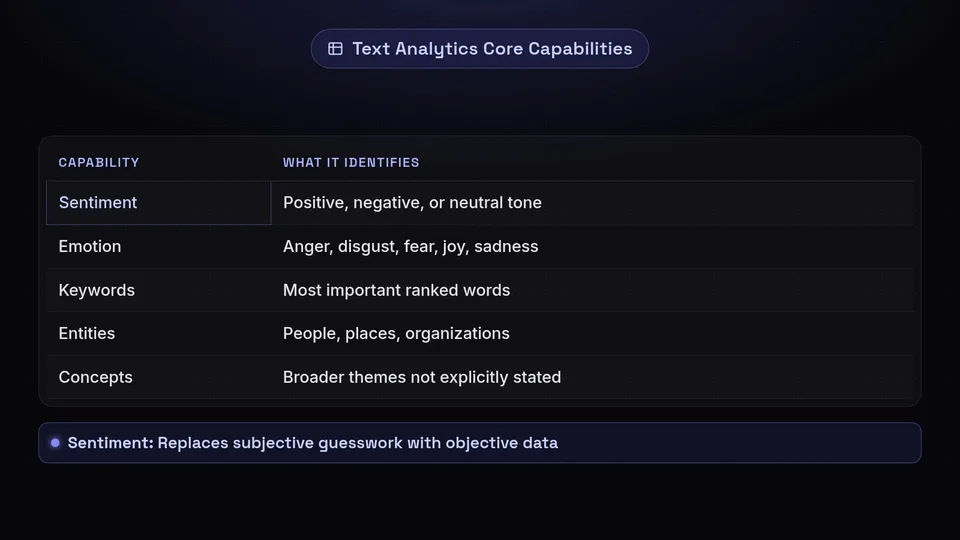
IBM Watson Natural Language Understanding (NLU) is a cloud-native AI service that analyzes text to extract metadata from content such as concepts, entities, keywords, categories, sentiment, emotion, relations, and semantic roles. Born from the same cognitive computing lineage that famously won Jeopardy!, Watson NLU represents the pinnacle of accessible, enterprise-grade natural language processing.
Core Capabilities for Marketers
While Watson NLU is used across various industries for complex data mining, its application in marketing is particularly profound. Here are the core features that make it a powerhouse for content creators:
- Sentiment Analysis: Determines whether the overall tone of a document, sentence, or specific target phrase is positive, negative, or neutral.
- Emotion Analysis: Goes a step deeper than sentiment by identifying specific emotions such as anger, disgust, fear, joy, and sadness.
- Keyword Extraction: Automatically identifies the most important keywords in a text, ranking them by relevance.
- Entity Recognition: Identifies people, places, organizations, and other specific entities mentioned in your text.
- Concept Tagging: Understands the broader concepts your text relates to, even if those specific words are not explicitly mentioned in the copy.
By running your social media drafts through this sophisticated engine, you transition from subjective guesswork ("Does this sound okay to you?") to objective, data-driven content optimization.
Why Text Analytics Matters in Social Media

Social media is inherently conversational, but unlike a face-to-face conversation, you lack the benefit of vocal inflection, body language, and immediate interpersonal feedback. Text is notoriously difficult to interpret correctly. A sarcastic remark might be read as a genuine insult; a passionate defense might be interpreted as unhinged anger.
Protecting Brand Reputation
The primary reason to utilize text analytics before publishing is risk mitigation. In an era where cancel culture and viral backlash are real threats to brand equity, publishing a post with unintended negative sentiment can cause a PR nightmare. Watson NLU acts as an unbiased editorial assistant, flagging combinations of words that trigger high 'anger' or 'disgust' scores before the public ever sees them.
Ensuring Brand Voice Consistency
Every brand has a distinct voice. A playful fast-food chain will have a very different linguistic profile compared to a legacy financial institution. If your brand guidelines dictate an uplifting, joyful, and supportive tone, Watson NLU can score your drafts against these parameters. If a draft scores high in 'sadness' or 'fear', the writer knows they need to revise the copy to better align with the brand's established identity.
Optimizing for the Algorithm
Beyond human interpretation, social media algorithms themselves are increasingly relying on natural language processing to categorize and distribute content. If your post is meant to contribute to a trending topic about 'sustainable energy', but Watson NLU's keyword and concept extraction fails to identify 'sustainability' as a core theme in your draft, it is highly likely the platform's algorithm will miss it too. Text analytics ensures your copy is semantically dense and topically relevant.
The Role of Sentiment Analysis in Content Strategy
Of all the features within Watson NLU, sentiment analysis is arguably the most critical for social media managers. Sentiment analysis algorithms use natural language processing, text analysis, and computational linguistics to systematically identify, extract, quantify, and study affective states and subjective information.
The Nuance of Neutrality
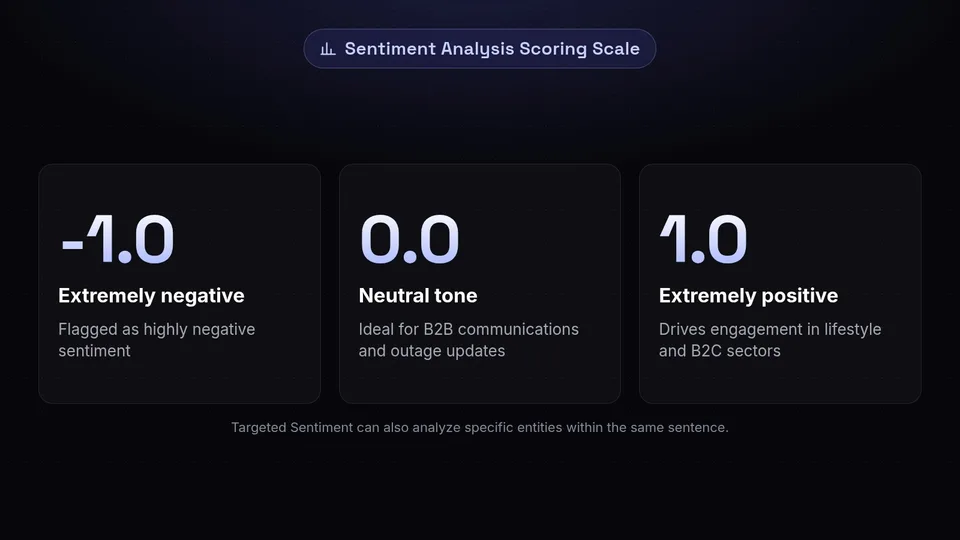
It is a common misconception that all marketing copy must be overwhelmingly positive. While positivity drives engagement in lifestyle and B2C sectors, B2B communications, crisis management, and journalistic updates often require a strictly neutral tone. Watson NLU scores sentiment on a scale from -1.0 (extremely negative) to 1.0 (extremely positive), with scores hovering around 0.0 indicating neutrality.
For example, if your company experiences a software outage, your update tweet should not be 'joyful' or 'positive'. It should be factual, empathetic, and neutral. Running an outage update through Watson NLU helps ensure you aren't accidentally using overly optimistic language that might frustrate users experiencing downtime.
Targeted Sentiment
One of the most powerful aspects of Watson NLU is 'Targeted Sentiment'. Instead of just analyzing the whole post, you can ask Watson to analyze the sentiment surrounding a specific entity. If you are a retailer tweeting a comparison between two products, you can analyze the sentiment applied to Product A versus Product B within the same sentence. This ensures your copy is framing your key offerings in the intended light.
"The difference between the right word and the almost right word is the difference between lightning and a lightning bug." - Mark Twain. In the context of social media, sentiment analysis is the tool that helps you find the lightning.
Step-by-Step Tutorial: Integrating Watson NLU
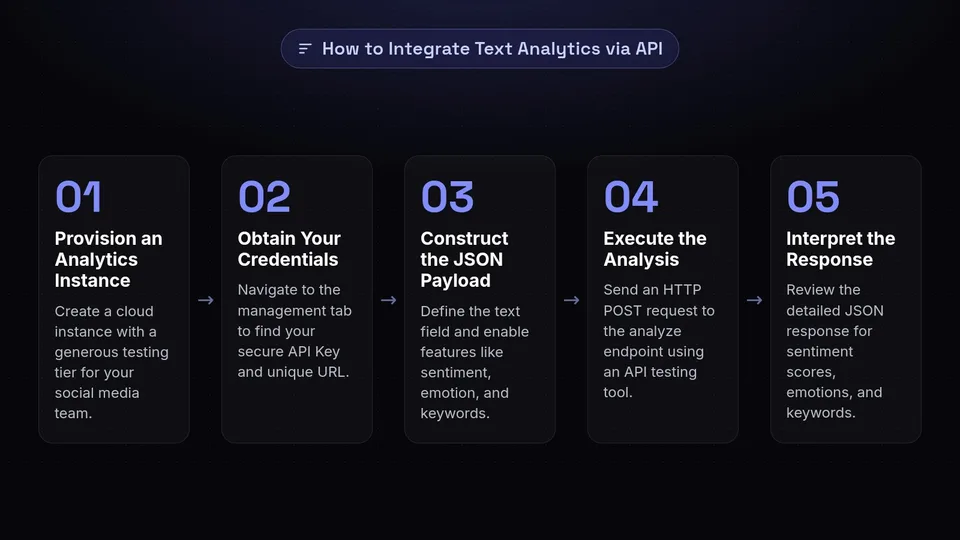
Now that we understand the 'why', let us dive into the 'how'. This tutorial will guide you through the process of setting up Watson NLU and using it to analyze a social media draft. While developers can integrate this directly into custom CMS platforms, marketers can also use simple API testing tools like Postman to run these checks.
Step 1: Provision a Watson NLU Instance
First, you need an IBM Cloud account. Once registered, navigate to the IBM Cloud Catalog and search for 'Natural Language Understanding'. Create an instance of the service. IBM offers a generous 'Lite' tier which is perfect for testing and small-scale social media teams, allowing up to 30,000 NLU items per month at no cost.
Step 2: Obtain Your Credentials
After your service is provisioned, navigate to the 'Manage' tab of your Watson NLU instance. Here, you will find your API Key and your unique URL. Keep these secure, as they are the keys to accessing the text analytics engine.
Step 3: Construct the JSON Payload
To analyze text, you need to send a request to the Watson NLU API. This request includes a JSON payload that contains your draft text and specifies which features you want to analyze. Here is an example of how your request payload should look if you want to analyze sentiment, emotion, and keywords:
You will define the 'text' field with your social media draft. Then, under 'features', you will enable 'sentiment', 'emotion', and 'keywords'. For keywords, you can specify a limit (e.g., return the top 5 keywords) to keep the data manageable.
Step 4: Execute the Analysis
Using a tool like Postman, or a simple cURL command in your terminal, send an HTTP POST request to your Watson NLU URL (specifically the `/v1/analyze` endpoint), using Basic Auth with 'apikey' as the username and your actual API key as the password. Attach your JSON payload to the body of the request.
Step 5: Interpret the Response
Watson NLU will return a detailed JSON response. You will see a document-level sentiment score, a breakdown of the five core emotions with confidence scores ranging from 0.0 to 1.0, and an array of extracted keywords with their individual relevance scores. The key to this step is establishing baselines. What is an acceptable 'joy' score for a product launch? What is the maximum threshold for 'sadness' in a corporate social responsibility post? By defining these parameters, you can objectively judge the API's output.
Before and After: Watson NLU in Action
To truly grasp the power of watson nlu text analytics, let us look at some hypothetical scenarios where a social media manager uses the tool to refine their drafts before publishing.
Scenario 1: The Product Launch
Original Draft: "Finally, the wait is over. The new X-Pro headphones are out. Stop using your old, broken earbuds and buy these now. You won't regret it."
Watson NLU Analysis: The AI scores this draft with high 'anger' (0.65) and 'disgust' (0.40), largely driven by words like 'broken', 'stop', and 'regret'. The overall sentiment is surprisingly negative (-0.35) despite being a product launch.
Revised Draft: "The wait is over! Experience crystal-clear sound with the brand new X-Pro headphones. Upgrade your daily listening experience today. Get yours now!"
Watson NLU Analysis: The revised draft scores high in 'joy' (0.82) and has a strongly positive sentiment (0.75). The aggressive, commanding tone has been replaced with an inviting, benefit-driven message, vastly improving its potential for positive engagement.
Scenario 2: The Apology/Service Update
Original Draft: "We are incredibly sorry for the massive disaster with our servers today. It was a complete nightmare and we are furiously working to fix this terrible mess. Please be patient."
Watson NLU Analysis: Watson flags this with off-the-charts 'sadness' (0.78) and 'fear' (0.60). The words 'disaster', 'nightmare', 'furiously', and 'terrible mess' induce panic rather than calm. The sentiment is extremely negative (-0.85).
Revised Draft: "We are aware of the current server connectivity issues and our engineering team is actively deploying a fix. We apologize for the inconvenience and appreciate your patience while we restore full service."
Watson NLU Analysis: The emotion scores stabilize. 'Sadness' drops to a low hum (0.20), and the overall sentiment moves to a manageable, factual neutral (-0.10). This communicates the problem without inciting panic, protecting the brand's professional image.
Scenario 3: B2B Thought Leadership
Original Draft: "Look at our new blog post about AI. It has some good stuff about data and how to use it better in your company. Read it here."
Watson NLU Analysis: The keyword extraction feature returns weak, generic terms: 'blog post', 'good stuff', 'company'. The concept tagging fails to identify the core topic accurately due to vague language.
Revised Draft: "Unlock the power of predictive analytics. Our latest whitepaper explores how enterprise companies can leverage AI-driven data models to accelerate revenue growth. Read the full analysis here."
Watson NLU Analysis: Watson NLU now extracts strong, highly relevant keywords: 'predictive analytics', 'AI-driven data models', 'revenue growth'. Concept tagging successfully identifies 'Artificial Intelligence' and 'Business Intelligence'. This tells the social media manager that the algorithms (like LinkedIn's) will easily categorize and distribute this post to the right professional audience.
Advanced Text Analytics Techniques for Social Media
Once you have mastered basic sentiment and emotion checks, you can unlock advanced strategies to further refine your social media presence.
Automated Hashtag Generation via Entity Extraction
Choosing the right hashtags is often a guessing game. By utilizing Watson NLU's Entity and Keyword extraction, you can automate this process. If Watson identifies 'Elon Musk' as a Person entity, 'Tesla' as an Organization entity, and 'Electric Vehicles' as a high-relevance keyword, you instantly have your core hashtags: #ElonMusk #Tesla #ElectricVehicles. Because these are derived from the semantic core of your text, they are guaranteed to be highly relevant.
Semantic Roles for Clarity
Semantic roles parsing is a feature that identifies the subject, action, and object in your sentences. In social media, brevity and clarity are paramount. Passive voice or convoluted sentence structures can confuse readers as they scroll quickly. By running your text through semantic role analysis, you can ensure that the 'Actor' (your brand or the customer) is clearly performing the 'Action' (the benefit or the verb), leading to punchier, more direct copywriting.
Competitor Benchmarking
Text analytics isn't just for your own drafts. You can scrape the recent social media posts of your top competitors and run them through Watson NLU. What is their dominant emotion? Are they relying heavily on 'joy' while your brand relies on 'trust' (which often maps to neutral sentiment and specific concept tags)? By mapping the emotional and semantic landscape of your industry, you can find the whitespace. If every competitor is shouting with high-energy, positive sentiment, perhaps a calm, authoritative, neutral tone will help your brand stand out.
Multilingual Social Media Strategy
For global brands, Watson NLU is a game-changer. It natively supports multiple languages including French, German, Spanish, Portuguese, Japanese, and Korean. Translating a post is one thing; ensuring the translated post carries the same emotional weight and sentiment as the original is another. By running your localized drafts through Watson NLU, you can verify that a joke translated into Spanish hasn't accidentally triggered high 'disgust' or 'anger' scores due to cultural linguistic nuances.
Automating the Process with SchedulifyX
While manually running drafts through an API using Postman is a great way to learn how text analytics works, it is not a sustainable workflow for a busy social media manager posting dozens of times a week across multiple platforms. The friction of copying, pasting, and analyzing JSON responses will quickly bottleneck your content pipeline.
This is where SchedulifyX steps in to revolutionize your workflow. As an AI-powered social media scheduling platform, SchedulifyX integrates advanced natural language processing directly into your drafting dashboard.
Seamless Pre-Publishing Checks
With SchedulifyX, you don't need to be a developer to harness the power of AI. When you type your post into the SchedulifyX composer, our built-in text analytics engine instantly evaluates your copy in real-time. You get a clean, visual dashboard showing your sentiment score, emotion breakdown, and extracted keywords right next to your draft.
Brand Voice Guardrails
SchedulifyX allows you to set custom 'Brand Voice Guardrails'. If your brand strategy dictates that no post should ever exceed a 0.4 'anger' score, SchedulifyX will automatically flag any draft that violates this rule, preventing you from scheduling or publishing the post until it is revised. It acts as an automated, infallible editor that never sleeps.
Smart Suggestions
Beyond just pointing out flaws, SchedulifyX uses generative AI paired with text analytics to suggest improvements. If your sentiment is too negative, click a button, and SchedulifyX will rewrite the sentence to boost the 'joy' or 'neutrality' score while retaining your core message. It also automatically suggests the highest-performing hashtags based on the entity and keyword extraction of your specific post.
Conclusion
The days of relying solely on gut feeling to judge the quality of a social media post are over. In a landscape where brand reputation is fragile and algorithms are incredibly sophisticated, utilizing watson nlu text analytics and sentiment analysis is no longer a luxury—it is a necessity. By understanding the emotional resonance, semantic clarity, and core entities of your copy before you hit publish, you protect your brand from PR crises, ensure consistency, and drastically improve your chances of algorithmic success.
However, the true power of these tools is unlocked when they are seamlessly integrated into your daily workflow. Stop wasting time bouncing between APIs, spreadsheets, and scheduling tools. Elevate your social media strategy by embracing automation and AI-driven insights.
Ready to transform your content creation process? Try SchedulifyX today. Experience the peace of mind that comes with knowing every single post is perfectly optimized, emotionally calibrated, and ready to engage your audience. Sign up for a free trial and let our AI-powered platform take your social media presence to the next level.