Meta's 2026 API Changes: What Social Media Managers Need to Know
SchedulifyX Team · May 19, 2026
Discover everything social media managers need to know about Meta's 2026 API changes. Learn how the latest Facebook, Instagram, and Graph API updates impact you.
The landscape of social media management is in a constant state of flux, but few events send ripples through the industry quite like a major update to Meta's developer ecosystem. As we navigate through 2026, Meta has rolled out one of its most comprehensive and transformative updates to date. The meta api changes 2026 represent a paradigm shift in how third-party tools, brands, and agencies interact with the world's largest social network. Whether you are scheduling content, pulling complex analytics, or managing community interactions, these updates will fundamentally alter your daily workflows.
For social media managers, APIs (Application Programming Interfaces) are the invisible engines that power efficiency. They are the bridges that connect your favorite platforms—like SchedulifyX—to Meta's vast servers. When Meta tweaks the facebook api, overhauls the instagram api, or introduces strict new protocols to the foundational graph api, the impact is felt universally. From stricter data privacy regulations to the introduction of advanced AI-driven endpoints, the 2026 rollout is designed to make the platform safer, faster, and significantly more intelligent.
In this comprehensive guide, we will break down exactly what the meta api changes 2026 entail, why they matter, and how you can proactively adapt your strategies to stay ahead of the curve. Grab a cup of coffee, and let us dive into the future of social media management.
The Evolution of Meta's Developer Platform
To truly understand the magnitude of the meta api changes 2026, we must first look back at how Meta's developer platform has evolved. Over the last decade, Meta has transitioned from an open-wild-west of data sharing to a highly regulated, privacy-first ecosystem.
A Brief History of the Graph API
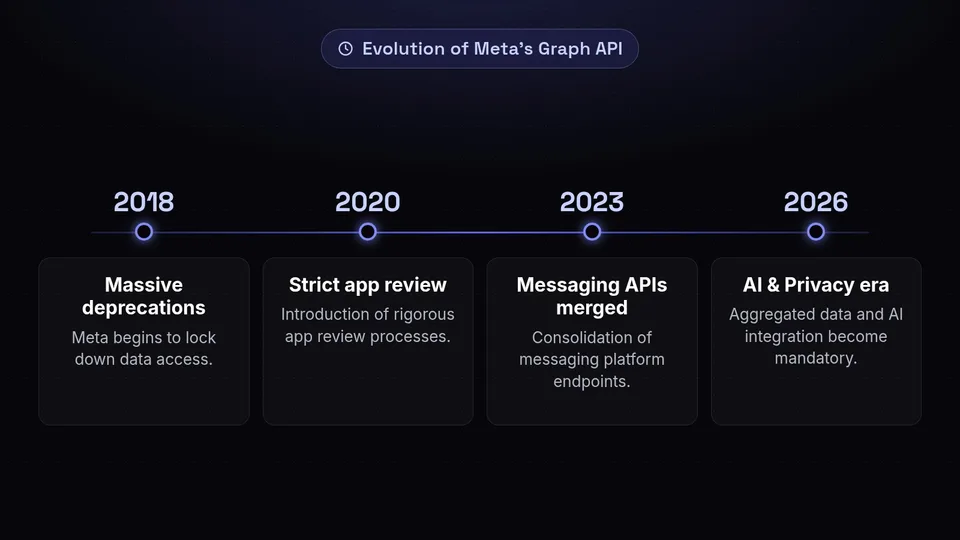
Introduced over a decade ago, the graph api revolutionized how developers interacted with Facebook. It replaced the old REST API and introduced a node-based system where "nodes" (users, photos, pages) were connected by "edges" (comments, tags, likes). This made data retrieval incredibly intuitive. However, early versions of the API were heavily criticized for being too permissive, culminating in the infamous Cambridge Analytica scandal. Since then, Meta has been on a relentless mission to lock down data access. We saw massive deprecations in 2018, the introduction of strict app review processes in 2020, and the merging of messaging APIs in 2023.
Why 2026 is a Milestone Year for Meta APIs
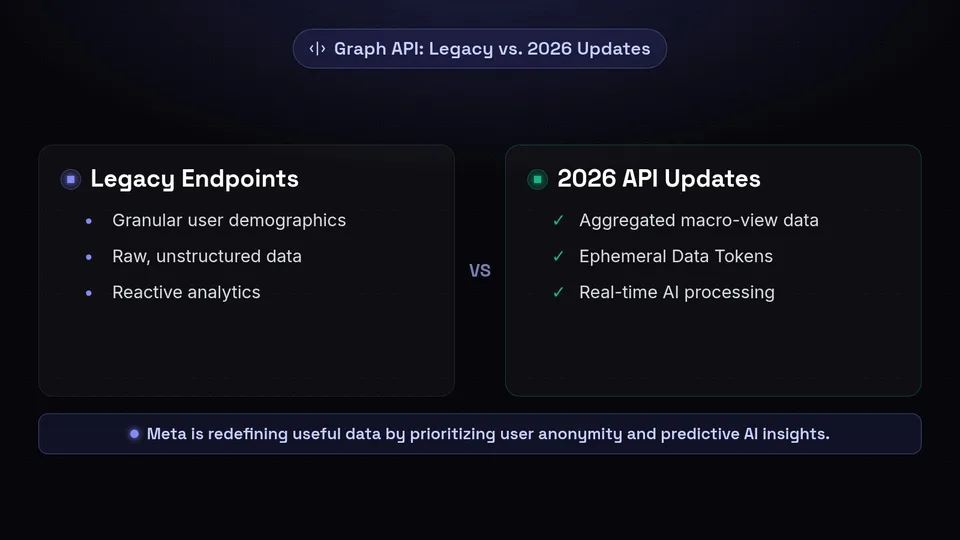
The year 2026 marks a critical juncture. Global data privacy laws (like the updated GDPR, CCPA, and emerging frameworks in Asia and South America) have forced tech giants to rethink data architecture fundamentally. Furthermore, 2026 is the year AI integration moves from a "nice-to-have" feature to a mandatory infrastructural layer. Meta's 2026 updates are not just about restricting data; they are about redefining what data is useful. By deprecating legacy endpoints that provided raw, unstructured data, Meta is pushing developers toward aggregated, AI-processed analytics that protect user anonymity while providing deeper behavioral insights. Understanding this philosophical shift is crucial for any social media manager relying on the facebook api and instagram api.
Key Meta API Changes 2026 Explained
The latest iteration of the Graph API brings several sweeping changes. Let us break down the most critical updates that will affect your day-to-day operations.
Deprecation of Legacy Endpoints
One of the most immediate impacts of the meta api changes 2026 is the deprecation of several legacy endpoints. Meta is officially sunsetting endpoints related to granular user demographics on public posts. Previously, tools could pull detailed breakdowns of who was interacting with your content down to the micro-demographic level. In 2026, this data is being aggregated. While you will lose the ability to see highly specific individual data points, the new aggregated endpoints provide a more accurate macro-view of audience sentiment and engagement trends.
Stricter Data Privacy and Compliance Requirements
Data privacy is the cornerstone of the 2026 update. Meta has introduced "Ephemeral Data Tokens" for third-party apps. This means that when a user grants permission for an app to access their data, that token has a much shorter lifespan and requires more frequent re-authentication. For social media managers, this translates to more frequent prompts to reconnect your social accounts to your scheduling tools. While this may seem like an inconvenience, it is a necessary step to ensure compliance with global privacy mandates and to protect your brand from data liability.
Introduction of Real-Time AI Processing Endpoints
Perhaps the most exciting addition to the graph api in 2026 is the integration of AI processing endpoints. Meta is now allowing third-party tools to leverage its native Llama-based AI models directly through the API. This means your scheduling tools can now automatically generate alt-text, suggest optimal posting times based on real-time network traffic, and even predict the virality score of a piece of content before it is published. This is a game-changer for content strategy, moving the industry from reactive analytics to proactive, predictive scheduling.
Enhanced Instagram API Capabilities
The instagram api has historically lagged behind the Facebook API in terms of functionality, but 2026 levels the playing field. Meta has finally opened up full API access for collaborative posts (Collabs), advanced Reel analytics (including watch-time retention graphs), and interactive Story elements (like polls and question boxes). Previously, social media managers had to rely on native mobile apps for these features. Now, they can be fully managed, scheduled, and analyzed through third-party platforms.
How These Changes Impact Social Media Managers

Technical updates are only as important as their practical applications. How will the meta api changes 2026 actually change your daily workflow?
Adapting Your Posting Workflows
With the new API capabilities, your posting workflow is about to become much more streamlined. Because the instagram api now supports advanced features like Story stickers and Collabs, you will spend less time doing "manual publishing" on your phone. You can build comprehensive cross-platform campaigns entirely within your desktop scheduling tool. However, because of the new AI endpoints, you will also need to adapt to reviewing AI-generated suggestions. Social media managers will transition from being purely content creators to content curators and AI editors, reviewing auto-generated tags, alt-text, and predictive performance metrics before hitting publish.
Changes to Analytics and Reporting
Reporting is where you will feel the biggest shift. The days of exporting massive spreadsheets of granular user data are over. The new graph api forces a shift toward "Sentiment and Trend Reporting." Instead of reporting that "500 women aged 18-24 in New York liked this post," your reports will highlight that "This campaign generated a 45% positive sentiment lift among Gen Z demographics, driven primarily by video completion rates on Reels." This requires social media managers to educate their clients and stakeholders on new KPIs (Key Performance Indicators). You must pivot from vanity metrics to meaningful, aggregated engagement metrics.
The Shift in Community Management
Community management is also evolving. The 2026 API updates introduce unified threading for comments and DMs across Facebook, Instagram, and Threads. This means your inbox management tool will be faster and more reliable. Furthermore, Meta's new automated moderation endpoints allow third-party tools to instantly hide or flag toxic comments using Meta's native AI safety filters, drastically reducing the manual labor required to keep your brand's comment sections safe and welcoming.
Deep Dive: The Facebook API Overhaul
While Instagram often steals the spotlight, Facebook remains a critical platform for community building and local business marketing. The facebook api has received some highly specific updates in 2026.
Group API Limitations and Workarounds
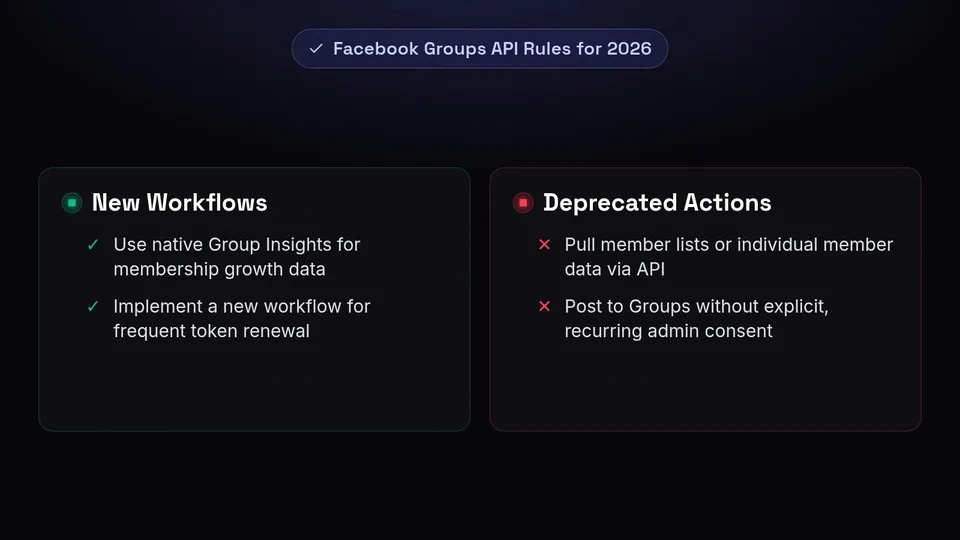
Facebook Groups have been heavily restricted in the 2026 update. To combat spam and misinformation, Meta has severely limited the ability of third-party apps to post into Groups without explicit, recurring administrative consent. If you manage a large portfolio of Groups, you will need to implement a new workflow for token renewal. Furthermore, the API no longer allows tools to pull member lists or individual member data from Groups. Social media managers must rely on native Group Insights for membership growth data, while using third-party tools purely for content distribution and aggregated engagement tracking.
Page Management and Automated Messaging
On the brighter side, Facebook Page management has been vastly improved. The new API allows for seamless integration of automated messaging workflows directly tied to specific ad campaigns. If a user clicks on a Facebook Ad, the API now allows your CRM or scheduling tool to trigger a highly personalized, multi-step Messenger sequence based on the exact ad creative they interacted with. This deep linking between the Facebook Ads API and the organic Page API bridges the gap between paid and organic social teams, fostering better collaboration.
Deep Dive: The Instagram API Upgrades
The instagram api updates are perhaps the most anticipated changes of 2026, offering long-awaited solutions to some of the platform's biggest pain points.
Reels and Stories Scheduling Enhancements
Short-form video is king, and Meta knows it. The 2026 API finally allows for the scheduling of multi-clip Reels with trending audio attached directly via the API. Previously, third-party tools struggled with audio licensing issues, forcing users to publish via the native app to get trending sounds. Meta has introduced a commercial audio library endpoint, allowing you to select approved, trending tracks right from your scheduling dashboard. Additionally, Story scheduling now supports dynamic tagging (mentioning other accounts) and location stickers via the API, making automated Stories just as engaging as manual ones.
Direct Messaging Automation Rules
Instagram DMs are the new storefront. The updated API expands "Icebreakers" and quick replies, but more importantly, it introduces Intent Recognition. By leveraging the new AI endpoints, the instagram api can analyze an incoming DM, determine the user's intent (e.g., "shipping inquiry," "product complaint," "collaboration request"), and route it to the appropriate folder or trigger a specific automated response. For social media managers dealing with high-volume accounts, this is nothing short of revolutionary.
Graph API: Technical Implications for Non-Developers
You do not need to be a software engineer to understand how the graph api works, but having a foundational understanding of the technical changes will make you a better social media manager.
Understanding Token Expirations
As mentioned earlier, Access Tokens are the digital keys that allow SchedulifyX to post on your behalf. In 2026, Meta has implemented dynamic token expiration. Instead of a flat 60-day expiration, tokens may expire sooner if Meta's security algorithms detect unusual login locations or unexpected spikes in API calls. Actionable Tip: Always ensure your primary Facebook account has Two-Factor Authentication (2FA) enabled, and log into your scheduling tool at least once a week to ensure your tokens remain active and fresh.
Rate Limits and Throttling
Rate limits dictate how many actions a tool can perform within a specific timeframe. To ensure platform stability, Meta has adjusted its rate-limiting algorithms. Instead of punishing an entire app (like SchedulifyX) if one user spams the system, the 2026 graph api isolates rate limits to the individual Page or Business Manager level. This means your account's performance is entirely dependent on your own behavior. If you attempt to publish 100 posts in a minute, your specific account will be throttled. Understanding this ensures you space out your content calendar sensibly.
Preparing Your Agency or Brand for the Transition
The meta api changes 2026 are not something you can ignore until they break your workflow. Proactive preparation is essential.
Conducting an API Audit
Start by auditing your current tech stack. List every third-party tool connected to your Meta Business Manager. This includes scheduling tools, analytics dashboards, CRM systems, and contest platforms. Go to your Facebook Business Settings and review the "Integrations" tab. Remove any apps you no longer use, as stale connections can trigger security flags under the new API rules.
Communicating Changes to Stakeholders
If you are an agency, you must communicate these changes to your clients immediately. Explain that their analytics reports might look different next month due to the deprecation of granular demographic data. Frame this positively: explain that the new aggregated data is more accurate and privacy-compliant. Provide them with a one-pager detailing how the new AI-driven insights will actually improve their campaign performance.
Updating Your Tech Stack
Not all social media tools will survive the 2026 updates. Tools with legacy codebases may struggle to adapt to the new AI endpoints and strict data privacy rules. It is crucial to partner with a platform that is agile, actively maintained, and recognized as an official Meta Business Partner. This ensures that when the API changes go live, your software updates seamlessly without any downtime.
How SchedulifyX is Ahead of the Curve
At SchedulifyX, we do not just react to API changes; we anticipate them. Our engineering team has been working closely with Meta's developer beta programs to ensure our platform is fully optimized for the meta api changes 2026.
Seamless Integration with the New Graph API
We have completely rebuilt our backend infrastructure to natively support the new graph api v20.0. This means you will experience zero downtime during the transition. Our new unified dashboard takes full advantage of the enhanced instagram api, allowing you to schedule Collabs, multi-clip Reels with commercial audio, and interactive Stories without ever touching your mobile device.
AI-Powered Fallbacks and Error Handling
We know that API token expirations are a major pain point. That is why SchedulifyX has introduced AI-Powered Fallbacks. If our system detects that your token is about to expire, we will send you an actionable SMS and email alert before a scheduled post fails. Furthermore, our platform leverages Meta's new AI processing endpoints to provide you with predictive performance scoring as you draft your content, ensuring you always publish the right message at the right time.
Frequently Asked Questions (FAQs) About Meta's 2026 API Changes
To help you navigate this complex transition, we have compiled answers to the most common questions we hear from social media managers.
- Q: Will I lose my historical analytics data?
A: No. Meta is not deleting your historical data natively, but third-party tools may no longer be able to pull granular data from posts published prior to the update. It is highly recommended to export your historical reports now for your archives. - Q: Can I still auto-publish to Facebook Groups?
A: Yes, but with caveats. You must be an admin of the Group, and you must explicitly re-authorize your scheduling app under the new 2026 compliance rules. Some third-party apps may drop Group support entirely, but premium platforms like SchedulifyX will maintain secure, compliant integrations. - Q: How do the new AI endpoints affect content ownership?
A: Any content generated or optimized using Meta's AI endpoints via the API remains your intellectual property. However, Meta's updated terms of service state that they may use aggregated, anonymized performance data to train future models. - Q: Why do I need to re-authenticate my accounts so often now?
A: The introduction of Ephemeral Data Tokens means security is tighter. Frequent re-authentication prevents bad actors from hijacking dormant API connections. Think of it as changing your password regularly—it is a minor inconvenience for major security. - Q: Are Reels finally getting full API support?
A: Yes! The 2026 instagram api update brings full feature parity to Reels, including trending audio selection from the commercial library, cover photo uploads, and advanced retention analytics.
Conclusion: Embracing the Future of Social Media Management
The meta api changes 2026 are undeniably vast, but they should not be a source of anxiety. Instead, view them as a massive leap forward for the industry. By prioritizing privacy, enhancing the facebook api and instagram api with powerful new features, and weaving AI directly into the graph api, Meta is giving social media managers the tools they need to be more strategic, efficient, and impactful.
The days of manual workarounds and fragmented reporting are coming to an end. The future belongs to those who adapt quickly, embrace AI-driven insights, and utilize platforms that are built for the modern web.
Are you ready to future-proof your social media strategy? Do not let outdated tools hold you back. Sign up for SchedulifyX today and experience the seamless power of the 2026 Meta API updates. Let us handle the technical complexities so you can focus on what you do best: building incredible communities.