Mastering the Nonprofit Social Media Campaign Architecture
SchedulifyX Team · August 21, 2026
Discover a proven cause campaign structure using a multi-week sequence of awareness, story, and ask posts to maximise fundraising and donor stewardship.
In the highly competitive digital landscape, charitable organisations often struggle to convert passive followers into active donors. The difference between a post that garners a few sympathetic 'likes' and a campaign that successfully funds a critical initiative lies entirely in the underlying strategy. To achieve meaningful results, organisations must move away from ad-hoc posting and embrace a meticulously planned nonprofit social media campaign.
Important Notice: Before we delve into the mechanics of this strategy, we must state plainly and early that the scenario outlined in this article is an explicitly illustrative model. It uses round, hypothetical numbers for the sake of clarity and education. It is not a customer story, nor does it represent a specific client result. Furthermore, we do not attribute any hypothetical outcome in this model to any real-world organisation or to the use of SchedulifyX.
By understanding the psychological journey of a donor, we can construct a robust cause campaign structure that guides the audience from initial awareness to financial commitment, and ultimately, to long-term advocacy. This article explores the ideal architecture for cause-driven accounts, detailing the precise sequence of content required to drive action.
The Anatomy of a Cause Campaign Structure
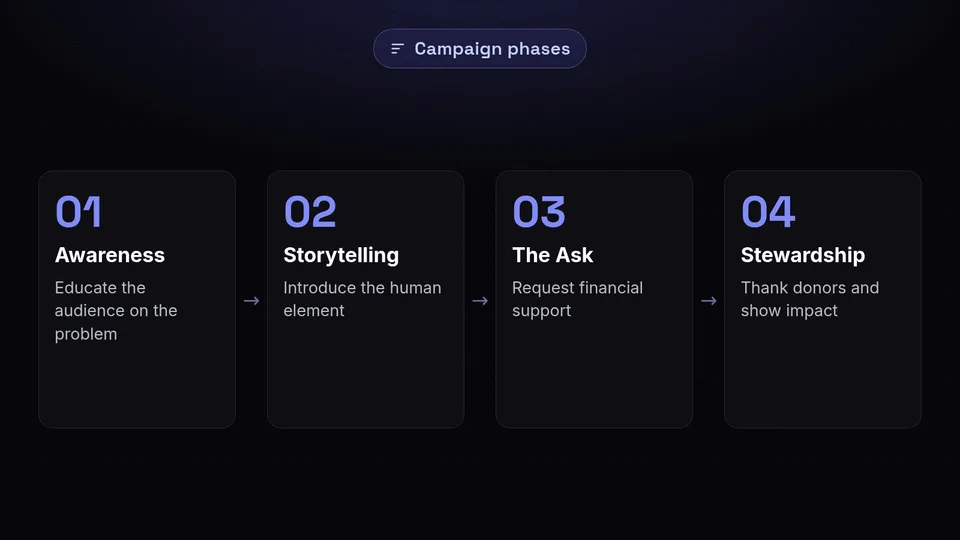
A successful cause campaign is not a single event; it is an orchestrated series of touchpoints designed to educate, evoke emotion, and prompt action. The architecture of such a campaign relies on a foundational understanding of digital behaviour. Social media users do not typically log onto platforms with the intention of parting with their money. They seek connection, entertainment, and information. Therefore, a sudden, unprompted request for funds disrupts the user experience and often falls flat.
A well-designed cause campaign structure respects the user's journey. It builds a case for support over time, ensuring that when the financial ask is finally made, the audience is already primed, educated, and emotionally invested in the outcome. This architecture typically spans four to six weeks and is divided into distinct phases: Awareness, Storytelling, The Ask, and Stewardship.
To execute this seamlessly, campaign managers must rely on precise scheduling and overarching visibility. Utilising a robust content calendar ensures that no phase is rushed and that the narrative unfolds logically across all chosen platforms.
The Multi-Week Fundraising Content Sequence
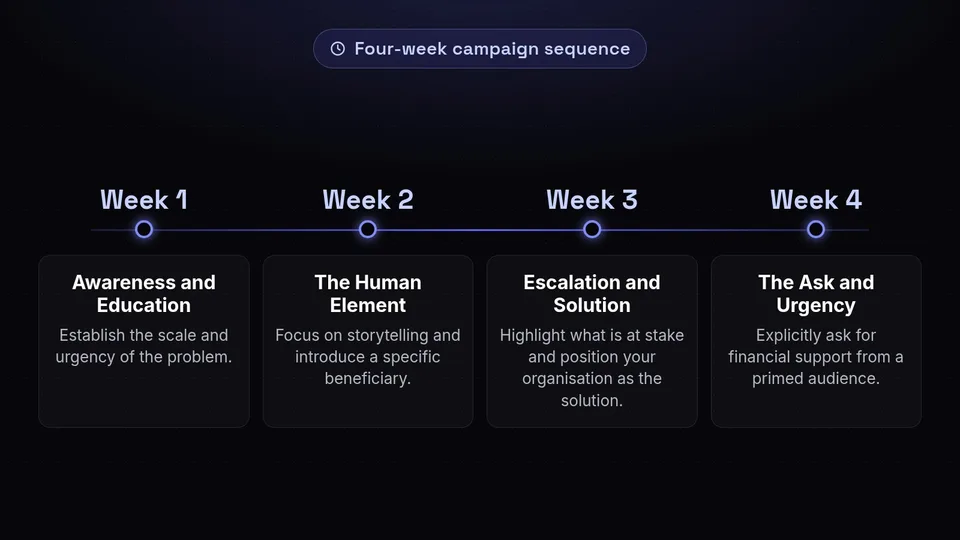
The core of this architecture is the fundraising content sequence. This sequence dictates the flow of information and the gradual escalation of emotional intensity. Let us break down a standard four-week model.
Week 1: Awareness and Education (The Problem)
The first week is dedicated to establishing the scale and urgency of the problem. Content during this phase should be highly shareable and heavily reliant on data, infographics, and broad contextual narratives. The goal is not to ask for money, but to make the audience realise that a significant issue exists and requires immediate attention.
- Content Types: Startling statistics, myth-busting carousels, short educational videos.
- Primary Metric: Reach, impressions, and shares.
- Call to Action (CTA): "Learn more," "Share this to spread awareness," "Save this post."
Week 2: The Human Element (The Story)
Once the audience understands the macro-level problem, the campaign must transition to the micro-level impact. Humans are wired to respond to individual narratives rather than abstract statistics. Week two focuses on storytelling, introducing a specific beneficiary, community, or environment affected by the issue highlighted in week one.
- Content Types: Testimonials, behind-the-scenes footage, day-in-the-life videos, emotive photography.
- Primary Metric: Engagement (likes, comments, watch time).
- CTA: "Read their full story via our link," "Leave a message of support."
Week 3: Escalation and Solution (The Transition)
Week three bridges the gap between the emotive story and the upcoming financial ask. The narrative escalates, highlighting what is at stake if action is not taken. Crucially, this phase introduces your organisation as the vehicle for the solution, positioning the donor as the hero who empowers that solution.
- Content Types: Impact projections, staff interviews explaining the intervention, urgent updates.
- Primary Metric: Click-through rate (CTR) to the website, newsletter sign-ups.
- CTA: "See how we are tackling this," "Join our mailing list for updates."
Week 4: The Ask and Urgency (The Climax)
Only after three weeks of meticulous priming does the campaign explicitly ask for financial support. Because the audience understands the problem (Week 1), feels emotionally connected to the victims (Week 2), and believes in your solution (Week 3), the ask feels like a natural, empowering next step rather than an intrusion.
- Content Types: Direct appeal videos from leadership, countdown timers, clear graphic text posts.
- Primary Metric: Conversion rate, total donations, average gift size.
- CTA: "Donate now," "Give today to double your impact."
Why the Ask Post Underperforms Without Preceding Stories

A common pitfall in digital fundraising is attempting to shortcut the fundraising content sequence by jumping straight to the 'Ask'. Organisations often cite a lack of time or resources as the reason for this truncated approach. However, the data and behavioural psychology consistently show that an isolated ask post dramatically underperforms.
"Without context and emotional resonance, a donation request is merely a transaction. Donors do not give to institutions; they give to outcomes and emotions."
When an ask post appears without preceding story posts, it suffers from several critical disadvantages:
- High Cognitive Load: The user must simultaneously process the existence of a problem, the validity of your organisation, and the decision to part with their money, all within a three-second scroll. This cognitive overload leads to inaction.
- Lack of Emotional Priming: Empathy is the primary driver of charitable giving. Without a narrative to trigger empathy, the user's emotional state remains neutral, making them highly unlikely to convert.
- Algorithmic Penalties: Ask posts generally receive lower organic engagement (likes and comments) than story posts. If your account has not built up algorithmic momentum through highly engaging story posts in the preceding weeks, the social media platform will limit the reach of your ask post.
Implementing the Donation-Ladder Logic
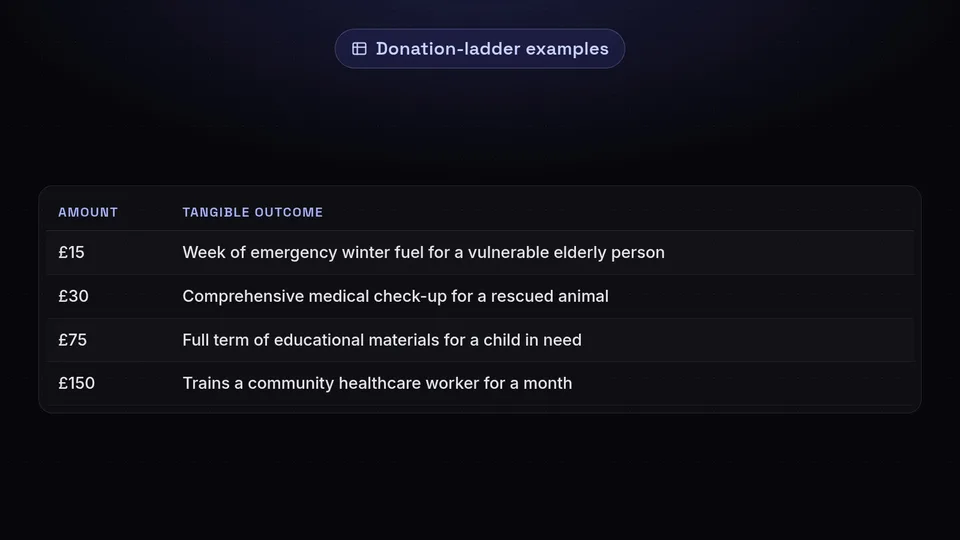
When the time comes to make the ask, the way you frame the financial request is just as important as the request itself. This is where donation-ladder logic becomes essential. A donation ladder is a psychological tool that ties specific monetary values to tangible, real-world outcomes.
Instead of directing users to a generic donation page with an open text box, a highly optimised nonprofit social media campaign directs them to a landing page (and mirrors this language in the social copy) that provides concrete options. For example:
- £15 provides a week of emergency winter fuel for a vulnerable elderly person.
- £30 funds a comprehensive medical check-up for a rescued animal.
- £75 supplies a full term of educational materials for a child in need.
- £150 trains a community healthcare worker for a month.
This logic serves two powerful purposes. Firstly, it utilises price anchoring. By presenting a range of options, including higher tiers, the middle tiers suddenly appear more reasonable and accessible, often increasing the average gift size. Secondly, it creates a sense of agency. The donor is no longer just throwing money into a void; they are 'buying' a specific, positive outcome. They can visualise the exact impact of their £30.
Leveraging Matched-Giving Windows
To inject genuine urgency into the final week of your cause campaign structure, few tactics are as effective as a matched-giving window. This is a period during which a major donor, corporate sponsor, or philanthropic foundation agrees to match public donations pound-for-pound, up to a certain amount.
Matched giving fundamentally alters the donor's calculation. The perceived value of their contribution doubles, while their personal cost remains the same. It triggers a positive form of FOMO (Fear Of Missing Out)—if they do not donate within this specific 48-hour window, they are leaving 'free' impact on the table.
To maximise this window, timing is everything. You must ensure your posts hit the feeds of your most engaged followers exactly when they are most likely to be online and receptive. Utilising a best time to post tool is critical during this 48-hour sprint. The content should be high-energy, featuring live countdowns, thermometer graphics showing progress towards the match limit, and urgent, direct language.
Post-Campaign Stewardship: The Vital Final Step
A campaign does not end when the fundraising goal is met. The most expensive donor to acquire is a new one; the most cost-effective is a retained one. Therefore, post-campaign stewardship is the vital final phase of the architecture.
Stewardship is the process of thanking donors, demonstrating the impact of their gift, and nurturing the relationship for future campaigns. This should be a structured sequence of its own:
- The Immediate Thank You (0-48 hours): Social media posts celebrating the total raised, thanking the community, and expressing immense gratitude.
- The Action Update (2-4 weeks): Content showing the funds being put to use. If the campaign was for winter blankets, show the blankets arriving at the warehouse.
- The Impact Report (3-6 months): A detailed follow-up showing the long-term results of the campaign. This closes the loop and proves to the donor that their investment was worthwhile, priming them perfectly for your next campaign.
A Worked Example: The Illustrative Model
To demonstrate how this architecture functions mathematically, let us examine an explicitly illustrative model. As stated previously, this uses round, hypothetical numbers to demonstrate the logic and is not based on a real client or the SchedulifyX platform's specific performance.
The Scenario: A cause-driven account with 50,000 followers aims to raise £10,000 for a specific community project over a four-week campaign, culminating in a 48-hour matched-giving window.
The Funnel Breakdown
Phase 1 & 2: Awareness and Story (Weeks 1-3)
Through a consistent cadence of educational carousels and emotive video stories, the campaign generates a total of 200,000 impressions across all social platforms. Because the content is highly resonant and not yet asking for money, it achieves a healthy engagement rate of 5%, resulting in 10,000 engagements (likes, comments, saves, shares).
Phase 3: The Ask (Week 4)
The campaign transitions to the financial ask. The account posts clear CTAs, driving traffic to the donation landing page. Of the 10,000 highly engaged users who have followed the story, 10% are motivated to click the link. This generates 1,000 highly qualified clicks to the landing page.
Phase 4: Conversion and Donation-Ladder
The landing page utilises strict donation-ladder logic, presenting options of £20, £50, and £100. Because the audience was thoroughly primed by the fundraising content sequence, the landing page converts at an impressive 20%.
From the 1,000 visitors, the campaign secures 200 individual donations. Thanks to the psychological anchoring of the donation ladder, the average gift size settles at £50.
The Result:
200 donations × £50 average gift = £10,000 raised.
The Multiplier:
Because these final posts were timed perfectly to coincide with a pre-arranged matched-giving window, the £10,000 is matched by a corporate sponsor, resulting in a total campaign impact of £20,000.
This model illustrates why the sequence matters. If the organisation had skipped the 200,000 impressions of storytelling and jumped straight to the ask, the click-through rate would likely have been a fraction of a percent, and the landing page conversion rate would have plummeted, resulting in a failed campaign.
Conclusion
Mastering the cause campaign structure requires discipline, empathy, and strategic foresight. By respecting the donor's journey—moving patiently through awareness, deeply engaging storytelling, and finally, a clear, laddered ask—nonprofits can dramatically improve their fundraising outcomes.
Remember that an isolated ask post is a recipe for underperformance. It is the invisible architecture of the preceding weeks that guarantees the success of the final moment. By implementing matched-giving windows and committing to rigorous post-campaign stewardship, cause-driven accounts can transform passive audiences into dedicated communities of supporters.
Executing a multi-week, cross-platform strategy requires precision. To ensure your narrative unfolds exactly as planned, and to hit those critical matched-giving windows with perfect timing, explore how a dedicated scheduling platform like SchedulifyX can streamline your workflow and elevate your next campaign.