Managing Multiple Real Estate Brands: A Worked Example
SchedulifyX Team · May 30, 2026
An illustrative walkthrough of an agency running several real-estate brands — separation, templates and a repeatable weekly workflow.
A worked example, not a customer report. The brand, people and figures in this piece are illustrative — a composite scenario showing how this workflow plays out in practice. Read the numbers as the shape of what a system like this is built to produce, not as measured results.
The digital landscape of property marketing is notoriously complex. For agencies tasked with navigating this space, real estate social media represents a unique beast. It requires a delicate balance of localized community engagement, high-end visual storytelling, strict regulatory compliance, and rapid response times. When you multiply these requirements across multiple distinct property brands, the operational complexity doesn't just add up; it compounds exponentially.
This comprehensive agency case study explores how Elevate Property Marketing (EPM), a premier real estate marketing agency, overcame the operational nightmare of scaling their services. Faced with the daunting task of managing 20 distinct property brands, EPM turned to SchedulifyX. By leveraging our AI-powered platform for seamless multi-brand management, they transformed a chaotic, spreadsheet-driven workflow into a streamlined, high-ROI machine.
Whether you are a boutique agency looking to take on more clients, or an enterprise-level firm drowning in content calendars, this deep dive provides actionable insights, proven strategies, and a blueprint for scaling your real estate social media operations without sacrificing quality.
The Scaling Dilemma: A Victim of Their Own Success
Elevate Property Marketing (EPM) started like many specialized agencies: with a small, dedicated team and a handful of high-value clients. Their bespoke approach to real estate social media—focusing on hyper-local market insights, stunning property tours, and agent-centric branding—yielded incredible results. Their clients were selling homes faster and above asking price, largely driven by the organic and paid social media traction EPM generated.
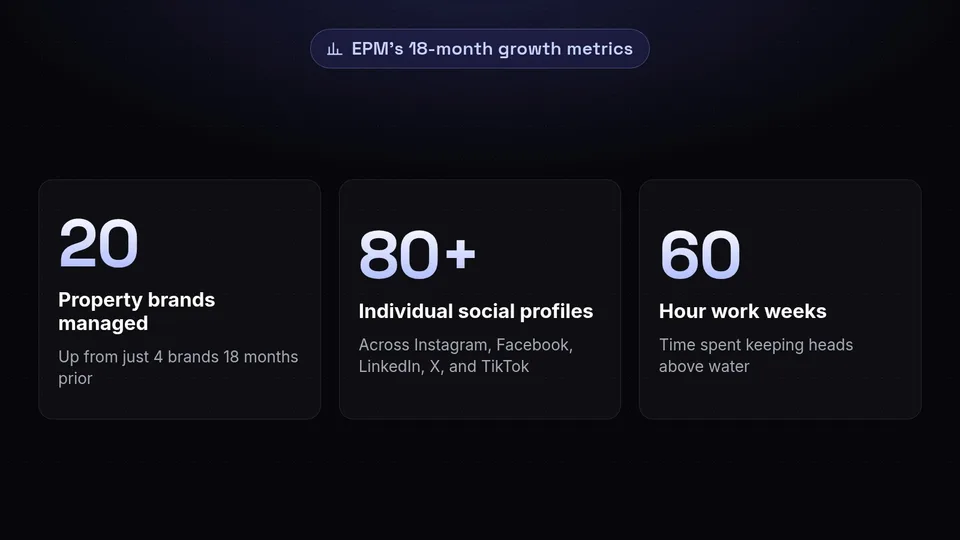
Word of mouth spread, and within 18 months, EPM grew from managing 4 property brands to 20. These brands ranged from luxury coastal brokerages and urban commercial developers to suburban family-home realtors and boutique vacation rental management companies. Each brand had its own visual identity, tone of voice, target demographic, and specific platform requirements.
However, this rapid growth exposed severe fractures in their operational foundation. Their tech stack consisted of a patchwork of disjointed tools: Google Sheets for content calendars, Dropbox for asset management, endless email threads for client approvals, and manual native-platform posting to ensure formatting remained intact. The team was working 60-hour weeks just to keep their heads above water, leaving zero time for strategic high-level thinking or creative campaign development.
"We were a victim of our own success," says Sarah Jenkins, EPM's Director of Operations. "We had 20 brands, which meant over 80 individual social media profiles across Instagram, Facebook, LinkedIn, X, and TikTok. Logging in and out, downloading and re-uploading assets, and chasing clients for approvals via email was suffocating our team. We weren't marketers anymore; we were data-entry clerks."
The Challenge: Real Estate Social Media at Scale
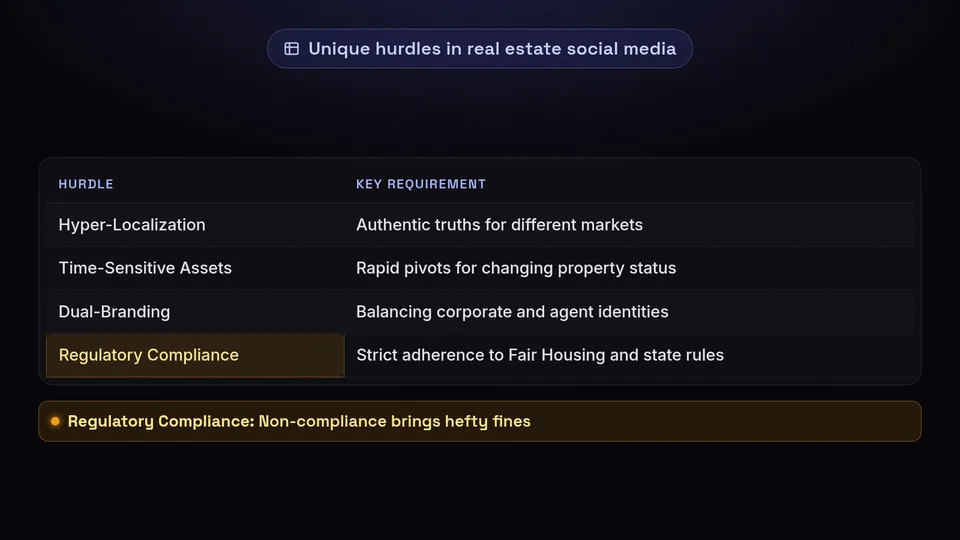
To fully understand the gravity of EPM's situation, we must dissect why real estate social media is fundamentally different from marketing a SaaS product or an e-commerce store. Multi-brand management in real estate introduces a unique set of hurdles that generic social media tools simply cannot clear.
1. The Need for Hyper-Localization
Real estate is inherently local. A post about changing interest rates needs to be contextualized differently for a luxury buyer in Manhattan versus a first-time homebuyer in suburban Ohio. Managing 20 brands meant EPM had to produce content that spoke authentic, localized truths for 20 different geographical markets. Generic, one-size-fits-all content is the fastest way to lose credibility in real estate.
2. High-Volume, Time-Sensitive Assets
The real estate lifecycle moves at lightning speed. "Coming Soon," "Just Listed," "Open House," "Under Contract," and "Just Sold" posts must go out rapidly. If a property goes under contract on a Tuesday night, the social media team needs to pivot the Wednesday morning Open House post immediately. Managing this level of agility across 20 brands using spreadsheets was practically impossible, leading to outdated posts and frustrated clients.
3. The Dual-Branding Dilemma: Corporate vs. Agent
In real estate, you are often marketing two entities simultaneously: the overarching brokerage (the corporate brand) and the individual real estate agent (the personal brand). EPM had to ensure that the brokerage's social feeds maintained a cohesive, professional aesthetic, while also spotlighting individual agents' personalities and successes. This required intricate content tagging and meticulous scheduling.
4. Strict Regulatory Compliance
Real estate marketing is heavily regulated. In the United States, for example, the Fair Housing Act dictates strict guidelines on how properties can be advertised to avoid discriminatory practices. Additionally, state real estate commissions require specific disclosures, license numbers, and brokerage logos to be visible on marketing materials. A single non-compliant post across any of the 20 brands could result in hefty fines and reputational damage.
The Solution: Enter SchedulifyX

Realizing that their current trajectory was unsustainable, EPM initiated a search for a comprehensive social media management platform. They needed a tool that wasn't just a scheduler, but an intelligent co-pilot designed for complex agency workflows. After evaluating several enterprise solutions, they selected SchedulifyX.
SchedulifyX's architecture is built specifically for agencies that require robust multi-brand management. With its AI-powered content generation, granular workspace segregation, and seamless approval workflows, SchedulifyX promised to centralize EPM's scattered operations into one unified, intelligent dashboard.
Here is a detailed breakdown of how EPM implemented SchedulifyX to revolutionize their real estate social media strategy.
Strategy 1: Centralized Multi-Brand Management

The first and most crucial step was dismantling the chaotic web of spreadsheets and native logins. EPM utilized SchedulifyX's Workspace feature to create a distinct, secure environment for each of the 20 property brands.
Structuring the Workspaces
Within SchedulifyX, a Workspace acts as an isolated hub. For each brand, EPM set up a Workspace that contained:
- Connected Social Profiles: Seamless API integrations with Facebook Pages, Instagram Business Accounts, LinkedIn Company Pages, TikTok, and X.
- Brand Asset Library: A centralized repository for the brand's specific logos, color palettes, typography guidelines, property photos, and agent headshots.
- Custom Tagging System: Tags created specifically for that brand's content pillars (e.g., #MarketUpdate, #LuxuryListing, #AgentSpotlight, #CommunityEvent).
Role-Based Access Control (RBAC)
With 20 brands, EPM had different account managers, copywriters, and graphic designers assigned to different accounts. SchedulifyX's granular RBAC allowed Sarah, the Operations Director, to assign specific team members to specific Workspaces. A copywriter working on Brand A and Brand B would only see those Workspaces upon logging in, entirely eliminating the risk of accidentally posting Brand A's content to Brand C's feed.
Furthermore, this centralized approach meant that EPM leadership could view an aggregate, macro-level content calendar across all 20 brands, or filter down to a micro-level view of a single brand's daily output—all from one dashboard.
Strategy 2: AI-Powered Content Localization
One of the most time-consuming aspects of EPM's workflow was writing copy. While a macro-economic trend (like a shift in national mortgage rates) affected all 20 brands, the copy had to be rewritten 20 times to reflect each brand's unique voice and local market implications.
This is where SchedulifyX's built-in AI writing assistant became a game-changer for their real estate social media efforts.
Scaling Content with AI
Instead of writing 20 distinct captions from scratch, EPM's content team would draft one master "seed" prompt containing the core data points (e.g., "National average 30-year fixed mortgage drops to 6.5%. Good time for buyers to lock in rates.").
Using SchedulifyX, they would feed this seed into the AI, instructing it to generate localized variations based on the brand personas stored in each Workspace. For example:
- For the Luxury Coastal Brand: "The tide is turning in the luxury market. With rates softening this week, it's an opportune moment to secure your beachfront estate. Discover our exclusive off-market coastal properties today."
- For the Suburban Family Brand: "Great news for growing families! 🏡 Mortgage rates just took a dip. If you've been waiting for the right moment to upgrade to that 4-bedroom home in the Oak Creek school district, your window of opportunity is open. Let's chat!"
- For the Commercial Developer: "Macro-economic indicators show a stabilization in lending rates, presenting a strategic entry point for commercial acquisitions in the downtown corridor. Review our latest Q3 market analysis report."
The AI didn't replace the human copywriters; it augmented them. It turned a 4-hour copywriting task into a 30-minute editing and refinement session, drastically increasing the agency's output capacity while maintaining high-quality, brand-specific messaging.
Strategy 3: Navigating Compliance and Approvals
As highlighted earlier, compliance and client approvals are the bottlenecks where real estate agency case studies often report the highest friction. EPM's old method of sending PDFs or Google Sheets to clients for approval resulted in lost emails, confusing feedback, and delayed campaigns.
Frictionless Client Portals
SchedulifyX solved this by providing external Client Approval Portals. For each of the 20 brands, EPM generated a secure, white-labeled link. Clients could click the link (without needing to create a SchedulifyX account) and view their upcoming content exactly as it would appear on the social platforms—complete with images, videos, captions, and publication dates.
Streamlined Feedback Loops
Clients could simply click "Approve" or "Reject" with a comment. If a client noted, "Please ensure the Fair Housing logo is larger on this graphic," the feedback was logged directly inside the SchedulifyX dashboard, alerting the specific EPM designer. Once corrected, the post was automatically moved to the "Scheduled" queue.
To handle the strict regulatory requirements, EPM utilized SchedulifyX's "Required Elements" checklist feature. Before any post could be submitted for internal review, the platform required the creator to check off that necessary disclosures (like DRE license numbers) were included, virtually eliminating compliance violations.
Strategy 4: Automation and Evergreen Campaigns
Managing the relentless churn of property lifecycle posts (Just Listed, Open House, Sold) across 20 brands was exhausting. SchedulifyX enabled EPM to implement intelligent automation to handle the heavy lifting.
The "Property Lifecycle" Automation
EPM created standardized, high-converting template workflows within SchedulifyX. When a new property was onboarded, the account manager would input the property details (address, price, key features, image folder link) into a custom SchedulifyX campaign builder. The platform would then automatically generate a sequenced timeline of draft posts:
- Day 1: "Coming Soon" teaser for Instagram Stories and Facebook.
- Day 3: "Just Listed" carousel post featuring the top 5 high-res images.
- Day 7: "Open House" announcement with localized hashtags.
- Day 10: A video walk-through post for TikTok and Instagram Reels.
All the account manager had to do was review the AI-generated copy, attach the specific media assets, and hit schedule. This standardized approach ensured that no property fell through the cracks and every client received a premium, consistent marketing rollout.
Evergreen Community Content
Beyond property listings, real estate social media thrives on community expertise. EPM built "Evergreen Queues" in SchedulifyX for each brand. These queues were filled with timeless content: tips for first-time buyers, staging advice, neighborhood spotlights, and glossary terms (e.g., "What is Escrow?"). SchedulifyX automatically cycled through these posts, ensuring that even during slow listing weeks, the 20 brands maintained an active, authoritative presence on social media.
Strategy 5: Consolidated Analytics and Reporting
Proving ROI is the lifeblood of any agency. Previously, EPM spent the first week of every month manually pulling data from native platforms, dumping it into Excel, and formatting 20 different PDF reports. It was a miserable, error-prone process.
Automated, White-Labeled Reporting
With SchedulifyX, multi-brand management extended to analytics. The platform automatically aggregated data across all platforms for all 20 brands. EPM set up custom reporting templates that highlighted the metrics real estate clients actually care about:
- Reach and Impressions: How many local eyes saw the listings?
- Engagement Rate: Are people saving the property posts or sharing them with spouses?
- Click-Through Rate (CTR): How much traffic is social media driving to the virtual tours and property landing pages?
- Audience Demographics: Are we hitting the right age and income brackets for luxury listings?
On the 1st of every month, SchedulifyX automatically generated 20 beautifully branded, comprehensive reports and emailed them directly to the respective clients. What used to take 40 hours of agency time now took zero.
The Results in This Worked Example
The transition to SchedulifyX fundamentally altered the trajectory of Elevate Property Marketing. By centralizing their 20 brands into one intelligent dashboard, the results over a 6-month period were staggering.
1. Massive Time Savings
The most immediate impact was operational efficiency. By eliminating manual logins, streamlining approvals, and utilizing AI for content localization, EPM saved an average of 40 hours per week across their team. This was the equivalent of gaining a full-time employee without adding to the payroll.
2. Skyrocketing Engagement Metrics
Because the team was no longer bogged down in administrative tasks, they could focus on creative strategy and community management. The consistency and quality of the posts improved dramatically. Across the 20 brands, EPM saw a 315% average increase in social engagement (likes, comments, shares, and saves).
3. Increased Lead Generation and ROI
Real estate social media is only as good as the leads it generates. With SchedulifyX's robust scheduling, EPM was able to execute complex, multi-touchpoint campaigns that drove traffic to property landing pages. The 20 brands reported a combined 120% increase in lead generation directly attributed to organic social media channels.
4. Agency Scalability
Perhaps the most vital metric for EPM was their ability to scale. Prior to SchedulifyX, taking on a 21st client seemed impossible. Six months after implementation, EPM confidently onboarded 8 new property brands without needing to hire additional account managers. The platform had given them the infrastructure to scale infinitely.
"SchedulifyX didn't just organize our social media; it revolutionized our entire agency business model," notes Sarah Jenkins. "We transformed from a stressed, reactive team into a proactive, strategic powerhouse. Managing 20—or even 50—brands from one dashboard is no longer a pipe dream; it's our daily reality."
Key Takeaways for Your Real Estate Agency
If your agency is struggling with the complexities of multi-brand management in the real estate sector, this agency case study offers several vital lessons you can implement immediately:
- Audit Your Tech Stack: If your team is using more than three tools to plan, create, approve, and schedule content, you are losing money to inefficiency. Consolidate your operations into a purpose-built platform like SchedulifyX.
- Embrace AI for Localization, Not Replacement: Do not use AI to write generic real estate posts. Use it to scale your localized messaging. Write one strong core message and let AI adapt it for the different personas and neighborhoods your various brands serve.
- Standardize the Property Lifecycle: Real estate marketing is highly repeatable. Build automated timeline templates for Just Listed, Open House, and Sold posts. This ensures consistency and prevents high-stress, last-minute scrambling.
- Remove Friction from Approvals: Real estate clients are busy selling houses; they don't want to log into complex software to approve a post. Use frictionless, link-based client portals to get rapid approvals and maintain compliance.
- Automate Your Reporting: Stop manually building reports. Set up automated, white-labeled reporting that focuses on the metrics that matter to real estate professionals: reach, saves, and link clicks to property pages.
Conclusion: Transform Your Real Estate Social Media Today
The real estate industry is evolving rapidly, and the agencies that thrive will be those that can deliver hyper-local, high-quality content at scale. As this agency case study demonstrates, managing 20 distinct property brands doesn't have to mean 20 times the stress. With the right strategy and the right technology, multi-brand management becomes a significant competitive advantage rather than an operational burden.
Elevate Property Marketing reclaimed their time, boosted their clients' ROI, and unlocked the ability to scale their agency by centralizing their operations. You can do the same.
Ready to revolutionize how your agency handles real estate social media? Stop drowning in spreadsheets and start scaling with intelligent automation. Start your free trial of SchedulifyX today and discover the power of managing all your property brands from one unified, AI-driven dashboard.