The Rise of Decentralized Social Media: Bluesky & Mastodon
SchedulifyX Team · May 20, 2026
Explore the rise of decentralized social media, including Bluesky, Mastodon, and the Fediverse. Learn how the AT Protocol is reshaping digital communities.
For over a decade, our digital lives have been governed by a handful of massive tech conglomerates. These centralized platforms have dictated everything from the content we see to the ways we interact, leveraging proprietary algorithms and monetizing our attention. However, a significant paradigm shift is underway. The rise of decentralized social media is fundamentally changing the landscape of online communication, shifting power away from corporate monopolies and placing it directly into the hands of users and communities.
Spurred by sudden leadership changes at major networks, increasing concerns over data privacy, and a growing distaste for opaque algorithmic manipulation, millions of users are migrating to alternative platforms. At the forefront of this digital exodus are platforms like Bluesky and Mastodon, powered by revolutionary frameworks like the AT Protocol and the Fediverse. This comprehensive guide will explore the mechanics, platforms, challenges, and strategic implications of decentralized social media, offering actionable insights for brands and creators looking to navigate this new frontier.
What is Decentralized Social Media?
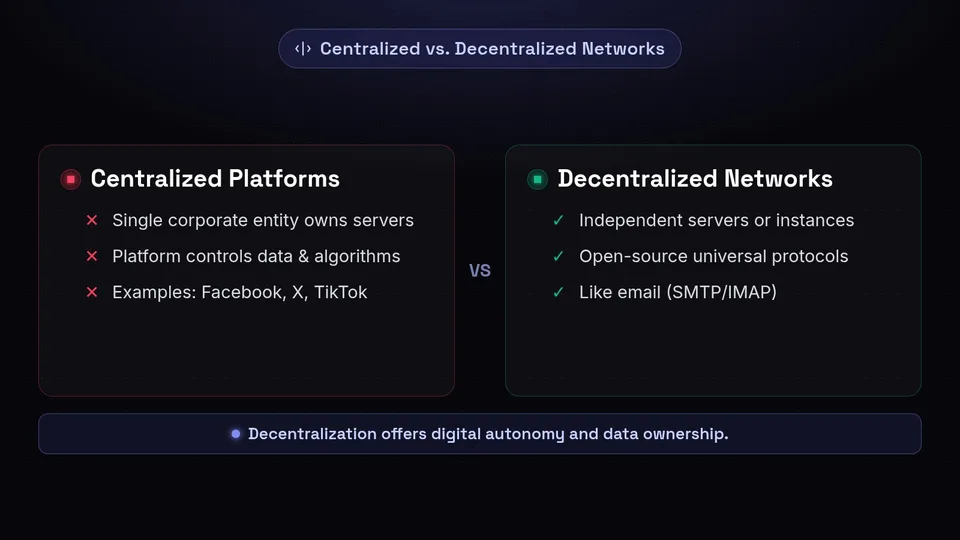
To understand decentralized social media, it is helpful to first look at the traditional, centralized model. Platforms like Facebook, X (formerly Twitter), and TikTok operate on a centralized architecture. A single corporate entity owns the servers, controls the user data, writes the algorithms, and enforces the moderation policies. If you disagree with their rules, or if the platform shuts down, you lose your audience, your content, and your social graph.
Decentralized social media operates differently. Instead of a single central server owned by one company, these networks run on independent servers (often called instances or nodes) that are hosted by various individuals, organizations, or communities. These servers communicate with each other using standardized, open-source protocols.
The Email Analogy
The best way to conceptualize decentralized networks is to think about email. If you have a Gmail account, you can easily send an email to a friend who uses Yahoo Mail or Outlook. You don't both need to be on the exact same service provider to communicate. This is because email relies on universal protocols (like SMTP and IMAP). Decentralized social networks apply this exact same logic to social networking.
"Decentralization is not just a technological shift; it is a cultural movement toward digital autonomy, data ownership, and community-driven moderation."
When you join a decentralized network, you are not just signing up for a platform; you are joining a broader ecosystem. You choose a specific server that aligns with your interests or values, but you retain the ability to follow, message, and interact with users on entirely different servers. This architecture prevents any single billionaire or corporation from unilaterally changing the rules for everyone.
The Fediverse Explained: An Interconnected Web
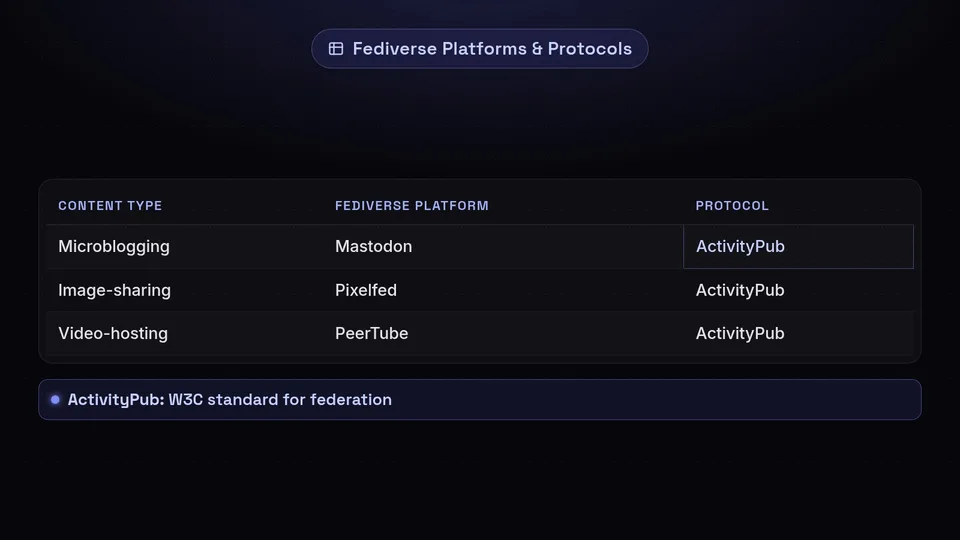
The term Fediverse—a portmanteau of "federated" and "universe"—refers to the ensemble of federated servers that are used for web publishing and file hosting, but which, while independently hosted, can communicate with each other. The lifeblood of the Fediverse is a protocol known as ActivityPub.
The Role of ActivityPub
ActivityPub is an open, decentralized social networking protocol established as a standard by the World Wide Web Consortium (W3C). It provides a client/server API for creating, updating, and deleting content, as well as a federated server-to-server API for delivering notifications and content across the network.
Because of ActivityPub, a user on a microblogging platform (like Mastodon) can follow and interact with a user on an image-sharing platform (like Pixelfed) or a video-hosting platform (like PeerTube). The content seamlessly appears in their unified feed. This interoperability is the defining characteristic of the Fediverse, breaking down the walled gardens that have defined Web 2.0.
Federation vs. Isolation
Servers in the Fediverse can choose how they interact with the broader network. A server can be fully federated, meaning its users can interact with anyone else in the Fediverse. Alternatively, if a server becomes known for hosting malicious content or spam, other servers can choose to "defederate" from it, effectively cutting off communication to protect their own users. This creates a decentralized moderation system where communities self-police the network through association.
Mastodon: The Pioneer of the Modern Fediverse

When Elon Musk acquired Twitter in late 2022, Mastodon experienced an unprecedented surge in popularity, becoming the de facto symbol of decentralized social media for the mainstream public. Created by Eugen Rochko in 2016, Mastodon is a free, open-source microblogging platform that looks and feels somewhat similar to X, but operates on a radically different backend.
How Mastodon Works
Unlike centralized apps where you simply create an account, joining Mastodon requires you to select an "instance" (server). Instances are often categorized by geography (e.g., mastodon.uk), profession (e.g., fosstodon.org for open-source developers), or specific interests (e.g., wandering.shop for sci-fi fans).
Once registered, users have access to three distinct timelines:
- Home Timeline: Displays posts from the people you actively follow, regardless of which server they are on.
- Local Timeline: Displays a chronological feed of all public posts made by users on your specific server. This fosters a strong sense of local community.
- Federated Timeline: Displays public posts from your server's users, plus posts from users on other servers that people on your server follow. It is a broader view of the Fediverse.
The Mastodon Culture
Mastodon is heavily driven by its community culture, which traditionally eschews corporate advertising, algorithmic feeds, and growth-hacking tactics. Feeds are strictly chronological. There are no algorithms pushing controversial content to the top to drive engagement. For brands and marketers, this requires a significant shift in strategy. You cannot pay to boost a post; you must earn engagement through genuine, high-quality interactions and community building.
Bluesky and the AT Protocol: A New Vision
While Mastodon relies on ActivityPub, another major contender has entered the arena with a different technological approach: Bluesky. Originally incubated within Twitter under Jack Dorsey in 2019, Bluesky eventually spun out as an independent public benefit corporation. It aims to create a decentralized framework that feels as frictionless as traditional social media.
The AT Protocol
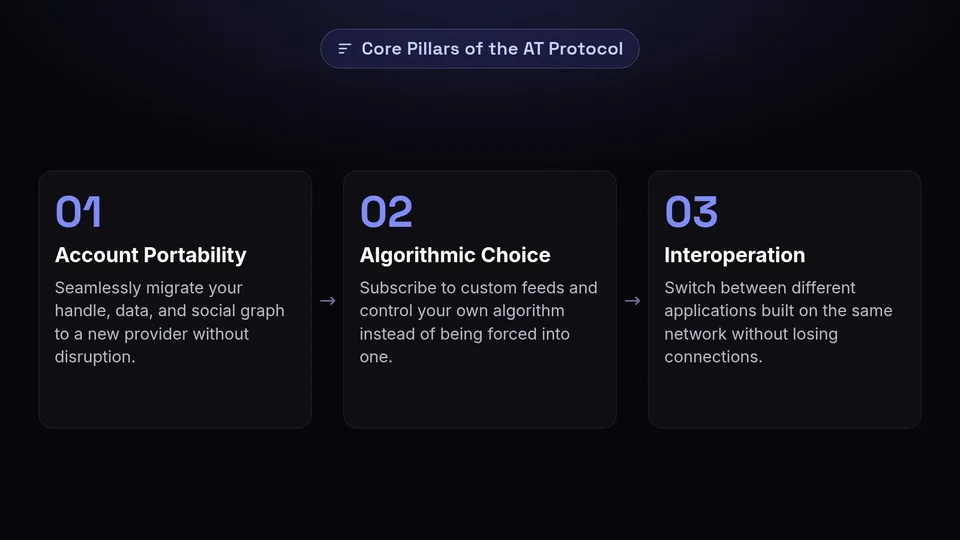
Instead of ActivityPub, Bluesky is built on the AT Protocol (Authenticated Transfer Protocol). The AT Protocol was designed from the ground up to solve some of the user experience friction points found in older federated models. It focuses on three core pillars:
- Account Portability: On the AT Protocol, your digital identity is not tied to a specific server. You own your data and your social graph. If you become dissatisfied with your current hosting provider, you can seamlessly migrate your entire account—including your followers, handle, and data—to a new provider without any disruption.
- Algorithmic Choice: Centralized platforms force users into a single algorithmic feed. Bluesky flips this model by introducing custom feeds. Users can subscribe to different algorithms created by developers. You can have a feed dedicated solely to mutuals, a feed optimized for breaking news, or a feed that only shows pictures of cats. You control the algorithm, not the platform.
- Interoperation: Like the Fediverse, the AT Protocol is designed to allow different applications to be built on top of the same underlying network, ensuring that users can switch apps without losing their connections.
Bluesky's Growth and Appeal
Bluesky gained massive traction through a tightly controlled invite-only beta phase, which created artificial scarcity and high demand among journalists, tech enthusiasts, and creatives. After opening to the public, it quickly amassed millions of users. Its user interface is remarkably similar to traditional microblogging platforms, making the onboarding process much smoother for the average user compared to Mastodon's server-selection process.
Beyond the Big Two: Other Players in the Space
While Bluesky and Mastodon dominate the headlines, the ecosystem of decentralized social media is vast and rapidly expanding. Several other platforms and protocols are carving out significant niches.
Threads and ActivityPub Integration
Perhaps the most massive development in the decentralized space is Meta's involvement. Meta launched Threads as a direct competitor to X. Crucially, Meta promised to make Threads compatible with ActivityPub. They have slowly begun rolling out this integration, allowing Threads users to share their posts with the wider Fediverse. This move has sparked intense debate. Proponents argue it brings massive mainstream adoption to decentralized protocols, while critics fear Meta will employ an "embrace, extend, and extinguish" strategy to eventually dominate the open web.
Nostr
Nostr (Notes and Other Stuff Transmitted by Relays) is a fundamentally different type of decentralized network. Heavily favored by the cryptocurrency and Bitcoin communities, Nostr does not rely on servers communicating with each other. Instead, clients publish cryptographic signatures to "relays" (dumb servers that just pass data along). It is incredibly resilient to censorship, though its user experience remains highly technical.
The Fediverse Suite: Pixelfed, PeerTube, and Lemmy
The ActivityPub protocol powers more than just text-based microblogging. An entire suite of decentralized alternatives exists:
- Pixelfed: An image-sharing platform that serves as a decentralized alternative to Instagram. It features chronological feeds and no advertisements.
- PeerTube: A decentralized, peer-to-peer video hosting platform. It reduces server costs by using WebTorrent technology, allowing viewers to share the bandwidth load of popular videos.
- Lemmy: A link aggregator and discussion forum, functioning as the decentralized answer to Reddit. Following controversial API changes at Reddit, Lemmy saw a massive influx of migrating communities.
Why Brands and Creators Should Care
For social media managers, marketers, and content creators, the fragmentation of the social landscape can feel overwhelming. However, dismissing decentralized social media as a passing fad is a strategic error. The shift toward decentralization offers unique opportunities and mitigates significant risks.
1. Audience Ownership and Platform Risk
In the Web 2.0 era, you rent your audience from tech giants. An unexpected algorithm update, an accidental account suspension, or a platform's decline can instantly wipe out years of audience-building efforts. Decentralized platforms—particularly those utilizing the AT Protocol for account portability—allow you to truly own your social graph. If a server shuts down, you take your followers with you.
2. High-Quality, Niche Communities
Because decentralized networks often organize around specific interests (via instances or custom feeds), they naturally foster highly engaged, niche communities. While the total user count might be lower than Facebook, the signal-to-noise ratio is vastly superior. Brands that can authentically integrate into these communities will find a highly receptive audience that values genuine interaction over corporate broadcasting.
3. Transparency and Algorithmic Control
Navigating the "black box" algorithms of TikTok or X is a constant struggle for marketers. Decentralized platforms offer transparency. On Mastodon, the chronological feed means that if you post when your audience is active, they will see it. On Bluesky, the ability to create and subscribe to custom feeds means brands could theoretically build their own algorithms to serve their communities.
4. First-Mover Advantage
Establishing a presence on these networks now, while they are still in their formative stages, allows brands to secure their handles, understand the community culture, and build authority without the intense competition found on legacy platforms.
Challenges Facing Decentralized Networks
Despite the immense promise, decentralized social media is not without its hurdles. The path to mainstream ubiquity is fraught with technical, cultural, and economic challenges.
The User Experience (UX) Friction
The biggest barrier to entry remains the onboarding process. Explaining "instances," "defederation," and "protocols" to a casual user who just wants to scroll through memes is a steep uphill battle. While Bluesky has made great strides in hiding the complex plumbing behind a clean interface, Mastodon and other Fediverse apps still suffer from a learning curve that deters mass adoption.
Fragmentation and Discovery
When communities are scattered across thousands of independent servers, finding friends, brands, and trending content becomes difficult. Global search is intentionally limited on many decentralized platforms to prevent harassment and dogpiling, but this also stifles viral discovery and makes it harder for creators to grow their audiences organically.
Moderation and Safety
Content moderation in a decentralized world is incredibly complex. Without a central authority, the burden of moderation falls on the volunteer administrators of individual servers. While the "defederation" tool is powerful, it can lead to echo chambers and fragmented networks where entire servers are blocked due to the actions of a few bad actors. Ensuring child safety, combating hate speech, and managing spam require coordinated efforts across disparate nodes.
Monetization and Sustainability
Most centralized platforms are free because they harvest user data to sell targeted advertising. Decentralized platforms generally reject this model. Consequently, server costs are typically funded through donations, Patreon, or out of the pocket of the administrators. As these networks scale, finding sustainable, ethical monetization models that do not rely on surveillance capitalism will be critical to their long-term survival.
How to Build a Strategy for Decentralized Social Media
Adapting to this new landscape requires a shift in mindset. Marketers cannot simply copy-paste their Twitter or Instagram strategies onto Mastodon or Bluesky. Here is a framework for building a successful decentralized strategy:
1. Secure Your Brand Identity
The first step is defensive. Claim your brand handles across major decentralized networks. On Mastodon, choose an instance that aligns with your industry (e.g., a tech company joining a tech-focused server) or consider hosting your own branded instance for ultimate control. On Bluesky, secure your handle and consider using your domain name as your handle (e.g., @brand.com) as a built-in verification method.
2. Listen and Learn the Culture
Decentralized communities are highly sensitive to inauthentic corporate behavior. Spend time listening. Understand the local etiquette. On Mastodon, for example, the use of Content Warnings (CWs) for sensitive topics, eye contact in photos, or even long threads is part of the cultural norm. Respect these community guidelines.
3. Focus on Value, Not Volume
Without algorithmic amplification, your content must stand on its own merit. Focus on providing high-quality, informative, or entertaining content that encourages direct replies and shares (boosts). Engage in conversations rather than just broadcasting messages.
4. Leverage Cross-Posting Tools Intelligently
Managing multiple networks can drain resources. Utilize advanced social media management tools to streamline your workflow. However, tailor your messaging for each platform. Strip out platform-specific jargon (like "retweet") when posting to the Fediverse.
5. Monitor the Ecosystem
The decentralized landscape is moving incredibly fast. Keep an eye on protocol developments, new platform launches, and shifts in user migration. Agility is your best asset in the Web3 and decentralized era.
Conclusion
The rise of decentralized social media represents one of the most significant evolutions in the history of the internet. Platforms like Bluesky and Mastodon, supported by the AT Protocol and the Fediverse, are proving that an alternative to the centralized, ad-driven monopolies is not only possible but highly desirable. While challenges in user experience, moderation, and scalability remain, the momentum toward digital ownership and algorithmic transparency is undeniable.
For brands, creators, and social media managers, the time to adapt is now. Embracing these platforms early provides a unique opportunity to build resilient, highly engaged communities free from the whims of centralized algorithms.
Managing a presence across both legacy platforms and new decentralized networks doesn't have to be overwhelming. SchedulifyX is your AI-powered social media scheduling platform designed to handle the complexities of the modern digital landscape. With seamless integration, intelligent analytics, and cross-platform publishing capabilities, SchedulifyX empowers you to maintain a consistent, engaging presence wherever your audience lives. Start future-proofing your social media strategy with SchedulifyX today.