Social Media Crisis Management: A Step-by-Step Response Plan
SchedulifyX Team · April 15, 2026
Protect your brand reputation with our comprehensive social media crisis management response plan. Discover actionable steps to handle any online emergency.
In today's hyper-connected digital landscape, a brand's reputation can take decades to build and only minutes to destroy. A single poorly worded tweet, a customer service failure that goes viral, or a tone-deaf marketing campaign can ignite a firestorm of negative attention. This is why having a robust social media crisis management plan is no longer optional for businesses—it is a critical necessity. When the unexpected happens, how your brand responds in the first few hours will dictate whether you emerge with your brand reputation intact or suffer long-term damage.
Welcome to the ultimate guide on navigating digital disasters. In this comprehensive article, we will break down exactly what constitutes a social media crisis, why preparation is your best defense, and provide a detailed, step-by-step response plan to help you weather the storm. Whether you are a small business owner, a dedicated social media manager, or a PR executive, these actionable insights will equip you with the tools needed for effective crisis management.
Introduction

The speed of the internet is both a blessing and a curse. While it allows brands to reach millions of potential customers instantly, it also means that mistakes are amplified globally in real-time. A social media crisis can strike at any moment, often without warning. It might stem from an internal error, such as an employee posting from the wrong account, or an external factor, like a coordinated boycott or a data breach. Regardless of the origin, the lack of a structured crisis management strategy can lead to panic, disorganized responses, and ultimately, a devastated brand reputation.
Preparation is the cornerstone of effective crisis management. By the time a crisis hits, it is already too late to start figuring out who needs to approve a public statement or how to pause your automated marketing campaigns. You need a playbook. This article serves as that playbook, guiding you through the essential steps to mitigate damage, communicate effectively, and rebuild trust with your audience.
What is a Social Media Crisis?
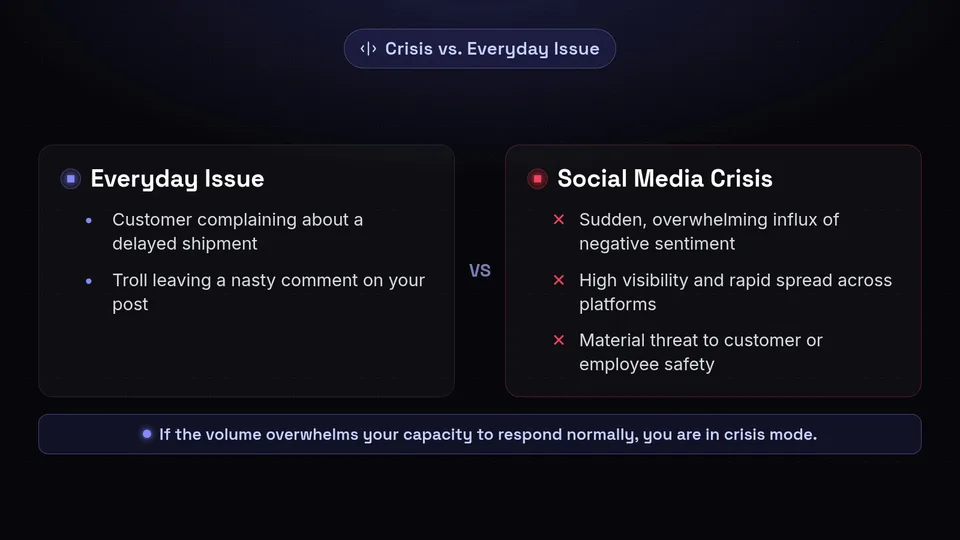
Before diving into the response plan, it is crucial to define what actually constitutes a social media crisis. Not every negative comment or angry customer is a crisis. A customer complaining about a delayed shipment is a customer service issue. A troll leaving a nasty comment on your Instagram post is a moderation issue.
A true social media crisis is an event that significantly disrupts your business operations, threatens your brand reputation, and has the potential to cause lasting financial or structural damage. It is characterized by a sudden, overwhelming influx of negative sentiment, high visibility, and a rapid spread across multiple platforms.
"A social media crisis is an event that negatively impacts a brand's reputation, resulting in a significant loss of trust, revenue, or audience engagement, and requires immediate, strategic intervention."
To distinguish between a minor hiccup and a full-blown crisis, ask yourself the following questions:
- Is the issue spreading rapidly beyond our normal audience?
- Are major media outlets or high-profile influencers picking up the story?
- Does this issue align with a broader social, political, or cultural sensitivity?
- Is there a material threat to the safety of our customers or employees?
- Is the volume of negative mentions overwhelming our capacity to respond normally?
If the answer to several of these is "yes," you are in crisis mode.
Types of Social Media Crises
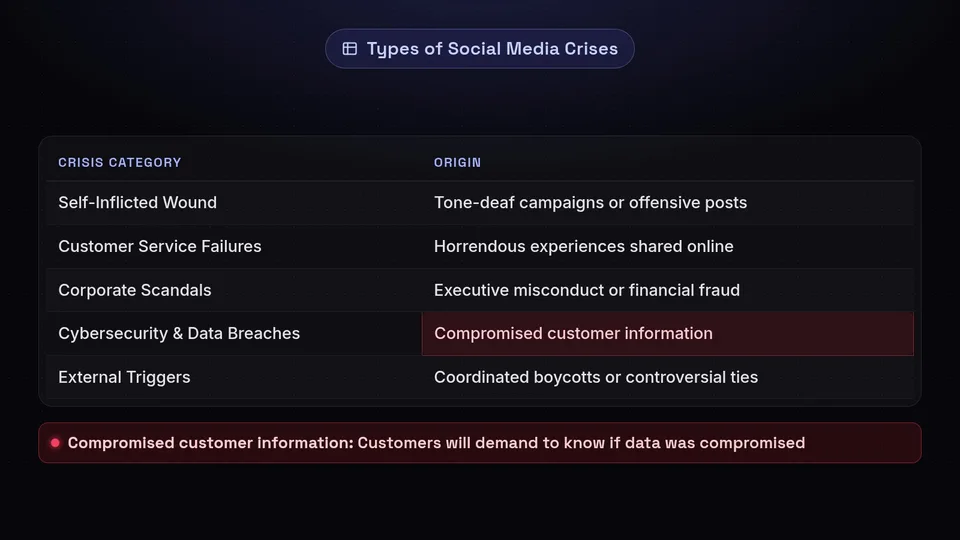
Understanding the nature of the emergency is the first step in effective crisis management. Social media crises generally fall into several distinct categories:
1. The Self-Inflicted Wound
This occurs when a brand or its representatives post something offensive, insensitive, or factually incorrect. This includes tone-deaf marketing campaigns that miss the mark on cultural nuances, inappropriate jokes, or employees accidentally posting personal opinions on corporate accounts.
2. Customer Service Failures Gone Viral
What starts as a single customer complaint can escalate into a crisis if handled poorly. If a customer documents a horrendous experience—such as finding a foreign object in their food or experiencing blatant discrimination—and shares it online, it can quickly go viral, prompting others to share similar experiences.
3. Corporate Scandals and Executive Misconduct
When high-level executives are caught in scandals—ranging from financial fraud to inappropriate workplace behavior—the fallout immediately spills over onto the brand's social media channels. The public will demand accountability and transparency directly from the brand's profiles.
4. Cybersecurity and Data Breaches
In an era where data privacy is paramount, a breach of customer information is a massive crisis. Customers will flood social media demanding to know if their data was compromised and what the company is doing to fix it.
5. External Triggers and Boycotts
Sometimes, a brand is pulled into a crisis due to external events. This could be an association with a controversial public figure, a supplier caught using unethical labor practices, or being targeted by a coordinated online boycott over political or social stances.
The Impact on Brand Reputation
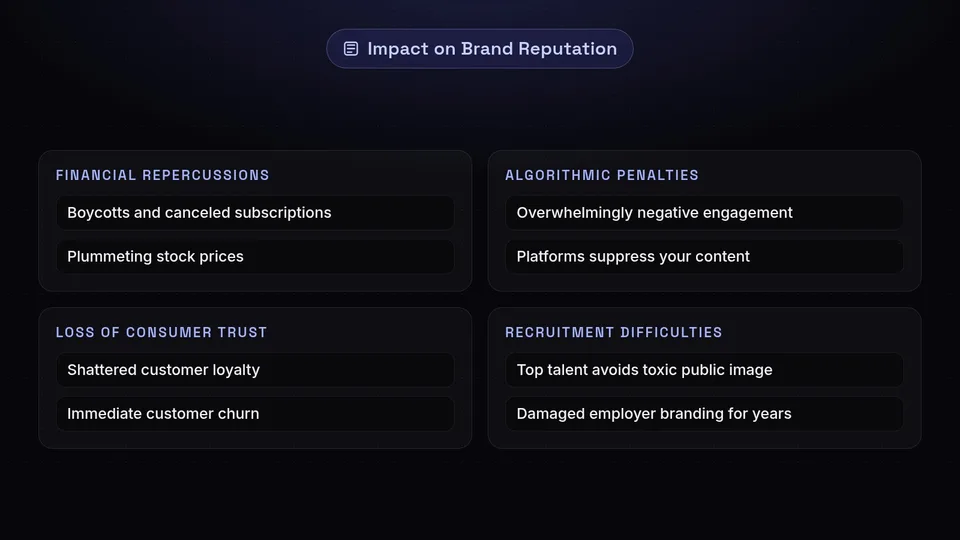
The stakes in social media crisis management are incredibly high. The impact on your brand reputation can manifest in several damaging ways:
- Loss of Consumer Trust: Trust is the foundation of customer loyalty. A mishandled crisis shatters that trust, leading to immediate customer churn.
- Financial Repercussions: Boycotts, canceled subscriptions, and plummeting stock prices are common side effects of a viral PR disaster.
- Recruitment Difficulties: Top talent does not want to work for a company with a toxic public image. A severe crisis can damage your employer branding for years.
- Algorithmic Penalties: Social media algorithms prioritize engagement. If your engagement is overwhelmingly negative, platforms may suppress your content, making it harder to reach your audience even after the crisis has passed.
Given these severe consequences, having a proactive, step-by-step response plan is non-negotiable. Let us explore the eight critical steps to managing a social media crisis.
Step 1: Build Your Crisis Management Team
You cannot fight a fire if you do not know who is holding the hose. The very first step in your crisis management plan—which must be completed long before a crisis actually occurs—is assembling a dedicated crisis response team. This team needs clear roles, responsibilities, and a defined chain of command.
Key Roles in a Crisis Team:
- The Crisis Manager: The team leader who orchestrates the response, makes final decisions, and ensures all moving parts are coordinated.
- Social Media Manager(s): The frontline responders who monitor sentiment, pause scheduled content, and publish the approved messaging.
- Public Relations / Communications Lead: The individual responsible for crafting the core message, writing press releases, and ensuring consistency across all channels.
- Legal Counsel: Essential for reviewing statements to ensure the company is not exposing itself to legal liability.
- Customer Support Liaison: Connects the social team with the customer service department to ensure a unified response to incoming inquiries.
- Executive Sponsor (CEO/CMO): High-level leadership who provides final approval on critical statements and may act as the public face of the apology if the crisis is severe enough.
Ensure that this team has a dedicated communication channel (like a specific Slack channel or emergency group chat) and that everyone has access to each other's emergency contact information, including after-hours phone numbers.
Step 2: Establish Guidelines and Identify the Crisis
Not every negative tweet requires waking up the CEO at 2:00 AM. You need a clear framework to identify the severity of an issue and dictate the appropriate level of response. A common approach is the "Traffic Light System."
Green (Normal Operations)
Standard negative feedback, minor customer complaints, or isolated trolling. Action: Handled by the social media or customer service team using standard response protocols. No escalation needed.
Yellow (Emerging Issue)
An increasing volume of complaints about a specific issue, a negative post from a mid-tier influencer, or a controversial topic gaining traction. Action: The Social Media Manager alerts the PR Lead and Crisis Manager. The team monitors the situation closely and prepares holding statements just in case.
Red (Full-Blown Crisis)
Viral outrage, major media coverage, legal/safety threats, or severe corporate missteps. Action: The entire Crisis Management Team is activated. All scheduled content is paused, and emergency protocols are initiated.
By establishing these guidelines, you empower your frontline social media managers to act decisively without second-guessing whether they should sound the alarm.
Step 3: Pause All Scheduled Content
When a crisis hits, the absolute worst thing your brand can do is proceed with "business as usual." Imagine a scenario where your company is trending on Twitter for a massive product recall, and your automated social media software posts a cheerful message saying, "It's a great day to try our new products!"
This makes the brand look incredibly tone-deaf, insensitive, and disconnected from reality. It will instantly pour gasoline on the fire.
Immediate Action: The moment a "Red" crisis is identified, the very first tactical step is to pause all automated social media scheduling. This is where using an intelligent platform like SchedulifyX becomes invaluable. With a single click, you can halt all outbound marketing messages across every platform, ensuring no inappropriate content slips through the cracks while your team assesses the situation.
Do not forget to also pause paid advertising campaigns. You do not want to be spending money to promote a brand that is currently facing public backlash.
Step 4: Assess the Situation and Gather Facts
In the heat of a social media crisis, the pressure to respond immediately is immense. However, responding with incorrect or incomplete information will only make things worse. You must take a deep breath and gather the facts.
The 5 Ws of Crisis Assessment:
- Who: Who is involved? Is it a customer, an employee, a partner, or a competitor? Who is driving the conversation online?
- What: What exactly happened? What is the core issue? What are people saying?
- Where: Where did the crisis originate? Is it contained to Twitter (X), or has it spread to TikTok, LinkedIn, and mainstream news?
- When: When did the incident occur, and when did it start gaining traction online?
- Why: Why are people so upset? Is it a violation of trust, a safety concern, or a moral outrage?
During this phase, utilize social listening tools to track hashtags, brand mentions, and overall sentiment. This data will provide a clear picture of the scale of the problem and help inform your response strategy.
Step 5: Formulate Your Initial Response
Silence is not golden during a crisis; it is deadly. If you do not control the narrative, the internet will create one for you. While you may not have all the answers immediately, you need to issue a "holding statement" to acknowledge the situation.
The Holding Statement
A holding statement is a brief, factual message that lets your audience know you are aware of the issue and are actively looking into it. It buys you time to conduct a thorough investigation.
Example: "We are aware of the situation regarding [Issue] and are taking this matter very seriously. We are currently investigating the details and will provide a full update as soon as we have more information."
The Anatomy of a Perfect Apology
Once you have gathered the facts and determined that your brand is at fault, you must issue a formal apology. A poorly crafted apology (the dreaded "non-apology") can cause a secondary crisis. To protect your brand reputation, your apology must include three elements:
- Ownership: Take clear, unequivocal responsibility. Do not use passive language ("Mistakes were made") or shift blame. Say, "We messed up."
- Empathy: Acknowledge the pain, frustration, or inconvenience caused to your audience. Never say, "We are sorry if anyone was offended." That invalidates their feelings. Instead, say, "We are sorry that our actions caused harm."
- Action: An apology without changed behavior is manipulation. Clearly state the steps you are taking to fix the current issue and the measures being implemented to ensure it never happens again.
Ensure that this response is published where the crisis originated. If the crisis started on TikTok, your primary response should be a video on TikTok, not just a text post on LinkedIn.
Step 6: Communicate Internally
A critical, yet often overlooked, aspect of crisis management is internal communication. Your employees are your brand ambassadors. If they are left in the dark, they might accidentally say the wrong thing to a customer, leak unverified information to the press, or post personal opinions on social media that contradict the official company stance.
As soon as a crisis is identified and a holding statement is prepared, send an internal memo to all staff. This memo should include:
- A brief, factual summary of what is happening.
- The official holding statement or public response.
- Clear instructions on what employees should and should not do (e.g., "Please do not engage with comments about this issue on your personal social media accounts").
- Information on where to direct inquiries from the press or customers (e.g., "Please forward all media requests to the PR department at [email protected]").
Keeping your team informed prevents rumors from spreading internally and ensures a unified front externally.
Step 7: Monitor the Situation and Engage
Publishing your statement is not the end of the crisis; it is often just the beginning of the recovery phase. You must continuously monitor the reaction to your statement and engage with your audience where appropriate.
Active Social Listening
Keep your social listening tools running at full capacity. Are people accepting the apology? Are new details emerging? Is the negative sentiment beginning to trend downward? Tracking these metrics will help you determine if your crisis management strategy is working or if further action is required.
Rules of Engagement
- Do not argue: Never get defensive or start arguing with angry commenters. It is a battle you will not win.
- Answer legitimate questions: If users have genuine questions about how the resolution affects them (e.g., "How do I get a refund for the recalled product?"), answer them promptly and courteously.
- Ignore the trolls: Differentiate between angry customers and internet trolls who are just trying to provoke a reaction. Do not feed the trolls.
- Move conversations offline: For complex or highly emotional customer issues, try to move the conversation to direct messages, email, or a phone call as quickly as possible.
Maintain a visible presence. Let your audience see that you are actively working through the problem, not just dropping a statement and hiding.
Step 8: Post-Crisis Analysis and Recovery
Eventually, the storm will pass. The volume of negative mentions will return to normal levels, and the news cycle will move on to the next big story. However, your work is not done. The post-crisis phase is critical for long-term brand reputation recovery and future prevention.
The Debrief Meeting
Gather your Crisis Management Team for a comprehensive debrief. Ask the hard questions:
- What caused the crisis, and how can we prevent it from happening again?
- How quickly did we identify the issue?
- Was our internal communication effective?
- Did our public response resonate well with the audience?
- What bottlenecks or failures occurred in our response plan?
Updating the Playbook
Use the insights gained from the debrief to update your social media crisis management playbook. If you discovered that legal approval took too long, establish pre-approved holding statements. If a specific employee made a mistake, invest in better social media training for the team.
Rebuilding Trust
Rebuilding your brand reputation takes time. You cannot simply go back to posting memes and promotional content the day after a major crisis. Your content strategy needs to shift. Focus on transparency, community building, and demonstrating the positive changes you promised in your apology. Consider highlighting behind-the-scenes improvements, sharing user-generated content from loyal customers, and engaging in proactive community management.
Common Mistakes to Avoid During a Crisis
Even with a solid plan, emotions can run high, leading to critical errors. Here are some of the most common pitfalls to avoid during a social media crisis:
- Deleting Negative Comments: Unless a comment violates your community guidelines (e.g., hate speech, threats, spam), do not delete it. Deleting valid criticism looks like a cover-up and will only enrage your audience further.
- Going Silent: Ignoring the problem will not make it go away. It creates an information vacuum that your detractors will happily fill with rumors and speculation.
- Losing Your Temper: The person managing the social accounts must remain professional at all times. Snarky or defensive replies will immediately become screenshots that fuel the fire.
- Relying on Bots: Turn off auto-responders during a crisis. People want to know they are being heard by a human being, not a machine.
How SchedulifyX Can Help Protect Your Brand
Managing a social media presence is complex enough during normal operations; during a crisis, it can feel overwhelming. That is where having the right technology stack becomes a lifesaver. SchedulifyX is designed not just to help you grow your audience, but to protect your brand reputation when things go wrong.
With SchedulifyX, you gain access to vital crisis management tools:
- The "Panic Button": Instantly pause all scheduled posts across every social media platform with a single click, ensuring no tone-deaf content goes live during an emergency.
- Advanced Social Listening: Monitor brand mentions, keywords, and sentiment analysis in real-time, allowing you to detect a brewing crisis before it reaches a boiling point.
- Approval Workflows: Prevent self-inflicted crises by setting up multi-tier approval workflows, ensuring that every post is reviewed by a manager before it goes live.
- Unified Inbox: Manage the flood of incoming messages and comments from a single dashboard, enabling your team to respond quickly and consistently.
By integrating an AI-powered platform like SchedulifyX into your daily operations, you are building a fortified defense system for your brand's digital presence.
Conclusion
A social media crisis is a test of a brand's character, agility, and commitment to its audience. While you cannot predict when a crisis will strike, you can absolutely control how you respond. By building a dedicated team, establishing clear protocols, prioritizing transparency, and leveraging the right tools, you can navigate the turbulence of a digital disaster.
Effective social media crisis management is not about avoiding mistakes altogether—it is about demonstrating accountability and empathy when things go wrong. A well-handled crisis can actually strengthen your brand reputation, proving to your customers that you are a company that stands by its values even in the face of adversity.
Don't wait for a crisis to realize you need a plan. Start building your response strategy today, and equip your team with the tools they need to succeed. Ready to safeguard your brand's online presence? Try SchedulifyX today and discover how our advanced scheduling, pausing, and listening features can be your ultimate crisis management partner.