Social Media ROI Calculator: Prove Your Value to Clients
SchedulifyX Team · April 25, 2026
Learn how to build a social media ROI calculator, translate vanity metrics into business value, and prove the financial impact of your campaigns to clients.
Picture this: You have just wrapped up a phenomenal quarter for your client. Their Instagram engagement is up by 300%, their TikTok videos are going viral, and their follower count has doubled. You walk into the quarterly review meeting beaming with pride, ready to present these stellar metrics. Then, the client drops the dreaded question: "This is great, but how much money did this actually make us?"
If you have ever worked in social media management, you have likely felt the icy chill of this question. Bridging the gap between social media engagement and actual revenue is one of the most significant challenges marketers face today. Likes, shares, and retweets are fantastic for brand awareness, but they do not pay the bills. To keep your clients happy, justify your retainer, and secure larger budgets, you must speak the language of business: Return on Investment (ROI).
This is where a social media ROI calculator becomes your most valuable asset. In this comprehensive guide, we will break down exactly how to calculate social media ROI, what metrics you need to track, and how to present this data so your clients see the undeniable value of your work.
What is Social Media ROI?

Social media Return on Investment (ROI) is a measure of the value created by your social media activities compared to the investment required to execute them. In its simplest form, it answers the question: For every dollar we spent on social media, how many dollars did we get back?
However, social media ROI is not always strictly monetary. Depending on the client's specific business goals, "return" could mean lead generation, customer retention, brand sentiment improvement, or reduced customer support costs. But ultimately, to prove your worth to a skeptical client or a strict CFO, you must find a way to tie these outcomes back to a financial value.
"Social media ROI is the bridge between creative marketing efforts and hard business outcomes. Without it, you are just making noise. With it, you are driving a business forward."
Why You Need a Social Media ROI Calculator

Many social media managers rely on native platform analytics—Facebook Insights, X Analytics, Instagram Professional Dashboard—to report on their success. While these tools are essential for optimizing content, they are woefully inadequate for proving business value. Building and utilizing a dedicated social media ROI calculator provides several critical benefits:
1. Justifies Your Agency Retainer or Salary
When budgets get tight, marketing is often the first department to face cuts. If a client views your social media services as an "expense" rather than a "revenue driver," your contract is at risk. An ROI calculator proves that you are an investment that yields positive returns.
2. Validates Your Strategy
Are your high-production-value YouTube videos generating more leads than your quick, low-cost TikToks? An ROI calculator strips away the vanity metrics and shows you exactly which platforms and content types are driving actual business results, allowing you to pivot your strategy effectively.
3. Unlocks Larger Budgets
If you can definitively prove to a client that spending
Core Metrics to Include in Your ROI Calculation
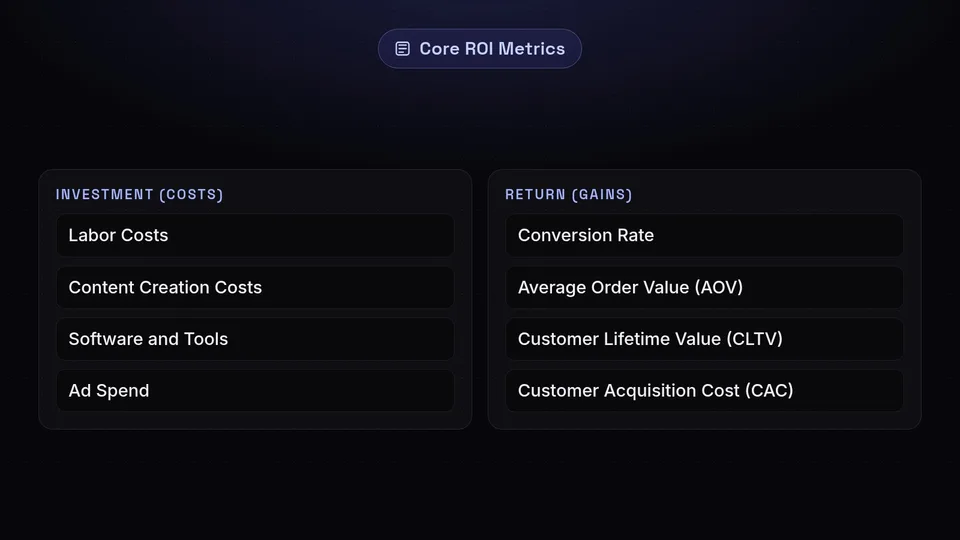
Before you can use a social media ROI calculator, you need to gather the right data. You must distinguish between vanity metrics (likes, followers) and business metrics. Here are the core metrics you need to track:
The Investment Metrics (Your Costs)
- Labor Costs: The hourly rate or salary of the social media managers, copywriters, and designers working on the campaign.
- Content Creation Costs: Expenses for stock photos, video production, graphic design, and copywriting.
- Software and Tools: The cost of your social media scheduling tools (like SchedulifyX), analytics platforms, and design software.
- Ad Spend: The actual money paid to social networks for boosting posts or running paid ad campaigns.
The Return Metrics (Your Gains)
- Conversion Rate: The percentage of social media traffic that completes a desired action (e.g., making a purchase, filling out a lead form).
- Average Order Value (AOV): The average amount of money a customer spends when they make a purchase originating from social media.
- Customer Lifetime Value (CLTV): The total revenue a business can reasonably expect from a single customer account throughout their relationship.
- Customer Acquisition Cost (CAC): How much it costs to acquire a new customer through your social media efforts.
The Standard Social Media ROI Formula
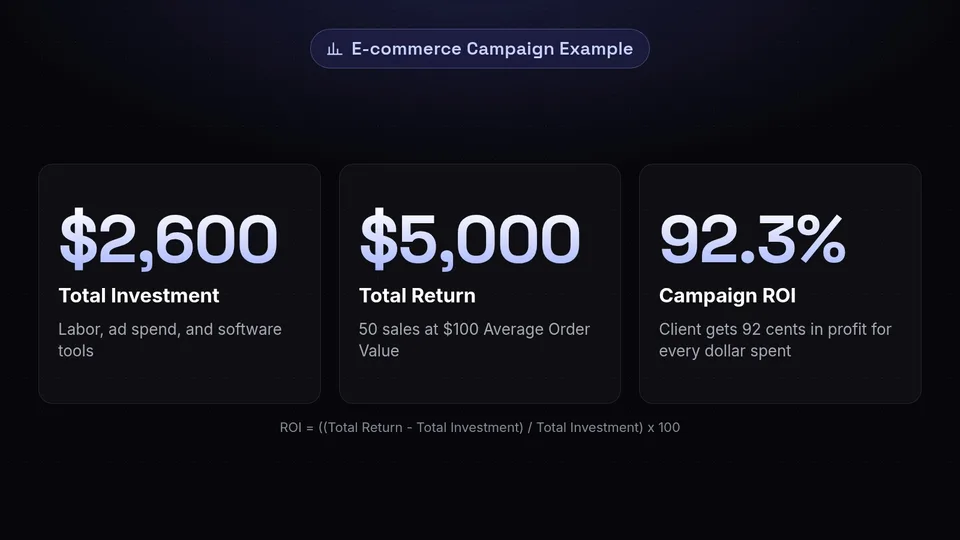
At the heart of every social media ROI calculator is a fundamental financial formula. It is the same formula used by Wall Street investors and real estate moguls, adapted for digital marketing.
Social Media ROI = ((Total Return - Total Investment) / Total Investment) x 100
Let us look at a practical example. Suppose you run a month-long campaign for an e-commerce client.
- Labor: ,500
- Ad Spend:
,000- Software/Tools:
00- Total Investment: $2,600
Using Google Analytics, you track that the social media campaign directly resulted in 50 sales, with an Average Order Value of
00.- Total Return: $5,000
Now, plug it into the formula:
ROI = (($5,000 - $2,600) / $2,600) x 100
ROI = ($2,400 / $2,600) x 100
ROI = 0.923 x 100
ROI = 92.3%In this scenario, for every dollar the client spent on your social media campaign, they got their dollar back, plus an additional 92 cents in profit. That is a compelling story to tell in a client meeting.
Step-by-Step: How to Calculate Social Media ROI
Knowing the formula is only half the battle. The real challenge lies in accurately gathering the data to plug into it. Here is a step-by-step process to build your social media ROI calculator workflow.
Step 1: Define Clear Business Objectives
You cannot measure ROI if you do not know what "return" looks like for your specific client. Sit down with the client and ask: What is the primary goal of this campaign? Is it direct e-commerce sales? Is it B2B lead generation? Is it driving foot traffic to a local brick-and-mortar store? Define the objective clearly.
Step 2: Set Up Proper Tracking
You cannot attribute revenue to social media without proper tracking mechanisms in place. You must implement:
- UTM Parameters: Add UTM tags to every single link you post on social media. This allows Google Analytics to track exactly which post, on which platform, drove a specific visitor to the website.
- Conversion Pixels: Install the Meta Pixel, TikTok Pixel, and LinkedIn Insight Tag on the client's website. This allows the social platforms to track what users do after they click your links.
- Custom Landing Pages: For specific campaigns, create dedicated landing pages that are only accessible via your social media links. Any conversion on that page can be 100% attributed to your social efforts.
Step 3: Assign Monetary Values to Actions
If the client is an e-commerce brand, assigning a value is easy (the price of the product). But what if the goal is lead generation? You need to work with the client's sales team to determine the value of a lead. (We will cover this in depth in the next section).
Step 4: Calculate Total Investment
Be meticulous here. Do not just count the ad spend. If you spent 10 hours writing copy, and your agency bills at
00/hour, that is,000 of investment. If you ignore labor and overhead, your ROI will look artificially high, which can lead to poor business decisions down the line.Step 5: Run the Calculator and Analyze
Plug your numbers into the formula. But do not stop at the final percentage. Analyze the nuances. Did Facebook generate a lower ROI than LinkedIn? Did video content yield a higher ROI than static images? Use these insights to refine your next campaign.
Translating Soft Metrics into Hard Dollars
This is where many social media managers get stuck. How do you calculate ROI when the client is a B2B SaaS company, and your social media goal is to get people to download a free whitepaper? You have to translate "soft metrics" into hard dollars using historical conversion data.
Here is how you do it:
Let us say your client knows that, historically, 10% of people who download a whitepaper eventually request a software demo. They also know that their sales team closes 20% of demo requests. Finally, the lifetime value (LTV) of a new software customer is
0,000.You can work backward to find the value of a single whitepaper download:
- 1 Customer = 0,000
- It takes 5 demos to get 1 customer (20% close rate). Therefore, 1 demo request is worth $2,000 (
0,000 / 5).- It takes 10 whitepaper downloads to get 1 demo request (10% conversion rate). Therefore, 1 whitepaper download is worth $200 ($2,000 / 10).
Now you have your benchmark. If your social media campaign generates 50 whitepaper downloads, you can confidently report to your client that you generated
0,000 in pipeline value. This transforms a soft metric (a PDF download) into a hard, undeniable business metric.Common Mistakes When Calculating Social Media ROI
Even seasoned marketers can stumble when building a social media ROI calculator. Avoid these common pitfalls to ensure your reporting remains accurate and credible.
1. Ignoring the Attribution Window
Social media is often a "top of funnel" activity. A user might see your Instagram post on Monday, click the link, browse the site, but not buy anything. On Friday, they might remember the brand, Google the name, and make a purchase. If you only use "last-click attribution," Google gets the credit, and your social media ROI looks terrible. Ensure you are looking at multi-touch attribution models to see the true impact of your social campaigns.
2. Forgetting the Cost of Labor
As mentioned earlier, time is money. If an organic viral TikTok takes a team of three people 40 hours to conceptualize, film, and edit, that is a significant financial investment. Failing to include labor costs in your ROI calculator creates a false sense of profitability.
3. Promising Unrealistic Timelines
ROI takes time to materialize, especially for organic social media and B2B sales cycles. If you calculate ROI after week one of a six-month campaign, the numbers will likely be negative. Set clear expectations with clients about when it is appropriate to measure and report on ROI.
How to Present ROI to Your Clients
You have done the math. You have a fantastic ROI percentage. Now, you need to present it. Handing a client a complex spreadsheet is the fastest way to lose their attention. You need to tell a story with your data.
Visual Dashboards
Use data visualization tools to create clean, easy-to-read dashboards. Show a clear funnel: Reach -> Engagement -> Clicks -> Conversions -> Revenue. When clients can visually see how a social media view trickles down into a dollar sign, the concept of ROI "clicks" in their minds.
Contextualize the Numbers
Do not just say, "We achieved a 150% ROI." Contextualize it. Say, "For every
you gave us this month, we handed you $2.50 back." Frame the data in terms of their overall business goals. If their goal was to reduce customer acquisition costs, show them how your social strategy acquired customers for 20% less than their Google Ads campaigns.Highlight the 'Bonus' Value
While hard ROI is the main event, do not completely ignore the soft metrics. Frame them as the "cherry on top." For example: "Not only did this campaign generate
0,000 in direct sales, but as a bonus, we also increased your brand's follower count by 5,000 people, creating an audience we can retarget for free in the future."Streamlining Your ROI with SchedulifyX
Calculating social media ROI requires meticulous tracking, consistent posting, and careful time management. The more time you spend doing manual, repetitive tasks, the higher your labor costs soar—which directly eats into your campaign's ROI.
This is where SchedulifyX becomes an indispensable part of your ROI strategy. As an AI-powered social media scheduling platform, SchedulifyX is designed to maximize your efficiency and boost your bottom line.
- Reduce Labor Costs: By automating your posting schedule across multiple platforms, SchedulifyX drastically reduces the hours your team spends on manual publishing. Lower labor costs mean a lower "Investment" figure in your formula, instantly boosting your ROI.
- AI-Powered Optimization: Stop guessing when your audience is online. SchedulifyX uses AI to determine the exact times your posts are most likely to drive engagement and clicks, increasing your "Return."
- Unified Analytics: Instead of pulling data from five different native platforms to build your ROI calculator, SchedulifyX provides unified, easy-to-read analytics. You can see exactly which posts are driving the most traffic, allowing you to optimize your strategy in real-time.
Proving your worth to clients does not have to be a stressful, end-of-the-month scramble. By understanding the math, tracking the right metrics, and using powerful tools to streamline your workflow, you can transform social media from a perceived "expense" into a proven revenue engine.
Ready to lower your agency's labor costs, increase your campaign efficiency, and drive higher ROI for your clients? Try SchedulifyX today and take the guesswork out of your social media strategy.

- It takes 5 demos to get 1 customer (20% close rate). Therefore, 1 demo request is worth $2,000 (
- Ad Spend: