University Social Media Across Departments: A Worked Example
SchedulifyX Team · June 3, 2026
An illustrative scenario of a university coordinating many department accounts — governance, approvals and scheduling in one system.
A worked example, not a customer report. The brand, people and figures in this piece are illustrative — a composite scenario showing how this workflow plays out in practice. Read the numbers as the shape of what a system like this is built to produce, not as measured results.
In the fast-paced world of higher education, maintaining a cohesive brand voice across a sprawling campus is a monumental task. For most institutions, university social media is not just a single feed; it is a complex web of interconnected departments, colleges, student organizations, and alumni networks. When left unchecked, this web can quickly tangle into a chaotic mess of inconsistent messaging, overlapping content, and off-brand posts.
This case study explores how a prominent mid-sized university—let's call them Midwest State University (MSU)—transformed their fragmented digital presence. By leveraging a centralized strategy and the power of AI-driven tools, the core marketing team successfully reigned in and streamlined 15 distinct multi-department accounts. The result? A unified brand voice, a significant boost in prospective student engagement, and dozens of hours saved each week.
The Higher Education Social Media Dilemma
Higher education institutions are unique ecosystems. Unlike a traditional corporate brand with a singular target audience, universities must speak to a vast and diverse array of stakeholders simultaneously. A single university's audience includes prospective students (Gen Z), current students, parents, alumni, faculty, donors, and the local community.
To cater to these distinct groups, universities historically adopted a decentralized approach to social media. The College of Engineering created its own Twitter account; the Admissions office launched an Instagram; the Alumni Association focused on Facebook and LinkedIn. While this allowed for targeted communication, it inevitably led to a phenomenon known in education marketing as "social media sprawl."
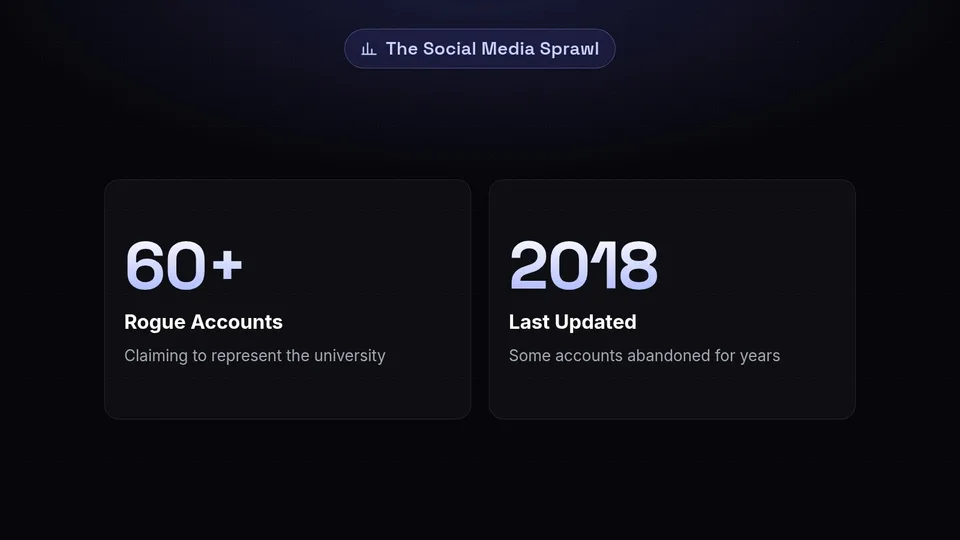
"We had over 60 different social media accounts claiming to represent the university. Some hadn't been updated since 2018, others were using outdated logos, and several were actively contradicting the main university messaging. It was a brand reputation nightmare." – Director of Communications, MSU
This sprawl dilutes the primary brand, confuses prospective students, and creates massive inefficiencies. When every department operates in a silo, there is no cross-promotion, no sharing of high-quality assets, and no unified strategy for major university events like Homecoming or Giving Day.
The Challenge: Managing Multi-Department Chaos
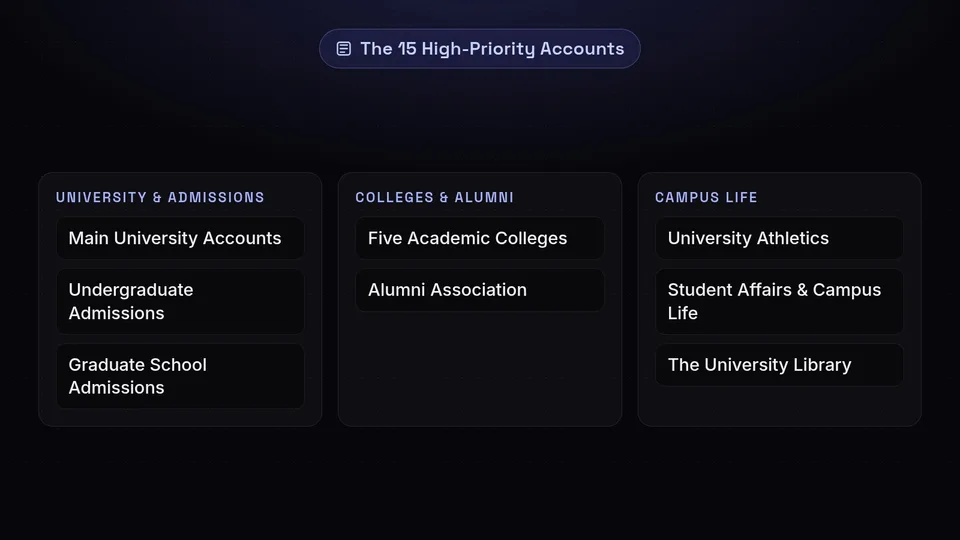
Before their transformation, MSU's central marketing team was struggling to keep their head above water. They had identified 15 high-priority, multi-department accounts that were essential to the university's core mission. These included:
- Main University Accounts (Instagram, Facebook, Twitter/X, LinkedIn)
- Undergraduate Admissions
- Graduate School Admissions
- Alumni Association
- University Athletics
- Five distinct Academic Colleges (Business, Arts & Sciences, Engineering, Nursing, Education)
- Student Affairs & Campus Life
- The University Library
The challenges associated with managing these 15 entities were manifold:
1. Inconsistent Branding and Voice
The College of Business was posting highly corporate, formal content, while the Student Affairs account was posting unregulated memes. While tone should adapt to the audience, the underlying brand voice and visual identity (colors, fonts, logos) were completely misaligned, making it seem like 15 different institutions rather than one cohesive university.
2. Resource Drain and Duplication of Effort
Without a centralized system, departments were duplicating efforts. The central marketing team would hire a professional photographer for a campus event, but the College of Engineering didn't know those photos existed. Consequently, the engineering team would post low-quality smartphone photos of the same event. This lack of asset sharing was a massive drain on resources.
3. The "Rogue" Account Problem
Because there was no easy way for departments to request posts on the main university channels, departments felt forced to create their own accounts to get their messages out. This led to a bloated ecosystem where important announcements were buried on accounts with fewer than 100 followers.
4. Lack of Analytics and Reporting
When the University President asked for a quarterly report on social media performance, the marketing team had to manually log into 15 different native platforms, export CSV files, and spend days combining the data into a single spreadsheet. There was no holistic view of the university's digital footprint.
Step 1: The Comprehensive Social Media Audit
The first step in streamlining the university's social media presence was to stop the bleeding. The central marketing team initiated a comprehensive, campus-wide social media audit. This is a critical step for any multi-department organization looking to regain control.
They began by searching every major social network for the university's name, acronyms, and department variations. They cataloged every account in a master spreadsheet, noting the platform, handle, follower count, date of last post, and the perceived account owner.
The "Keep, Merge, or Delete" Framework
Once the audit was complete, the team applied a strict framework to determine the fate of each account:
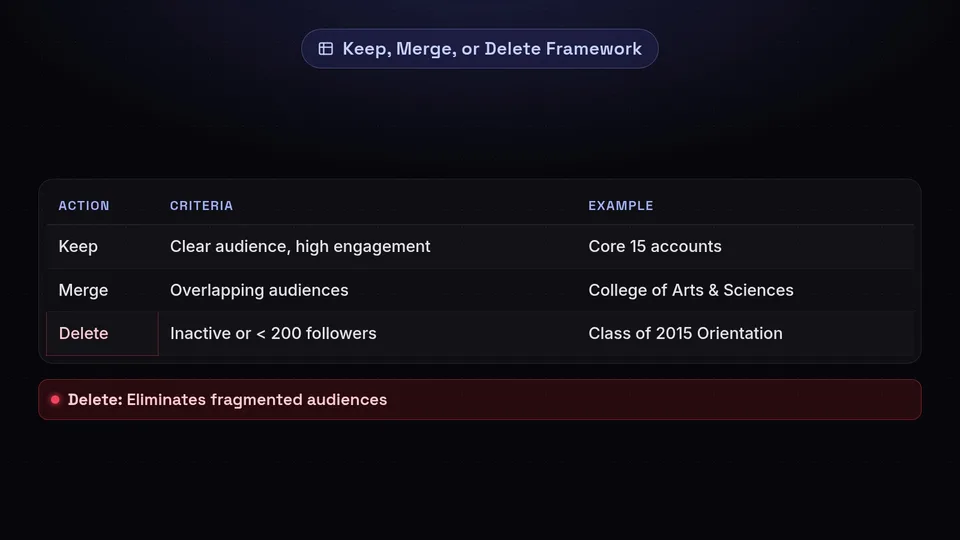
- Keep: Accounts with a clear, unique audience, consistent posting history, and high engagement. (These became the core 15 accounts).
- Merge: Accounts that had overlapping audiences. For example, the "College of Arts" and "College of Sciences" accounts were merged into a single "College of Arts & Sciences" account to pool resources and followers.
- Delete/Archive: Inactive accounts, accounts with fewer than 200 followers, or accounts created for single, past events (e.g., "MSU Class of 2015 Orientation").
By enforcing this framework, the university eliminated dozens of rogue accounts, funneling that fragmented audience back toward the primary 15 departmental channels.
Step 2: Establishing Governance and Permissions

Consolidating the accounts was only half the battle. To prevent the sprawl from happening again, MSU needed to implement a strict governance model. This is where the transition to a centralized, multi-department scheduling platform became essential.
The university adopted a tiered permission structure. Instead of handing out native Twitter or Instagram passwords to student workers or department heads—a massive security risk—they routed everything through a centralized dashboard.
Defining Roles in a Multi-Department Setup
The new workflow categorized users into specific roles:
- Global Administrators: The central marketing team. They had access to all 15 accounts, could publish directly, and had the final say on brand guidelines.
- Department Managers: Communications staff within specific colleges (e.g., the Marketing Coordinator for the College of Business). They could draft posts, schedule content for their specific channels, and view their department's analytics.
- Contributors/Student Interns: Student workers who could draft posts and upload media, but required approval from a Manager or Administrator before anything went live.
"Implementing an approval workflow changed everything. Our student interns could still generate authentic, Gen-Z friendly content, but we had a safety net to ensure no typos or off-brand messaging made it to the public feed." – Social Media Manager, MSU
This governance structure empowered departments to maintain control over their specific narratives while ensuring the central marketing team retained ultimate oversight of the university's digital reputation.
Step 3: Developing a Unified Content Strategy
With the accounts audited and the permissions set, the next hurdle was content. How do you align 15 distinct departments under one strategic umbrella? The answer lies in establishing university-wide content pillars.
In education marketing, content pillars are the core themes that represent the institution's values and goals. MSU established four primary pillars that every department had to incorporate into their monthly content calendars:
1. Academic Excellence & Research
Highlighting faculty achievements, groundbreaking research, and student academic success. The Graduate School might focus on a published paper, while the main account highlights a prestigious grant awarded to the university.
2. Student Life & Campus Culture
Showcasing the vibrancy of the campus. Student Affairs focused on club events and mental health resources, while Admissions used this pillar to show prospective students what it's like to live in the dorms.
3. Alumni Success & Legacy
Demonstrating the ROI of the university degree. The Alumni Association spearheaded this, but individual colleges were encouraged to share stories of their specific graduates succeeding in the workforce.
4. Community Impact & Athletics
Building school spirit and local pride. Athletics naturally dominated this pillar, but the university library might participate by showing how they support local high school programs.
By utilizing a shared content calendar, departments could finally see what others were planning. If the College of Engineering was hosting a massive robotics competition, the central marketing team could see it on the shared calendar and plan to amplify it on the main university channels, creating a synergistic effect rather than operating in silos.
Step 4: Leveraging AI for Education Marketing
Managing 15 accounts requires generating a massive volume of content. To prevent burnout, the MSU marketing team turned to AI-powered tools to streamline their workflow.
Artificial Intelligence is rapidly transforming how universities approach social media. Here is how MSU utilized AI to supercharge their 15 departmental accounts:
Intelligent Caption Generation and Tailoring
A single piece of news—such as the opening of a new Science Center—needs to be communicated differently across various platforms and departments. The central team used AI to generate platform-specific variations of the same announcement.
- For LinkedIn (Alumni Focus): AI helped draft a professional post focusing on how the new center would drive regional economic growth and research opportunities.
- For Instagram (Prospective Student Focus): AI generated a punchy, emoji-filled caption highlighting the state-of-the-art labs and student hangout spaces, complete with trending hashtags.
- For Twitter/X (Media/Community Focus): AI condensed the press release into a concise, impactful thread tagging local news outlets.
Optimal Send Times by Audience
Prospective high school students interact with social media at vastly different times than mid-career alumni. The marketing team utilized AI algorithms that analyzed historical engagement data to determine the optimal posting times for each specific account. The Admissions account saw posts automatically scheduled for late evenings when high schoolers were active, while the Alumni account posted during morning commutes and lunch breaks.
Automated Asset Tagging
With a centralized media library, the team used AI to automatically tag uploaded photos and videos. If a photographer uploaded 500 photos from a football game, the AI would tag images with "football," "marching band," "cheerleaders," and "stadium." When the Admissions team needed a photo of the marching band three months later, they could find it instantly, eliminating the old "duplication of effort" problem.
The Results: Data-Driven Success
The transition from a chaotic, decentralized mess to a streamlined, AI-powered multi-department strategy yielded remarkable results for Midwest State University. Within the first six months of implementing this new system, the data spoke for itself.
1. Massive Increases in Engagement
By eliminating rogue accounts and focusing audience attention on the core 15 channels, overall engagement rates skyrocketed. The university saw a 42% increase in cross-platform engagement. Because content was higher quality and better targeted thanks to AI, users were liking, commenting, and sharing at unprecedented rates.
2. Significant Time Savings
The automation of reporting, the implementation of approval workflows, and the use of AI for caption generation saved the central marketing team an estimated 25 hours per week. Instead of chasing down passwords and manually compiling spreadsheets, the team could focus on high-level strategy and creative video production.
3. Unified Brand Perception
Perhaps the most critical, albeit qualitative, result was the unification of the university's brand. Prospective students visiting the Admissions Instagram saw the same visual language and tone as they did on the main university Facebook page. This consistency builds trust and presents the university as a modern, organized, and prestigious institution.
4. Increased Cross-Departmental Collaboration
The shared workspace fostered a new culture of collaboration. The Athletics department began regularly sharing content with the Alumni association, driving ticket sales for homecoming events. The silos were finally broken down.
Best Practices for Multi-Department Social Media
The success of MSU serves as a blueprint for other institutions grappling with social media sprawl. If you are an education marketing professional looking to streamline your university's digital presence, consider these best practices:
- Conduct Annual Audits: Social media is dynamic. New accounts will inevitably pop up. Conduct an audit every year to identify and eliminate rogue accounts before they dilute your brand.
- Invest in a Centralized Tool: You cannot effectively manage 15+ accounts natively. Invest in a platform that offers multi-workspace capabilities, shared media libraries, and robust approval workflows.
- Create a Social Media Policy Document: Clearly outline who is allowed to create accounts, what the brand guidelines are, and what the consequences are for violating the policy. Make this mandatory reading for any staff or student worker given social media access.
- Embrace Student Creators (Safely): Gen Z prospective students want to hear from current students, not corporate administrators. Utilize student interns for TikTok and Instagram Reels, but use a scheduling tool with an approval layer to ensure brand safety.
- Leverage AI to Scale: Use AI to overcome the blank page syndrome. Let AI draft your initial captions, suggest hashtags, and analyze your best posting times so your human team can focus on authentic storytelling.
Conclusion: Transform Your University Social Media
Managing university social media is undeniably complex. Balancing the needs of admissions, alumni, athletics, and various academic departments requires patience, strategy, and the right technology. As the case study of Midwest State University proves, streamlining a multi-department setup is not only possible, but it is essential for modern education marketing.
By conducting a ruthless audit, establishing clear governance, unifying the content strategy, and leveraging the power of AI, universities can transform their digital presence from a chaotic liability into their most powerful recruitment and engagement asset.
Ready to bring order to your university's social media chaos? SchedulifyX is the ultimate AI-powered social media scheduling platform designed for complex, multi-department organizations. With built-in approval workflows, centralized media libraries, and AI-driven content optimization, SchedulifyX empowers higher education marketing teams to collaborate seamlessly and amplify their institution's unique voice. Sign up for a free demo today and see how SchedulifyX can revolutionize your campus communications.