Why Every Brand Needs a Video-First Content Strategy in 2026
SchedulifyX Team · July 7, 2026
Discover why a video-first strategy is crucial for brands in 2026. Explore engagement data, algorithm trends, AI tools, and ROI to boost your social media.
In the rapidly evolving landscape of digital marketing, the transition from text and image-based content to dynamic, motion-driven media is complete. As we navigate through 2026, it is no longer sufficient to treat video as an afterthought or a supplementary piece of your marketing pie. Adopting a video first strategy is now the fundamental baseline for any brand that wishes to remain relevant, visible, and profitable. The digital ecosystem has fundamentally rewired consumer expectations, making social media video the primary language of the internet.
Think about your own digital consumption habits. When was the last time you read a 2,000-word social media post without a visual hook? Audiences today demand immediate, engaging, and immersive experiences. This shift is not merely anecdotal; it is deeply embedded in the architecture of every major social platform's algorithm, backed by staggering engagement data, and accelerated by unprecedented advancements in artificial intelligence.
In this comprehensive guide, we will explore the critical components of video content marketing 2026. We will dive deep into the engagement data proving its dominance, analyze algorithm preferences across platforms, compare the ROI of short form video versus long-form content, and provide a practical framework to implement this strategy. Finally, we will show you how to leverage AI tools and platforms like SchedulifyX to scale your video output effortlessly.
The Shift to a Video-First Strategy in 2026

To understand why a video first strategy is imperative, we must look at the technological and cultural shifts that have brought us to 2026. The rollout of global 6G networks and the ubiquity of high-speed satellite internet have eliminated the bandwidth constraints that once hindered high-definition video consumption. Today, streaming 4K video on a mobile device while commuting is a frictionless experience.
Culturally, the "TikTokification" of the internet has altered attention spans and information processing. Consumers now prefer to learn, be entertained, and make purchasing decisions through video. A video-first strategy does not mean abandoning text or images entirely; rather, it means that video is the core pillar from which all other content is derived. When you create a video first, you can easily transcribe it into a blog post, extract audio for a podcast, and pull screenshots for image posts. This top-down approach ensures maximum content efficiency.
Furthermore, consumer trust is increasingly tied to authenticity, which is best conveyed through video. Seeing a real person, understanding their tone of voice, and observing their body language builds a parasocial relationship that static text simply cannot achieve. Brands that hide behind logos and stock photos are losing ground to those that put their founders, employees, and customers in front of the camera.
Engagement Data: Why Social Media Video Dominates
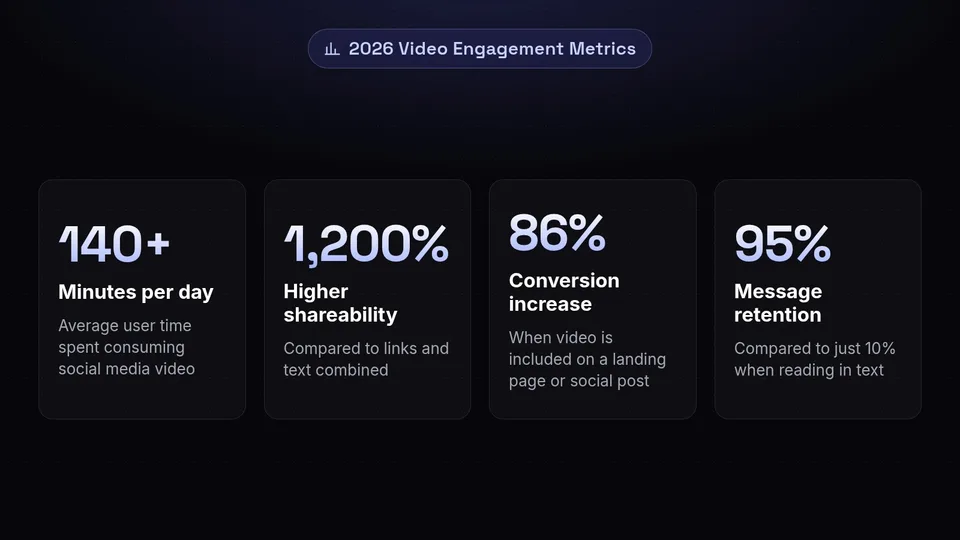
If you are still on the fence about pivoting your resources, the engagement data for video content marketing 2026 paints an undeniable picture. The metrics consistently show that video outperforms every other medium across key performance indicators (KPIs) such as reach, retention, shares, and conversions.
- Watch Time Over Dwell Time: In 2026, the average user spends over 140 minutes per day consuming social media video. Platforms are prioritizing "watch time" over traditional metrics like clicks or likes. If your content can hold a viewer's attention for more than 3 seconds, its reach potential increases exponentially.
- Higher Shareability: Video content is shared 1,200% more times than links and text combined. The viral loop of modern social media relies heavily on users sharing relatable or educational video snippets via direct messages (DMs), which has become the new "newsfeed."
- Conversion Rates: Including a video on a landing page or in a social commerce post increases conversion rates by up to 86%. Consumers are highly visual buyers; they want to see a product in action or hear a service explained dynamically before committing their dollars.
- Information Retention: Studies show that viewers retain 95% of a message when they watch it in a video, compared to just 10% when reading it in text. For brand recall, video is unequivocally the superior medium.
These statistics highlight a fundamental truth: maximizing your video marketing roi requires aligning your output with consumer consumption habits. If your audience is spending 80% of their digital lives watching videos, allocating 80% of your marketing budget to static ads is a recipe for irrelevance.
Algorithm Preferences Across Major Platforms
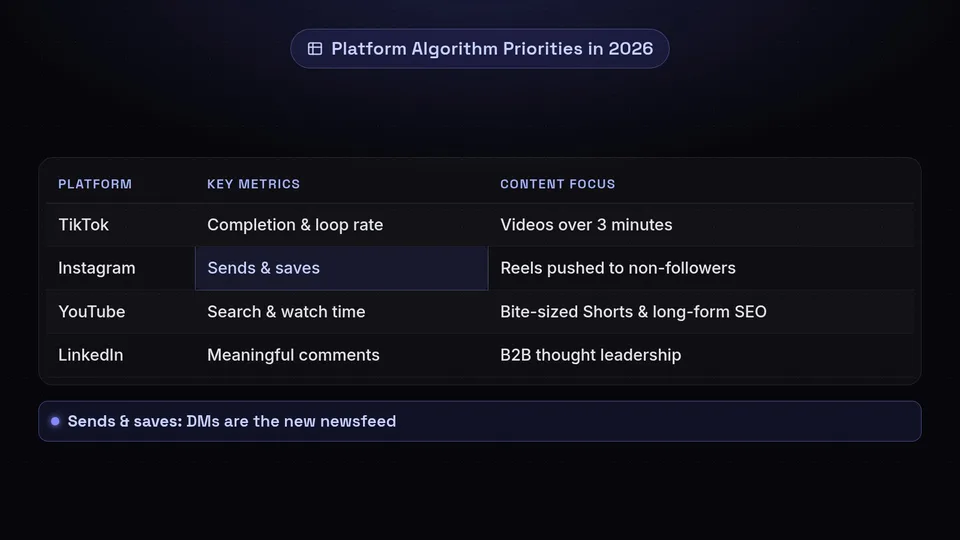
Every social media platform has its unique algorithm, but in 2026, they all share a common denominator: a ravenous appetite for video. Understanding how each platform treats video is crucial for tailoring your video first strategy.
TikTok: The Discovery Engine
TikTok remains the undisputed king of organic discovery. Its algorithm is heavily weighted toward "completion rate" and "loop rate." TikTok doesn't care about your follower count; it cares about whether your video can keep a user on the app. In 2026, TikTok has expanded its push for longer-form content (videos over 3 minutes), rewarding creators who can maintain high retention rates over extended periods with significantly boosted reach and monetization opportunities.
Instagram: The Hybrid Hub
Instagram has fully integrated Reels into every aspect of its interface. While photos still exist, the algorithm aggressively pushes Reels to non-followers via the Explore page and the main feed. Instagram's algorithm in 2026 highly values "sends" (shares via DM) and "saves." Creating highly educational or relatable short form video that users want to share with friends is the fastest way to grow on Instagram.
YouTube: The Search and Shorts Juggernaut
YouTube offers a dual-threat advantage. YouTube Shorts competes directly with TikTok, offering massive reach for vertical, bite-sized content. However, YouTube's traditional long-form horizontal videos remain the ultimate tool for deep relationship building and SEO. Because YouTube is owned by Google, a well-optimized long-form video will rank in search results for years, providing evergreen video marketing roi that ephemeral platforms cannot match.
LinkedIn: The B2B Video Revolution
Historically a text-heavy platform, LinkedIn's 2026 algorithm heavily favors native video. B2B brands utilizing video for thought leadership, behind-the-scenes company culture, and product demos are seeing 5x more engagement than standard text posts. The algorithm rewards videos that spark meaningful conversations in the comments, making it essential to end your videos with a strong, discussion-provoking question.
X (formerly Twitter): The Real-Time Video Feed
X has transformed into an "everything app" where native video plays a central role. The algorithm amplifies high-quality, native video uploads, especially those tied to trending topics or breaking industry news. For brands, posting quick, unpolished, real-time video updates on X is a powerful way to stay relevant in fast-moving conversations.
Short-Form Video vs Long-Form Video: Analyzing the ROI
A successful video first strategy does not force you to choose between short-form and long-form; rather, it requires you to understand the distinct ROI of each and how they work together in an ecosystem.
The Power of Short-Form Video
Short form video (typically under 60-90 seconds) is the ultimate top-of-funnel tool. Its primary purpose is discovery and awareness. Because these videos are quick to consume, users are willing to watch content from creators they don't know.
The ROI of short-form video is measured in reach, brand awareness, and follower acquisition. It is highly cost-effective to produce, especially when batch-recorded. However, the conversion rate directly from a short-form video can be lower because the viewer hasn't spent enough time with your brand to build deep trust. Short-form is the hook.
The Depth of Long-Form Video
Long-form video (podcasts, webinars, 10+ minute YouTube videos) is a middle and bottom-of-funnel asset. The reach will naturally be lower than short-form, but the depth of engagement is profound. If a user spends 20 minutes listening to your brand's podcast on YouTube, they are highly qualified and primed to convert.
The ROI of long-form video is measured in lead quality, customer lifetime value (CLV), and direct sales. Long-form content builds authority and trust. It is the destination.
The Synergy: The Hub and Spoke Model
To maximize video marketing roi in 2026, brands use the Hub and Spoke model. You create one high-quality piece of long-form "Hub" content (e.g., a 30-minute interview). You then use AI tools to chop that video into 15-20 "Spoke" pieces of short form video. The short clips are distributed across TikTok, Reels, and Shorts to grab attention and drive traffic back to the long-form Hub, where the actual conversion takes place.
The Role of AI Video Tools in Scaling Production
One of the primary historical barriers to a video first strategy was the cost and time associated with production. In 2026, AI video tools have completely democratized the production process, allowing small teams to produce Hollywood-level output.
1. Automated Editing and Clipping: AI platforms can now ingest a one-hour podcast, analyze the transcript for the most engaging moments (based on emotional spikes and keyword density), and automatically generate dozens of vertical short-form clips complete with dynamic captions, B-roll, and background music. This turns a week of editing into a 10-minute task.
2. AI Avatars and Voice Clones: For brands struggling to find on-camera talent, AI avatars have become indistinguishable from real humans. You can type a script, select a digital avatar, and generate a photorealistic video in minutes. Combined with voice cloning technology, brands can localize their video content into 50 different languages instantly, opening up global markets with zero additional production cost.
3. Script Generation and Ideation: Large Language Models (LLMs) are now deeply integrated into the creative process. By feeding an AI your brand guidelines, target audience, and current trends, it can generate a month's worth of highly engaging video hooks and scripts tailored specifically to the algorithms of TikTok or Instagram.
4. Generative B-Roll and Assets: Instead of paying for expensive stock footage, text-to-video AI models allow marketers to generate custom, hyper-specific B-roll footage in seconds. Need a cinematic shot of a futuristic city for your intro? Just type the prompt, and the AI generates it.
By leveraging these AI tools, brands can maintain the high volume of content required by modern algorithms without burning out their creative teams or depleting their marketing budgets.
A Practical Video Content Framework for Brands
Knowing the theory is one thing; executing it is another. Here is a step-by-step, practical framework for implementing your video content marketing 2026 strategy.
Step 1: Define Your Content Pillars
Identify 3 to 5 core topics that your brand has authority in. For example, a SaaS company might choose: 1) Industry Trends, 2) Software Tutorials, 3) Customer Success Stories, and 4) Company Culture. Every video you create must fall into one of these pillars to ensure brand consistency.
Step 2: The Ideation and Hook Phase
The first 3 seconds of a video dictate its success. Spend 80% of your ideation time crafting the "hook." A strong hook addresses the viewer's pain point immediately, uses pattern interrupts (sudden visual or audio changes), or asks a compelling question. Keep an ongoing swipe file of trending audio, formats, and hooks in your industry.
Step 3: Batch Production
Do not create videos one by one; it is highly inefficient. Schedule one or two production days per month. On these days, set up your lighting and camera, and record 20-30 videos back-to-back. Use a teleprompter app if necessary. This batching process ensures a consistent flow of content for the entire month.
Step 4: The AI-Assisted Post-Production Workflow
Run your raw footage through AI editing software. Add dynamic, animated captions (crucial since many users watch with sound off initially). Insert generative B-roll to keep the visual pacing fast—aim for a visual change every 2-3 seconds to retain attention.
Step 5: Omnichannel Distribution and Optimization
A video created for TikTok shouldn't just live on TikTok. Remove the watermark and distribute that same asset across Instagram Reels, YouTube Shorts, LinkedIn Video, and Facebook Reels. However, ensure you customize the copy, hashtags, and tagging for each specific platform's nuances.
Step 6: Analyze and Iterate
Review your analytics weekly. Look past vanity metrics like "views." Focus on Retention Rate (where are people dropping off?) and Hook Rate (what percentage of people watched past 3 seconds?). Use this data to refine your scripts and editing style for the next batch production day.
Overcoming Common Video Marketing Challenges
Even with a solid framework, transitioning to a video first strategy comes with hurdles. Acknowledging and preparing for these challenges is key to long-term success.
The Consistency Trap: Algorithms reward consistency above all else. Brands often start strong, posting daily, but burn out after three weeks. The solution is realistic pacing. It is better to post three high-quality videos a week consistently for a year than to post daily for a month and then disappear. Batching and scheduling are your best defenses against inconsistency.
Perfectionism vs. Authenticity: Many brands carry over their high-budget TV commercial mindset to social media video. This is a mistake. On platforms like TikTok, overly polished, highly produced videos are often swiped past because they look like traditional ads. Users crave raw, authentic, "lo-fi" content shot on a smartphone. Lowering your production value can ironically increase your engagement and lower your costs.
Measuring Direct ROI: Proving the video marketing roi of top-of-funnel short-form video can be tricky for B2B brands with long sales cycles. To overcome this, implement robust tracking. Use unique promo codes in your videos, utilize UTM parameters in your bio links, and always ask "How did you hear about us?" on your intake forms. Over time, you will see the undeniable correlation between video views and inbound leads.
Conclusion: Automate Your Video-First Strategy with SchedulifyX
As we look ahead through 2026 and beyond, the mandate for brands is clear: adapt to the video-centric digital landscape or risk fading into obscurity. A well-executed video first strategy empowers your brand to build deeper emotional connections, leverage algorithmic organic reach, and drive unparalleled business growth. By mastering the balance between short form video for discovery and long-form video for depth, and by utilizing cutting-edge AI tools, you can scale your operations efficiently.
However, producing great video is only half the battle; distributing it consistently across multiple platforms at the optimal times is where many brands stumble. This is where your strategy needs a powerful engine.
SchedulifyX is the ultimate AI-powered social media scheduling platform designed specifically for the modern, video-first brand. With SchedulifyX, you can seamlessly upload your bulk video content, automatically tailor the aspect ratios and captions for each specific platform, and schedule weeks of content across TikTok, Instagram, YouTube, and LinkedIn in just a few clicks. Furthermore, SchedulifyX's advanced AI analytics dive deep into your video performance, giving you actionable insights on hook rates and retention to continuously improve your video marketing roi.
Don't let the complexities of multi-platform distribution bottleneck your brand's potential. Embrace the future of video content marketing 2026, streamline your workflow, and let your content shine. Start automating your success today with SchedulifyX.