Watson NLU in SchedulifyX: Master Social Media Sentiment
SchedulifyX Team · July 10, 2026
Ensure every post resonates. Discover how SchedulifyX's Watson NLU integration brings sentiment analysis and emotion detection to your social media strategy.
In the fast-paced world of digital marketing, the line between a viral sensation and a PR disaster is often razor-thin. A single misplaced word, a tone-deaf joke, or an overly aggressive promotional push can alienate your audience in seconds. For social media managers, the pressure to consistently deliver engaging, brand-aligned, and emotionally intelligent content is immense. That is exactly why we are thrilled to announce our most groundbreaking feature update yet: the integration of IBM Watson NLU into SchedulifyX.
This powerful new integration brings enterprise-grade sentiment analysis social media capabilities directly into your publishing workflow. By leveraging advanced text analytics, emotion detection, keyword extraction, and comprehensive content quality scoring, SchedulifyX now acts as your AI-powered co-pilot, ensuring that every single post you schedule resonates perfectly with your target audience before it ever goes live.
In this comprehensive guide, we will explore exactly how this integration works, why it is a game-changer for your brand's digital presence, and how you can start utilizing these cutting-edge tools today.
The High Stakes of Social Media Communication
Before we dive into the technical marvels of our new integration, it is crucial to understand the landscape we are navigating. Social media is no longer just a broadcasting channel; it is a dynamic, two-way conversation between brands and consumers. In this environment, empathy and emotional intelligence are not just nice-to-haves; they are critical business imperatives.
Consider the modern consumer. They are bombarded with thousands of marketing messages every single day. To cut through the noise, brands often resort to edgy humor, bold claims, or rapid-fire trendjacking. While these strategies can yield high engagement, they also carry significant risk. A post intended to be humorous might be interpreted as insensitive. A message meant to convey urgency might come across as aggressive and spammy.
The consequences of these missteps are measurable and severe. Studies show that a significant percentage of consumers will unfollow a brand on social media if they feel the content is irrelevant, inauthentic, or emotionally tone-deaf. Furthermore, rebuilding brand trust after a social media faux pas requires immense time, effort, and resources.
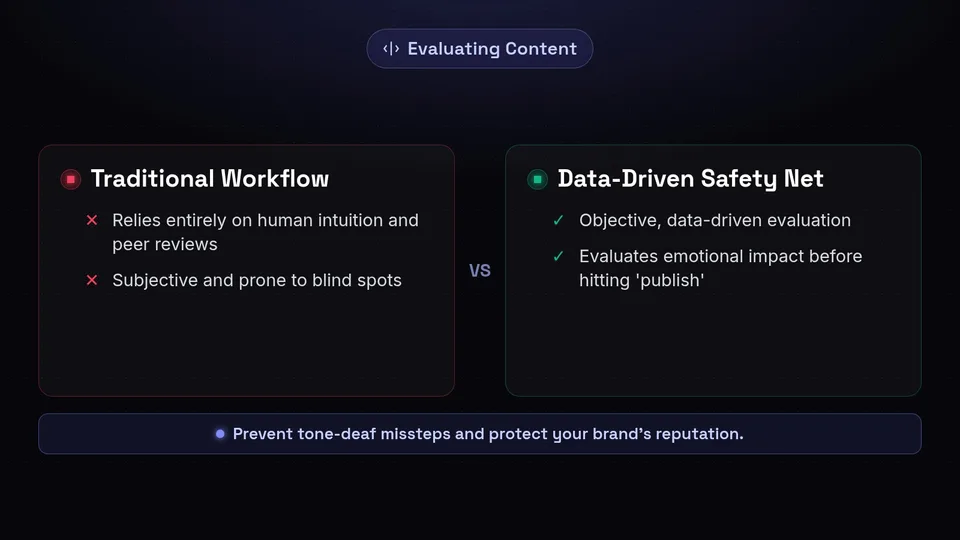
This is where the traditional social media publishing workflow falls short. Until now, social media managers have had to rely entirely on their own intuition and peer reviews to gauge how a post might be received. While human intuition is invaluable, it is also subjective and prone to blind spots. We realized that our users needed a safety net—an objective, data-driven tool to evaluate the emotional impact of their content before hitting 'publish.' This realization led us directly to IBM Watson.
What is Watson NLU and Text Analytics?

To provide our users with the best possible tools, we knew we had to partner with the best in the artificial intelligence industry. IBM Watson Natural Language Understanding (NLU) represents the pinnacle of modern text analytics. But what exactly does that mean for you?
At its core, Watson NLU is an advanced artificial intelligence system designed to analyze text and extract metadata from content such as concepts, entities, keywords, categories, sentiment, and emotion. Unlike basic keyword-matching algorithms, Watson NLU utilizes deep learning models to understand the context, nuance, and semantic structure of human language.
The Power of Natural Language Processing
Natural Language Processing (NLP) is a branch of artificial intelligence that helps computers understand, interpret, and manipulate human language. Watson NLU excels in this area by breaking down sentences, understanding the relationship between words, and identifying the underlying meaning. When applied to social media content, this means the AI can distinguish between a user saying "This new feature is sick!" (positive sentiment in a modern context) and "This food made me sick" (negative sentiment).
By integrating Watson NLU into SchedulifyX, we are bringing this enterprise-level text analytics capability directly to your dashboard. You don't need a degree in data science or a massive IT budget to access the world's most sophisticated language models. We have seamlessly woven this technology into the very fabric of our post composer, providing you with real-time, actionable insights as you type.
Introducing Pre-Publish Sentiment Analysis Social Media

The crown jewel of this integration is our new pre-publish sentiment analysis social media feature. Sentiment analysis is the automated process of determining whether a piece of text expresses a positive, negative, or neutral attitude. While many platforms offer sentiment analysis for social listening (analyzing what others are saying about your brand), SchedulifyX is pioneering pre-publish sentiment analysis (analyzing what you are about to say to your audience).
How It Works in Practice
Imagine you are drafting a response to a customer complaint on Twitter. You want to be firm but polite. As you type your response into the SchedulifyX composer, Watson NLU analyzes your text in real-time. A subtle indicator on your screen shifts from green (positive) to yellow (neutral) to red (negative). If your response is skewing too negative, the system flags it, allowing you to soften your language before you hit send.
This feature is equally powerful for proactive marketing campaigns. If you are launching a new product, you want your announcement to radiate positivity, excitement, and innovation. The sentiment analysis tool will score your draft on a scale from -1.0 (highly negative) to +1.0 (highly positive). By aiming for a high positive score, you can ensure your copy is inherently uplifting and engaging.
Preventing Brand Crises
One of the most significant benefits of pre-publish sentiment analysis is crisis prevention. During times of global unrest, economic downturns, or industry scandals, the general mood of the public can shift dramatically. Content that might have been perfectly acceptable a week ago could suddenly seem insensitive. By consistently monitoring the sentiment of your outgoing posts, you create a vital checkpoint that prevents accidental tone-deafness, protecting your brand's reputation when it matters most.
Mastering Empathy with Emotion Detection
While sentiment analysis tells you if a post is generally positive or negative, emotion detection takes your understanding a massive step further. Human communication is complex, and "positive" or "negative" doesn't always capture the full picture. Watson NLU's emotion detection capabilities allow SchedulifyX to analyze your text for five distinct emotional tones: Joy, Anger, Sadness, Fear, and Disgust.
The Five Dimensions of Emotion
- Joy: Indicates happiness, satisfaction, and excitement. High joy scores are ideal for product launches, milestone celebrations, and community spotlights.
- Anger: Indicates frustration or hostility. While usually avoided, a controlled amount of anger might be appropriate for a brand taking a strong stance on a social justice issue or advocating against an industry injustice.
- Sadness: Indicates sorrow or grief. Useful when posting empathetic messages during a tragedy or apologizing for a major service outage.
- Fear: Indicates anxiety or concern. This can be a powerful tool in awareness campaigns (e.g., cybersecurity threats), but must be used sparingly to avoid alienating your audience.
- Disgust: Indicates revulsion. Rarely used in standard marketing, but can appear in campaigns addressing public health issues or environmental pollution.
Fine-Tuning Your Brand Voice
By providing a breakdown of these five emotions, SchedulifyX empowers you to fine-tune your brand voice with unprecedented precision. Let's say you are writing a post to create urgency for a limited-time sale. You want to generate excitement (Joy), but if your language is too aggressive ("Don't miss out or you'll regret it!"), the emotion detection tool might flag a high level of Fear or Anger. You can then adjust your copy to focus on the positive benefits ("Grab yours today and experience the magic!"), increasing Joy and reducing negative emotions.
This level of emotional intelligence ensures that your content not only captures attention but also fosters the exact emotional connection you want to build with your audience. It transforms social media management from a guessing game into a precise, empathetic science.
Maximizing Reach with Keyword Extraction
Creating emotionally resonant content is only half the battle; ensuring that content reaches the right audience is equally important. This is where the keyword extraction capabilities of our Watson NLU integration come into play. As you draft your posts, the AI automatically identifies and extracts the most significant keywords, entities, and concepts from your text.
Automated Hashtag Generation
One of the most immediate benefits of keyword extraction is intelligent hashtag generation. Instead of manually brainstorming hashtags or relying on generic, overused tags, SchedulifyX analyzes the core themes of your post and suggests highly relevant keywords. If you are writing about sustainable packaging in the coffee industry, the system will instantly extract terms like "Sustainability," "Eco-Friendly Packaging," and "Coffee Supply Chain." You can then seamlessly convert these extracted keywords into targeted hashtags with a single click.
SEO for Social Media
Social media platforms are increasingly functioning as search engines. Users search Instagram, TikTok, and LinkedIn for specific topics, not just specific accounts. By utilizing Watson NLU's keyword extraction, you can ensure your posts are optimized for in-app search. The AI helps you identify the most salient terms in your copy, allowing you to emphasize them and improve your content's discoverability. This application of text analytics bridges the gap between traditional SEO and social media strategy, driving organic reach and engagement.
Elevating Standards with Content Quality Scoring
With sentiment analysis, emotion detection, and keyword extraction running simultaneously, you are presented with a wealth of data. To make this data instantly actionable, SchedulifyX introduces the proprietary content quality scoring system. This system aggregates the insights from Watson NLU and combines them with social media best practices (such as character limits, hashtag counts, and readability) to generate a single, comprehensive score out of 100.
The Anatomy of the Quality Score
Your Content Quality Score is broken down into several key metrics:
- Emotional Alignment: Does the detected emotion match your intended goal? (e.g., High Joy for a promotional post).
- Sentiment Balance: Is the post overly negative without a strategic reason?
- Clarity and Readability: Is the language accessible to your target demographic?
- Keyword Optimization: Are the core concepts clearly identifiable by the AI?
- Platform Optimization: Does the post adhere to the specific best practices of the target platform (e.g., Twitter vs. LinkedIn)?
A Built-In Approval Workflow
For agencies and large marketing teams, the Content Quality Score revolutionizes the approval workflow. Managers can set minimum score thresholds for different types of content. For example, a junior social media manager might need a score of 85 or higher before a post can be automatically scheduled. If the score falls below the threshold, the post is flagged for manual review. This ensures a consistent standard of excellence across all channels, regardless of who is writing the copy, drastically reducing bottlenecks and improving team efficiency.
Real-World Scenarios for Your Brand
To truly grasp the transformative power of this integration, let's explore how different businesses can apply these features in real-world scenarios.
Scenario 1: Crisis Management and PR
Imagine a software company experiences a massive server outage, leaving thousands of users unable to access their data. The social media manager needs to draft an update. In a rush, they write: "Servers are down. We are fixing it. Stop submitting support tickets."
When inputted into SchedulifyX, Watson NLU immediately flags this text. The sentiment analysis scores it as highly negative. The emotion detection highlights high levels of Anger and zero Joy or Sadness (empathy). The Content Quality Score plummets.
Prompted by these insights, the manager rewrites the post: "We sincerely apologize for the current server outage. We understand how frustrating this is for your workflow. Our engineering team is working around the clock to restore access, and we will provide updates every 30 minutes. Thank you for your patience."
The AI now scores the sentiment as neutral/positive (focusing on solutions), detects Sadness (empathy/apology), and gives a high Content Quality Score. The crisis is managed with grace and professionalism.
Scenario 2: Launching a New Product
A fashion brand is launching a vibrant new summer collection. The copywriter drafts a caption: "The new clothes are here. Buy them now before they sell out."
The AI analyzes the text. The sentiment is neutral. The emotion detection shows zero Joy. The keyword extraction only pulls "clothes." The score is mediocre.
The copywriter revises: "Get ready to soak up the sun! ☀️ Our vibrant new Summer Collection has officially dropped. Experience lightweight fabrics, bold colors, and effortless style. Elevate your summer wardrobe today!"
Watson NLU detects high Joy, highly positive sentiment, and extracts keywords like "Summer Collection," "lightweight fabrics," and "effortless style." The Content Quality Score hits 98/100. The post is primed for maximum engagement.
Scenario 3: Routine Customer Engagement
A B2B consulting firm wants to share a thought leadership article on LinkedIn. They draft a highly technical, dry summary. Watson NLU's text analytics reveals that the text is entirely devoid of emotion and the sentiment is completely flat. Recognizing that even B2B audiences respond to emotional resonance, the marketer injects a hook about the "frustrations of outdated workflows" (touching slightly on Anger/Fear) and the "relief of optimized systems" (Joy), creating a compelling narrative arc that drives higher click-through rates.
The Technical Magic Behind the Integration
For the tech-savvy users wondering how we pulled this off, the integration between SchedulifyX and IBM Watson NLU is built on a robust, low-latency API architecture. When you type in the SchedulifyX composer, the text is securely transmitted to IBM's cloud infrastructure via encrypted API calls.
Watson NLU processes the text using its pre-trained deep learning models, which have been trained on vast datasets of human language to understand nuance, slang, and context. The analysis results—sentiment scores, emotion probabilities, and extracted entities—are returned to SchedulifyX in milliseconds.
Our proprietary algorithms then take these raw data points and translate them into the visual indicators and the Content Quality Score you see on your screen. This seamless integration ensures that you experience zero lag in your workflow. The AI operates silently in the background, offering insights only when you need them, without ever slowing down your creative process. Furthermore, we maintain strict data privacy standards; your draft content is analyzed for scoring purposes but is never used to train external public AI models without your consent.
Step-by-Step Guide to Activating the Feature
Ready to master your social media sentiment? Activating and using the Watson NLU features in SchedulifyX is incredibly straightforward. Here is how you can get started today:
- Log In to SchedulifyX: Access your dashboard and navigate to the 'Composer' tab to start drafting a new post.
- Enable AI Insights: On the right-hand side of the composer, toggle the switch labeled 'Watson NLU Insights.' (Note: This feature is available on all Pro and Enterprise plans).
- Draft Your Content: Begin typing your post. As you write, you will notice the AI Insights panel updating in real-time.
- Review the Sentiment Gauge: Check the color-coded sentiment bar. Ensure it aligns with your brand's intended tone (Green for positive, Yellow for neutral, Red for negative).
- Analyze Emotions: Click the 'Emotions' dropdown to see the radar chart of Joy, Anger, Sadness, Fear, and Disgust. Adjust your adjectives and phrasing to shift the emotional balance.
- Optimize Keywords: Review the 'Extracted Keywords' section. Click the '+' icon next to any relevant keyword to instantly add it to your post as a hashtag.
- Check Your Quality Score: Look at the top right corner for your overall Content Quality Score. Click on the score to see a detailed breakdown of areas for improvement.
- Schedule with Confidence: Once your score is in the green and you are happy with the emotional resonance of your post, hit 'Schedule' or 'Publish.'
The Future of AI in Social Media Management
The integration of Watson NLU for pre-publish sentiment analysis social media is just the beginning of SchedulifyX's AI journey. We believe that artificial intelligence will not replace social media managers; rather, it will empower them to be more strategic, empathetic, and effective.
Looking ahead, our product roadmap includes expanding these text analytics capabilities even further. We are exploring features like predictive engagement scoring (estimating how many likes/comments a post will get based on its emotional profile), tone translation (automatically rewriting a post from 'casual' to 'professional' with one click), and multi-lingual sentiment analysis to support global brands.
By continually harnessing the power of advanced AI, SchedulifyX is committed to providing you with the ultimate toolkit for digital communication. We are moving beyond mere scheduling and entering the era of intelligent content optimization.
Conclusion: Elevate Your Social Media Today
In a digital ecosystem where every word counts, leaving your brand's tone to chance is a risk you can no longer afford to take. By combining the intuitive scheduling power of SchedulifyX with the unparalleled text analytics of IBM Watson NLU, you now have the ability to guarantee that every post is emotionally resonant, perfectly targeted, and optimized for success.
Whether you are managing a global enterprise brand or a growing local business, features like sentiment analysis social media, emotion detection, keyword extraction, and content quality scoring will fundamentally transform how you communicate online. You will save time, prevent costly PR mistakes, and build deeper, more authentic connections with your audience.
Don't just schedule your posts—optimize their impact. Log in to your SchedulifyX account today to experience the Watson NLU integration for yourself, or upgrade to a Pro plan to unlock the full suite of AI-powered insights. Let's make every post resonate.