AI Agents Transforming Social Media Marketing in 2026
SchedulifyX Team · July 6, 2026
Discover how autonomous AI agents are revolutionizing social media marketing in 2026, from real-time trend detection to hyper-personalized content creation.
The landscape of digital marketing has undergone a seismic shift. As we navigate through 2026, the days of manual posting, reactive community management, and static content calendars are firmly behind us. We have entered the era of autonomous social media, driven by sophisticated AI agents that do much more than simply follow a schedule. These intelligent systems are now the driving force behind the most successful online brands, fundamentally changing how businesses interact with their audiences.
Understanding how ai agents social media integrations work is no longer an optional advantage; it is a critical necessity for survival. From autonomous content creation to real-time trend detection, performance optimization, and conversational commerce, AI agents are redefining the boundaries of digital engagement. In this comprehensive guide, we will explore the profound impact of these technologies and how your brand can leverage them to dominate the digital space.
The Evolution of Social Media Automation Trends
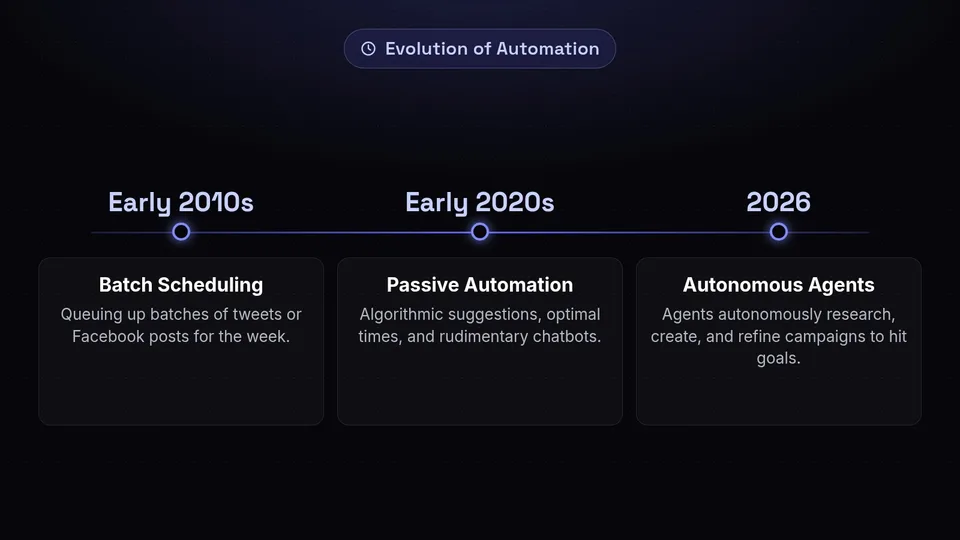
To truly appreciate the power of AI marketing 2026, we must first look back at the trajectory of social media automation trends over the past decade. The evolution has been rapid, moving from simple convenience tools to complex, cognitive systems capable of strategic decision-making.
From Schedulers to Autonomous Agents
In the early 2010s, automation meant queuing up a batch of tweets or Facebook posts for the week. By the early 2020s, automation had evolved to include basic algorithmic suggestions, optimal posting times, and rudimentary chatbots. However, these systems were still inherently passive. They required a human operator to feed them content, set the parameters, and analyze the resulting data.
Today, in 2026, the paradigm has shifted from passive scheduling to active agency. We are no longer just automating tasks; we are delegating objectives. An AI agent is given a goal—such as "increase engagement among Gen Z users by 15% this quarter"—and the agent autonomously researches, creates, schedules, tests, and refines the campaign to achieve that specific outcome.
Why 2026 is the Tipping Point
Several converging technological advancements have made 2026 the tipping point for autonomous social media:
- Advanced Multi-Modal LLMs: The latest generation of Large Language Models can seamlessly process and generate text, images, audio, and high-definition video simultaneously.
- Decreased Latency: Edge computing and advanced neural processing units (NPUs) have reduced AI inference times to milliseconds, enabling true real-time interactions.
- Contextual Memory: Modern AI agents possess long-term memory architectures, allowing them to remember past interactions with specific users and build ongoing, personalized relationships.
Autonomous Social Media: The Role of AI Agents
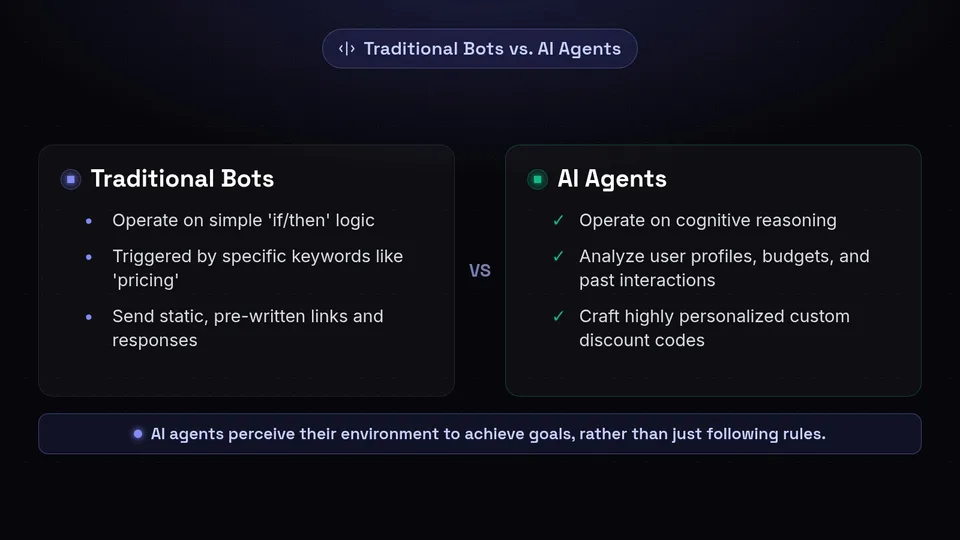
The term "AI agent" is frequently used, but what does it actually mean in the context of social media marketing? Understanding the distinction between a standard AI tool and an autonomous agent is crucial for grasping the future of the industry.
What Exactly is an AI Agent?
Unlike a standard generative AI model that simply responds to a prompt, an AI agent is a system that can perceive its environment, make decisions, and take actions to achieve a specific goal. In the realm of ai agents social media, the "environment" comprises social platforms, trending topics, user comments, and competitor activities.
"An AI agent doesn't just write a post; it identifies the need for a post, determines the optimal format, generates the creative assets, publishes it at the perfect millisecond, and engages with the resulting comments—all without human intervention."
How AI Agents Differ from Traditional Bots
Traditional social media bots were rule-based. They operated on simple "if/then" logic (e.g., IF someone messages "pricing," THEN send the pricing link). AI agents, however, operate on cognitive reasoning. If a user asks about pricing, the AI agent can analyze the user's profile, determine their likely budget, assess their previous interactions with the brand, and craft a highly personalized response that might include a custom discount code or a tailored product recommendation.
AI Content Creation: Beyond Basic Generation

One of the most visible transformations in AI marketing 2026 is the evolution of ai content creation. We have moved far beyond generating generic blog posts or stock-like images. Today's AI agents are virtual creative directors, capable of producing hyper-personalized, multi-modal content at an unprecedented scale.
Hyper-Personalized Content at Scale
Mass broadcasting is dead. The algorithm rewards relevance above all else. AI agents excel at micro-segmentation, creating hundreds of variations of a single campaign tailored to distinct audience niches. For example, a global footwear brand launching a new sneaker doesn't just post one promotional video. Their AI agent generates 50 different videos: one highlighting the shoe's durability for outdoor enthusiasts, another focusing on its streetwear aesthetic for fashion influencers, and another emphasizing its ergonomic support for athletes. The agent then autonomously distributes these variations to the feeds of the corresponding demographics.
Multi-Modal Generation (Text, Video, Image)
The barrier between text, image, and video generation has dissolved. AI agents can now ingest a text-based brief and output a fully edited, 60-second vertical video, complete with AI-generated voiceovers, dynamic captions, and trending background music. Furthermore, these agents can adapt the content format natively for each platform—turning a long-form YouTube essay into a snappy TikTok dance trend or an insightful LinkedIn carousel, entirely autonomously.
Real-Time Trend Detection and Agility
In the fast-paced world of social media, being early to a trend is the difference between viral success and irrelevance. Human marketers simply cannot monitor the sheer volume of data required to spot micro-trends before they peak. This is where AI agents shine.
Riding the Algorithmic Waves
AI agents continuously monitor global data streams, analyzing audio snippets, visual motifs, hashtags, and sentiment shifts across billions of posts. When an agent detects an emerging trend relevant to its brand's niche, it can instantly generate and publish participatory content. This level of agility ensures that a brand is always part of the cultural conversation, capitalizing on algorithmic momentum before human competitors have even noticed the trend.
Predictive Analytics in AI Marketing 2026
Beyond reacting to current trends, advanced AI agents utilize predictive analytics to forecast future movements. By analyzing historical data, seasonal shifts, and cross-platform cultural signals, AI agents can predict what topics will resonate with a target audience weeks in advance. This allows brands to establish thought leadership and set trends, rather than merely following them.
Performance Optimization on Autopilot
The traditional approach to social media analytics involved weekly or monthly reports, followed by manual adjustments to future campaigns. In 2026, performance optimization is a continuous, autonomous process.
Dynamic Scheduling and A/B Testing
Forget static posting schedules. Autonomous social media agents utilize dynamic scheduling, analyzing the real-time online status and behavioral patterns of individual followers to determine the absolute optimal moment to deploy content. Furthermore, agents conduct continuous, invisible A/B testing. They might release two slightly different thumbnails to a small fraction of the audience, instantly analyze the click-through rates, and automatically route the winning variant to the broader audience.
Self-Correcting Campaigns
Perhaps the most powerful feature of AI agents is their ability to self-correct. If a campaign is underperforming against its KPIs, the agent doesn't wait for a human to intervene. It autonomously diagnoses the issue—perhaps the call-to-action is too weak, or the background music is negatively impacting retention—and generates a revised version of the content on the fly. This closed-loop optimization ensures maximum ROI for every piece of content published.
The Rise of Conversational Commerce
Social media is no longer just a top-of-funnel brand awareness tool; it is a primary sales channel. AI agents have transformed Direct Messages (DMs) and comment sections into highly effective storefronts.
Seamless In-App Transactions
Consumers in 2026 expect frictionless experiences. They do not want to click a link in a bio, navigate an external website, and fill out a checkout form. AI agents facilitate seamless in-app transactions through conversational commerce. A user can comment on a post saying, "I love that jacket," and the brand's AI agent will instantly DM them, confirm their size based on past purchases, offer a personalized styling tip, and process the payment directly within the chat interface.
AI Agents as Brand Ambassadors
These agents are not robotic order-takers; they are sophisticated brand ambassadors. They are programmed with the brand's exact tone of voice, values, and humor. They can handle complex customer service inquiries, de-escalate complaints with empathy, and build genuine rapport with followers. By providing instant, 24/7, highly personalized interactions, AI agents dramatically increase customer loyalty and lifetime value.
Ethical Considerations and Human Oversight
While the capabilities of AI agents are awe-inspiring, the shift toward autonomous social media is not without its challenges. As we hand over the keys to our brand's public persona, ethical considerations and strategic human oversight become paramount.
Maintaining Brand Authenticity
The greatest risk of AI automation is the loss of authentic human connection. If an audience feels they are exclusively interacting with machines, trust will erode. Successful brands in 2026 use AI agents to handle the heavy lifting of data analysis, content generation, and routine inquiries, freeing up human marketers to focus on high-level strategy, community building, and genuine, unscripted interactions.
Data Privacy and Compliance
AI agents require vast amounts of data to function effectively. Brands must navigate strict data privacy regulations, ensuring that their AI agents are compliant with global standards. Transparency is key; users must be aware of how their data is being used to personalize their experience, and brands must implement robust guardrails to prevent AI hallucinations or the accidental sharing of sensitive information.
Preparing Your Brand for the AI Agent Era
The transition to AI-driven marketing is inevitable. Brands that fail to adapt will quickly find themselves outpaced by faster, more agile, and more personalized competitors. Here is how you can prepare your brand for the AI agent era.
Steps to Integrate AI Agents
- Audit Your Current Tech Stack: Evaluate your existing social media tools. Are they passive schedulers, or do they offer cognitive, agentic capabilities?
- Define Your Brand Guardrails: Before deploying an AI agent, you must strictly define your brand's voice, values, and boundaries. What topics should the agent avoid? What is the escalation protocol for sensitive issues?
- Start with Hybrid Automation: Do not switch to full autonomy overnight. Implement AI agents in a "copilot" mode, where they suggest actions and generate content for human approval, before gradually increasing their autonomy.
- Focus on Clean Data: AI agents are only as good as the data they are trained on. Ensure your customer relationship management (CRM) and analytics platforms are feeding accurate, high-quality data to your AI systems.
Upskilling Your Marketing Team
The role of the social media manager is evolving from a "creator and poster" to an "AI orchestrator and strategist." Marketing teams must upskill in prompt engineering, AI system management, and data interpretation. The human element will shift toward setting the overarching vision, defining the emotional core of the brand, and managing the AI agents that execute the tactics.
Conclusion: Embrace the Future with SchedulifyX
The transformation brought about by ai agents social media integration is the most significant leap forward in digital marketing since the invention of the smartphone. As we look at the landscape of AI marketing 2026, it is clear that autonomous social media is not a futuristic concept; it is the current reality. From revolutionizing ai content creation to setting new social media automation trends, AI agents are empowering brands to connect with their audiences on a deeper, more personalized level than ever before.
To thrive in this new era, you need a platform built from the ground up for the age of autonomy. SchedulifyX is your ultimate partner in this journey. As an industry-leading AI-powered social media scheduling platform, SchedulifyX goes beyond basic automation. Our proprietary AI agents seamlessly integrate into your workflow, offering real-time trend analysis, dynamic performance optimization, and hyper-personalized content generation. Don't let your brand fall behind in the algorithmic race. Embrace the future of marketing, elevate your strategy, and let SchedulifyX transform your social media presence today.