Best Tools for Scheduling Social Media Posts (2026)
SchedulifyX Team · August 22, 2026
Discover the best tools for scheduling social media posts in 2026. Compare pricing models, platform features, and honest weaknesses of top management tools.
Finding the absolute best tools for scheduling social media posts has never been more complicated. If you search for reviews of social media management tools today, you are usually met with affiliate-driven listicles or vendor blogs that miraculously rank their own product as the flawless, undisputed champion. We are taking a different approach.
As the team behind SchedulifyX, we obviously have a horse in this race. However, we also know that modern marketing teams, agency owners, and creators are savvy. You are comparing tools because you want the truth about what fits your specific workflow, not a sanitized sales pitch. Every platform has distinct strengths, and every platform—including ours—has honest weaknesses.
In this comprehensive, genuinely comparative roundup, we are breaking down the top contenders in the market as of August 22, 2026. We will explore how different pricing models quietly punish certain types of users, analyze recent platform updates, and look at approval workflows, API integrations, and free tiers. Our goal is to help you find the best social media scheduler for your exact needs, even if that tool isn't ours.
The State of Social Media Management Tools in 2026

The landscape of social media has shifted dramatically over the past few years, and the software that supports it has had to adapt rapidly. We are no longer just scheduling text to Facebook and Twitter; we are orchestrating complex, multi-format campaigns across highly fragmented networks.
One of the most significant shifts we have seen recently involves API access and ecosystem control. For example, as of August 14, 2026, LinkedIn has paused onboarding for new SNAP partners for Sales Navigator API access, effectively closing the "apply and wait" option for developers. This kind of platform-level restriction forces social media management tools to constantly pivot, meaning the reliability and feature sets of your chosen scheduler can change overnight.
Simultaneously, the rise of decentralized and alternative networks has fractured audiences. Brands are now looking to manage social media tools that can handle not just the legacy giants, but emerging spaces. SchedulifyX's own platform expansion in April 2026 confirmed support for 10 platforms, notably including Threads, Bluesky, and Mastodon, reflecting a growing demand for broader platform coverage beyond the traditional walled gardens.
With these technical shifts in mind, the most critical factor in choosing a tool often comes down to how a vendor chooses to charge you for their software.
Understanding Pricing Models: Who Gets Punished?
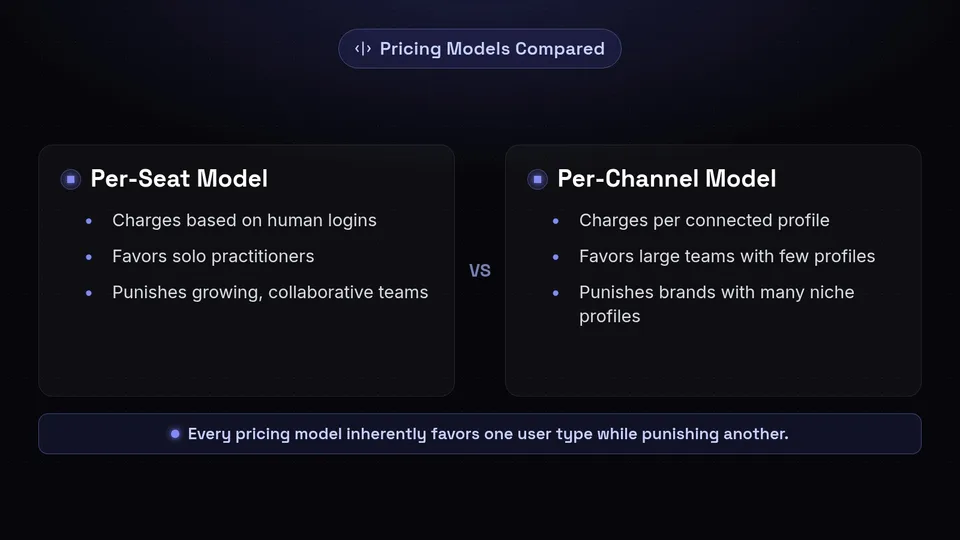
When evaluating the best tools for scheduling social media posts, the actual dollar amount on the pricing page is only half the story. The more important question is: What is the pricing model, and how does it scale as my business grows? Every pricing model inherently favors one type of user while actively punishing another.
The Per-Seat Model (Hootsuite, Sprout Social)
The per-seat model charges you based on the number of human beings logging into the software. As of August 11, 2026, Hootsuite verified a four-tier model: Standard ($99/user/mo), Professional (
- Who it favors: Solo practitioners or small, highly centralized marketing teams where only one or two people need access to the dashboard.
- Who it punishes: Growing teams, collaborative environments, and agencies. In this model, every new hire, freelance copywriter, or client who needs approval access adds a full seat price. If you want to add a junior social media manager to Hootsuite's Professional tier, it costs an additional 99/month. This makes it the most expensive unit for collaborative environments, and Sprout Social's per-seat scaling is frequently noted as prohibitive for large agencies.
The Per-Channel Model (Buffer)
Instead of charging by the human, the per-channel model charges based on the number of social media profiles you connect.
- Who it favors: Large teams managing a very small, focused number of social media profiles.
- Who it punishes: Brands with many profiles but small teams, as well as creators managing multiple niche accounts. For instance, as of August 22, 2026, connecting 10 channels on Buffer's Team plan costs 00/month, even if those channels are managed by a single person. The cost scales poorly if you are trying to maintain a presence across Twitter, LinkedIn, Facebook, Instagram, TikTok, Pinterest, Threads, and Bluesky for multiple sub-brands.
The Per-Social Set or Brand Model (Later, Metricool)
This model bundles one of each platform (e.g., one Instagram, one Facebook, one Twitter) into a "set" or "brand" and charges per bundle.
- Who it favors: In-house brand managers who only oversee one single company's digital presence.
- Who it punishes: Multi-brand freelancers and small marketing agencies. Later charges approximately $25/month per "social set," while Metricool starts at $25/month per brand (as of August 2026). If a freelancer takes on five small local business clients, their software costs multiply rapidly, even if the total posting volume remains relatively low.
The Tiered/Fair-Use Model (SchedulifyX)
This model offers a flat rate for a bundled allowance of users, profiles, and features, often metered by usage credits.
- Who it favors: Small to medium teams and agencies who need predictable baseline costs for collaboration. For example, as of August 2026, SchedulifyX offers a flat $29/month Professional tier that includes 3 team members and 15 profiles.
- Who it punishes: High-volume AI users and massive enterprises. SchedulifyX uses AI credit metering (500 text / 300 video credits on the Pro tier). This complicates monthly budgeting for teams that rely heavily on generative AI for every single post, as they may hit credit caps before the month is over. Furthermore, hard account caps exist (like the 15-profile limit on Professional), forcing upgrades for high-volume agencies.
Deep Dive: Comparing the Top Social Media Schedulers

Choosing between legacy giants and premium enterprise tools requires balancing features against scalable costs. Let's look at the specific features, recent updates, and ideal use cases for the top platforms in the industry.
Sprout Social: Best for Enterprise Analytics & Advanced Reporting
Sprout Social has long positioned itself as the premium, enterprise-grade solution among social media management tools, and their recent updates solidify this stance. They are undeniably stronger than SchedulifyX when it comes to deep, enterprise-level analytics and cross-channel ad reporting.
In June 2026, Sprout rolled out several significant feature updates. On June 11, they integrated ad performance metrics specifically for TikTok, bridging the gap between organic scheduling and paid reporting. Shortly after, on June 23, they added native support for Snapchat scheduling, catering to brands targeting Gen Z demographics. Additionally, on June 25, they enhanced "SproutLink," adding support for up to 50 custom buttons and clickable social icons on link-in-bio pages, a massive boon for e-commerce brands.
The Catch: While Sprout includes robust analytics, the per-seat pricing model makes it incredibly expensive to scale. Furthermore, the interface is often described by users as less "slick" and modern than newer, lightweight competitors like Metricool. Functionally, as of August 2026, it still does not support scheduling for private Facebook groups.
Hootsuite: Best for Traditional Corporate Teams
Hootsuite is the legacy giant of the industry. If you are working in a traditional corporate environment, Hootsuite is often the default choice due to its long-standing reputation and massive integration directory.
As verified on August 11, 2026, the platform has settled firmly into its four-tier model, with the Professional tier (
99/user/mo) acting as the most common entry point for growing teams. However, Hootsuite heavily gates its collaborative features. If you need custom reports or approval workflows—essential features for agencies—you are limited to the "Team" tiers and above, which drastically increases the financial commitment.The Catch: Hootsuite operates on a strict "pay or leave" philosophy; there is absolutely no free tier available. Furthermore, despite its premium price tag, it lacks native support for certain platform-specific features that modern creators rely on. For example, as of August 2026, you cannot post a photo and a video together in a single Facebook post, nor can you utilize native TikTok audios through their scheduler.
Buffer: Best for Solo Creators and AI Developers
Buffer has always been celebrated for its clean, straightforward interface, but their recent moves show a strong pivot toward developers and technical marketers. In this specific arena, Buffer is significantly stronger than SchedulifyX.
On August 10, 2026, Buffer launched a full developer API complete with a hosted Model Context Protocol (MCP) server. This is a game-changer for technical teams building custom AI workflows. Instead of just manual posting limits, Buffer's plan tiers now determine request ceilings for AI agents like Claude or n8n. This allows developers to build headless, automated content pipelines directly into Buffer's infrastructure.
Buffer also maintains a highly accessible Free Tier, offering 3 social profiles and 10 scheduled posts per channel, making it a great starting point for beginners.
The Catch: The API rate limits on Buffer's Essentials plan can severely throttle these new AI-driven workflows, forcing developers to upgrade to higher tiers. Additionally, as mentioned in the pricing breakdown, the per-channel cost scales very poorly for creators managing multiple niche accounts.
Later & Metricool: Best for Visual Planners and Brand Managers
Later and Metricool represent the more visually focused side of social media management tools.
Later remains heavily focused on visual planning, making it the go-to choice for Instagram and Pinterest-heavy strategies. Its drag-and-drop grid planner is industry-leading. However, its workflow is frequently cited as less efficient for high-volume, text-based platforms like X (formerly Twitter) or LinkedIn.
Metricool, on the other hand, offers an interface that many users describe as noticeably slicker than heavier tools like Sprout Social. Starting at roughly $25/month per brand (as of August 2026), it is a streamlined, aesthetically pleasing option for brand managers.
The Catch: Both tools utilize the per-social set or per-brand pricing model, which heavily punishes multi-brand freelancers who need to manage dozens of small clients without paying a premium for each individual brand connected.
SchedulifyX: Best for AI-Assisted Teams Needing Broad Platform Coverage
We built SchedulifyX to address the gap between legacy tools that ignore emerging platforms and fully autonomous AI tools that post without supervision. In April 2026, we expanded the platform to natively support 10 platforms, including decentralized networks like Threads, Bluesky, and Mastodon.
Our core philosophy revolves around what we call the "Human-in-the-Loop" requirement. Every piece of AI-generated content on our platform requires human approval before it goes live. We also offer a generous Free Tier (3 profiles, 20 posts/mo, and 10 AI text credits) and a highly competitive Professional tier ($29/mo for 3 team members and 15 profiles).
The Catch: We are committed to being transparent about our own limitations. Our "Human-in-the-Loop" requirement actively prevents fully autonomous, hands-off posting. If you are a team looking for total, unmonitored automation, our platform will slow you down. Furthermore, our AI credit metering (500 text/300 video credits on Pro) can complicate monthly budgeting, and account caps (15 profiles on Pro) mean high-volume enterprise agencies will eventually outgrow our standard tiers.
Honest Weaknesses: What the Sales Pages Won't Tell You
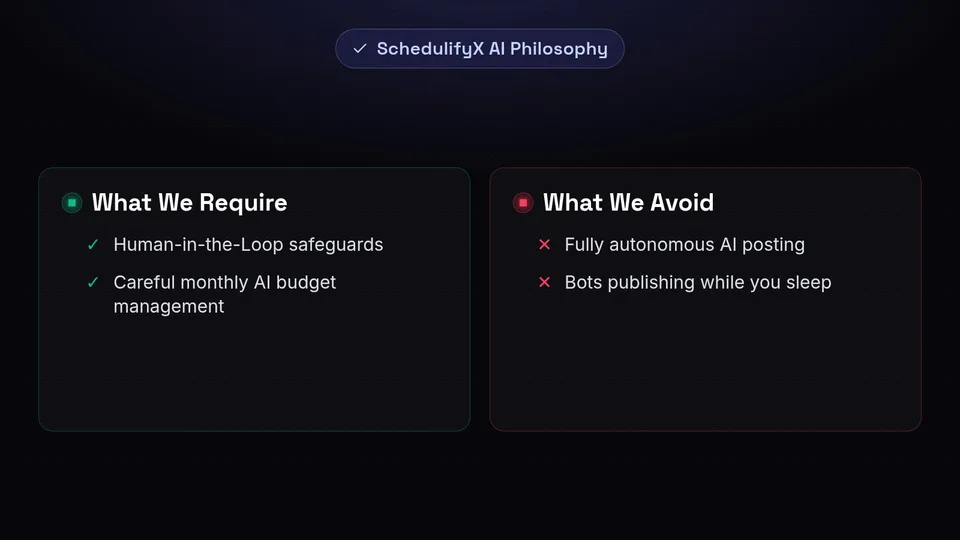
Every tool has limitations; SchedulifyX prioritizes human oversight rather than fully autonomous bots. To truly find the best tools for scheduling social media posts, you have to look past the marketing copy and understand what these tools cannot do. Here is a summary of the honest weaknesses across the board as of August 2026:
- Where Sprout Social beats SchedulifyX: Sprout's enterprise analytics, cross-channel reporting, and native TikTok ads integrations (added June 11, 2026) are vastly superior for large corporate marketing departments.
- Where Buffer beats SchedulifyX: Buffer's August 10, 2026 launch of a full developer API and hosted MCP server makes them the undisputed choice for developers wanting to integrate custom AI agents (like Claude or n8n) directly into their scheduling pipelines.
- Where Hootsuite falls short: The complete lack of a free tier alienates startups, and the 99/user/mo Professional tier creates massive organizational friction when growing teams need to add seats. Missing basic native features (like Facebook photo+video posts) is hard to justify at that price point.
- Where SchedulifyX falls short: We do not allow fully autonomous AI posting. If you want a bot to generate and publish content while you sleep, our "Human-in-the-Loop" safeguard will feel like a bottleneck. Additionally, our credit-based AI metering requires careful monthly budget management compared to tools with unlimited text generation.
How to Choose the Right Tool for Your Team
Choosing the best social media scheduler requires matching your team's structural reality to a vendor's pricing and feature model. Here is a quick checklist to guide your decision:
Are you a solo developer building AI workflows?
Look closely at Buffer. Their recent MCP server integration and API access are built exactly for this use case, provided you can manage the rate limits on lower tiers.Are you a large enterprise needing deep ad reporting?
Sprout Social is likely your best bet. Despite the prohibitive per-seat costs, their June 2026 updates regarding TikTok ads and SproutLink make them a powerhouse for data-driven e-commerce.Are you a highly visual brand focused on Instagram?
Later's visual grid planning remains top-tier, provided you don't need heavy text-based scheduling for platforms like LinkedIn or X.Are you a collaborative team needing broad network coverage (including Bluesky/Mastodon) with AI assistance?
This is where SchedulifyX shines. If you want AI to do the heavy lifting but insist on human approval before publishing, our $29/mo flat-rate Professional tier is designed for you.Conclusion & Next Steps
The reality is that there is no single "perfect" software. The best tools for scheduling social media posts are simply the ones whose strengths align with your daily workflow and whose weaknesses you can comfortably live with.
If you are frustrated by per-seat pricing models that punish your growing team, or if you need to reach audiences on emerging platforms like Threads and Mastodon with safe, human-approved AI assistance, we invite you to see if SchedulifyX is the right fit. You can review our full feature breakdowns and credit limits on our Pricing page.
If, however, you need deep enterprise ad reporting, headless developer APIs, or fully autonomous posting, we highly encourage you to explore our competitors. We have compiled a deeper dive into other options on our Alternatives page to help you make the most informed decision possible.
Please note: The software industry moves fast. All specific pricing figures, plan limits, and feature sets mentioned in this article are accurate based on our research as of August 22, 2026. Pricing models and feature availability change frequently, so always confirm current details directly on the vendor's own pricing page before making a purchase decision.
Sources
Facts checked against the sources below on August 22, 2026.