How to Use X in 2026: The Ultimate Guide for Beginners to Power Users
SchedulifyX Team · August 20, 2026
Master X (formerly Twitter) in 2026. Discover the latest algorithm updates, Grok timelines, monetization changes, and proven strategies to grow your account.
Welcome to the new era of social media. If you are wondering how to use X (formerly Twitter) in 2026, you are not alone. The platform has undergone a massive transformation, shedding legacy features and embracing AI-driven algorithms, new monetization models, and entirely revamped community structures. Whether you are searching for a comprehensive guide on Twitter for beginners 2026 or you are a seasoned creator looking for advanced X tips to decode the latest algorithmic shifts, this guide covers everything you need to know.
In 2026, the old playbooks simply do not work. The platform has retired Communities, introduced Grok-powered Custom Timelines, overhauled its creator rewards, and open-sourced its recommendation engine. To succeed today, you need a deep understanding of how the algorithm evaluates your content, how to navigate link suppression, and how to build a profile that converts casual scrollers into loyal followers.
This comprehensive, beginner-to-power-user guide will walk you through setting up an optimized profile, understanding the "Phoenix" algorithm, leveraging Lists, mastering scheduling, and building the habits necessary to grow a highly engaged account on X.
Setting Up a Profile That Converts in 2026
Before you worry about algorithms and engagement metrics, you must build a strong foundation. When a user discovers your post on their timeline and clicks your avatar, you have roughly three seconds to convince them to hit the "Follow" button. In 2026, profile optimization is less about clever aesthetics and more about clear, immediate value proposition.
The Anatomy of a High-Converting Bio
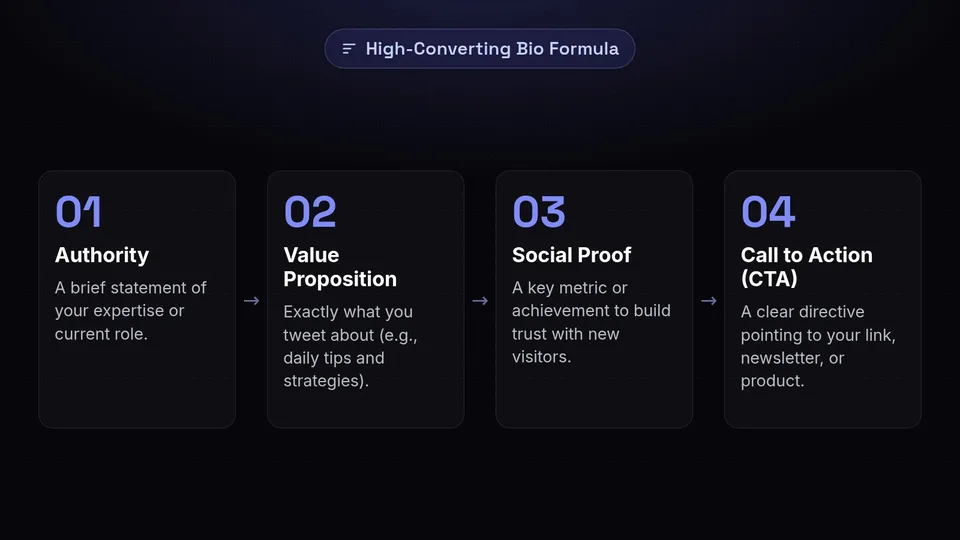
Your bio is prime real estate. It should clearly state who you are, what you do, and what kind of content followers can expect. With strict character limits, every word matters. A proven formula for a high-converting bio includes:
- Authority: A brief statement of your expertise or current role.
- Value Proposition: Exactly what you tweet about (e.g., "I share daily X tips and marketing strategies").
- Social Proof: A key metric or achievement, if applicable.
- Call to Action (CTA): A directive pointing to your link, newsletter, or product.
To ensure your bio perfectly fits the platform's constraints without awkward cut-offs, always draft and measure your copy using a reliable character counter before publishing. This tool is invaluable for optimizing your bio, your display name, and your top-level posts.
Visual Branding: Avatar and Banner
Your avatar should ideally be a high-quality, recognizable headshot. If you are running a brand account, a crisp, centered logo works best. The banner (header image) is often underutilized; treat it as a billboard. Use this space to visually reinforce your value proposition, showcase a product release, or display social proof. Ensure the text in your banner is centered and visible on both mobile and desktop screens, as cropping varies wildly between devices.
The Power of the Pinned Post
Your pinned post is the final piece of the profile puzzle. It serves as an introduction to your best work. In 2026, the most effective pinned posts are high-value threads, viral "megaposts" that showcase your deep expertise, or a direct lead magnet offering free value in exchange for an email sign-up. Rotate your pinned post monthly to keep your profile feeling fresh and relevant to your latest initiatives.
Decoding the 2026 X Algorithm: The "Phoenix" Engine
If you want to know how to use X effectively, you must understand how the platform decides what content to show users. On January 20, 2026, X open-sourced the details of its Grok-1 Transformer-based recommendation system, internally dubbed "Phoenix." This provided unprecedented transparency into the AI-mediated scoring system that governs the "For You" feed.
Candidate Sourcing and the 1,500 Post Rule
Every time a user opens the app or refreshes their feed, the For You algorithm extracts approximately 1,500 candidate posts. These posts are pulled from a mix of people the user follows (In-Network) and people they don't follow (Out-of-Network). The ratio fluctuates, but the goal is always to maximize user retention and session length.
The Three Pillars of Ranking
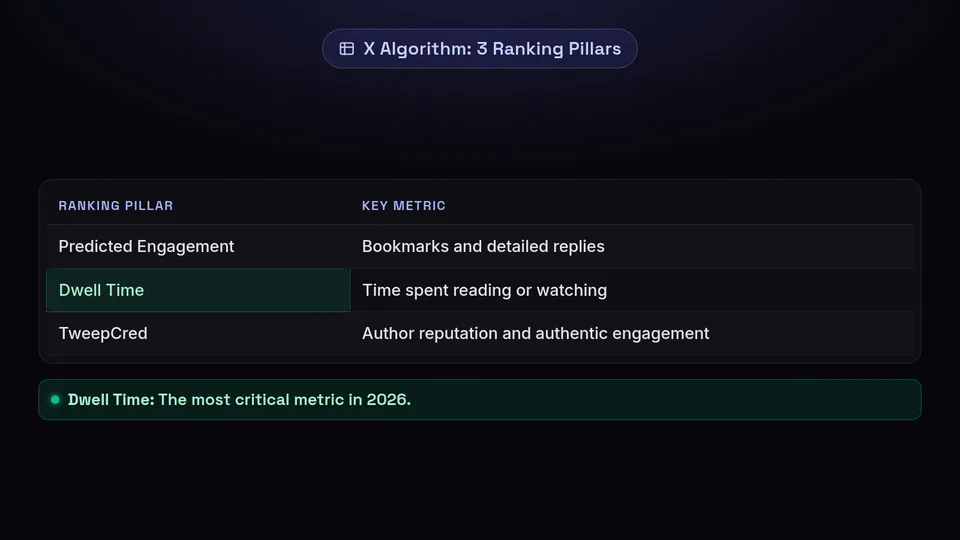
Once the 1,500 candidates are sourced, the neural network models evaluate and rank them based on three primary criteria:
- Predicted Engagement: The algorithm calculates the statistical probability that a user will reply, repost, like, or bookmark the post. Bookmarks and detailed replies carry significantly more weight than a simple "like."
- Dwell Time: This is perhaps the most critical metric in 2026. Dwell time measures the exact amount of time a user spends reading your text, expanding your threads, or watching your native video. High dwell time signals to the algorithm that your content is captivating, prompting it to push the post to a wider audience.
- Author Reputation (TweepCred): Your account is assigned an internal reputation score known as "TweepCred." This score increases when you consistently publish high-quality content that generates authentic engagement. It decreases if your posts are frequently ignored, if you engage in spammy behavior, or if you receive community notes correcting your claims.
The "Under the Hood" Transparency Update
In a massive move for transparency, X published the updated source code for its recommendation algorithm on GitHub on August 14, 2026. Alongside this release, Elon Musk announced a pilot feature called "Under the Hood." Currently available to a randomized test group, this feature allows users to view aggregate account and post labels that directly affect their visibility. If you are part of this pilot, you can see in real-time how your TweepCred and engagement metrics are influencing your reach, removing much of the guesswork from your strategy.
Replies vs. Top-Level Posts: The New Engagement Paradigm

A common mistake in any Twitter for beginners 2026 strategy is treating the platform solely as a broadcasting tool. X is fundamentally a conversational network. The 2026 algorithm explicitly prioritizes conversation depth and thoughtful back-and-forth interactions over raw, superficial like counts.
The Mutual Connection Boost
In July 2026, X implemented a major algorithmic update that significantly boosts posts from mutual connections. This applies to both the primary home feed and the reply threads beneath popular posts. If you follow someone and they follow you back, your interactions are heavily prioritized. This makes networking and building genuine, mutual relationships more critical than ever for organic reach.
The Downvote Penalty for Low-Quality Replies
Historically, users would spam viral posts with low-effort replies (e.g., "Great post!" or single emojis) to siphon impressions. In March 2026, X aggressively cracked down on this by integrating reply downvotes as a direct ranking signal. If your reply is deemed low-quality, off-topic, or spammy, users can downvote it. Accumulating downvotes penalizes your reply, sinking it to the bottom of the thread and negatively impacting your overall account TweepCred. To succeed, your replies must add genuine value, offer a counter-perspective, or expand on the original author's point.
Navigating the End of X Communities and the Rise of XChat
One of the most significant shifts in the platform's architecture occurred in the spring of 2026. If you are looking for how to use Twitter communities, you need to pivot your strategy immediately.
The Shutdown of X Communities
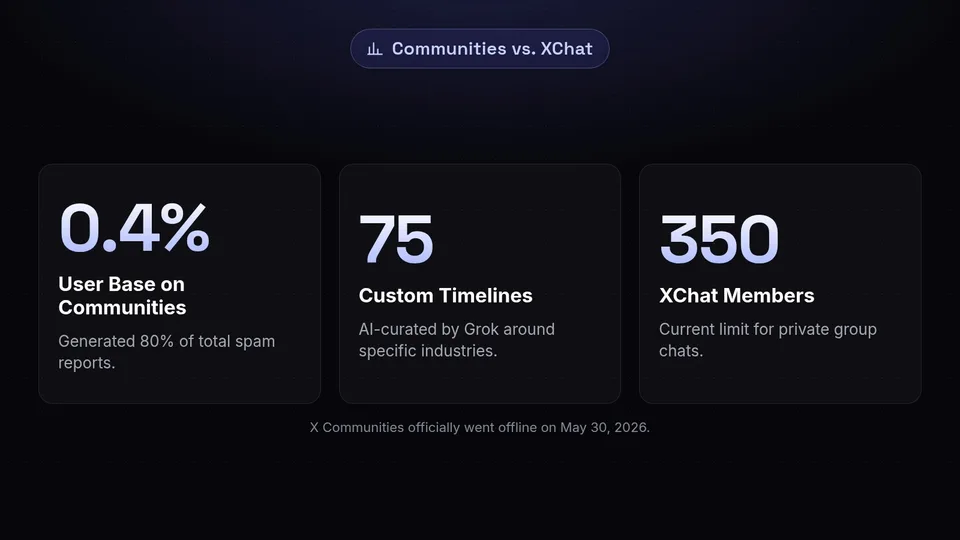
Between April 21 and 23, 2026, Nikita Bier, the Head of Product at X, announced the permanent retirement of X Communities, which officially went offline on May 30, 2026. The data behind this decision was stark: Bier reported that Communities were actively used by less than 0.4% of the user base, yet they generated roughly 80% of the platform's total spam reports, scams, and malware distribution. The feature had become an unmoderated liability rather than a networking asset.
Embracing Grok Custom Timelines and XChat
To fill the void left by Communities, X launched two powerful new features announced concurrently by Nikita Bier on April 21-22, 2026:
- Grok-Powered Custom Timelines: X introduced 75 distinct, AI-curated topic timelines. Powered by the Grok AI, these timelines automatically aggregate the highest-quality posts around specific industries, hobbies, and news events. Users can pin these timelines next to their "For You" feed. To get your content featured in these timelines, you must consistently use relevant keywords and maintain a high TweepCred in your specific niche.
- Expanded XChat Group Chats: For intimate, real-time networking, X expanded its direct messaging capabilities with XChat. These group chats now feature joinable links and support up to 350 members per chat (with official plans to expand to 1,000 members). XChat is the new frontier for private networking, mastermind groups, and direct audience engagement.
Mastering Content Strategy, Link Penalties, and Monetization
Creating great content is only half the battle; formatting it correctly for the algorithm and understanding the monetization landscape is what separates amateurs from professionals.
The Link Suppression Penalty
One of the most vital X tips for 2026 involves outbound links. X wants to keep users on its platform. Consequently, posts containing external URLs directly in the body text are heavily suppressed by the algorithm. If you paste a link to your blog or YouTube video in your main post, its reach will be artificially throttled.
The Workaround: Savvy creators bypass this penalty by utilizing the "reply link" strategy. Write a compelling, text-only top-level post that generates high dwell time and curiosity. Then, place your external link in the first reply to that post, or continue the thought in a thread and place the link at the very end. This ensures the primary post achieves maximum algorithmic distribution before directing traffic off-site.
Original Content Rewards: The New Monetization Standard
On August 10, 2026, X fundamentally changed how creators earn money on the platform. The company announced the sunsetting of its legacy Creator Revenue Sharing program, replacing it with the "Original Content Rewards" program. This shift was designed to combat the rampant issue of stolen content, engagement farming, and endless reposting.
In their official announcement, X stated: "The best content on X doesn't stop at resharing what already exists — it adds something new." The new monetization model heavily favors original text, native video uploads, and unique insights. Accounts that primarily curate or repost unoriginal memes will see their payouts drop to zero, while genuine creators will receive a larger share of the revenue pool.
Using Lists for Noise-Free Curation
With the "For You" feed dominated by algorithmic recommendations, keeping track of specific people can be challenging. This is where X Lists become your most powerful tool for noise-free curation.
Lists offer dedicated, non-algorithmic, chronological feeds. They allow you to organize accounts into specific categories without cluttering your primary timeline. You do not even need to follow an account to add them to a list.
Strategic Use Cases for Lists
- Competitor Tracking: Create a private list of your industry competitors. You can monitor their product launches, content strategies, and audience interactions silently, as users are not notified when added to a private list.
- Lead Generation: Build lists of potential clients, investors, or partners. Engage with their content daily from this dedicated feed to build rapport before sliding into their direct messages.
- Industry News: Curate a public list of top journalists, news outlets, and thought leaders in your niche. Public lists can be subscribed to by other users, which can optionally position your account as a hub of valuable curation.
Scheduling on X: Native Tools vs. Third-Party Solutions
Consistency is the bedrock of audience growth. To maintain a steady presence, you must schedule your content in advance. However, the native tools provided by X have severe limitations.
The Limitations of the Native Scheduler
X offers a free native scheduler, but it is highly restrictive. As of 2026, it works exclusively on desktop browsers via x.com. It does not support mobile scheduling, meaning you cannot queue up posts on the go. Furthermore, for non-subscribers, it only supports single posts up to 280 characters. Most importantly, the native scheduler does not support the scheduling of multi-post threads, which are essential for driving high dwell time and deep engagement.
Why Third-Party Tools Are Essential
To execute a professional strategy, a third-party social media management platform like SchedulifyX is necessary. SchedulifyX allows you to draft, visualize, and schedule complex threads, manage multiple accounts, and leverage AI to optimize your posting calendar across all devices.
When discussing third-party tools, it is important to look at the broader ecosystem. According to Buffer data (as of 2026-08-20), accounts active in 20+ out of 26 weeks generate ~450% more engagement per post than inconsistent accounts. While SchedulifyX is highly optimized for AI-driven post generation, thread scheduling, and tailored modern workflows, we plainly acknowledge that Buffer is historically stronger in its vast, long-term collection of legacy cross-platform engagement benchmark data. Please be aware that third-party tool pricing models (whether per seat, per channel, or flat rates), plan limits, and specific features change frequently; always confirm current details directly on the vendor's own pricing page.
Optimal Posting Habits for Sustainable Growth
Understanding the algorithm is only useful if you apply that knowledge through consistent, strategic habits. Growth on X is a marathon, not a sprint.
The Power of Consistency and Volume
As highlighted by the data mentioned above, consistency yields massive dividends. Accounts that post sporadically are penalized by the Phoenix algorithm, as their TweepCred degrades over periods of inactivity. Industry benchmarks in 2026 strongly recommend publishing 3 to 5 times daily. This volume ensures you have multiple at-bats to capture the algorithm's attention and cater to different time zones.
Mastering Early Engagement Velocity
Timing your posts is more critical than ever. The 2026 algorithm relies heavily on early engagement velocity. The engagement a post receives within the first 30 to 60 minutes of publishing serves as the primary distribution lever. If a post gets rapid replies, likes, and high dwell time immediately after going live, the neural network categorizes it as "hot" and pushes it to a massive Out-of-Network audience.
If you post when your audience is asleep or offline, you will miss this crucial 60-minute window, and your post will likely die in the algorithmic void. To capitalize on early engagement velocity, you must know exactly when your specific followers are online. You can evaluate and pinpoint these optimal windows using our best time to post tool, ensuring every piece of content hits the timeline exactly when it has the highest statistical probability of going viral.
Building a Daily Routine
To synthesize everything in this guide, a successful daily routine on X in 2026 looks like this:
- Drafting (30 mins): Use SchedulifyX to write 3-5 high-quality posts, ensuring one is a deep-dive thread. Check lengths with the character counter.
- Scheduling (10 mins): Slot these posts into your optimal time windows.
- Outbound Engagement (30 mins): Spend time in your curated Lists and the new Grok Custom Timelines. Leave highly thoughtful, valuable replies on larger accounts to build mutual connections and avoid the downvote penalty.
- Inbound Engagement (15 mins): Reply to everyone who commented on your posts to drive up conversation depth and boost your post's overall algorithmic weight.
Conclusion
Learning how to use X in 2026 requires adapting to a platform that values deep conversation, original content, and algorithmic precision. By optimizing your profile, understanding the Phoenix algorithm's focus on dwell time, leveraging Lists, and embracing the new Grok timelines over the defunct Communities, you position yourself for massive organic growth.
Remember, the tools you use dictate the efficiency of your strategy. Don't let native scheduling limitations hold back your potential. Take control of your content calendar, build complex threads, and hit your optimal posting windows effortlessly. Start scaling your audience today with SchedulifyX, the AI-powered social media scheduling platform built for the modern creator.
Sources
Facts checked against the sources below on August 20, 2026.
- X Twitter Algorithm Details Open Source Elon Musk 2026 8 — businessinsider.com
- X Original Content Rewards Monetization Program Announcement Eligibility — mashable.com
- socialpilot.co
- Grow On X After Communities Shutdown — postory.io
- X Communities Shutting Down What Creators Need To Know — opentweet.io
- X Introduces Topic Based Custom Timelines — socialmediatoday.com
- youtube.com
- X Twitter Algorithm Explained — adlibrary.com
- Twitter Algorithm 2026 — teract.ai
- What Is Twitter Algorithm — conbersa.ai