Meta Separates Threads Business Controls: September 2026 Update
SchedulifyX Team · September 23, 2026
Stay ahead with our social media news September 2026 briefing. Meta has introduced dedicated access controls for Threads, separating it from Instagram.
Welcome to your essential briefing on social media news september 2026. As the digital landscape continues to evolve at a rapid pace, staying informed about the latest platform updates is crucial for social media managers, agencies, and enterprise teams. This week, we are focusing on a significant development from Meta that directly impacts how businesses manage their presence across Facebook, Instagram, and Threads.
For a long time, managing Threads meant dealing with a tangled web of inherited permissions from Instagram. However, recent platform updates have fundamentally changed this dynamic. Meta has officially introduced dedicated, task-based access controls and permissions specifically for Threads profiles within its business management tools. This long-awaited separation provides organisations with the granular control necessary to secure their digital assets while empowering their teams to work more efficiently.
In this comprehensive guide, we will explore exactly what these changes entail, how to navigate the transition period, and what this means for your broader social media strategy as we move deeper into the final quarter of 2026.
The End of Inherited Instagram Permissions

When Threads was first launched, it was positioned as a direct offshoot of Instagram. This close integration was instrumental in driving initial adoption, allowing users to port their followers and profile details over with a single tap. However, for businesses, this integration came with a significant operational caveat: permissions were entirely inherited.
If a team member had administrative or editorial access to a brand's Instagram account via Meta Business Suite, they automatically possessed the exact same level of access to the brand's Threads profile. While this was convenient in the early days of the platform when brands were simply experimenting with text-based content, it quickly became a governance challenge as Threads matured into a primary communication channel.
Large organisations and agencies often require strict compartmentalisation of duties. A copywriter might need access to draft posts on Threads, but shouldn't necessarily have the ability to launch advertising campaigns on Instagram. Conversely, a media buyer needs access to ad accounts but has no business replying to customer service queries on a public timeline. The inherited permissions model made this level of granular control impossible, forcing businesses to either restrict access entirely or grant broader permissions than were strictly necessary.
Meta's latest update resolves this structural bottleneck. By separating Threads permission management from inherited Instagram settings, Meta is acknowledging Threads as a standalone pillar within its ecosystem, requiring the same level of enterprise-grade security and governance as Facebook and Instagram.
Understanding the New Threads Access Controls
The core of this week's announcement revolves around the introduction of dedicated task-based access controls. These controls are managed centrally through Meta's established business infrastructure, specifically the Organization Manager and Meta Business Suite.
This integration into existing enterprise tools means that social media managers do not need to learn a completely new interface. Instead, they will find new, specific toggles and assignment options dedicated exclusively to Threads alongside their existing Facebook and Instagram assets.
Partial Access vs. Full Access
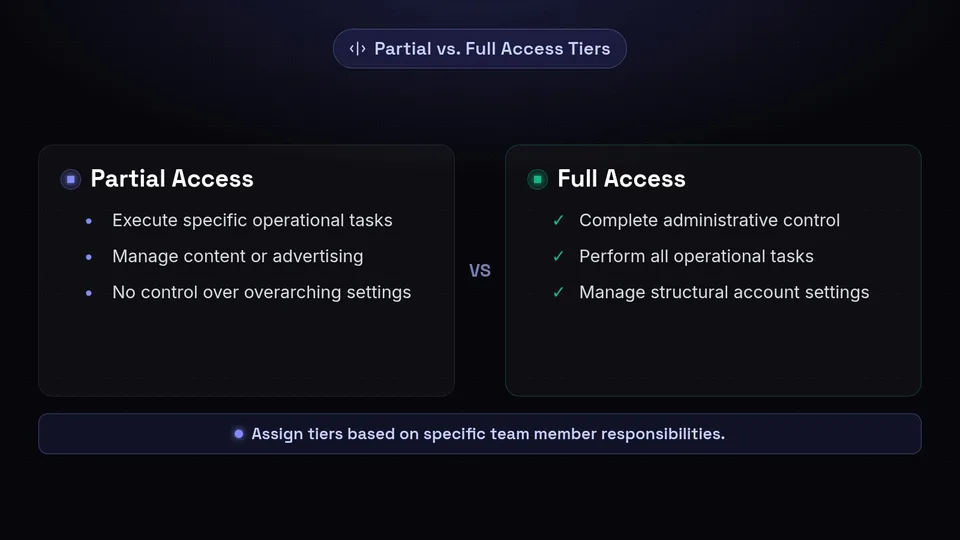
To provide maximum flexibility, Meta has structured these new controls around different tiers of access. Administrators can now assign roles based on the specific tasks an employee or agency partner needs to perform.
- Partial Access: This tier is designed for team members who need to execute specific operational tasks without having control over the account's overarching settings. Partial access can be further divided into content management or advertising management. A user with partial access for content might be able to draft and publish posts, while a user with partial access for advertising can manage campaigns without touching the organic feed.
- Full Access: This is the administrative tier. Users with full access have complete control over the Threads business profile. They can perform all the operational tasks of a partial access user, but they also hold the keys to the structural settings of the account.
A Breakdown of Task-Based Roles and Capabilities
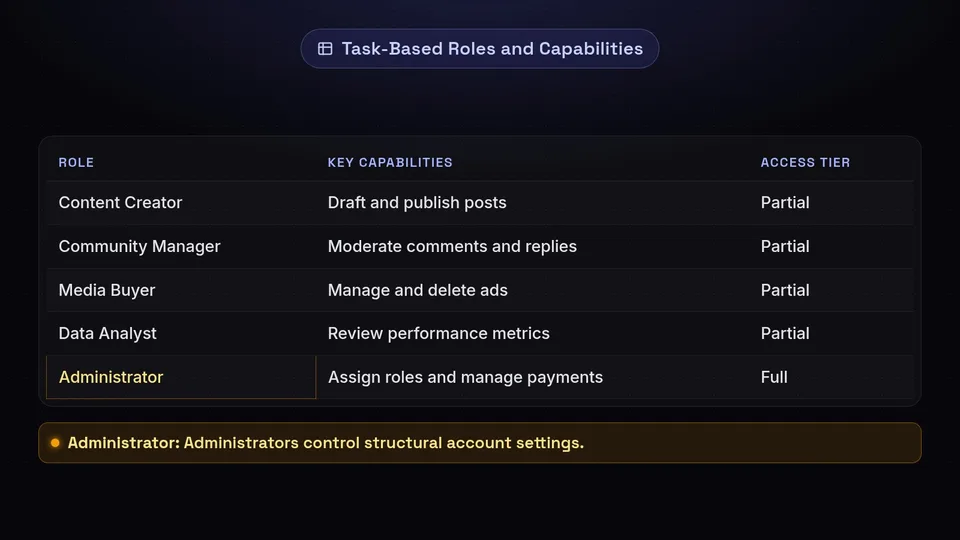
The true power of this update lies in the specific capabilities that can now be toggled on or off for individual users managing a Threads profile. According to the latest documentation provided by Meta, authorised users can be granted permission to perform a variety of distinct actions.
Content and Community Management
For organic social media teams, administrators can now grant specific permissions to post, manage, or delete content. This is crucial for brands that employ junior staff or external contractors for content creation. You can ensure that a content creator has the ability to draft and publish text, images, and videos to Threads without giving them the ability to alter account settings.
Furthermore, community management has been separated into its own actionable permission. Authorised users can be granted the ability to moderate comments and replies. Given the conversational nature of Threads, community moderation is often a full-time job. Brands can now assign dedicated community managers to monitor the Threads timeline, hide inappropriate replies, and engage with followers, all while restricting their access to other, more sensitive areas of the Meta Business Suite.
Advertising and Analytics
On the paid media side, access controls now allow specific users to manage and delete ads on Threads. As advertising on Threads continues to evolve, having dedicated media buyers who can optimise campaigns without interfering with organic content workflows is essential.
Equally important is the ability to view analytics. Data is the lifeblood of any modern social media strategy. The new permissions allow administrators to grant analytics access to stakeholders—such as clients, marketing directors, or data analysts—so they can review performance metrics, track engagement rates, and measure ROI without needing the ability to actually publish content or spend advertising budget.
Administrative Functions
For those granted full access, the capabilities extend to structural account management. Full admins can assign employee roles, dictating exactly who has access to what. They are also responsible for managing payment methods associated with the Threads profile, a critical security function that should always be restricted to a select few trusted individuals within an organisation.
Managing the Transition Period Effectively
Whenever major platform updates occur, there is inherently a transition period that requires careful management to avoid disruption. Meta has designed the rollout of these new controls with continuity in mind.
It is important to note that linked accounts will initially retain their inherited Instagram settings. This means that on the day the update rolls out to your Meta Business Suite, your team will not suddenly lose access to Threads. The system defaults to the legacy inheritance model to ensure that business operations can continue uninterrupted.
However, these inherited settings will only remain in place until custom permissions are actively configured by an administrator. This creates a vital action item for all social media directors and IT administrators.
Steps for a Smooth Transition
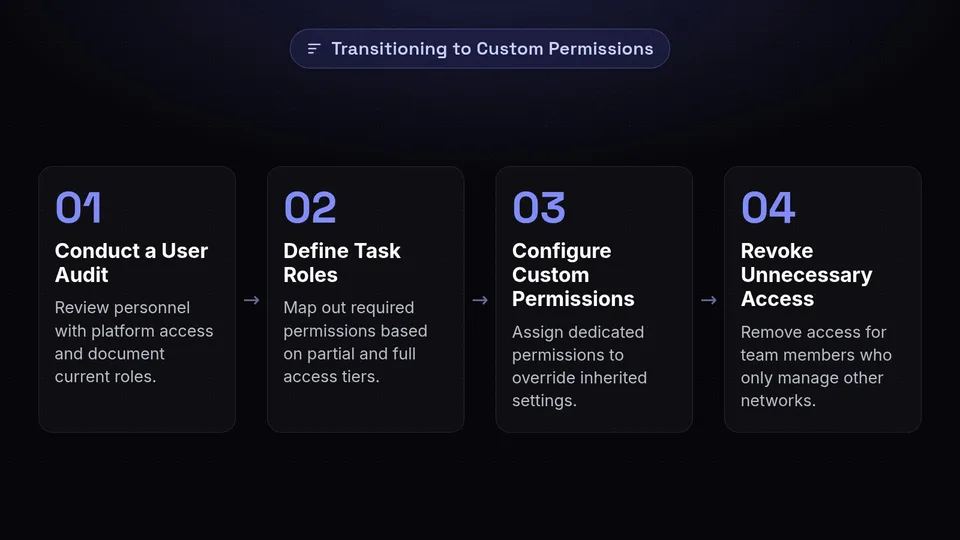
To ensure a secure and seamless transition to the new task-based controls, we recommend following a structured audit process:
- Conduct a User Audit: Review all personnel who currently have access to your brand's Instagram account via Meta Business Suite. Document their current roles and determine whether they actually require access to Threads.
- Define Threads Roles: Based on the new partial and full access tiers, map out exactly which permissions each team member needs. Does your copywriter need analytics access? Does your community manager need advertising access?
- Configure Custom Permissions: Navigate to the Organization Manager or Meta Business Suite and begin assigning the new, dedicated Threads permissions to your team members. As soon as you configure custom permissions for a user, their inherited Instagram settings for Threads will be overridden.
- Revoke Unnecessary Access: Use this opportunity to clean up your user list. If a team member only needs to manage Instagram and has no responsibilities on Threads, ensure their custom Threads permissions are revoked entirely.
Strategic Implications for Agencies and Large Teams
The introduction of dedicated access controls for Threads is more than just a minor administrative tweak; it represents a maturation of the platform that has profound strategic implications, particularly for agencies and large enterprise teams.
For agencies, client security and trust are paramount. In the past, explaining to a client that managing their Threads account required full access to their Instagram presence was often a difficult conversation, especially if different agencies were handling different platforms. The new task-based controls allow agencies to request only the exact permissions they need to execute their specific mandate on Threads, reducing friction during the onboarding process and limiting liability.
For large enterprise teams, this update facilitates better internal collaboration. By compartmentalising access, organisations can build cross-functional teams where specialists focus entirely on their areas of expertise. A dedicated crisis communications team, for example, can be granted immediate, high-level access to moderate replies on Threads during a PR event, without disrupting the day-to-day access of the standard social media marketing team.
Navigating Algorithm Changes with Better Governance
As we monitor algorithm changes across the social media landscape, agility is often the key to maintaining visibility and engagement. When platforms update how they prioritise content, brands must pivot their strategies quickly. However, agility must not come at the expense of security.
Robust governance, facilitated by these new access controls, actually enhances a team's ability to respond to algorithmic shifts. When roles are clearly defined and permissions are properly allocated, bottlenecks are removed. A content creator who spots a trending topic or a shift in the Threads algorithm can immediately draft and publish a response, knowing they have the specific partial access required to do so, without needing to wait for an overarching administrator to log in and approve the action due to shared login constraints.
Furthermore, by granting specific analytics access to data scientists or strategists, teams can monitor the real-time impact of algorithm changes on their Threads performance. These insights can then be fed back to the content creators, creating a rapid, secure feedback loop that keeps the brand ahead of the curve.
Optimising Your Workflow with SchedulifyX
While Meta's native tools like Meta Business Suite and Organization Manager are essential for setting fundamental access controls and permissions, executing a high-volume, multi-platform social media strategy requires a more robust, unified solution.
This is where an AI-powered social media scheduling platform becomes invaluable. Managing Facebook, Instagram, and Threads simultaneously demands a tool that can centralise content creation, streamline approvals, and automate publishing across all your connected profiles.
By integrating your newly secured Threads business profile with a comprehensive scheduling platform, you can maintain the strict governance established in Meta Business Suite while drastically improving your team's operational efficiency. You can draft a core piece of content, use AI to tailor the messaging specifically for the conversational tone of Threads versus the visual focus of Instagram, and schedule them to publish at optimal times—all from a single dashboard.
The separation of Threads access controls is a clear signal that the platform is here to stay as a distinct and vital channel for business communication. As you update your internal permissions and refine your strategy for the remainder of the year, ensuring you have the right technology stack to support your team is more important than ever.
Conclusion
The digital marketing environment is perpetually shifting, and keeping abreast of social media news september 2026 is the only way to ensure your brand remains competitive and secure. Meta's decision to introduce dedicated, task-based access controls for Threads Business Profiles marks a significant milestone in the platform's development, finally freeing it from the constraints of inherited Instagram permissions.
By taking immediate action to audit your team's access, define specific roles, and configure custom permissions within Meta Business Suite, you can protect your digital assets while empowering your staff to manage content, moderate communities, and analyse data more effectively.
To truly capitalise on these platform updates and streamline your entire social media operation across Facebook, Instagram, and Threads, it is time to upgrade your workflow. Discover how SchedulifyX can transform your team's productivity with advanced AI-powered scheduling and seamless multi-platform management. Start optimising your digital presence with SchedulifyX today.
Sources
Facts checked against the sources below on September 23, 2026.