Social Media News September 2026: Major Platform Updates
SchedulifyX Team · September 2, 2026
Discover the latest social media news for September 2026, including Meta's teen safety overhaul, LinkedIn's AI slop filter, and Snapchat algorithm changes.
The digital landscape is shifting rapidly, and staying ahead of the curve is essential for any modern marketer. In our comprehensive briefing on social media news September 2026, we are unpacking a series of transformative platform updates and algorithm changes that have redefined how brands must approach their digital strategies. From sweeping youth safety regulations to a growing backlash against inauthentic artificial intelligence, the past few weeks have introduced critical shifts in the social media ecosystem.
This month's developments highlight a clear industry trajectory: a renewed focus on user wellbeing, a demand for human-centric authenticity, and the sophisticated integration of AI for analysis rather than mere content generation. Whether you are scheduling campaigns for Generation Z or building thought leadership in the B2B space, these updates will inevitably impact your day-to-day operations.
Meta's Sweeping Teen Safety Overhaul
In what is arguably the most significant regulatory shift in recent social media history, Meta announced a comprehensive overhaul of its youth safety policies on August 26, 2026. Following a landmark lawsuit settlement involving California and 28 other U.S. states, the parent company of Instagram and Facebook has committed to funding online youth safety initiatives, agreeing to pay up to
Mandatory Default Protections
Historically, many of Meta's teen protection features required users or parents to actively opt-in. This is no longer the case. Meta is now switching these crucial teen protection settings on both Instagram and Facebook from opt-in to mandatory default settings. This immediate rollout fundamentally alters how younger demographics will interact with these platforms.
The concrete specifics of these default settings include:
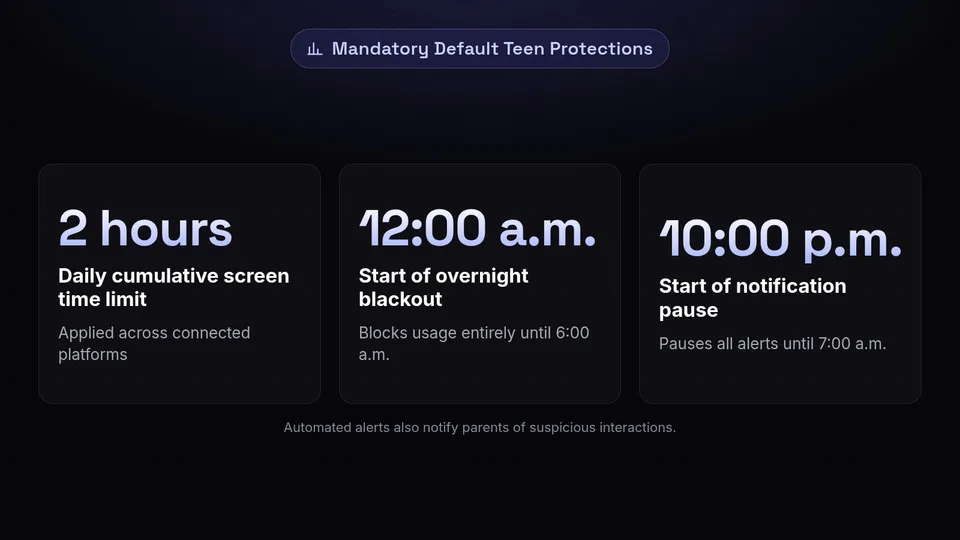
- Cumulative Screen Time Limits: A strict 2-hour daily screen time limit applied cumulatively across both Instagram and Facebook.
- Overnight Blackouts: A default block on platform usage between midnight and 6:00 a.m.
- Notification Pauses: A mandatory pause on all notifications overnight (from 10:00 p.m. to 7:00 a.m.) as well as during standard school hours.
- Parental Alerts: Automated alerts sent to parents if a teen attempts to link a second account or interacts with accounts flagged as suspicious.
A Call for Industry-Wide Standards
Meta is not viewing this as an isolated policy change but rather the beginning of a broader industry movement. Meta Chief Legal Officer CJ Mahoney emphasised the necessity of a unified approach, stating:
"Because teens move fluidly across dozens of apps, we need an industry-wide solution. We therefore call on our industry peers … to implement this new framework."
With Meta actively calling on competitors like TikTok and YouTube to adopt equivalent controls, marketers should anticipate that these restricted engagement windows for teenagers may soon become the standard across the entire social media ecosystem.
Snapchat's Stance on AI Content and Ad Integrations
As artificial intelligence continues to permeate content creation, platforms are being forced to draw a line between enhanced creativity and automated saturation. Snap Inc. has taken a definitive stance with dual updates announced in August 2026, balancing the restriction of AI-generated content in user feeds with the integration of advanced AI tools for advertisers.
Spotlight Algorithm Changes
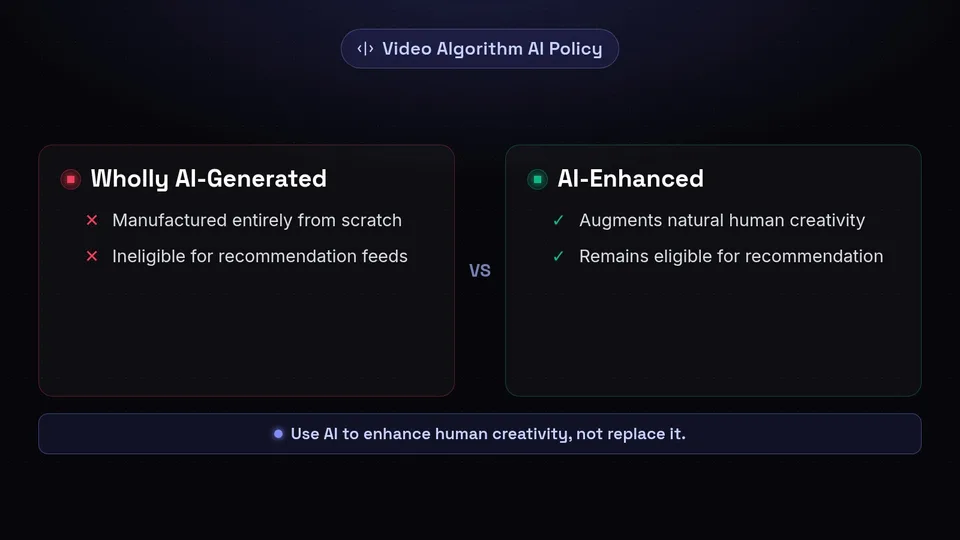
On August 31, 2026, Snap updated its Spotlight recommendation policy. The new platform updates dictate that wholly AI-generated videos are now ineligible for recommendation within the Spotlight feed. This represents a significant shift in algorithmic prioritisation, deliberately favouring human-made creativity and authentic moments over entirely synthetic media.
It is important to note the nuance in this policy: while wholly AI-generated videos face restriction, AI-enhanced videos remain eligible. This distinction encourages creators to use AI as a tool to augment their natural creativity—such as through advanced filters or editing tools—rather than relying on it to manufacture content from scratch.
Snap Ads MCP Server Launch
Conversely, Snapchat is heavily embracing AI on the backend for advertisers. On August 3, 2026, Snap launched the Snap Ads MCP Server. This establishes an official API connection linking Snap's Ads API directly to supported third-party AI agents, including ChatGPT, Claude, and Gemini.
This integration allows marketers to leverage these powerful AI models directly for campaign analysis and strategic planning. By bridging the gap between ad performance data and advanced language models, Snap is empowering advertisers to derive deeper insights and optimise their campaigns with unprecedented efficiency, all while maintaining the human element in the actual content presented to users.
LinkedIn's War on "AI Slop" and Inauthentic Engagement

The B2B networking giant is taking aggressive steps to preserve the quality of professional discourse on its platform. On August 14, 2026, LinkedIn's Chief Product Officer Hari Srinivasan announced a series of robust moderation updates aimed at combating the rising tide of mass-produced, low-effort content.
Introducing the "Seems Like AI Slop" Button
In a direct response to user feedback regarding the proliferation of generic, AI-generated posts, LinkedIn has deployed a new member reporting button explicitly labelled "seems like AI slop". This is more than just a venting mechanism for frustrated users; it is a vital data collection tool. The user signals generated from this button feed directly into LinkedIn's AI classifiers.
By crowdsourcing the identification of low-quality synthetic content, LinkedIn is actively training and refining its detection models against mass-produced inauthentic posts. This means the algorithm will become increasingly adept at suppressing content that lacks human insight and genuine professional value.
Retiring the AI Writer for a Proofreader
In alignment with this push for authenticity, LinkedIn has made a significant product change: it is retiring its native AI writing assistant. Instead of generating posts for users, the platform is replacing it with a proofreading tool. This encourages professionals to write their own original thoughts and insights, using AI solely to polish their grammar and structure, rather than outsourcing the ideation process entirely.
Automated Comment Moderation and Verification
The fight against inauthenticity extends to the comment section. LinkedIn confirmed that its automated moderation defences are now successfully blocking hundreds of thousands of fake comment attempts every single day. Furthermore, the platform has begun testing a new comment sort filter that allows users to display replies exclusively from verified members.
These platform updates collectively signal a massive shift in LinkedIn's algorithm changes, heavily penalising automated engagement tactics and rewarding verified, authentic human interaction.
What These Platform Updates Mean for Marketers

The social media news September 2026 brings forward requires a strategic pivot for digital marketers, social media managers, and content creators. The days of relying on sheer volume and automated generation are rapidly coming to an end. Here is how you should adapt your strategy in light of these developments.
1. Rethinking Scheduling and Engagement Windows
Meta's new mandatory default settings for teenagers—specifically the 2-hour daily limit, the midnight to 6:00 a.m. block, and the notification pauses during school hours and overnight (10:00 p.m. to 7:00 a.m.)—drastically alter the availability of younger demographics. If your brand targets Gen Z, your scheduling strategy must be ruthlessly precise.
You can no longer rely on late-night scrolling or school-day notifications to drive engagement. Content must be scheduled during the narrow windows when teens are actually active and able to receive notifications, primarily early evenings and weekends. Precision scheduling tools will become indispensable for maximising visibility within these restricted timeframes.
2. Pivoting from AI Generation to AI Enhancement
Both Snapchat's Spotlight policy and LinkedIn's war on "AI slop" deliver a clear message: platforms are actively suppressing wholly AI-generated content. Marketers must pivot their use of AI. Instead of using generative models to churn out bulk posts or synthetic videos, AI should be utilised for backend analysis, strategy, and enhancement.
Snapchat's new Snap Ads MCP Server is a prime example of this ideal use case. Marketers should leverage AI agents like ChatGPT, Claude, or Gemini to analyse campaign data, identify trends, and refine targeting strategies, whilst ensuring the actual creative assets remain fundamentally human and authentic.
3. Prioritising Verified, High-Quality B2B Content
For B2B marketers on LinkedIn, the introduction of the "seems like AI slop" reporting tool means that generic, thoughtless content poses a direct risk to your brand's reach and reputation. The retirement of the native AI writer underscores the platform's demand for original thought leadership.
To succeed amidst these algorithm changes, brands must invest in genuine subject matter expertise. Comments and community engagement must be authentic, as automated or superficial replies are increasingly likely to be blocked by LinkedIn's enhanced moderation defences or filtered out by users opting to view only verified members.
Conclusion
The social media news September 2026 has delivered shows an industry at a turning point. From Meta's
Navigating these platform updates and algorithm changes requires agility and precision. As engagement windows shift—particularly for younger audiences—and platforms crack down on low-effort automation, having a robust, intelligent scheduling strategy is more critical than ever.
This is where SchedulifyX becomes your ultimate strategic asset. By allowing you to meticulously plan, organise, and execute your social media campaigns, SchedulifyX ensures your authentic, human-crafted content reaches your audience exactly when they are online and receptive. Adapt to the new landscape today, and let SchedulifyX help you master the timing and delivery of your most impactful campaigns.
Sources
- First Thing Meta Changes Apps Instagram Facebook Teenagers Landmark Lawsuit — theguardian.com: https://www.theguardian.com/us-news/2026/aug/27/first-thing-meta-changes-apps-instagram-facebook-teenagers-landmark-lawsuit
- Meta Teen Time Limit — macrumors.com: https://www.macrumors.com/2026/08/26/meta-teen-time-limit/
- August 2026 Social Media Updates Roundup — techwyse.com: https://www.techwyse.com/news/social-media/august-2026-social-media-updates-roundup
- Boom Scroll August 2026 Social Media Updates — finnpartners.com: https://www.finnpartners.com/news-insights/boom-scroll-august-2026-social-media-updates/
- Social Media Updates — blog.gainapp.com: https://blog.gainapp.com/social-media-updates/
Sources
Facts checked against the sources below on September 2, 2026.