Organic vs Paid Social Media 2026: Strategy & ROI Guide
SchedulifyX Team · July 23, 2026
Struggling to balance your social media budget in 2026? Discover the ultimate guide to organic vs paid social media, ROI benchmarks, and hybrid strategies.
Welcome to the complex, AI-driven landscape of 2026. If you are a marketer, founder, or creator, you already know that the old playbooks no longer work. The debate between organic vs paid social media has evolved from an "either/or" scenario into a highly nuanced discussion about synergy, attribution, and algorithmic survival. With platforms prioritizing zero-click content, the rise of AI-generated feeds, and shifting user behaviors, understanding how to balance your efforts is more critical than ever.
In this comprehensive guide, we are going to dissect the current state of social media marketing. We will explore the harsh realities of organic reach decline, break down the costs associated with a modern paid social strategy, and provide actionable frameworks for allocating your social media budget 2026. Whether you are a scrappy startup or an enterprise giant, mastering the interplay between organic community building and paid amplification is the key to unlocking true social media ROI.
The State of Social Media in 2026
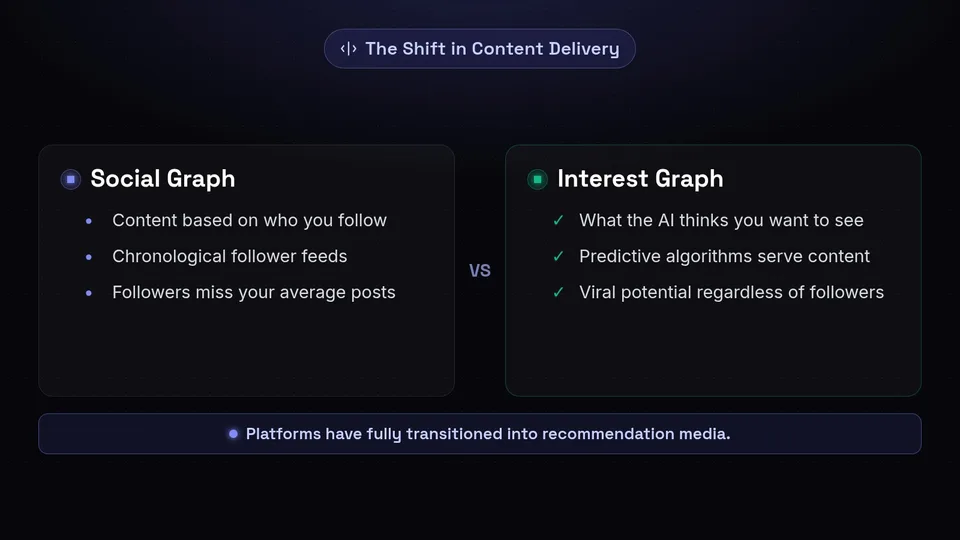
Before we dive into the specific strategies, we must understand the environment we are operating in. By 2026, social media platforms have fully transitioned into "recommendation media." The social graph (who you follow) has been heavily overshadowed by the interest graph (what the AI thinks you want to see). Platforms like TikTok, Instagram, YouTube, and even LinkedIn now serve content based on predictive algorithms rather than chronological follower feeds.
This shift has profound implications for both organic vs paid social media. On the organic side, it means that a single piece of exceptional content can go viral regardless of your follower count. However, it also means that your followers are less likely to see your average posts. On the paid side, ad targeting has become heavily reliant on machine learning, with platforms encouraging advertisers to use broad targeting and let the algorithm find the ideal customer.
"In 2026, you aren't just competing with your industry rivals; you are competing with AI-generated entertainment, hyper-personalized creator content, and the ever-shrinking attention span of the modern consumer."
Furthermore, we are seeing the entrenchment of "zero-click content." Platforms actively penalize posts containing external links because their primary goal is to keep users on their app. This necessitates native content creation, making tools like SchedulifyX essential for scheduling platform-specific, native formats efficiently.
Understanding Organic Social Media
Organic social media refers to any free content—posts, videos, stories, articles, and comments—that you share on your social profiles. It is the foundation of your brand's digital identity. When users visit your profile, your organic presence tells them who you are, what you value, and how you interact with your community.
The Purpose of Organic Social
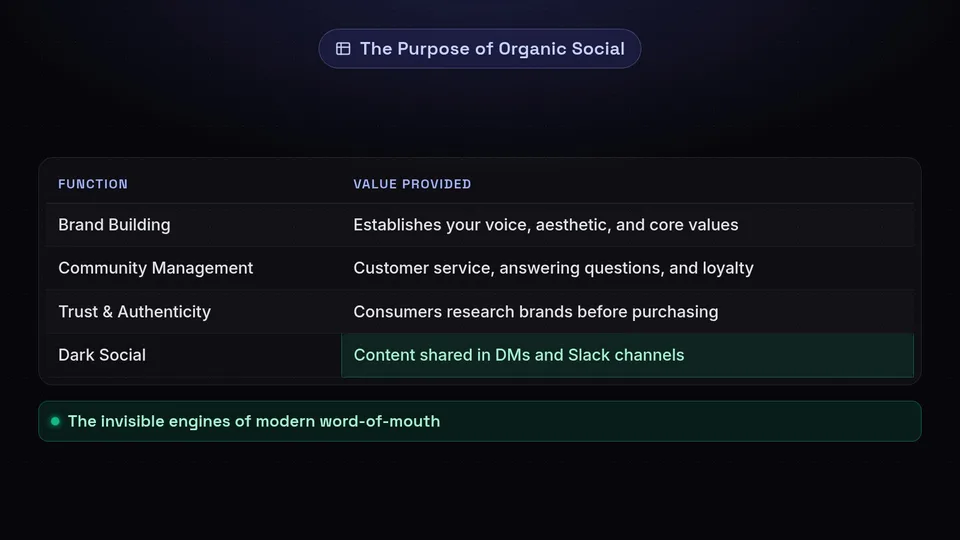
While organic social media might not be the rapid lead-generation engine it once was, it serves several irreplaceable functions:
- Brand Building & Identity: It establishes your voice, aesthetic, and core values.
- Community Management: It provides a space for customer service, answering questions, and building loyalty.
- Trust & Authenticity: Consumers research brands on social media before purchasing. An active, valuable organic presence builds trust.
- Dark Social Facilitation: High-quality organic content gets shared in DMs, Slack channels, and group chats—the invisible engines of modern word-of-mouth marketing.
Pros and Cons of Organic Social
Pros: It is highly cost-effective (costing only time and creative resources), builds long-term sustainable audiences, and fosters genuine brand loyalty that is difficult for competitors to replicate.
Cons: It is incredibly slow to build momentum, highly unpredictable due to algorithm changes, and increasingly difficult to scale without a massive content engine.
The Reality of Organic Reach Decline

Let us address the elephant in the room: the organic reach decline. For years, marketers have lamented the drop in organic reach across major platforms. In 2026, this is no longer a trend; it is the established reality. On platforms like Facebook and Instagram, average organic reach for business pages hovers between 1% and 3% of their total follower count.
Why is Organic Reach Declining?
The organic reach decline is driven by three main factors:
- Inventory Saturation: There is simply too much content being created. With the advent of generative AI, the volume of daily posts has skyrocketed, while user attention spans have remained finite.
- The Pay-to-Play Model: Social networks are publicly traded companies that rely on ad revenue. Limiting organic reach for brands naturally incentivizes them to spend money on ads.
- Shift to Entertainment: Users log on to be entertained, not sold to. If your organic content feels like a corporate press release, the algorithm will bury it in favor of engaging, creator-led content.
How to Combat the Decline
To survive the organic reach decline, brands must pivot from "broadcasting" to "community building." This means creating highly shareable, relatable, or educational content. It means leveraging employee advocacy—having your team share company content on their personal profiles, which often see higher reach. It also requires a rigorous posting schedule, utilizing AI-powered platforms like SchedulifyX to post at the exact moments your audience is most active.
Mastering Your Paid Social Strategy
If organic social is the slow-burning fire of brand loyalty, a paid social strategy is the gasoline you pour on it to accelerate growth. Paid social involves paying platforms to display your content to specific target audiences. This includes boosted posts, display ads, video ads, and sponsored messages.
The Role of Paid Social in 2026
A modern paid social strategy is essential for predictable, scalable growth. While organic reach relies on algorithmic favor, paid social guarantees impressions. It allows you to target users based on demographics, interests, behaviors, and even predictive purchasing intent powered by AI.
- Lead Generation: Direct response campaigns designed to capture emails, phone numbers, or immediate sales.
- Retargeting: Serving ads to users who have previously interacted with your organic content or visited your website, significantly increasing conversion rates.
- Market Testing: Rapidly A/B testing messaging, visuals, and offers before rolling them out to your organic channels or broader marketing campaigns.
2026 Platform-Specific Ad Costs
Understanding the financial landscape is crucial for planning your social media budget 2026. Ad costs have fluctuated due to privacy regulations, AI targeting efficiencies, and platform competition. Here is a breakdown of what you can expect regarding Cost Per Mille (CPM) and Cost Per Click (CPC) across major networks in 2026.
Meta (Facebook & Instagram)
Despite increased competition from newer platforms, Meta remains a powerhouse due to its massive user base and sophisticated AI targeting (Advantage+).
Average CPM:
Average CPC: $0.80 -
Best for: E-commerce, D2C brands, retargeting, and broad demographic reach.
TikTok
TikTok's ad platform has matured significantly, offering robust search ads and shoppable formats. However, creative fatigue happens rapidly here, requiring constant new video assets.
Average CPM: $8 -
Average CPC: $0.60 -
Best for: Gen Z and Millennial audiences, impulse purchases, influencer whitelisting.
LinkedIn remains the undisputed king of B2B marketing. While expensive, the quality of leads and the ability to target by job title, company size, and industry make it indispensable for B2B paid social strategy.
Average CPM: $35 - $55
Average CPC: $5.00 - $9.00
Best for: High-ticket B2B services, SaaS, enterprise software, recruiting.
X (formerly Twitter) & Emerging Platforms
X continues to serve a niche for real-time engagement and tech/finance audiences. Meanwhile, platforms like Reddit and niche decentralized networks offer cheaper, highly engaged communities.
Average CPM (X): $6 -
Average CPC (X): $0.50 - $0.90
Best for: Tech products, event promotions, highly opinionated brand campaigns.
Organic vs Paid Social Media: Core Differences
To build a cohesive strategy, you must understand the fundamental differences between organic and paid efforts across several dimensions:
- Speed of Results: Paid social delivers immediate visibility and rapid data. You can launch a campaign and see traffic within hours. Organic social requires months, sometimes years, to build a meaningful, converting audience.
- Intent and Targeting: Organic reaches whoever the algorithm decides to show it to, usually your existing followers and a small percentage of new users. Paid allows you to pinpoint exact demographics, behaviors, and even users who have abandoned their shopping carts.
- Longevity: Paid stops the second you turn off your budget. Your traffic drops to zero instantly. Organic content, especially searchable content on platforms like YouTube or Pinterest, can continue to drive traffic for years.
- Analytics and Measurement: Paid social provides highly granular ROI tracking, attribution modeling, and conversion data. Organic analytics are often softer, focusing on engagement rates, shares, and follower growth.
Social Media ROI Benchmarks for 2026
Measuring social media roi (Return on Investment) is the ultimate challenge for marketers. In 2026, the traditional "last-click attribution" model is practically obsolete due to cross-device journeys and privacy blockers. Marketers now rely on Media Mix Modeling (MMM) and multi-touch attribution to gauge true ROI.
How to Calculate Social Media ROI
The basic formula remains: (Return - Investment) / Investment x 100 = ROI %. However, "Return" must be clearly defined. Is it direct revenue? Customer Lifetime Value (CLV)? Or lead generation value?
2026 ROI Benchmarks by Industry
While every business is unique, here are the average benchmark multipliers (Return on Ad Spend - ROAS) marketers are aiming for in 2026:
- E-commerce (D2C): 2.5x - 4.0x ROAS. The focus here is on high-volume, lower-margin sales driven by platforms like Meta and TikTok.
- B2B SaaS: 1.5x - 2.5x ROAS (measured over a 12-month LTV). B2B relies heavily on LinkedIn, where upfront acquisition costs are high, but customer retention makes it profitable.
- Local Services: 3.0x - 5.0x ROAS. High localized intent on platforms like Facebook and Google Local drives strong returns for service-based businesses.
- Information & Education (Courses): 2.0x - 3.5x ROAS. Driven heavily by organic authority building combined with aggressive paid retargeting.
Pro Tip: Remember that organic social media ROI is harder to quantify but essential for reducing your overall blended Customer Acquisition Cost (CAC). A strong organic presence makes your paid ads perform better because users already trust your brand.
Building a Winning Hybrid Social Media Strategy
The most successful brands in 2026 do not view organic vs paid social media as a battle. Instead, they utilize a hybrid social media strategy where each side feeds and strengthens the other. Here is how to build an integrated engine:
1. The "Test and Scale" Method
Use your organic channels as a free testing ground. Post a variety of content types, hooks, and messaging to your organic audience. Monitor the analytics via SchedulifyX to see which posts garner the highest engagement rate, watch time, and shares. Once you identify a "winner," turn that organic post into a paid ad. You already know the market responds to it, which drastically reduces your risk of wasting ad spend on untested creatives.
2. The Retargeting Flywheel
Organic reach might be declining, but organic engagement is highly valuable data. Run top-of-funnel organic campaigns to generate video views or profile visits. Then, use your paid social strategy to retarget those exact users with a specific call-to-action (CTA), such as a lead magnet, discount code, or webinar sign-up. This bridges the gap between casual organic scrollers and paying customers.
3. Boosting for Social Proof
When running paid conversion ads, users often look at the likes and comments to gauge legitimacy. By putting a small paid budget behind a strong organic post to build up its "social proof" (likes, positive comments), you can then use that same post ID for a conversion campaign. High social proof lowers your CPMs and increases click-through rates.
4. Creator and Influencer Whitelisting
A major trend in 2026 is partnering with creators for organic content, and then paying to boost their content from their handle (whitelisting). This blends the authenticity of organic creator content with the targeted distribution of paid ads, often resulting in the highest social media ROI available today.
How to Allocate Your Social Media Budget 2026
With the landscape understood, how do you actually distribute your social media budget 2026? Budget allocation depends entirely on your business size, revenue model, and growth goals. Below are three frameworks tailored for different stages of business growth.
Framework 1: The Bootstrapped Startup / Small Business
When cash is tight, you must rely on sweat equity and highly targeted spend. Your goal is survival, proof of concept, and building a core community.
- Organic Content Creation (40%): Invest heavily in founder-led content, raw behind-the-scenes videos, and leveraging smartphones. Time is your biggest investment here.
- Targeted Paid Ads (30%): Focus exclusively on bottom-of-funnel retargeting. Do not spend money on brand awareness. Run ads only to people who have visited your site or engaged with your organic content.
- Software & Tools (20%): Invest in scheduling and analytics tools like SchedulifyX to automate distribution, saving you dozens of hours a week.
- Community Engagement (10%): Allocate resources (or time) to manually engage with other accounts, reply to every comment, and participate in industry groups.
Framework 2: The Mid-Market Growth Company
You have product-market fit and revenue. Now, you need to scale. This requires a balanced approach to feed the top of the funnel while aggressively converting the bottom.
- Paid Acquisition & Scaling (50%): Half your budget should go to paid social. Split this into 60% prospecting (finding new audiences) and 40% retargeting.
- High-Quality Organic Production (25%): Upgrade your content. Invest in better video editing, graphic design, and perhaps an in-house content creator. Your organic feed needs to look professional and trustworthy.
- Influencer & Creator Partnerships (15%): Start paying micro-influencers to create user-generated content (UGC) for your brand, which you can use in both organic and paid channels.
- Tools & Analytics (10%): Upgrade your software stack for deeper attribution modeling, social listening, and enterprise-level scheduling with SchedulifyX.
Framework 3: The Enterprise Brand
For large enterprises, social media is about market dominance, brand sentiment, and massive scale. The budgets are large, and the strategies are highly integrated.
- Brand Awareness & Paid Media (40%): Large-scale paid campaigns across multiple platforms, including high-CPM placements like YouTube Mastheads or TikTok TopView ads.
- Creator Ecosystems & Sponsorships (30%): Long-term contracts with macro-influencers, brand ambassadors, and funding original content series.
- Organic Community & Customer Care (15%): Dedicated teams monitoring organic social for customer service, crisis management, and real-time trend participation.
- Advanced Tech Stack & AI (15%): Massive investment in AI-driven predictive analytics, custom API integrations, and comprehensive platform management via tools like SchedulifyX to coordinate global teams.
Conclusion & Next Steps
As we navigate 2026, the debate of organic vs paid social media is definitively settled: you cannot reach your full potential without both. Relying solely on organic social leaves you vulnerable to the unpredictable nature of organic reach decline and algorithm updates. Conversely, relying purely on a paid social strategy without an organic foundation leads to sky-high acquisition costs and zero brand loyalty.
To maximize your social media ROI, you must embrace a hybrid approach. Let your organic content serve as the authentic voice and testing ground for your brand, and use your paid budget as the precision tool to amplify your best ideas and drive measurable conversions. Carefully plan your social media budget 2026 to ensure you are funding content creation, ad distribution, and the technology required to manage it all.
Ready to take control of your 2026 social media strategy? Managing a hybrid approach requires precision, consistency, and powerful analytics. SchedulifyX is the AI-powered social media scheduling platform designed to help you seamlessly organize your organic content calendar, analyze your best-performing posts, and provide the insights you need to fuel your paid campaigns. Start optimizing your social media workflow today with SchedulifyX and turn your social channels into a unified engine for growth.