Meta's Global AI Age Checks Lead a Week of AI Rule Changes
SchedulifyX Team · November 10, 2026
10 November 2026: Meta takes AI age checks worldwide, TikTok upgrades AI ad video, YouTube's AI music fix goes global and Pinterest's AI rules become binding.
This is the SchedulifyX industry briefing for 10 November 2026, covering the week from 3 November. The theme is AI in social media: the AI tools platforms put in your hands, the automated checks they run on their users, and the rules that sit behind both. Four developments stood out this week, and one regulatory deadline is now close enough to plan for.
In short: Meta is taking its AI age estimation on Instagram worldwide, TikTok has upgraded the AI video in its ad tools, YouTube's AI fix for music copyright claims has gone global outside Europe, and Pinterest's rules for its generative AI tools become part of its terms on 12 November. In the EU, the remaining AI Act marking deadline falls on 2 December.
Meta takes AI age estimation worldwide on Instagram
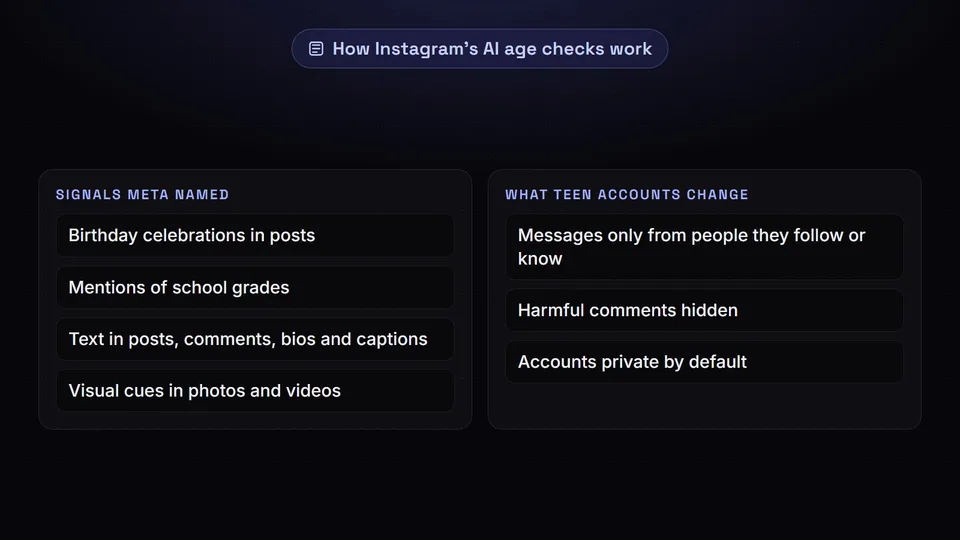
On 9 November Meta said it is expanding its AI age-estimation technology on Instagram worldwide, as TechCrunch reported. The system looks for accounts that probably belong to teenagers, including accounts that gave an adult birthday, and moves them into Teen Account protections. Those protections include direct messages only from people the teen follows or is already connected to, hidden harmful comments, and private accounts by default.
According to the same report, the system draws on context in a profile, such as birthday celebrations or mentions of school grades, on text across posts, comments, bios and captions, and on visual cues from photos and videos. Until now it ran only in a limited set of countries. Meta says it is continuing to roll the technology out on Facebook and plans a similar global rollout for Threads later this year, and parents in the US will start seeing an in-feed video on Instagram explaining the approach. Meta has not published accuracy figures for the system.
The timing has context. In August, Meta reached settlements worth up to
For brands, the practical effect is on reach and messaging among younger audiences. If your audience includes 13 to 17-year-olds, expect more of them to be in Teen Accounts, where messages can only come from accounts they follow or are already connected to. Outreach that relies on messaging people who do not follow you will reach fewer of them.
TikTok upgrades the AI video in its ad tools
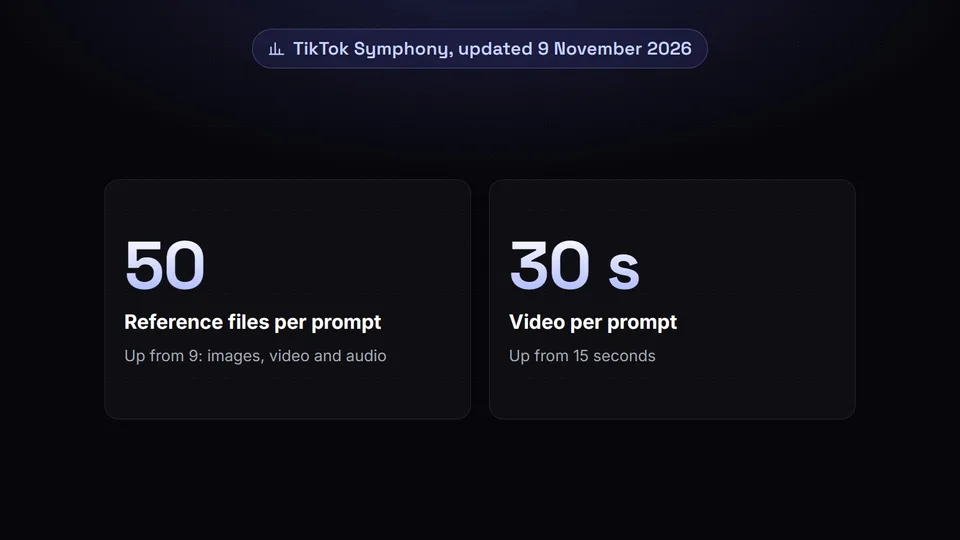
TikTok has updated Symphony, its suite of AI tools for creating ads, Social Media Today reported on 9 November. Symphony Agent can now produce video ads with newer Dreamina Seedance models, which the report describes as producing sharper, more realistic imagery with better lighting and more consistent characters from frame to frame.
Two limits have grown. Advertisers can now upload up to 50 reference files, combining images, video and audio, up from 9, and the updated models can generate up to 30 seconds of video per prompt, up from 15. A Symphony API lets advertisers generate content inside their own creative management platforms, and from 9 November advertisers outside North America can buy BytePlus tokens to use the Seedance models through Symphony.
The report did not mention any change to labelling, so TikTok's existing rules on disclosing AI-generated content in ads still apply. If you plan to test generated video at the new lengths, check those rules in TikTok's advertising policies before you scale up spending.
Longer, more realistic generated video also raises the bar for review. A 30-second ad gives a model more room to drift from your product, your brand's look or what you can actually claim, so treat generated ads like any other creative: someone who knows the product should watch every version before it runs, and the claims in it should be ones you can support.
YouTube's AI music fix for copyright claims goes global
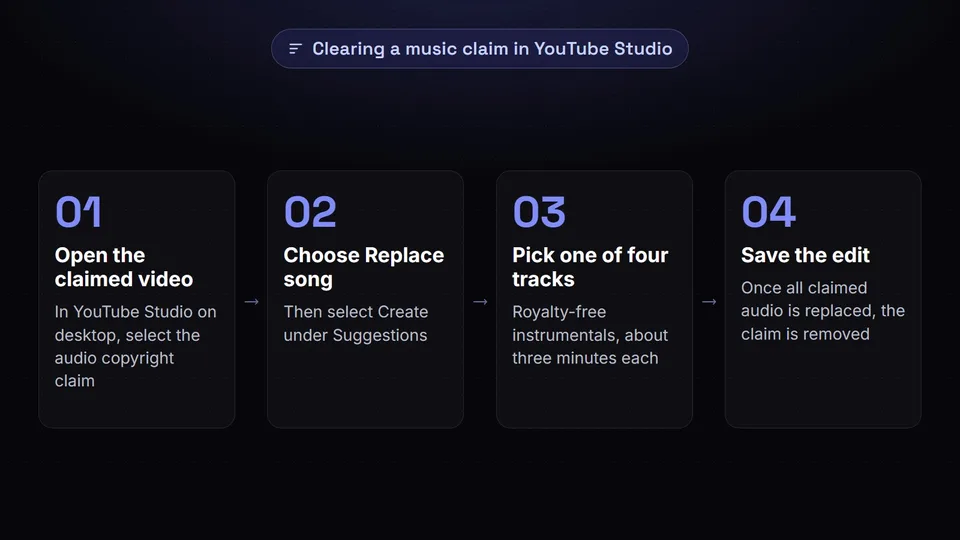
On 3 November YouTube expanded the AI music option in YouTube Studio's Replace song tool from the US to creators in most countries outside the European Economic Area, as ContentGrip reported. The EU, Norway, Iceland and Liechtenstein are excluded, and YouTube has not said whether or when they will get it.
When a video receives an audio copyright claim, a creator can open the Replace song tool on desktop, choose Create under Suggestions and receive four royalty-free instrumental tracks to pick from. Once all of the claimed audio is replaced, the Content ID claim is removed without re-uploading the video. The tracks are instrumental only, creators cannot ask for a style, the feature is not yet in the mobile app, and a saved edit cannot be reverted to the original audio.
The licence is the detail to note. YouTube's help documentation says the generated music is intended solely for videos and other content created on YouTube, so a track made to clear a claim is not cleared for Reels, TikTok, your website or paid ads. Use it to fix the YouTube video and source other music for everything else.
For channels that repurpose live streams, events or older videos, this matters more than it might seem. Music picked up in the background of a recording is a common source of Content ID claims, and until now the options were to mute the section, trim it or swap in a track from YouTube's audio library by hand. YouTube has not named the model that generates the tracks or said who owns the compositions, which is another reason to keep them where the licence clearly applies.
Pinterest makes its generative AI rules binding
From 12 November, Pinterest's updated Terms of Service incorporate its acceptable use guidelines for generative AI, PPC Land reported on 8 November. Breaking those guidelines becomes a breach of the user agreement, and the stated consequences include losing access to Pinterest's generative AI features, suspension and termination of the account.
The guidelines prohibit, among other things, using the AI tools to violate intellectual property or privacy, to get around safety measures, to impersonate others, to spread harmful misinformation, and to create spam or scams. The same update adds Pinterest's generative AI models to the models its Privacy Policy says are trained on users' Pins, and for users outside the European Economic Area, Switzerland and the UK, accepting the updated terms counts as consent to the processing that policy describes. The update does not change how Pinterest labels AI-made images; its existing labels for AI-generated or modified Pins, based on image metadata and its own detection, continue.
If your team uses Pinterest's AI features for creative or ads, read the guidelines before 12 November. What used to be advice is now part of the contract that governs your account.
What to watch: the EU's 2 December marking deadline
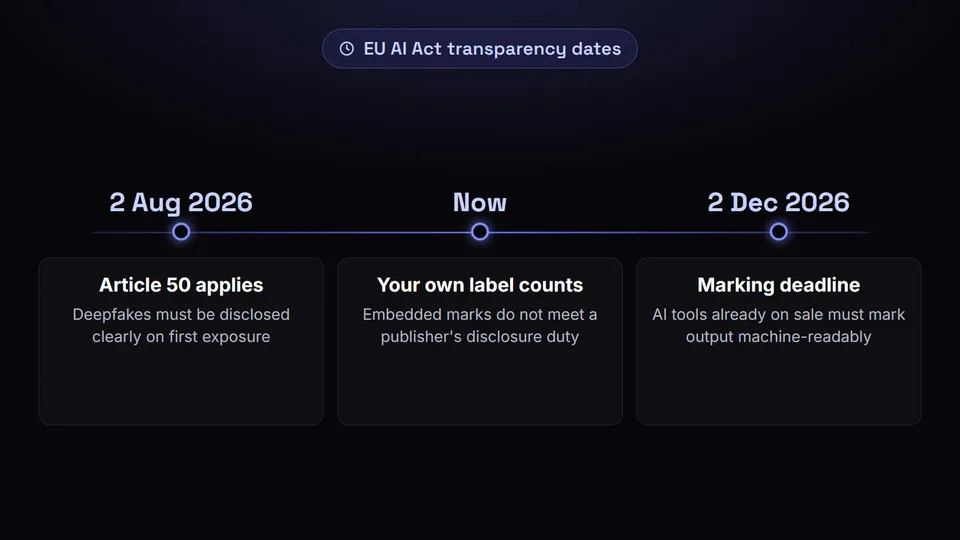
The EU AI Act's transparency rules in Article 50 have applied since 2 August 2026. According to the European Commission, organisations that publish deepfakes must disclose them clearly and visibly at the latest on first exposure, and they cannot rely on the invisible marks a generator embeds to meet that duty. For evidently artistic, satirical or fictional work, the disclosure can be made in a way that does not spoil the work. Whether something counts as a deepfake depends partly on whether its intended audience would reasonably take it as real, and content generated before 2 August 2026 does not have to be labelled retrospectively.
One grace period remains. Providers of generative AI systems that were already on the market before 2 August 2026 have until 2 December 2026 to comply with the duty to mark AI-generated content in a machine-readable way. Expect more AI tools to embed provenance information by then, and more platforms to detect and label AI-generated content automatically as a result.
For a brand, the obligation that matters is your own. If you publish realistic AI-generated images, video or audio of people, places or events to audiences in the EU, label them yourself. Do not assume a platform's automatic label will appear, or that it will count as your disclosure.
What this means for your content
- Review teen-facing activity on Instagram. More younger users will be in Teen Accounts, so messaging people who do not follow you will reach fewer of them.
- Check disclosure before scaling AI ads on TikTok. The tools now produce longer, more realistic video, and the rules on disclosure have not changed.
- Keep YouTube's replacement music on YouTube. It clears a claim there, but its licence does not cover other platforms.
- Read Pinterest's AI guidelines before 12 November if anyone on your team uses its generative tools.
- Label realistic AI content yourself for EU audiences, whatever a platform does automatically.
Conclusion
This week's news has a common thread: platforms are using AI more heavily on both sides, in the tools they offer and in the checks they run, while the rules around both are hardening. The useful response is the same in each case: know which rules apply to the tools you use, and make your own disclosures rather than relying on someone else's system.
SchedulifyX publishes this briefing every week. If you manage several platforms, scheduling your posts in SchedulifyX gives you one calendar to check against changes like these before anything goes out.
Sources
Facts checked against the sources below on November 10, 2026.
- Meta expands Instagram's AI age-guessing tech globally (TechCrunch)
- TikTok updates its AI video ad tools (Social Media Today)
- YouTube expands AI music claim repair beyond the US (ContentGrip)
- Pinterest users who abuse AI tools can lose accounts from November 12 (PPC Land)
- Transparency obligations under Article 50 of the AI Act (European Commission)
