The Ultimate 5-Minute Sunday Social Media Audit Framework
SchedulifyX Team · June 16, 2026
Master your weekly social media review with this quick 5-minute Sunday audit framework. Analyze metrics, spot trends, and plan your week with SchedulifyX.
In the fast-paced world of digital marketing, staying ahead of the curve requires more than just scheduling posts and hoping for the best. It requires consistent, strategic reflection. However, for busy social media managers, creators, and business owners, finding the time to dive deep into analytics can feel like an impossible luxury. Enter the 5-minute Sunday social media routine—a streamlined, highly effective framework designed to give you maximum insights with minimal time investment.
A comprehensive social media audit doesn't always have to be a sprawling, multi-hour endeavor involving massive spreadsheets and complex data visualization tools. Sometimes, all you need is a focused, quick social media analysis to ensure your strategy remains aligned with your goals. By dedicating just five minutes at the end of your week to review your performance, you can identify what worked, what failed, and how to pivot for the week ahead.
In this comprehensive tutorial, we will break down the ultimate 5-minute Sunday audit framework. You will learn how to conduct an efficient weekly social media review, check key metrics, identify your top-performing posts, spot emerging trends, and plan strategic adjustments. Let's transform your Sundays from a day of content anxiety into a day of strategic empowerment.
The Power of a Sunday Social Media Routine

Sundays possess a unique psychological weight. For many, they represent the bridge between the exhaustion of the past week and the potential of the week to come. Establishing a sunday social media routine capitalizes on this transitional mindset. Instead of waking up on Monday morning scrambling to figure out what to post, a Sunday routine allows you to approach the new week with clarity, purpose, and a data-backed strategy.
Think of this routine as a weekly reset button. It is a moment of quiet reflection before the noise of the workweek begins. When you make this quick social media analysis a non-negotiable part of your weekend, you shift your approach from reactive to proactive. You are no longer just participating in the social media landscape; you are actively commanding your presence within it.
Why You Need a Weekly Social Media Review
Many marketers fall into the trap of only reviewing their analytics at the end of the month or, worse, at the end of the quarter. While monthly and quarterly reports are essential for understanding macro-trends, they are too slow for day-to-day optimization. A weekly social media review provides the agility necessary to thrive in today's algorithmic environment.
1. Rapid Course Correction
Algorithms change, audience preferences shift, and cultural conversations evolve at lightning speed. If a specific content format is suddenly being suppressed by an algorithm, you don't want to wait 30 days to find out. A weekly review allows you to pivot immediately, saving you from wasting time and resources on ineffective content.
2. Capitalizing on Micro-Trends
Trends on platforms like TikTok, Instagram Reels, and X (formerly Twitter) often have a lifespan of just a few days. By reviewing your performance weekly, you can spot the early signs of a trend that resonates with your audience and double down on it before the window of opportunity closes.
3. Preventing Creator Burnout
Content creation is exhausting. When you don't know what is working, you tend to throw everything at the wall to see what sticks—a surefire recipe for burnout. A regular social media performance check tells you exactly what to focus on, allowing you to cut the fluff and conserve your creative energy for high-ROI activities.
The 5-Minute Framework: A Step-by-Step Guide
The secret to a successful 5-minute social media audit lies in extreme focus. You must know exactly what you are looking for before you open your analytics dashboard. This is not the time to get lost in vanity metrics or deep-dive into audience demographics. This is a rapid-fire, high-level assessment.
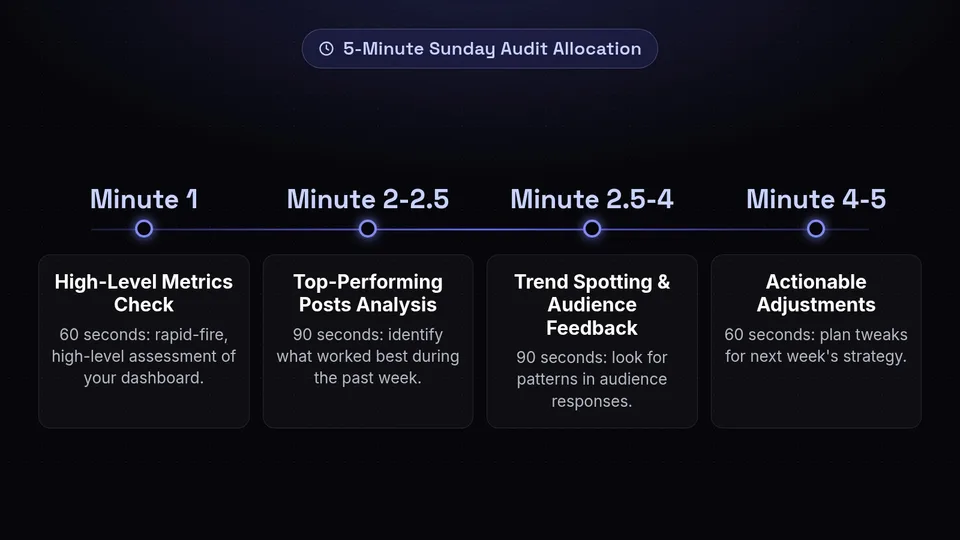
Here is how to allocate your 5 minutes:
- Minute 1: High-Level Metrics Check (60 seconds)
- Minute 2-2.5: Top-Performing Posts Analysis (90 seconds)
- Minute 2.5-4: Trend Spotting & Audience Feedback (90 seconds)
- Minute 4-5: Actionable Adjustments for Next Week (60 seconds)
Let's break down each step in detail.
Step 1: The 60-Second Social Media Performance Check
Your first 60 seconds are dedicated to the raw numbers. Open your analytics dashboard—whether that is the native insights on platforms like Instagram and LinkedIn, or a centralized hub like SchedulifyX—and look at your week-over-week (WoW) performance.
Metrics to Check:
- Total Impressions/Reach: Is your content being seen by more or fewer people than last week?
- Engagement Rate: Are people actually interacting with your content, or just scrolling past? (Calculated as Total Engagements / Total Impressions x 100).
- Follower Growth: Did you gain or lose followers? (Note: Keep this in perspective; a small drop is normal, but a massive spike or plunge requires investigation).
- Click-Through Rate (CTR): If your goal was to drive traffic to a link in your bio or website, how many clicks did you generate?
The Goal: You are looking for anomalies. If your reach is up 20%, make a mental note. If your engagement rate plummeted, make a mental note. Do not try to solve the "why" just yet; simply observe the "what."
Step 2: Identifying Top-Performing Posts (90 Seconds)
Now that you have a pulse on your overall performance, it is time to look at the specific pieces of content that drove those numbers. Spend the next 90 seconds identifying your top 2 or 3 posts of the week, as well as your biggest flop.
Analyzing the Winners
When you look at your top-performing posts, ask yourself the following questions:
- Format: Was it a carousel, a short-form video, a text-only post, or an infographic?
- Hook: What was the first sentence or the first 3 seconds of the video? Did it ask a question, state a bold opinion, or offer a solution?
- Topic: What was the subject matter? Was it educational, entertaining, inspirational, or promotional?
- Timing: What day and time was it posted?
Analyzing the Losers
Equally important is understanding what failed. Look at the post with the lowest reach or engagement. Was the hook weak? Was the visual unappealing? Was the topic irrelevant to your audience's current pain points?
"The fastest way to grow on social media is not just creating more content, but creating more of what your audience has already proven they love. Let your winners dictate your strategy."
Step 3: Spotting Trends and Audience Behavior (90 Seconds)
For the third phase of your quick social media analysis, shift your focus from the quantitative data to the qualitative data. This means looking at your comments, direct messages, and the broader industry landscape.
Reviewing Audience Feedback
Skim through the comments on your top posts. What are people saying? Are they asking follow-up questions? Are they disagreeing with your premise? Are they tagging their friends? Audience comments are a goldmine for future content ideas. If three people asked the same question in your comments this week, that question should be the topic of a post next week.
Spotting Industry Trends
Take a quick glance at your industry's thought leaders or your "For You" page. Are you noticing any recurring themes? Is there a new trending audio clip everyone is using? Is there a breaking news story in your niche that you need to comment on? Incorporating these micro-trends into your content calendar keeps your brand relevant and timely.
Step 4: Planning Adjustments for the Week Ahead (60 Seconds)
The final 60 seconds of your social media audit are the most crucial. Data without action is just trivia. You must use the insights you've gathered to make tangible adjustments to your upcoming content calendar.
Actionable Next Steps:
- Double Down: If carousels about productivity tools performed exceptionally well, adjust your schedule to include another productivity carousel this week.
- Pivot: If your promotional posts received zero engagement, rewrite the copy for this week's promo post to focus more on value and less on the hard sell.
- Engage: If you noticed a specific follower leaving insightful comments, make a note to proactively engage with their content this week to build community.
- Optimize: If you noticed posts published at 9 AM performed better than those at 2 PM, adjust your SchedulifyX queue to prioritize morning slots.
Jot down these 2-3 actionable takeaways in a notebook or your digital workspace. You are now ready to tackle the week ahead with a data-driven strategy.
Platform-Specific Audit Checklists
While the 5-minute framework applies generally, each platform has unique nuances. If you are focusing your audit on a specific channel, keep these platform-specific metrics in mind during your social media performance check.
- Saves and Shares: On Instagram, these are the highest-value engagement metrics. A high number of saves indicates your content is highly educational or valuable. A high number of shares indicates it is relatable or entertaining.
- Reels Watch Time: Are viewers dropping off after 3 seconds? If so, your hooks need work.
- Story Completion Rate: Are people tapping through all your stories, or exiting after the first one?
- Dwell Time: LinkedIn's algorithm heavily favors posts that keep users reading. Analyze your longer, text-based posts to see which ones retained attention.
- Comment Depth: On LinkedIn, a thoughtful, multi-sentence comment is worth far more than a simple "Great post!" Look for posts that sparked real dialogue.
- Profile Views: Did your content drive people to view your profile and potentially check out your services?
X (Twitter)
- Bookmarks: Similar to Instagram saves, bookmarks on X indicate high-value reference material.
- Thread Completion: If you write threads, look at the engagement on the final tweet compared to the first tweet to gauge drop-off.
- Quote Reposts vs. Standard Reposts: Quote reposts indicate that your content provoked a strong enough reaction for someone to add their own commentary.
TikTok
- Average Watch Time: This is the holy grail metric on TikTok. If your watch time is high, the algorithm will push your video to the FYP (For You Page).
- Traffic Source Types: Are your views coming from your followers, or from the FYP? This tells you if you are nurturing your existing audience or reaching new people.
Common Pitfalls to Avoid During Your Weekly Social Media Review
Even with a streamlined 5-minute system, it is easy to fall into bad habits. To ensure your sunday social media routine remains effective, avoid these common pitfalls:
1. Obsessing Over Vanity Metrics
It is easy to get caught up in follower counts and likes. However, these metrics rarely correlate directly with business growth. Focus instead on actionable metrics like engagement rate, link clicks, and saves. A post with 50 likes and 10 link clicks is often more valuable than a post with 500 likes and 0 clicks.
2. Overreacting to a Single Bad Week
Algorithms fluctuate. Holidays, global events, and even nice weather can cause a temporary dip in social media usage. If your numbers are down one week, note it, but do not panic and completely overhaul your entire strategy. Look for sustained trends over 2-3 weeks before making drastic changes.
3. Ignoring the "Why"
Spotting that a post performed well is only half the battle. If you don't take the time to hypothesize why it performed well, you won't be able to replicate its success. Always dig into the hook, format, and timing.
4. Failing to Document Insights
If you perform your 5-minute audit but don't write down your findings, you will forget them by Tuesday. Keep a running Google Doc, Notion page, or dedicated notebook for your weekly insights. Over time, this document will become a personalized playbook for your brand's social media success.
Elevate Your Social Media Strategy with SchedulifyX
Implementing a quick social media analysis every Sunday is one of the highest-leverage habits you can build as a marketer or creator. In just five minutes, you transition from guessing to knowing, ensuring that every piece of content you publish in the coming week is optimized for success.
However, an audit is only as good as the data you have access to, and gathering that data from multiple native apps can quickly eat up your five minutes. This is where AI-powered platforms revolutionize the process.
With SchedulifyX, your weekly social media review is practically done for you. Our advanced analytics dashboard aggregates all your cross-platform performance data into one easy-to-read interface. You can instantly see your top-performing posts, track engagement trends, and utilize our AI insights to generate recommendations for the week ahead. Instead of spending your Sunday manually calculating engagement rates, you can spend it making high-level strategic decisions.
Stop letting the algorithm dictate your success. Take control of your strategy, implement the 5-minute Sunday audit framework, and let SchedulifyX handle the heavy lifting. Start your free trial today and transform the way you approach social media.