6 Content Calendar Mistakes and Why Calendars Fail
SchedulifyX Team · October 6, 2026
Discover the most common content calendar mistakes and why calendars fail. Avoid these six predictable planning pitfalls to streamline your social media strategy.
Every social media manager, marketing director, and digital strategist has experienced the familiar surge of optimism that accompanies a brand-new content calendar. The grid is perfectly aligned, the colour-coding is pristine, and the upcoming weeks stretch out as a flawless roadmap of engaging, timely posts. Yet, fast forward just a few weeks, and that same calendar is often abandoned, disorganised, or entirely ignored. The schedule breaks down, posts are missed, and teams revert to reactive, last-minute publishing.
If this scenario sounds familiar, you are not alone. The transition from proactive planning to chaotic execution is a well-documented phenomenon in digital marketing. But why does this happen so consistently? The reality is that content calendars fail for predictable reasons. They do not collapse overnight; they erode gradually due to structural flaws in how they are built and maintained.
Understanding these underlying vulnerabilities is the first step towards building a sustainable social media strategy. By identifying the most common content calendar mistakes, you can design a system that works for your team rather than against them. In this comprehensive guide, we will explore six critical planning pitfalls, examine the mechanics of why calendars fail, and provide actionable frameworks to ensure your scheduling efforts remain robust, flexible, and effective over the long term.
Overcomplicating the Initial Setup
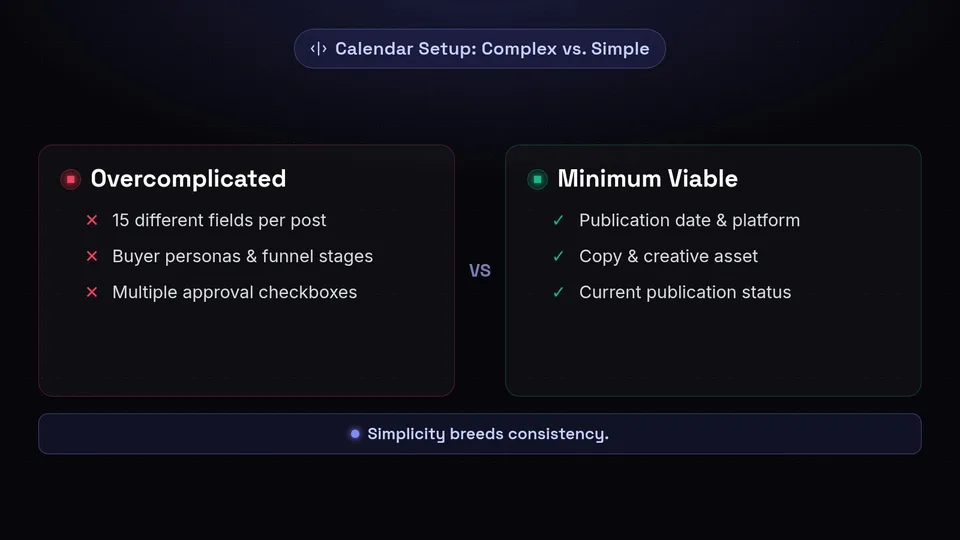
One of the most frequent content calendar mistakes occurs before a single post is even published. In an attempt to be thorough, teams often design calendars that are overwhelmingly complex. When setting up a new system, it is tempting to include columns for every conceivable metric and tag: content pillars, buyer personas, funnel stages, tone of voice, character counts, and multiple approval checkboxes.
The Mechanism of Complexity
The problem with this approach is rooted in operational friction. Every additional field in a calendar represents a micro-task that a team member must complete. When a calendar requires a user to fill out fifteen different fields just to schedule a single tweet or update, the administrative burden quickly outweighs the value of the post itself. This friction leads to procrastination. Team members will naturally delay updating the calendar because the process is tedious. Once one or two posts are skipped, the calendar ceases to be an accurate reflection of the strategy, and trust in the document plummets.
Embracing Minimum Viable Planning
To avoid these planning pitfalls, teams must embrace the concept of minimum viable planning. A calendar should only capture the information strictly necessary to execute the strategy. At its core, a functional entry requires the publication date, the platform, the copy, the creative asset, and the current status. By stripping away non-essential fields, you reduce the barrier to entry for your team. If a specific tag or category is not being actively used to filter data or drive strategic decisions, it should be removed from the workflow entirely. Simplicity breeds consistency.
Ignoring the Approval Bottleneck
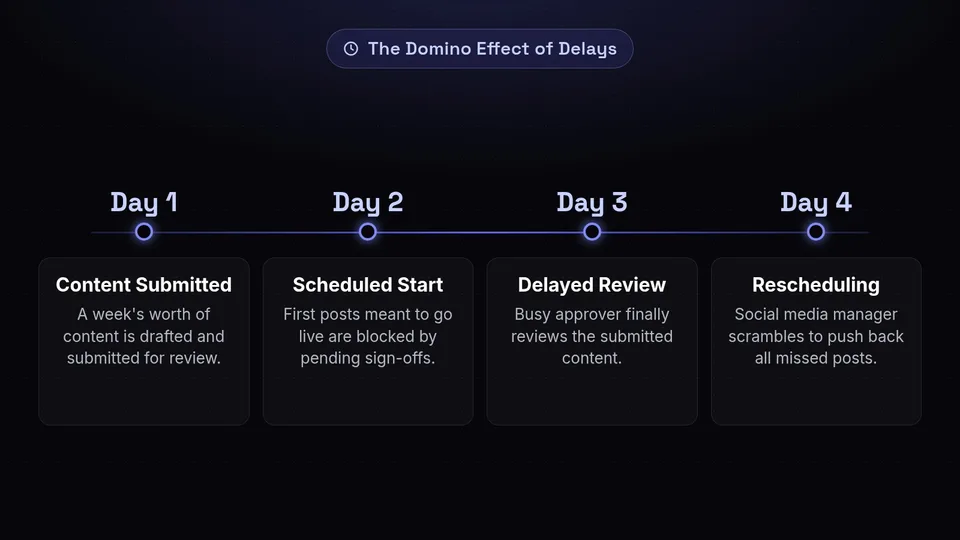
Another primary reason why calendars fail is the misalignment between the scheduling pace and the approval process. A calendar may dictate that three posts need to go live every day, but if every single post requires sign-off from a busy department head or client, you have engineered a systemic bottleneck.
The Domino Effect of Delayed Sign-offs
The mechanism of this failure is straightforward. A social media manager drafts a week's worth of content and submits it for review. The approver, managing their own demanding workload, does not review the content until a day after the first posts were scheduled to go live. The social media manager must then scramble to reschedule the missed posts, pushing back subsequent content. This creates a domino effect. The calendar becomes a rolling backlog of delayed tasks rather than a forward-looking strategy. Eventually, the team stops scheduling in advance because they know the dates will inevitably change.
Streamlining the Review Process
To resolve this, the approval workflow must be integrated seamlessly into the calendar's architecture. This can be achieved by establishing clear service-level agreements (SLAs) for approvals—for instance, agreeing that all content will be reviewed within 48 hours of submission. Alternatively, teams can move towards a framework of distributed accountability. Instead of requiring granular approval for every daily update, senior stakeholders can approve broader monthly themes or content pillars, empowering the social media team to execute the daily posts independently. Reducing the number of gatekeepers is essential for maintaining calendar momentum.
Failing to Build in Flexibility

Digital marketing is inherently dynamic. Trends emerge overnight, platform algorithms shift, industry news breaks, and global events dictate sudden changes in tone. One of the most severe content calendar mistakes is treating the schedule as an immutable contract rather than a flexible guide.
The Illusion of Perfect Foresight
When a calendar is filled to maximum capacity weeks in advance, it creates an illusion of perfect foresight. However, this rigidity is precisely why calendars fail when reality intervenes. If a major industry development occurs, a rigidly packed calendar leaves no room for the team to pivot and publish a timely response. If they force the new post into the schedule, they must manually displace and reschedule everything else. Furthermore, publishing tone-deaf, pre-scheduled promotional content during a serious news event can severely damage brand reputation. A calendar that cannot bend will inevitably break.
Designing Strategic Buffers
The solution is to design your schedule with intentional gaps. Do not schedule content for every available slot. Instead, implement strategic buffers—leaving specific days or times entirely blank to accommodate reactive content, user-generated posts, or breaking news. Treat your calendar as a framework containing foundational, evergreen content that anchors your strategy, while leaving ample breathing room for the spontaneous engagement that social media audiences crave. Flexibility is not a lack of planning; it is the most sophisticated form of planning.
Disconnecting Planning from Creation
A calendar is merely a representation of intent. It says, 'We intend to publish this video on Tuesday.' However, if the video is not actually filmed, edited, and formatted by Tuesday, the calendar is useless. A classic planning pitfall is treating the scheduling calendar and the content production workflow as two entirely separate entities.
The Gap Between Idea and Asset
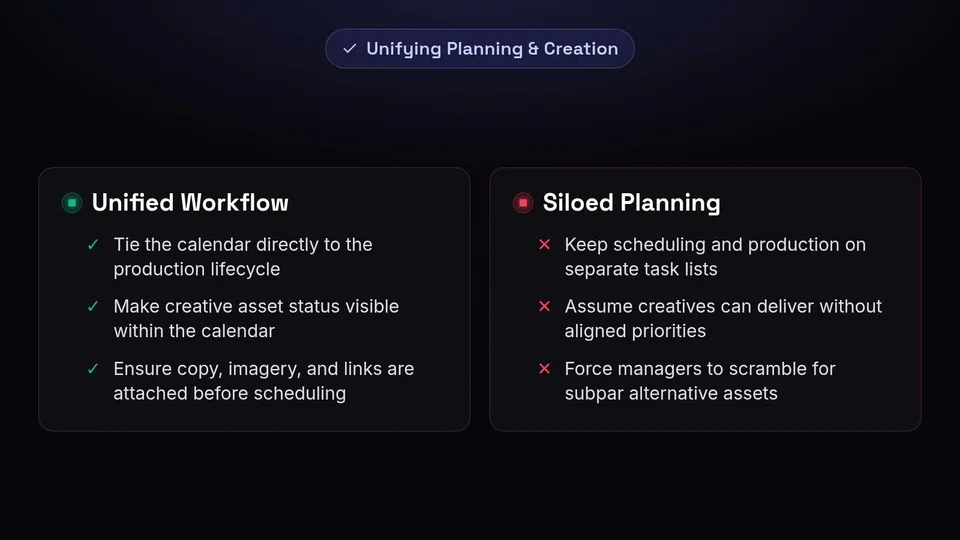
When planning is disconnected from creation, teams operate in silos. The social media strategist fills the calendar with ambitious ideas, assuming the creative team can deliver them on time. The designers and videographers, meanwhile, are working from their own separate task lists with different priorities. As publication dates approach, the assets are not ready. The social media manager is forced to either publish a subpar alternative or leave the slot empty. This disconnect transforms the calendar from a reliable schedule into a wish list.
Unifying the Workflow
To prevent this, the calendar must be tied directly to the production lifecycle. The status of the creative asset must be visible within the calendar itself. Before a post is firmly scheduled for publication, all necessary components—copy, imagery, video, and tracking links—must be attached or at least rigorously tracked in the same system. By unifying the planning and creation phases, you ensure that your calendar reflects reality, ensuring that what is scheduled is actually ready to be shared.
Neglecting Platform Nuances
In the pursuit of efficiency, marketers often fall into the trap of cross-posting. They write a single piece of copy, attach a single image, and schedule it to be blasted simultaneously across LinkedIn, X (formerly Twitter), Facebook, and Instagram. While this certainly fills up the calendar quickly, it is one of the most detrimental content calendar mistakes a brand can make.
The Homogenisation of Content
Different social media platforms possess entirely different cultures, user expectations, and technical requirements. What performs well as a professional, long-form text post on LinkedIn will likely fail on X, where brevity and quick engagement are paramount. Instagram demands high-quality visual storytelling, while Facebook leans towards community discussion and shared links. When a calendar is built around homogenous, copy-pasted content, engagement rates plummet. The audience quickly realises the brand is broadcasting rather than engaging, leading to algorithmic penalties and a loss of followers. The calendar may be full, but the strategy is failing.
Platform-Specific Tailoring
A successful content calendar must account for platform nuances. Instead of scheduling the exact same post across all channels, schedule a core concept and dedicate time to tailoring the execution for each network. Adjust the tone, resize the imagery to native aspect ratios, utilise platform-specific features (like polls or carousels), and modify the call-to-action. Your calendar should visually represent this tailored approach, ensuring that your brand speaks the right language in the right digital environment.
The Ghost Town Effect: Lack of Maintenance
Finally, we must address the most silent killer of social media strategies: the lack of ongoing maintenance. A content calendar is not a 'set it and forget it' tool. It is a living, breathing document that requires regular tending. When teams fail to maintain the calendar, it suffers from what can be termed the ghost town effect.
The Erosion of Trust
The mechanism here is gradual decay. A meeting is moved, so a post is delayed, but no one updates the calendar. A campaign is cancelled, but the placeholder remains on the grid. Slowly, discrepancies between the calendar and reality begin to accumulate. Once team members notice that the calendar is inaccurate, they stop checking it. They stop trusting it. They revert to sending direct messages to ask, 'What are we posting today?' Once this erosion of trust occurs, the calendar is effectively dead, regardless of how much effort went into its initial creation.
Implementing Scheduled Maintenance
To combat this, maintenance must be treated as a non-negotiable task. Assign clear ownership of the calendar to a specific individual—usually the social media manager or content lead. Schedule a brief, weekly calendar review meeting with all relevant stakeholders. During this time, audit the upcoming week, confirm that all assets are ready, adjust dates based on new developments, and archive old, irrelevant placeholders. By institutionalising calendar maintenance, you preserve the integrity of the tool and ensure it remains the single source of truth for your marketing efforts.
Overcoming Planning Pitfalls
Recognising why calendars fail is only half the battle; the true challenge lies in implementing systems that actively resist these failures. The content calendar mistakes we have explored—overcomplication, approval bottlenecks, rigidity, disconnected workflows, platform homogenisation, and lack of maintenance—are all symptoms of a process that prioritises the tool over the team using it.
To overcome these planning pitfalls, you must design a workflow that is empathetic to human behaviour. Keep your categorisation simple so that updating the system is effortless. Streamline your approvals to maintain momentum. Build in strategic buffers so that your team can breathe and react to the world around them. Connect your planning directly to your asset creation so that you are scheduling realities, not just ideas. Respect the unique culture of each social media platform, and above all, commit to regular, disciplined maintenance of the schedule.
Conclusion
Building a successful social media presence requires more than just good ideas; it requires flawless execution. As we have seen, content calendars fail for predictable reasons, but these failures are entirely preventable. By understanding the mechanics of these common content calendar mistakes, you can refine your processes, eliminate operational friction, and create a sustainable rhythm for your digital marketing.
Managing this process manually via disconnected spreadsheets is often the root cause of these planning pitfalls. To truly streamline your workflow, you need tools designed to bridge the gap between strategy and execution. SchedulifyX is an AI-powered social media scheduling platform built to help you avoid these exact traps. By centralising your planning, streamlining your platform-specific tailoring, and providing the flexibility modern teams demand, SchedulifyX empowers you to build a content calendar that actually works. Take control of your social media strategy today and turn your planning into predictable, stress-free publishing.