How to Batch a Month of LinkedIn Posts in One Afternoon
SchedulifyX Team · September 17, 2026
Discover how to reclaim your time by batching a full month of LinkedIn content in a single afternoon. Learn our step-by-step framework for consistent posting.
Maintaining a consistent presence on LinkedIn is a powerful way to build professional authority, attract new opportunities, and nurture a network of industry peers. However, the daily scramble to draft, edit, and publish a post can quickly become a drain on your energy. Staring at a blank text box every morning while trying to conjure an insightful professional update is a recipe for burnout. The solution to this common professional dilemma is learning how to batch linkedin content.
Batching is a productivity technique that involves grouping similar tasks together to minimise the cognitive load of context switching. By dedicating a single afternoon to your LinkedIn strategy, you can generate, draft, refine, and schedule an entire month's worth of posts. This comprehensive guide will walk you through the exact process of building a robust linkedin content calendar and maintaining an unshakeable linkedin posting schedule, all while reclaiming your daily focus for your core professional work.
The Mechanics of Content Batching
Before diving into the practical steps, it is vital to understand why batching works. The human brain is not naturally designed for rapid context switching. Transitioning from analytical tasks, such as reviewing financial spreadsheets or writing code, to creative tasks, like drafting a compelling social media narrative, requires a significant shift in cognitive function. Every time you switch gears, you expend mental energy, leading to a phenomenon known as attention residue, where part of your focus remains on the previous task.
Why Context Switching Drains Your Energy
When you attempt to write a single LinkedIn post each day amidst your regular workload, you force your brain to repeatedly warm up to the creative process. You must remember your strategic goals, find an idea, write the copy, edit it, and then log into the platform to publish it. This fragmented approach is inefficient.
By choosing to batch linkedin content, you consolidate that warm-up period. Once you enter a state of creative flow, generating the fourth or fifth post becomes significantly easier than generating the first. You are already in the mindset of your audience, your tone of voice is dialed in, and your ideas naturally begin to connect and compound.
The Four Phases of Batching
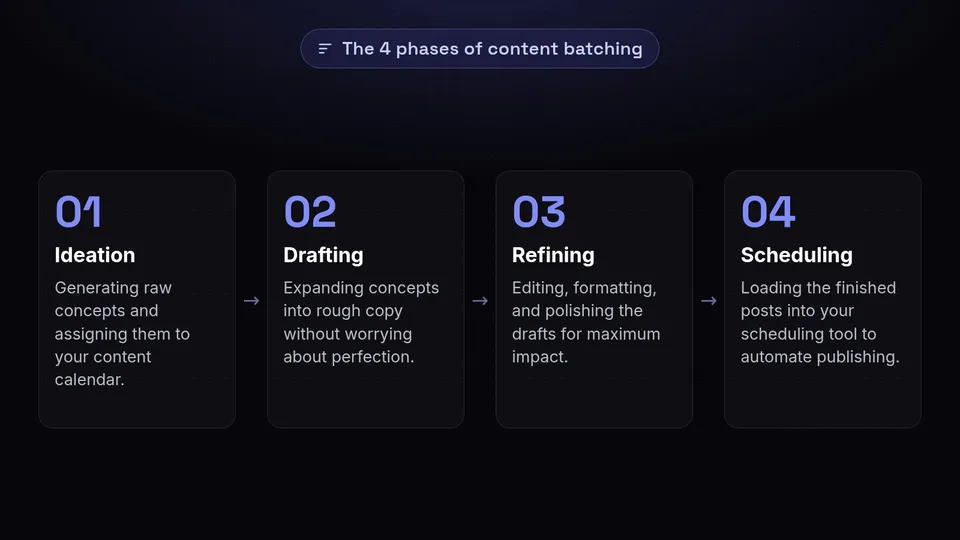
To successfully batch a month of content in one afternoon—typically a block of roughly four hours—you must divide the work into distinct phases. Mixing these phases will sabotage your efficiency. The phases are:
- Ideation: Generating the raw concepts and assigning them to your linkedin content calendar.
- Drafting: Expanding those concepts into rough copy without worrying about perfection.
- Refining: Editing, formatting, and polishing the drafts for maximum impact.
- Scheduling: Loading the finished posts into your scheduling tool to automate your linkedin posting schedule.
Laying the Groundwork for a Month of Posts
You cannot successfully batch content if you sit down without a strategy. The preparation you do before your dedicated afternoon will dictate your success. The most effective way to prepare is by establishing clear content pillars.
Defining Your Core Pillars
Content pillars are the three to five core themes that you consistently discuss on your profile. They act as boundaries for your creativity, ensuring that your content remains relevant to your target audience and aligned with your professional goals. Without pillars, you risk publishing a disjointed feed that confuses your network.
Common examples of content pillars include:
- Actionable Industry Advice: Practical tips, frameworks, and methodologies related to your specific profession.
- Contrarian or Unique Perspectives: Respectful challenges to common industry narratives, demonstrating deep critical thinking.
- Personal Professional Journey: Lessons learned from failures, career transitions, or behind-the-scenes glimpses into your daily work.
- Cultural or Leadership Observations: Thoughts on team dynamics, management philosophies, or industry trends.
By defining these pillars in advance, you eliminate the overwhelming question of "What should I write about?" and replace it with "What can I share today about my specific pillars?"
Setting Up Your LinkedIn Content Calendar
A well-structured linkedin content calendar is the backbone of your batching process. This does not need to be a complex piece of software; a simple spreadsheet or a digital workspace board is perfectly sufficient. Your calendar should outline the days you intend to post and the specific pillar assigned to each day.
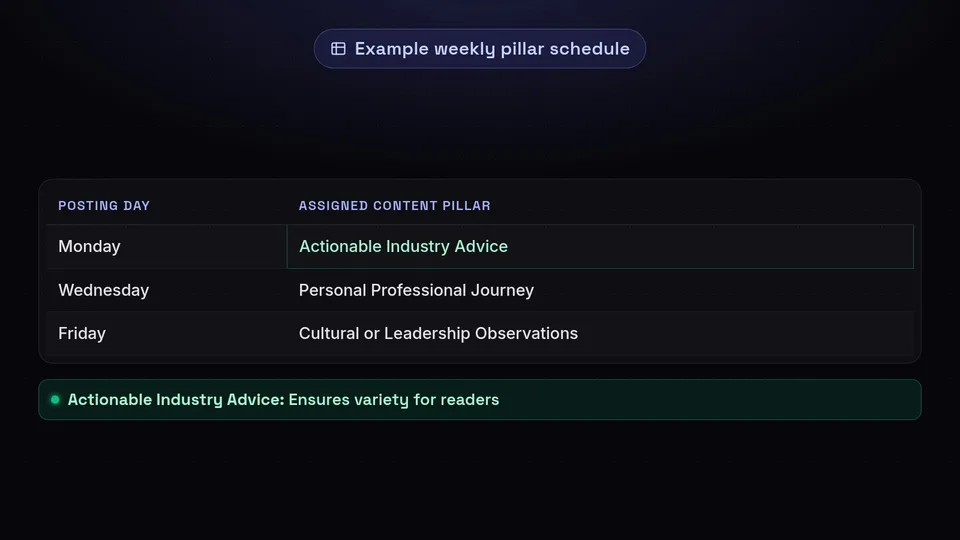
For instance, if your goal is to maintain a linkedin posting schedule of three times per week (e.g., Monday, Wednesday, and Friday), you will need approximately twelve posts for a four-week month. You can assign 'Actionable Advice' to Mondays, 'Personal Journey' to Wednesdays, and 'Industry Observations' to Fridays. This rhythm ensures variety for your readers and provides a clear roadmap for your batching session.
Step One: The Ideation Phase (0 to 45 Minutes)

As your dedicated afternoon begins, your first task is strictly ideation. Do not write full sentences. Do not worry about grammar. Your only goal is to fill the twelve slots on your linkedin content calendar with viable concepts.
Harvesting Ideas from Existing Assets
The most sustainable way to batch linkedin content is to stop trying to invent brilliant ideas from thin air. Instead, look at the work you are already doing. Your daily professional life is a goldmine of content.
- Client Questions: If one client or colleague asked you a specific question this week, it is highly likely that hundreds of people in your broader network have the exact same question. Turn the answer into a post.
- Meeting Notes: Review your notes from recent strategy sessions or project debriefs. What were the key takeaways or unexpected hurdles?
- Content Consumption: What articles, podcasts, or books have you consumed recently? Write down your distinct reaction or application of that material.
Using the Problem-Agitation-Solution Framework
If you are struggling to flesh out an idea, apply a proven copywriting framework like Problem-Agitation-Solution (PAS). First, identify a specific problem your audience faces. Next, agitate that problem by describing the negative consequences of leaving it unsolved. Finally, present your solution or methodology. Jotting down these three bullet points takes only a few minutes and provides a perfect outline for the drafting phase.
Structuring Ideas into a LinkedIn Posting Schedule
Once you have a list of twelve to fifteen rough ideas (it is always wise to generate a few extras), slot them into your calendar. Ensure that you are not clustering too many heavy, technical posts together. Balance them with lighter, more narrative-driven content. Once every slot is filled, close your notes and take a five-minute break to reset your mind for the next phase.
Step Two: The Drafting Phase (45 to 120 Minutes)

This is the most intensive part of the afternoon. Your objective here is to transform your bullet points into full drafts. The golden rule of the drafting phase is to separate writing from editing. If you stop to fix a spelling mistake or endlessly tweak a sentence, you will break your flow state and fail to finish the batch.
Writing the Hooks
The success of a LinkedIn post is heavily dependent on the first two to three lines. LinkedIn truncates longer posts with a 'see more' button. If your opening lines—your hook—do not compel the reader to click that button, the rest of your post will remain unread, regardless of how valuable the insight might be.
Spend a disproportionate amount of your drafting time on the hooks. A strong hook typically does one of the following:
- States a bold or counter-intuitive claim.
- Asks a highly specific, resonant question.
- Promises a tangible outcome or list of steps.
- Opens with a vulnerable or surprising personal statement.
Draft two or three alternative hooks for each post. You can select the strongest one during the refinement phase.
Expanding the Body Copy
With the hook established, expand on your core idea. Write conversationally, as if you were explaining the concept to a respected peer over coffee. Avoid overly dense corporate jargon, which tends to alienate readers on social platforms. Focus on clarity and momentum. If you are sharing a list of tips, draft the core points. If you are telling a story, get the beginning, middle, and end down on the page.
Crafting the Call to Action (CTA)
Every post should have a purpose. What do you want the reader to do after consuming your content? While not every post needs a hard sell, every post should encourage engagement. Your CTA might be a question prompting readers to share their experiences in the comments, an invitation to connect, or a gentle nudge toward a more comprehensive resource you have created. Draft a clear, concise CTA for the end of each post.
Step Three: The Refining and Formatting Phase (120 to 180 Minutes)
After another short break, return to your drafts with an analytical eye. You have successfully generated the raw material; now you must sculpt it into a format that performs well in the LinkedIn feed.
Editing for Clarity and Impact
Read each draft aloud. This is the most effective mechanism for catching awkward phrasing, overly long sentences, and unnatural rhythms. If you stumble over a sentence while reading it aloud, your audience will stumble over it in their heads. Cut the fluff. Professional audiences value their time, so ensure every word serves a purpose.
Review the alternative hooks you wrote in the previous phase. Select the most compelling one and ruthlessly delete the rest. Ensure that the transition from the hook to the main body is seamless.
Formatting for the LinkedIn Feed
The visual presentation of your text is just as important as the words themselves. Massive blocks of text are intimidating and frequently scrolled past. To optimise your content for readability, especially on mobile devices, you must embrace white space.
- Keep paragraphs short: One to three sentences per paragraph is ideal for social media.
- Use bullet points: Break down complex lists or steps using standard bullet points or relevant emojis to draw the eye down the page.
- Strategic emphasis: Use bolding or italics sparingly to highlight key takeaways, but avoid overusing them, which can make the post look cluttered.
Remember: The goal of formatting is to make the reading experience as frictionless as possible. A well-formatted post invites the reader to glide from the hook all the way down to the call to action.
Step Four: The Scheduling Phase (180 to 240 Minutes)
You now have a month's worth of polished, highly readable content. The final step is to automate the delivery. Relying on your memory to manually publish a post at the correct time each day introduces unnecessary stress and the risk of inconsistency.
Uploading to Your Scheduling Tool
Take your finished drafts and begin loading them into your chosen platform. This is where your linkedin content calendar transitions from a planning document to an active strategy. Carefully copy and paste your text, ensuring that the formatting (line breaks, bullet points) transfers correctly.
Pay close attention to the timing of your posts. While the ideal posting time varies depending on your specific network and time zone, consistency is the most critical factor. Choose times when your target audience is most likely to be active—often during morning commutes, lunch breaks, or early evenings—and stick to them.
Why SchedulifyX Simplifies the Process
When you are ready to implement your linkedin posting schedule, using a dedicated AI-powered platform like SchedulifyX streamlines the final hurdle of the batching process. SchedulifyX allows you to seamlessly input your entire month of content in one sitting. You can map out your posts visually, ensuring that your content pillars are evenly distributed across the weeks.
By trusting SchedulifyX to handle the precise timing and publication of your posts, you completely remove the daily operational burden of social media management. Your content will go live exactly as planned, allowing you to focus entirely on your actual work and the subsequent engagement.
Best Practices for a Sustainable LinkedIn Posting Schedule
Batching is a powerful system, but to maintain it month after month, you must adopt a sustainable mindset. It is easy to become overly ambitious in the beginning, only to burn out when the next batching day arrives.
Balancing Evergreen and Timely Content
One of the common concerns about deciding to batch linkedin content is the fear of appearing out of touch with current events. To mitigate this, ensure that the majority of your batched content is 'evergreen'—meaning it remains relevant regardless of the news cycle. Core industry advice, personal stories, and fundamental frameworks rarely expire.
Leave room in your linkedin content calendar for spontaneous, timely posts. If a major industry shift occurs, you can easily insert a real-time post into your schedule, pushing your evergreen batched content back by a day. Batching provides a safety net, not a rigid cage.
Engaging Beyond the Scheduled Posts
It is crucial to understand that scheduling your posts does not mean you can ignore the platform entirely. LinkedIn is a social network, and the algorithm heavily favours content that generates active conversations. When SchedulifyX publishes your post, your job shifts from creator to host.
Dedicate fifteen minutes a day to responding to comments on your posts. Acknowledge insights, answer questions, and foster a sense of community. Furthermore, spend time leaving thoughtful comments on the posts of your peers and industry leaders. This reciprocal engagement is what ultimately amplifies the reach of the content you worked so hard to batch.
Analysing Your LinkedIn Content Calendar Performance
The final component of a successful batching strategy occurs just before you sit down to plan your next month. You must review the performance of the current month to inform your future ideation.
Identifying What Resonates
Look at the metrics available to you. Which posts generated the most meaningful conversations in the comments? Which formats (lists, stories, contrarian views) resulted in the highest visibility? Identify the patterns in your successful posts. Perhaps your audience responds exceptionally well to actionable templates but ignores broad philosophical musings.
Iterating for the Next Batch
Use these observations to refine your content pillars and your approach for the next batching session. If a particular topic fell flat, do not force it into the next month's calendar. Double down on the formats and subjects that have proven to resonate. This iterative process ensures that your linkedin posting schedule becomes progressively more effective over time, maximizing the return on the hours you invest in your batching afternoon.
Conclusion
Committing to a consistent LinkedIn presence does not require sacrificing your daily productivity. By understanding the cognitive drain of context switching and adopting a structured approach to content creation, you can entirely transform your relationship with social media. When you learn to batch linkedin content, you take control of your time.
By dedicating just one focused afternoon to ideation, drafting, refining, and scheduling, you can build a comprehensive linkedin content calendar that works for you around the clock. You move from reactive, stressful daily posting to a proactive, strategic linkedin posting schedule that builds authority and drives engagement.
Ready to streamline your social media strategy and reclaim your time? Start leveraging the power of automated publishing and visual calendar management by visiting the SchedulifyX homepage today to set up your account and schedule your first successful batch of content.