Carousel or Reel? Choosing the Format Before You Shoot, Not After
SchedulifyX Team · September 8, 2026
Should you create a carousel or a reel? Discover the latest 2026 data on Instagram reach, engagement, and how to choose your format before you start shooting.
Every social media manager and content creator has faced the same dilemma: you have a brilliant idea for a post, but you are not sure how to execute it. Do you film a dynamic, fast-paced video, or do you design a multi-slide, swipeable graphic? The debate of carousel vs reel is one of the most common discussions in digital marketing today. However, a critical mistake many creators make is deciding on the format after the content has been shot or the core assets have been gathered.
Choosing your format before you shoot is essential. The way an audience consumes a video is fundamentally different from how they interact with a swipeable gallery. To maximise your social media strategy, you must understand the current algorithmic landscape, the distinct advantages of each format, and how user behaviour dictates success.
The Format Dilemma: Why You Must Choose First
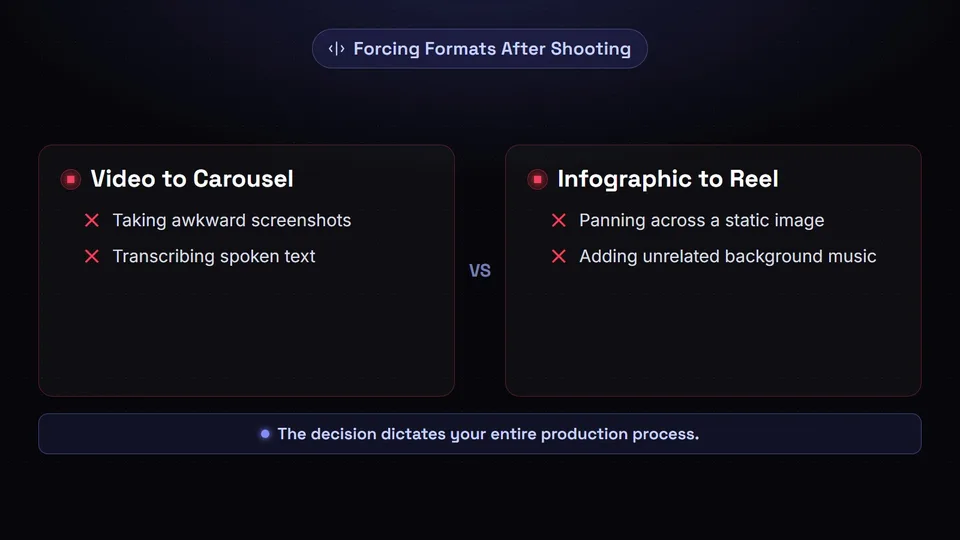
Imagine filming a five-minute talking-head video, only to realise later that the information would have been better served as a bulleted list. If you try to force that video into a carousel, you are left taking awkward screenshots and transcribing text that was meant to be spoken. Conversely, if you design a beautiful infographic and then decide it should be a Reel, you are left awkwardly panning across a static image with unrelated background music.
The decision between a carousel and a reel dictates your entire production process. It determines whether you need to write a script or outline a storyboard. It decides whether you need to focus on lighting and camera angles, or graphic design and typography. Most importantly, it dictates how the Instagram algorithm will categorise and distribute your content to your followers and potential new audiences.
The 2026 Data Landscape: Reach vs Engagement

To make an informed decision before you shoot, you must look at the data. The social media landscape shifts rapidly, but recent studies from 2026 provide a clear picture of how different formats perform on Instagram.
According to a June 2026 State of Social Media Engagement report by Buffer, which analysed an astonishing 52 million posts, the divide between reach and engagement is stark. The data reveals that Reels and carousels serve two very different, yet equally vital, purposes in a comprehensive social media strategy.
Reels are the undeniable champions of reach and discovery, while carousels dominate in driving deep, meaningful engagement and saves.
Understanding this dichotomy is the first step in deciding which format aligns with your specific goal for a given piece of content. Are you trying to get eyes on your brand, or are you trying to build a loyal, engaged community?
When to Choose Reels: The Discovery Engine
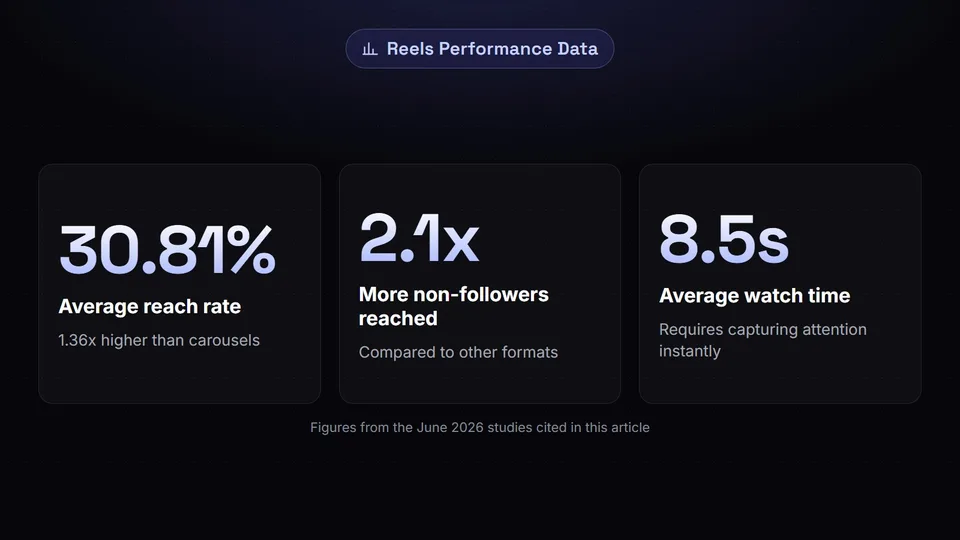
If your primary goal is brand awareness and reaching users who do not currently follow you, the Reel is your most powerful tool. The Buffer study from June 2026 highlighted that Reels achieve a remarkable 30.81% reach rate. To put that into perspective, this reach rate is 1.36 times higher than that of carousels, and a massive 2.25 times higher than single images.
Furthermore, the same study noted that Reels reach 2.1 times more non-followers than other formats. This makes Reels the ultimate top-of-funnel asset. When you are planning content designed to introduce a new concept, showcase a quick transformation, or entertain a broad audience, you should be scripting a Reel.
The Importance of the Hook
When you choose the Reel format, your production must focus entirely on the first few seconds. A June 16, 2026, Instagram Study by Metricool (which evaluated 24.3 million posts across 375,000 accounts) found that Reel watch times have doubled, reaching an average of 8.5 seconds. While 8.5 seconds may sound brief, in the context of short-form video, it represents a highly engaged viewer.
Knowing this before you shoot means you must design your video to capture attention instantly and deliver the payoff within that crucial 8.5-second window. You cannot afford a slow introduction. The decision to shoot a Reel means committing to high-energy, visually stimulating, and immediately relevant video content.
The Power of Carousels: Deep Engagement and Retention

While Reels win the battle for raw reach, carousels are the undisputed kings of engagement. If your goal is to educate your audience, provide step-by-step tutorials, or share detailed insights, the carousel format is vastly superior.
Data published by GA Creative on August 20, 2026, demonstrated this perfectly. In a two-month study period, carousel posts accounted for four out of their five most engaging Instagram posts. The researchers attributed this success to "user-paced interaction." Unlike a video that forces the viewer to consume information at the speed of the creator's speech, a carousel allows the user to swipe, read, and digest the information at their own pace.
The June 2026 Buffer study corroborates this, revealing that carousels generate a 6.90% median engagement rate. More impressively, carousels deliver 109% more engagement per person reached than Reels. A subsequent benchmark summary published by CreatorFlow on August 29, 2026 (referencing April 2026 data from Buffer and Socialinsider) confirmed that while Reels achieve that 30.81% reach rate, carousels lead in saves and engagement, boasting a 0.50% overall engagement rate across broader datasets.
Designing for the Save
The Metricool study also revealed a staggering statistic: carousels generated nine times more saves than single-image posts. When you decide to create a carousel before you start your production process, you should be designing specifically for that "save" metric. This means structuring your content as a valuable resource—something a user will want to bookmark and return to later.
Instagram Carousel Reach: The Second Chance Mechanic
One of the most compelling reasons to choose the carousel format is a unique algorithmic advantage often referred to as the "re-display mechanic." If you are concerned about instagram carousel reach lagging behind Reels, this mechanic helps close the gap.
On October 24, 2024, Head of Instagram Adam Mosseri announced that carousels receive algorithmic "second chances." By June 1, 2026, platform analysis thoroughly documented this re-display mechanic in action. Here is how it works: if a user scrolls past your carousel in their feed without engaging, the Instagram algorithm may re-serve that exact same post to them during a subsequent session.
However, it does not just show them the same post again. The algorithm will lead with the second slide of the carousel. This gives creators a literal second chance to capture the user's attention with a different visual or a different hook.
Exploiting the Second Chance
Because you are choosing your format before you shoot or design, you can strategically plan for this mechanic. Your first slide must be a strong, curiosity-inducing hook. But your second slide must be equally compelling, acting as an alternative hook for users who missed or ignored the first one. If you only decide to make a carousel after the fact, your second slide will likely just be a continuation of a thought, lacking the punch needed to stop the scroll during a re-display.
Reel vs Photo Engagement: The Fall of the Single Image
When discussing carousel vs reel, it is impossible to ignore the format that is rapidly losing ground: the single image. The debate of reel vs photo engagement has largely been settled by recent data.
The June 16, 2026, Metricool study found that single-image reach dropped by a severe 21.96% year-over-year. As social media platforms continue to prioritise immersive, time-consuming formats like short-form video and multi-slide galleries, the static, single photo is being pushed down the feed.
This data reinforces why planning is so crucial. If you show up to a location or a product shoot and only take a handful of static photographs, you are severely limiting your potential reach and engagement. You must plan to capture video for Reels, or at the very least, capture a series of varied images and graphics to construct a carousel. Relying on a single photo in 2026 is a strategy destined for diminishing returns.
The Hybrid Approach: Blending Carousels and Audio
What if you want the user-paced, high-engagement benefits of a carousel, but you also want a taste of the algorithmic distribution reserved for Reels? There is a hybrid strategy you can employ, provided you plan for it in advance.
During his October 24, 2024 announcement, Adam Mosseri confirmed a crucial detail: adding music track audio to a carousel post makes it eligible to be distributed inside the Reels tab. This was a game-changer for content creators. By simply integrating optional music into a carousel—a feature noted in the GA Creative study as a contributing factor to high engagement—you can push static, swipeable content into video-first discovery feeds.
When planning your carousel, consider the auditory experience. What track will complement the visual information? Will the pacing of the text match the tempo of the music? By planning this integration before you create the assets, you ensure a cohesive experience that appeals to both the algorithm and the end-user.
Planning Your Shoot: Practical Workflows
Now that we have established the data and the distinct advantages of each format, how do you actually apply this to your daily workflow? Here is a practical guide to choosing your format before you shoot.
Step 1: Define the Primary Goal
Before you write a single word or turn on a camera, ask yourself what you want this specific post to achieve. Look at your current analytics. Are you struggling to grow your follower count? If so, your goal is Discovery, and you should plan a Reel. Are your followers stagnant and rarely commenting or saving your content? Your goal is Community Nurturing, and you should plan a Carousel.
Step 2: Assess the Information Density
How complex is the topic you are covering? If you are sharing a quick tip, a funny observation, or a simple visual transformation, a Reel is perfect. The 8.5-second average watch time accommodates quick, punchy information.
However, if you are breaking down a complex industry report, sharing a five-step tutorial, or providing detailed analytical data, a Reel will overwhelm the viewer. They will not be able to read or process the information before the video loops. For high-density information, you must plan a carousel, taking advantage of the user-paced interaction that drives that 6.90% median engagement rate.
Step 3: Storyboard or Script
Once the format is chosen, the pre-production paths diverge:
- For a Reel: Write a script. Focus heavily on the first three seconds (the hook). Plan your B-roll, your transitions, and your call to action. Ensure the pacing is fast enough to retain viewers for that 8.5-second average.
- For a Carousel: Create a visual storyboard. Design slide one as your primary hook. Design slide two as your secondary hook (for the re-display mechanic). Break your complex information down into bite-sized, easily readable chunks across slides three through nine. Reserve slide ten for a strong call to action, specifically asking for a "Save" to boost your metrics.
Conclusion and Next Steps
The debate between carousel vs reel is not about which format is objectively better; it is about which format is right for the specific message you are trying to convey on any given day. Reels offer unparalleled reach and discovery, pushing your brand to non-followers at a rate 2.1 times higher than other formats. Carousels, on the other hand, build community, driving deep engagement, massive save rates, and algorithmic second chances.
By understanding instagram carousel reach mechanics and the stark reality of reel vs photo engagement, you can stop guessing and start strategising. The most successful creators do not let their assets dictate their format; they let their strategy dictate their assets. Choose your format before you shoot, plan accordingly, and watch your metrics improve.
Managing a diverse mix of Reels and carousels requires meticulous planning and consistent execution. SchedulifyX is an AI-powered social media scheduling platform designed to help you organise, plan, and automate your content calendar with precision. By streamlining your scheduling process, you can spend less time worrying about when to post and more time focusing on creating the perfect Reel or Carousel. Visit the SchedulifyX website today to discover how our intelligent scheduling tools can elevate your social media strategy.
Sources
Facts checked against the sources below on September 8, 2026.
- Instagram Content Formats Guide — creatorflow.so
- Reels Vs Carousels Which Is The Most Effective Owned Social Media Post Style — gacreative.com
- Instagram Reels Vs Feed Posts Which Gets More Engagement — smashballoon.com
- Press Release Instagram Study 2026 — metricool.com
- Instagram Confirms Carousels Get More Reach Engagement — jennstrends.com
- Instagram Carousel Vs Single Image — carouselli.com
- Cracking The Instagram Algorithm Single Photo Vs Carousel Posts — governmentsocialmedia.com