Instagram Hashtag Limit: Rebuilding Your Reach in 2026
SchedulifyX Team · September 1, 2026
Navigate the new Instagram hashtag limit with our comprehensive guide. Learn how to rebuild your hashtag strategy in 2026 to maximise reach and engagement.
Welcome to a new era of Instagram marketing. For years, social media managers, brands, and creators relied on a familiar tactic to boost their content's visibility: stuffing captions or first comments with a dense block of thirty hashtags. It was largely a numbers game. The more nets you cast into the vast ocean of Instagram's search ecosystem, the more likely you were to catch a wandering user. However, the landscape has fundamentally shifted. With the introduction of the strict Instagram hashtag limit, the days of hashtag hoarding are firmly behind us. The platform now caps your tags at just five per post.
This drastic reduction has sent ripples through the social media marketing community. If you have built your account's growth on the back of broad, high-volume hashtag strategies, this new constraint might feel like a severe penalty. However, this change is not a punishment; it is a clear signal from Instagram about how its algorithm now categorises and serves content. Understanding this shift is the first step to rebuilding a hashtag set that still earns meaningful reach.
In this comprehensive guide, we will explore the mechanics behind the new limit, definitively answer questions about how many hashtags Instagram requires for optimal performance, and outline a robust hashtag strategy 2026 that you can implement immediately to maintain and grow your audience.
The Evolution of the Instagram Hashtag Limit
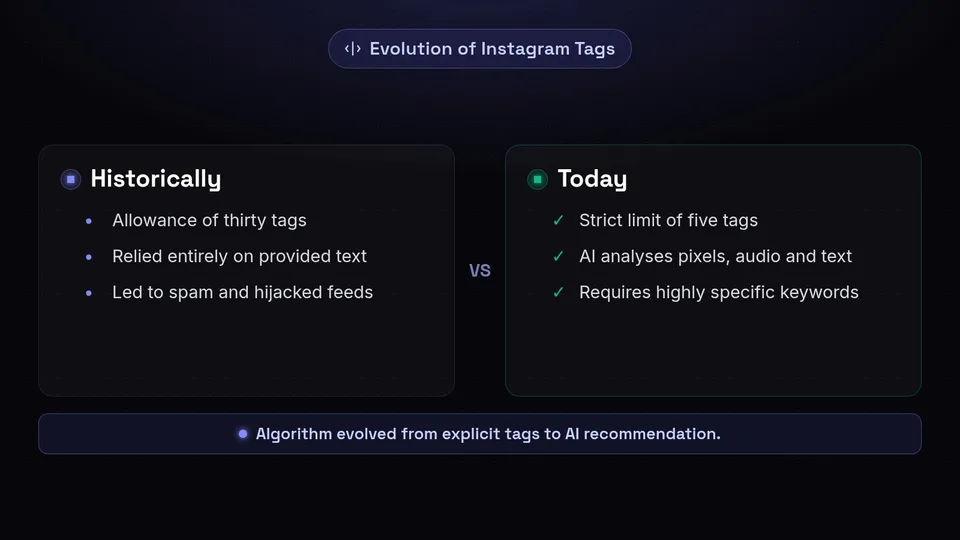
The shift away from the generous thirty-tag allowance did not happen overnight. Over the past few years, Instagram has been gradually refining its search and discovery mechanisms. The platform's algorithm has evolved from a simple feed reliant on explicit user tags to a highly sophisticated recommendation engine powered by machine learning.
Historically, hashtags were the primary way Instagram understood what an image or video contained. Because computer vision was in its infancy, the algorithm relied entirely on the text users provided. This led to the widespread practice of using thirty loosely related tags to maximise exposure. Unfortunately, this also led to spam. Users would routinely use popular but irrelevant tags to hijack trending feeds, resulting in a poor user experience for those genuinely searching for specific content.
As Instagram's artificial intelligence improved, the platform developed the ability to 'read' the actual content of a post. Today, the algorithm analyses the pixels in your image, the audio in your Reels, the text overlaid on your videos, and the natural language used in your captions. Consequently, the platform no longer needs thirty manual tags to understand your content. The new Instagram hashtag limit of five is a direct reflection of this technological advancement. Instagram is essentially telling creators: 'We already know what your post is about; just give us a few highly specific keywords to confirm our categorisation.'
How Many Hashtags Instagram Demands Now: Quality Over Quantity
When marketers ask, 'how many hashtags Instagram allows now?', the technical answer is a strict cap of five. But the strategic answer is much deeper. The restriction forces a complete psychological shift in how we approach content discovery.
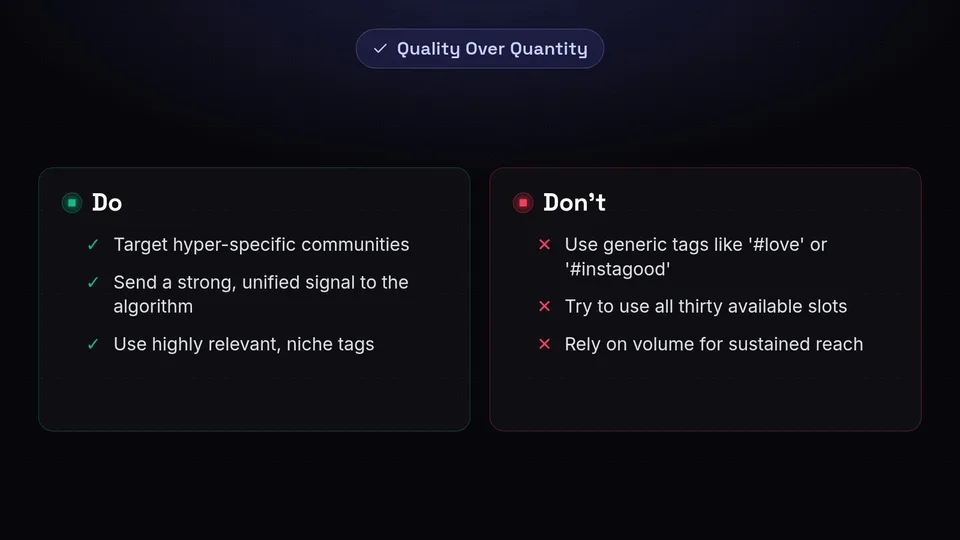
In the past, using all thirty available slots was considered best practice because there was no penalty for doing so. If twenty-five tags failed to generate reach, the remaining five might still pull in a few viewers. Today, every single tag you use must earn its place. When you only have five slots, using a generic tag like '#love' or '#instagood' is a wasted opportunity. These massive, saturated feeds move so quickly that your content will be buried within milliseconds, providing absolutely no sustained reach.
Therefore, the question is no longer about volume, but about precision. The new reality dictates that you must use your five allotted tags to target hyper-specific communities and search intents. By restricting the number of tags, Instagram is actively discouraging spam and encouraging creators to be intentional. When you use five highly relevant, niche tags, you send a strong, unified signal to the algorithm about your exact target audience, which improves your chances of appearing on the Explore page and in suggested feeds.
Decoding the Hashtag Strategy 2026

Crafting a robust hashtag strategy 2026 requires a fundamental shift in perspective. You can no longer rely on volume to compensate for a lack of relevance. The modern Instagram algorithm operates heavily on semantic search principles, much like traditional search engines such as Google.
Semantic search means the algorithm attempts to understand the context and intent behind a user's search query, rather than just matching exact keywords. For your hashtag strategy, this means your tags must align perfectly with the visual content, the caption, and the overall theme of your account. If there is a disconnect—for example, if you use a hashtag related to fitness on a post about baking—the algorithm will register this inconsistency. In the era of the five-tag limit, such inconsistencies can severely damage your post's reach, as the algorithm will struggle to categorise your content accurately.
A successful strategy in 2026 treats hashtags not as a lottery ticket for viral reach, but as a precise indexing tool. Your goal is to help the algorithm put your content in the right 'folder' so it can be served to users who have a demonstrated history of engaging with that specific type of content.
The Five-Tag Framework: Rebuilding Your Sets
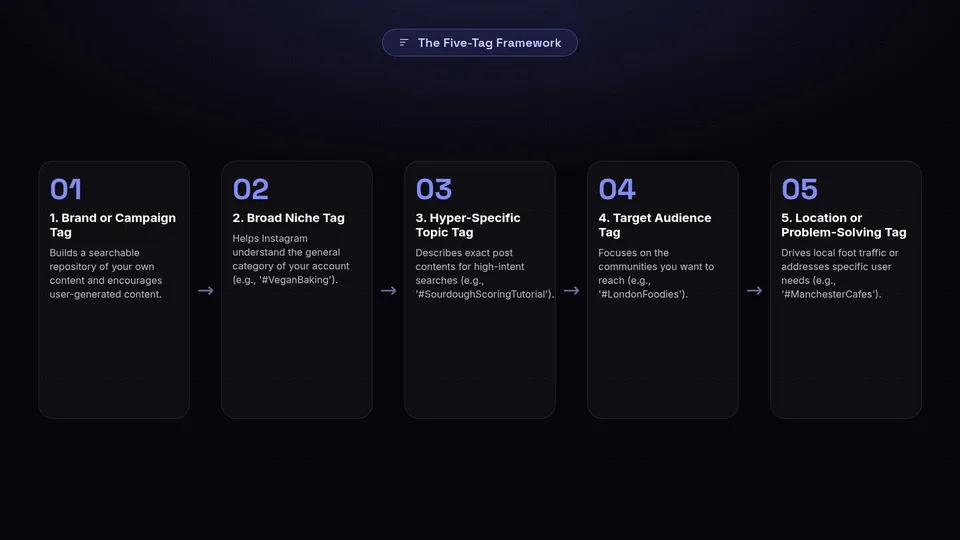
To maximise the potential of the new Instagram hashtag limit, you need a systematic approach to selecting your five tags. We recommend adopting the 'Five-Tag Framework', which ensures your tags cover different angles of discovery without overlapping or wasting space. Here is how to structure your five hashtags for every post:
1. The Brand or Campaign Tag
Your first tag should be dedicated to your brand or a specific marketing campaign. This tag is crucial for building a searchable repository of your own content and encouraging user-generated content (UGC). When followers want to see everything related to your brand, they will search this tag. Consistency is key here; use this tag across all your posts to build its authority over time.
2. The Broad Niche Tag
Your second tag should describe the broader industry or niche you operate within. This shouldn't be as broad as '#marketing', but rather something like '#SocialMediaManagement' or '#VeganBaking'. This tag helps Instagram understand the general category of your account, which is vital for appearing in the suggested accounts list and broader Explore page recommendations.
3. The Hyper-Specific Topic Tag
The third tag must describe the exact contents of the specific post. If you are sharing a tutorial on making sourdough bread, your hyper-specific tag might be '#SourdoughScoringTutorial'. These long-tail hashtags have lower search volumes, but the users searching for them have extremely high intent. They are looking for exactly what you are offering, making them much more likely to engage, save, or share your content.
4. The Target Audience or Community Tag
Your fourth tag should focus on the people you want to reach, rather than what the post is about. Think about the communities that gather on Instagram. Tags like '#LondonFoodies', '#SmallBusinessFounders', or '#DigitalNomadLife' help place your content directly into the feeds of community members who follow or regularly interact with those specific community hubs.
5. The Location or Problem-Solving Tag
Your final tag depends on your business model. If you are a local business, use this slot for a location-based tag (e.g., '#ManchesterCafes') to drive foot traffic and local awareness. If you are a digital or global business, use this slot for a problem-solving tag that relates to the pain point your post addresses (e.g., '#TimeManagementTips' or '#SEOStrategy'). This captures users who are actively searching for solutions.
Synergy Beyond the Tags: Caption SEO
Because of the Instagram hashtag limit, you cannot rely on tags alone to carry your keywords. This is where Caption SEO becomes a critical component of your hashtag strategy 2026. Instagram's search engine now indexes the words within your captions just as heavily as your hashtags.
To compensate for the lost twenty-five hashtag slots, you must weave those secondary and tertiary keywords naturally into your caption copy. Instead of listing them at the bottom, write descriptive, engaging sentences that provide context. For example, instead of using a tag for '#SocialMediaScheduling', you might write in your caption: 'Finding the right social media scheduling routine can transform how you manage your online presence.'
This approach achieves two things. First, it provides the algorithm with the rich semantic data it needs to categorise your post accurately. Second, it improves the accessibility of your content. Screen readers and users reading your captions benefit from clear, descriptive language rather than a disjointed list of keywords. Furthermore, ensure you are utilising the alt-text feature on your images and incorporating on-screen text in your Reels, as the algorithm parses these elements to build a complete profile of your content.
Tracking and Refining Your Performance
No strategy is complete without a system for measurement. With only five hashtags in play, tracking their performance is more straightforward but also more critical. You must regularly analyse your Instagram Insights to determine if your new tag sets are actually driving discovery.
Navigate to the insights of individual posts and look at the 'Reach' breakdown. Instagram provides data on how many accounts were reached via the Home feed, the Explore page, and directly from Hashtags. If your reach from hashtags is consistently negligible, it indicates that your Five-Tag Framework needs adjustment. You may be using tags that are too broad, or tags that do not align closely enough with your visual content.
It is highly recommended to maintain a dynamic spreadsheet of your hashtag sets. Group them by content pillar and rotate them regularly. Because you are only using five at a time, you have the opportunity to A/B test different combinations to see which hyper-specific tags yield the highest engagement rates for specific types of posts.
Streamlining Your Strategy with SchedulifyX
Adapting to the new Instagram hashtag limit requires careful planning, consistent execution, and continuous refinement. Manually researching, selecting, and typing out precise five-tag combinations for every post can quickly become a tedious administrative burden, pulling you away from the creative work of content production.
This is where leveraging an AI-powered social media scheduling platform can drastically improve your workflow. By planning your content calendar in advance, you have the time to carefully research and apply the most effective tags for each specific post, rather than scrambling to think of five relevant keywords at the moment of publication. Organised scheduling allows you to map out your content pillars, align your caption SEO with your chosen tags, and ensure a cohesive strategy across your entire grid.
As you rebuild your approach to accommodate the hashtag strategy 2026, remember that constraints often breed creativity. The five-hashtag cap is an invitation to be more intentional, more targeted, and more relevant to your ideal audience. Take control of your content planning, refine your keyword targeting, and start scheduling your highly optimised posts with SchedulifyX today.