20 Proven Hashtag Strategies to Boost Reach in 2026
SchedulifyX Team · July 16, 2026
Master your hashtag strategy 2026 with these 20 proven tactics for Instagram, TikTok, LinkedIn, and X. Boost reach, engagement, and visibility effortlessly.
Welcome to the new era of social media discoverability. If you are still relying on the same hashtag tactics you used in 2023, you are likely seeing a massive drop in your organic reach. The algorithms have evolved, semantic search has taken over, and user behavior has fundamentally shifted. To succeed today, you need a cutting-edge hashtag strategy 2026.
In this comprehensive guide, we will dive deep into the mechanics of modern discoverability. We will explore how platforms like Instagram, TikTok, LinkedIn, and X (formerly Twitter) categorize content, and we will reveal 20 actionable, proven strategies to skyrocket your reach. Whether you are conducting deep hashtag research or looking for the latest social media hashtag tips, this article is your ultimate blueprint for 2026.
The Evolution of Hashtags in 2026
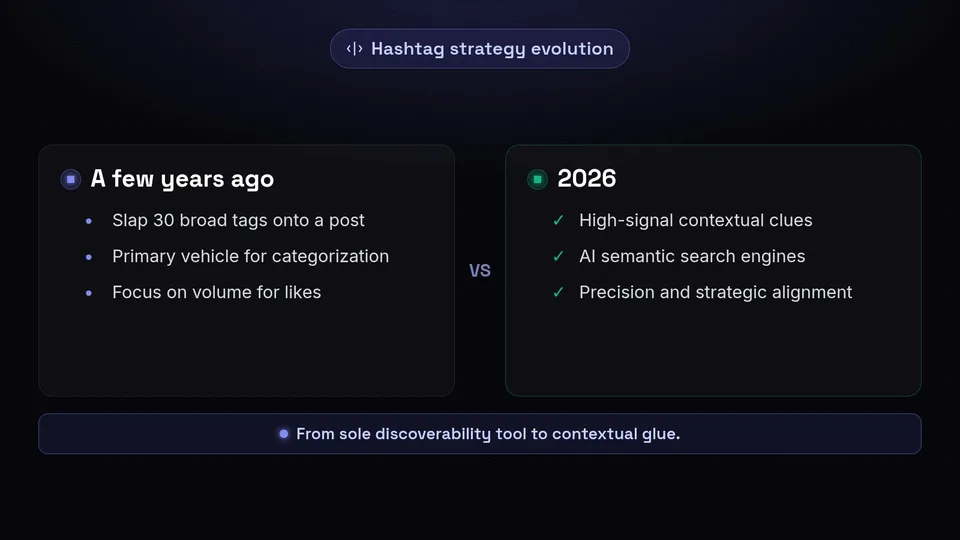
A few years ago, hashtags were the primary vehicle for content categorization. You would slap thirty broad tags onto an Instagram post and watch the likes roll in. Today, artificial intelligence and machine learning have transformed social media algorithms into highly sophisticated semantic search engines.
Platforms now analyze the visual content of your images, the audio in your videos, the context of your captions, and the historical behavior of your audience. So, do hashtags still matter? Absolutely. However, their role has shifted from being the sole discoverability tool to being the contextual glue that binds your content to specific communities and micro-niches.
"In 2026, hashtags act as high-signal contextual clues. They tell the algorithm exactly who your target audience is, accelerating the machine learning process and boosting initial reach."
Using the right instagram hashtags or tiktok hashtags is no longer about volume; it is about precision, relevance, and strategic alignment with your overall SEO strategy.
Platform-Specific Limits and Best Practices

Before diving into the 20 strategies, we must establish the baseline rules of engagement for 2026. Each platform has distinct limits and algorithmic preferences. Ignoring these nuances is a fast track to being shadowbanned or labeled as spam.
While Instagram technically allows up to 30 hashtags per post, the current algorithmic recommendation for 2026 is strictly between 3 to 5 highly relevant hashtags. Instagram's semantic search engine reads your caption and on-screen text, meaning that keyword stuffing with 30 tags actually confuses the AI and dilutes your content's categorization.
TikTok
TikTok is the undisputed king of social SEO. The platform relies heavily on conversational keywords. For tiktok hashtags, the sweet spot is 4 to 6 tags. Mix broad category tags (like #MarketingTips) with hyper-niche tags (like #B2BSaaSMarketing). Remember, character limits in captions mean you must balance text with your tags carefully.
LinkedIn remains a professional networking hub where spam is heavily penalized. The algorithm favors 3 to 5 niche hashtags. Placing them at the very end of your post is the standard best practice. Over-tagging on LinkedIn can significantly decrease your post's visibility in the feed.
X (formerly Twitter)
X moves at the speed of light. Because the platform is built on real-time conversations, 1 to 2 hashtags are optimal. Any more than two, and X's algorithm may flag the post as engagement bait or spam. Focus on trending topics or highly specific chat tags.
20 Proven Hashtag Strategies to Boost Reach
Now that we understand the landscape, let us explore the 20 actionable tactics that make up a winning hashtag strategy 2026.
1. The Hashtag Density Formula
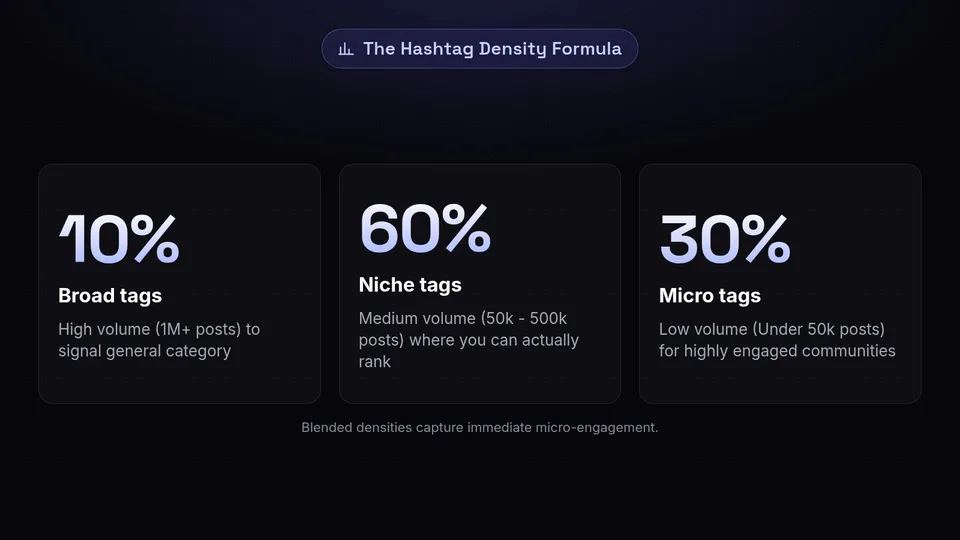
Not all hashtags are created equal. The Hashtag Density Formula involves categorizing tags by their total post volume to ensure you aren't buried in massive feeds or shouting into empty rooms. A balanced formula looks like this:
- 10% Broad: High volume (1M+ posts) to signal general category.
- 60% Niche: Medium volume (50k - 500k posts) where you can actually rank.
- 30% Micro: Low volume (Under 50k posts) for highly engaged, specific communities.
By blending these densities, you capture immediate micro-engagement which signals the algorithm to push your content to the broader tags.
2. Niche Hashtag Research
Effective hashtag research is the backbone of discoverability. Stop guessing and start analyzing. In 2026, niche research means looking at what your ideal customer is actively searching for, not just what your industry calls itself. If you sell vegan dog food, do not just use #DogFood. Use #VeganDogTreats, #PlantBasedPet, and #EcoFriendlyDog. Use native search bars to see auto-suggested tags—these are goldmines of current user intent.
3. The Branded Hashtag Hub
A branded hashtag is unique to your business (e.g., #SchedulifyXLife). However, in 2026, a branded hashtag must serve as a community hub, not just a corporate slogan. Encourage your audience to use it when sharing their successes or asking questions. This aggregates all brand-related content into one searchable feed, providing massive social proof and creating a self-sustaining ecosystem of user-generated content.
4. Trending Topic Hijacking (Ethically)
Trending topic hijacking involves jumping onto a viral hashtag to gain exposure. The key in 2026 is ethical and relevant hijacking. If a hashtag like #TechLayoffs2026 is trending, only use it if you have a genuinely valuable perspective, data point, or solution to offer. Spamming trending tags with unrelated promotional content will result in immediate algorithmic penalties.
5. Location-Based Hashtags for Local SEO
For brick-and-mortar businesses or local service providers, location-based hashtags are non-negotiable. Combine your industry with your city, neighborhood, or even local landmarks. Instead of just #CoffeeShop, use #AustinCoffeeRoasters or #SoCoCafe. This signals to the algorithm to show your content to users whose IP addresses or location services place them in your vicinity.
6. The "Problem-Solution" Tagging Method
Think about the psychology of the searcher. People use social media to solve problems. Frame your social media hashtag tips around the problem and the solution. For example, if you are a graphic designer, use problem tags like #StrugglingWithCanva alongside solution tags like #TypographyTips or #DesignHacks2026. This captures users at different stages of their awareness journey.
7. TikTok SEO and Conversational Hashtags
TikTok is increasingly being used as a primary search engine by Gen Z and Gen Alpha. Your tiktok hashtags must be conversational. Instead of just #Fitness, use tags that mimic search queries, such as #HowToLoseWeightIn30Days or #BeginnerGymRoutine. These long-tail conversational tags align perfectly with TikTok's semantic search capabilities.
8. LinkedIn Professional Community Tags
LinkedIn has fostered deep micro-communities. Find and use the tags that these communities follow religiously. Tags like #MarketingFriction, #SalesEnablement, or #FutureOfWork are heavily followed by decision-makers. When you use these tags, your post can appear in the notifications of users who follow the tag, even if they do not follow you.
9. X (Twitter) Real-Time Event Tags
On X, hashtags are best utilized for real-time events, conferences, or cultural moments. If Apple is hosting an event, using #AppleEvent alongside your hot take is a guaranteed way to spike impressions. The strategy here is speed and relevance. Be the first to provide a valuable insight using the official event tag.
10. Routine Banned Hashtag Audits
One of the most critical social media hashtag tips is avoiding banned tags. Platforms temporarily or permanently ban hashtags that become overrun with spam or inappropriate content. Sometimes, completely innocent tags (like #DeskSetup or #BeautyBlogger) get temporarily banned. Using a banned tag can shadowban your entire post. Conduct a monthly audit of your hashtag banks by manually searching them to ensure they still show a "Recent" feed.
11. Campaign-Specific Hashtags
When launching a new product or marketing campaign, create a specific, memorable hashtag. This allows you to track the exact ROI and engagement of that specific initiative. Keep it short, memorable, and easy to spell. For example, when launching a new AI scheduling feature, we might use #ScheduleSmarter2026.
12. The "Broad to Micro" Funnel Approach
Think of your hashtags as a marketing funnel. At the top of the funnel (broad awareness), use tags like #DigitalMarketing. In the middle (consideration), use #SocialMediaManagement. At the bottom (conversion/niche), use #AutomatedSchedulingTools. This ensures your post touches every layer of the audience's intent.
13. Combining Hashtags with Native SEO Keywords
In 2026, hashtags do not work in isolation. They must perfectly mirror the keywords used in your caption, your alt text, and your on-screen text. If your instagram hashtags include #VeganBaking, the phrase "vegan baking" must appear naturally in your caption and spoken in your Reel. This multi-layered signal is what triggers the algorithm to push your content viral.
14. Competitor Hashtag Analysis
Keep your friends close and your competitors closer. Analyze the top-performing posts of your direct competitors. What niche tags are they using that you are missing? Do not copy their branded tags, but look for the community and industry tags that are driving their engagement. Tools that offer competitive hashtag research can automate this process.
15. User-Generated Content (UGC) Amplification Tags
Create a specific tag designed solely for your customers to show off their purchases or results. Incentivize the use of this tag by running monthly giveaways. For example, "Tag your setups with #MySchedulifyX for a chance to win a year of premium!" This drives organic reach through your users' networks.
16. Event and Conference Piggybacking
Even if you are not attending a major industry conference (like INBOUND or WebSummit), you can still participate in the digital conversation. Follow the official event hashtag, engage with attendees, and post your own insights related to the event's themes using the tag. This positions you as an industry authority and gets your brand in front of a highly targeted audience.
17. Emotional and Sentiment Hashtags
People connect with emotions. Adding one or two sentiment-based tags can humanize your brand and connect with users on a personal level. Tags like #MondayMotivation, #FounderStruggles, or #MarketingHumor categorize your content by its emotional resonance, not just its technical topic.
18. Day-of-the-Week Themes
While #ThrowbackThursday (#TBT) is a classic, 2026 has brought hyper-niche daily themes. Find the ones relevant to your industry. #TechTuesday, #WellnessWednesday, or #FinanceFriday are excellent ways to participate in weekly recurring conversations that have dedicated followings.
19. Creator and Influencer Collab Tags
When collaborating with influencers, ensure there is a unified hashtag strategy. The influencer should use your branded tags, and you should use tags relevant to the influencer's specific audience. This cross-pollination of hashtags ensures that the algorithm maps the connection between both audiences, maximizing the collaborative reach.
20. AI-Powered Hashtag Generation
The final and most powerful strategy for a hashtag strategy 2026 is leveraging Artificial Intelligence. Manual hashtag research is time-consuming and prone to human error. AI tools can analyze real-time platform data, assess your image and caption, and instantly generate the mathematically optimal mix of broad, niche, and micro tags for that specific post.
How to Track and Measure Hashtag Performance
Implementing these 20 strategies is only half the battle; the other half is measurement. If you cannot track it, you cannot optimize it. Here is how to measure your hashtag success in 2026:
- Native Insights: Platforms like Instagram and TikTok provide data on how many impressions came directly from hashtags. Monitor this metric on a post-by-post basis.
- A/B Testing: Post similar types of content at similar times, but vary the hashtag clusters. Track which cluster yields higher reach and engagement.
- Share of Voice (SOV): For branded and campaign hashtags, use social listening tools to measure your SOV. Are people actually using your tag, or are you the only one posting?
- Click-Through Rate (CTR): High reach from hashtags is useless if it doesn't drive action. Correlate your highest-reach hashtag posts with your website analytics to see if that reach translates to traffic.
By treating your hashtags as trackable data points rather than an afterthought, you can continuously refine your approach, dropping underperforming tags and doubling down on the winners.
Conclusion: Automate Your Strategy with SchedulifyX
Mastering your hashtag strategy 2026 requires a blend of art and science. From understanding the nuanced differences between instagram hashtags and tiktok hashtags, to executing deep hashtag research and leveraging the density formula, the tactics outlined in this guide will give you a significant competitive advantage.
However, manually researching, grouping, and tracking these hashtags across multiple platforms every single day is exhausting. That is where automation comes in.
With SchedulifyX, our AI-powered social media scheduling platform, you can put these social media hashtag tips on autopilot. SchedulifyX analyzes your content, suggests the highest-performing, platform-specific hashtags in real-time, and schedules your posts for maximum visibility. Stop guessing and start growing.
Ready to revolutionize your social media reach? Sign up for SchedulifyX today and let our AI build your perfect hashtag strategy.