Instagram Reach Dropped? The Ultimate 2026 Diagnostic Guide
SchedulifyX Team · September 7, 2026
Wondering why your Instagram reach dropped? Discover the real reasons behind low reach in 2026, from algorithmic variance to format shifts, and how to fix it.
Waking up to discover your instagram reach dropped overnight is one of the most frustrating experiences for any creator, brand, or social media manager. You pour hours into crafting the perfect post, hit publish, and watch as the metrics stall. The immediate reaction is often panic. You might find yourself searching, "why is my instagram reach so low?" or worrying that your account has been secretly penalized. But before you overhaul your entire content strategy or abandon your account, it is critical to take a step back and diagnose the issue objectively.
In 2026, the Instagram algorithm is more complex, fragmented, and competitive than ever before. If your instagram reach down trend has you concerned, you need a diagnostic approach based on data, not fear. This comprehensive guide will walk you through the most likely reasons your Instagram is not reaching followers, structured by statistical likelihood rather than what feels the most alarming. We will explore everything from normal algorithmic variance and format-specific distribution shifts to the realities of account status and the myth of shadowbanning. By the end of this guide, you will know exactly which Insights matter, which ones are just noise, and how to leverage tools like SchedulifyX to get your strategy back on track.
1. Normal Variance and Week-to-Week Comparisons
When creators notice their instagram reach dropped, their first instinct is often to compare the current week's performance directly to the previous week. However, in the 2026 algorithmic landscape, comparing one week's reach directly to another yields highly misleading diagnostic data.
The Per-Post Audition Mechanism
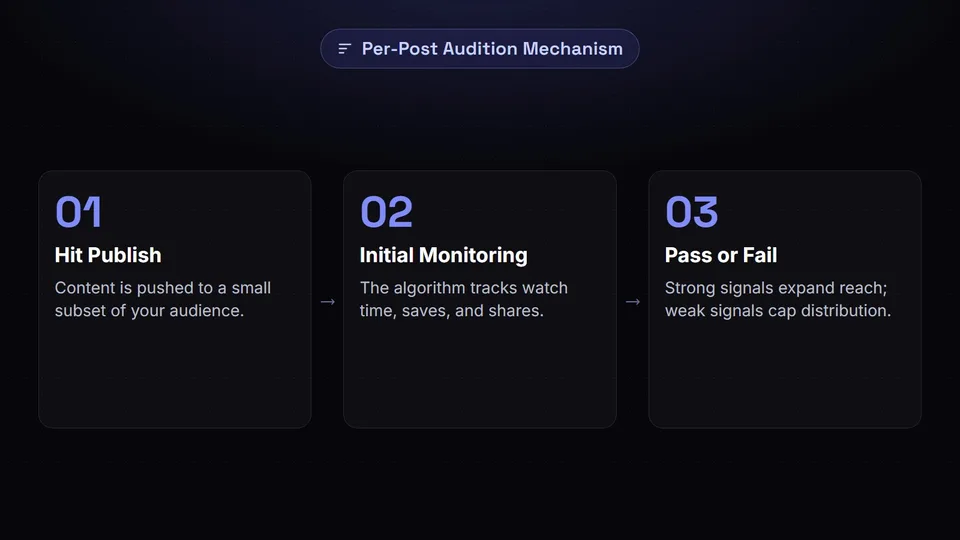
As of late August 2026, Instagram's algorithm evaluates content distribution on a strict per-post audition basis. This means that your account's historical performance does not guarantee future reach. Each time you hit publish, that specific piece of content is pushed to a small subset of your audience. The algorithm closely monitors how this initial sample group interacts with the post. If the engagement signals—such as watch time, saves, and shares—are strong, the post "passes the audition" and is pushed to a wider audience. If the signals are weak, the distribution is capped.
Because every post undergoes this independent audition, a single week of low reach does not indicate a fundamental flaw in your account. It simply means that the specific posts published during that timeframe did not resonate as strongly with the initial test audience.
Content-Testing Loops
Furthermore, single-week drops or individual low-performing posts often represent normal algorithmic variance during what data scientists call "content-testing loops." Instagram is constantly tweaking its recommendation models to keep users on the app longer. Sometimes, the platform will test your content against different user segments to see if it can find a new audience for you. During these testing phases, reach can fluctuate wildly. A sudden dip is rarely a sign of an account penalty or permanent distribution restriction; it is simply the algorithm gathering new data points.
Therefore, if you are asking "why is my instagram reach so low?" after just a few days of poor performance, the most accurate answer is usually: normal variance. You need a larger sample size—typically 30 to 60 days of data—to identify a genuine downward trend.
2. Format Shifts and Distribution Differences
If your reach has been steadily declining over a longer period, the next most likely culprit is a misunderstanding of how different content formats are distributed. Instagram does not use a single algorithm; rather, it utilizes distinct, AI-driven ranking systems tailored specifically to Feed, Reels, Stories, and Explore.
Reels: The Discovery Vehicle
Reels operate primarily as discovery vehicles designed to reach non-followers. The distribution of Reels is driven by specific retention metrics: watch time, completion rate, and sends per reach (users sharing the Reel via Direct Message). If your Reels are not getting reach, it is likely because they are failing to capture attention in the first three seconds or lacking the shareability factor that drives DM sends.
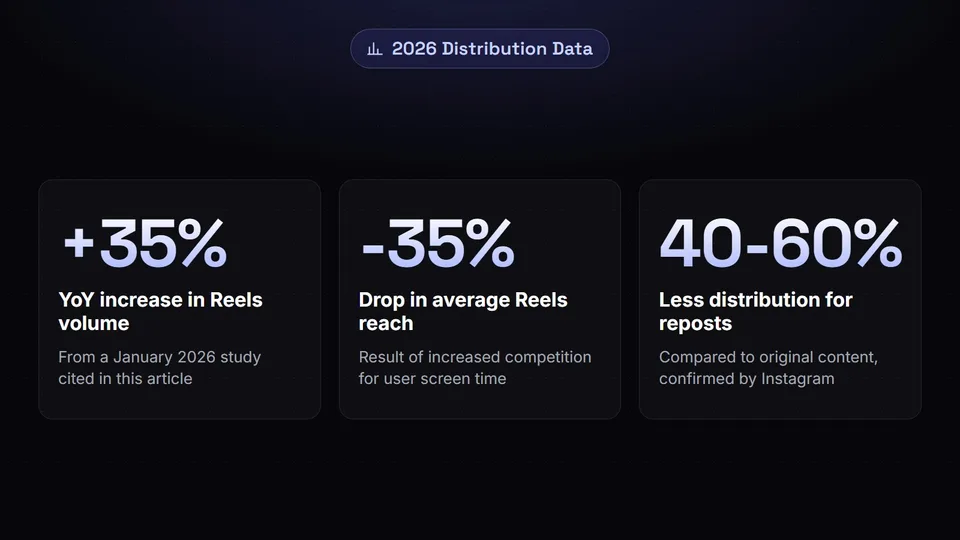
It is also crucial to understand the macro environment of Reels in 2026. A January 2026 study by Metricool, which analyzed nearly 40 million posts, revealed a staggering 35% year-over-year increase in Reels volume across the platform. Because user attention is a finite resource, this massive influx of content resulted in a corresponding 35% drop in average Reels reach. The competition is simply fiercer. You are not necessarily doing anything wrong; you are just competing against 35% more content for the same amount of user screen time.
Feed Posts and Carousels: The Retention Engine
In contrast to Reels, Feed posts and Carousels prioritize audience retention and community building among your existing followers. The algorithms governing these formats look for saves and conversation depth—specifically, back-and-forth comment threads. If your instagram not reaching followers issue is isolated to static posts, it likely means your content is not sparking meaningful dialogue or providing enough value to warrant a save.
The Repost Penalty
A major factor in reduced distribution is the reliance on unoriginal content. In January 2025, Instagram Head Adam Mosseri confirmed that reposts receive 40% to 60% less distribution than original content. The platform's AI systems have become incredibly adept at identifying duplicate content. Furthermore, accounts that share 10 or more reposts within a 30-day window are excluded from recommendation surfaces entirely. If your content strategy relies heavily on curating other people's videos or memes, this is almost certainly why your instagram reach down trend has accelerated.
3. The Follower-Count Effect: Rate vs. Absolute Reach
One of the most misunderstood concepts in social media analytics is the relationship between follower count, engagement rate, and absolute reach. Many creators believe their account is dying when, in reality, it is experiencing natural growing pains.
The New Benchmarks for Reach
If you are accustomed to the reach metrics of 2020, where seeing 10% to 15% of your audience was common, the 2026 reality will be a shock. According to July 2026 data from Socialinsider, follower-based reach has dropped to an average benchmark of just 2% to 3%. Other broader 2026 datasets suggest a slightly more optimistic range of 3.5% to 7.6%. Regardless of which benchmark you look at, the days of reaching a double-digit percentage of your followers organically are largely over. If your reach falls within these new 2026 parameters, your account is actually performing at industry standard.
The Engagement Rate Illusion
A critical diagnostic rule to remember is this: a falling engagement RATE alongside rising absolute reach indicates a growing account, not a failing one.
Engagement rate is calculated as: [(total interactions ÷ reach) × 100]. As your account grows and the algorithm pushes your content to a wider, colder audience (non-followers), your absolute reach increases. However, this colder audience is naturally less likely to engage with your content than your die-hard followers. Therefore, your distribution expands faster than your interaction volume, which mathematically dilutes the engagement-to-reach denominator ratio.
Seeing a lower engagement percentage can trigger panic, but if the total number of people seeing your content (absolute reach) is stable or growing, you are succeeding. For a much deeper dive into the math behind these metrics, we highly recommend reviewing our comprehensive analytics guide for Instagram and our detailed breakdown of engagement rate calculations.
4. Posting Cadence Changes and Threshold Status

When creators see their instagram reach dropped, human nature often dictates a "fight or flight" response. On social media, this translates to either panic-posting or abruptly pausing all content. Both reactions actively harm your reach.
The Danger of Panic-Posting
Increasing your posting frequency in response to falling reach—often referred to as "panic-posting"—is a disastrous strategy. When you flood the platform with rushed, lower-quality content in a desperate bid for views, you almost guarantee lower engagement per post. Because the algorithm evaluates distribution on a per-post basis, these weak engagement signals give the ranking systems more data points to suppress your wider distribution. You are essentially training the AI to view your account as a source of low-retention content.
Losing Threshold Status
Conversely, pausing your posts abruptly carries its own severe risks. Instagram relies on a mechanism known as "Threshold Status." When you publish a new piece of content, the algorithm initially tests it against your account's top 5% to 10% most engaged followers before deciding whether to distribute it further.
If you stop posting for an extended period, the algorithm's data on who constitutes your "most engaged" followers goes stale. When you finally return and post again, you have lost your Threshold Status. The algorithm has to rebuild its understanding of your audience from scratch, which almost always results in a significant, temporary drop in reach. Consistency—using a reliable tool like SchedulifyX to maintain a steady cadence—is far better than erratic bursts of activity followed by silence.
5. Content Triggering Lower-Quality Classification
If your posting cadence is consistent and you understand the new benchmark metrics, but your instagram reach down trend continues, you must audit your content for elements that trigger lower-quality classifications by Instagram's AI.
Watermarks and Misleading Tactics
Instagram's visual recognition AI is highly sophisticated in 2026. Content flagged for lower distribution includes any video bearing watermarks from external platforms (such as TikTok or YouTube Shorts logos). The platform wants native content, and it actively suppresses recycled videos from competitors. Additionally, using misleading text (clickbait), repetitive comment patterns, or spamming the same block of hashtags on every post will trigger algorithmic suppression.
The AI-Generated Persona Rule
A massive shift occurred recently regarding synthetic content. On September 1, 2026, Meta enforced a strict new policy requiring an "AI-generated profile" toggle for synthetic creators and virtual influencers. If you are utilizing AI avatars, synthetic voiceovers, or entirely AI-generated personas and fail to label them using this required toggle, your account will face severe consequences. Failure to label synthetic profiles results in immediate algorithmic suppression, completely removing your content from Explore and Reels recommendation surfaces. If you use AI in your content creation, compliance with the September 1st mandate is non-negotiable for reach.
6. Account Status Checks: Finding the Truth
Instead of guessing why your instagram not reaching followers, Instagram actually provides a direct diagnostic tool to tell you if you have violated any rules. This is found in the Account Status menu.
How to Check Your Status
You can check your official recommendation eligibility directly in the app. Navigate to your Profile → Menu (☰) → Settings and privacy → Account status.
This feature has evolved significantly over the years. On December 7, 2022, Adam Mosseri announced the expansion of Account Status for professional accounts, allowing creators to see exactly if their content complies with the Recommendations Guidelines for Explore, Reels, and Feed. More recently, on October 14, 2025, Meta updated Account Status again to detail when content visibility is restricted specifically to users under 18 due to the new default Teen Account settings.
Reading the Signals
When you open your Account Status, you are looking for green checkmarks. Green indicates normal eligibility; your account is in good standing and eligible for recommendation to non-followers.
If you see orange warnings, you have found the root of your problem. Orange signals indicate that specific posts have been flagged for violating guidelines, or that there are policy issues in your bio (such as prohibited links or language) that are restricting your non-follower discovery. If you have orange flags, you must delete the offending content or appeal the decision before your reach can recover.
7. The Honest Reality of Shadowbanning
No discussion about dropping reach is complete without addressing the elephant in the room: shadowbanning. When a creator asks, "why is my instagram reach so low?", the immediate assumption is often that a malicious algorithm has secretly banned them.
The Official Stance
Let’s be clear: Adam Mosseri and Meta have repeatedly confirmed that Instagram does not officially use the term "shadowban," nor do they engage in secret account suppression without notifying the user (which is exactly why Account Status exists). The most recent affirmations of this came in February 2025 and again on April 24, 2026.
The "0 Views" Rule
Most situations that users perceive as shadowbanning stem from standard algorithmic shifts, failure to meet the increasingly strict Recommendation Guidelines, or simply changing viewer watch-time habits.
There is a very simple diagnostic test to determine if you are truly "banned" from distribution. Look at your latest Reel or post. Did it receive more than 0 views? If a Reel or post receives 10, 50, or 100 views, the account is not shadowbanned. Non-zero views indicate that the algorithm did, in fact, test your content (the per-post audition). The fact that it stopped distributing it indicates a retention and watch-time issue with the content itself, rather than an account-level block. You are not shadowbanned; your content simply did not hold the audience's attention long enough to warrant wider distribution.
8. Insights Screens: Signal vs. Noise
To properly diagnose why your instagram reach dropped, you must look at the right data. The Instagram Insights dashboard is full of numbers, but in 2026, not all metrics are created equal. You must separate the signal from the noise.
The Signal Screens (What Matters)
If you want to understand algorithmic distribution, focus your attention on these metrics:
- Views: In April 2025, Instagram established "Views" as the primary unified video metric, officially replacing "Plays." Views now count replays, making it the most critical top-line metric for video performance.
- Reached Accounts (Followers vs. Non-Followers): This breakdown tells you exactly where your distribution is coming from. If your non-follower reach is dead, you have a discovery issue (likely a Reels retention problem or an Account Status flag).
- Sends per Reach: The number of times your content was shared via DM relative to its total reach. This is the strongest signal for algorithmic virality in 2026.
- Watch Time and Saves: These indicate deep engagement and retention, which are vital for Feed and Carousel distribution.
The Noise Screens (What to Ignore)
Conversely, obsessing over the following metrics will lead to false diagnoses:
- Total Follower Count: As discussed, absolute follower numbers matter very little when average organic reach is 2% to 3%. Losing a few followers daily is normal churn and does not impact your algorithmic standing.
- Raw Likes: Likes are the lowest-effort engagement metric. While nice to have, they carry minimal algorithmic weight in driving recommendation distribution compared to Saves and Sends.
- Pre-April 2025 Data: Any historical data referencing "Plays" or "Impressions" from before the April 2025 Insights overhaul is effectively obsolete for comparing current performance.
By focusing only on the signal metrics, you can accurately diagnose whether your content is failing the retention test, failing the shareability test, or simply experiencing normal variance.
Conclusion
Seeing your instagram reach dropped is stressful, but it is rarely the catastrophe it appears to be. By understanding the per-post audition process, the distinct differences between Feed and Reels distribution, and the new 2026 benchmarks for organic reach, you can approach your analytics with a cool head. Remember to check your Account Status for orange flags, ensure you are labeling any AI-generated content per the September 2026 mandate, and stop using the term "shadowban" as a catch-all for poor retention metrics.
The most effective way to recover from a dip in reach is to maintain a consistent, high-quality posting cadence without resorting to panic-posting. This allows the algorithm to re-establish your Threshold Status and find your engaged audience. To maintain that perfect consistency and track the analytics that actually matter, streamline your social media strategy with an AI-powered scheduling platform like SchedulifyX. By automating your posting schedule, you can spend less time worrying about the algorithm and more time creating the high-retention content your audience craves.
Sources
Facts checked against the sources below on September 7, 2026.
- Why Instagram Reels Not Getting Views — creatorflow.so
- Instagram Algorithm 2026 — creatorflow.so
- Instagram Reach Is Down What The Data Actually Says — sotrender.com
- Instagram Reach Dropped — unfollr.com
- Instagram Organic Reach In 2026 Is It Really Dead — rtnhouse.com
- outsourceaccelerator.com
- Instagram Is Done Letting Ai Influencers Hide In Plain Sight — gadgetreview.com
- Instagram Account Status — routenote.com
- Shadow Banning On Instagram — torro.io
- Why Is My Instagram Reach Dropping — creatorflow.so