Weekend Only Posting: A Guide to Constrained Schedules
SchedulifyX Team · August 22, 2026
Struggling to post daily? Discover how weekend only posting and batch scheduling can maintain your social media presence without overwhelming your weekdays.
In the fast-paced world of digital marketing, the prevailing advice often feels relentless: post daily, engage constantly, and never let your audience forget you exist. However, for many professionals, small business owners, and creators juggling full-time careers or personal commitments, this standard is not just exhausting—it is entirely unrealistic. If you find yourself unable to maintain a daily presence, you might be considering a constrained posting schedule. Specifically, you might be wondering if a strategy centred around weekend only posting can actually work.
The short answer is yes, but it requires a shift in mindset. Moving away from a daily posting cadence means you must rely heavily on strategic planning, robust batch scheduling, and a clear understanding of how to maximise your weekend engagement. This article is not a magical success story promising overnight virality; rather, it is a practical, honest guide to making a constrained schedule work for you. We will explore the realities of stepping back during the week, how to efficiently batch a week's worth of content in a single session, which formats survive being created in advance, and how to manage the inevitable weekday engagement gap.
The Reality of a Constrained Posting Cadence

Your posting cadence—the frequency and rhythm with which you publish content—is a fundamental pillar of your social media strategy. Most algorithms favour consistency. They reward accounts that keep users on the platform regularly. However, consistency does not strictly mandate daily posting. Consistency simply means setting an expectation with your audience and the algorithm, and then meeting that expectation reliably.
Adopting a constrained schedule, such as posting exclusively on Saturdays and Sundays, is a deliberate choice to prioritise sustainability over maximum theoretical reach. For those working demanding Monday-to-Friday jobs, trying to squeeze in content creation and community management on a Tuesday evening often leads to burnout and subpar content. By shifting your focus entirely to the weekend, you give yourself permission to reclaim your weekdays.
It is vital to approach this with realistic expectations. A constrained posting cadence is a marathon strategy, not a sprint. You are building a library of valuable content and a loyal, albeit perhaps smaller, community that knows exactly when to expect your insights. The goal here is not to beat the daily posters at their own game, but to play a different game entirely—one where your mental health and content quality take precedence over sheer volume.
The Honest Trade-Offs of Weekend Only Posting
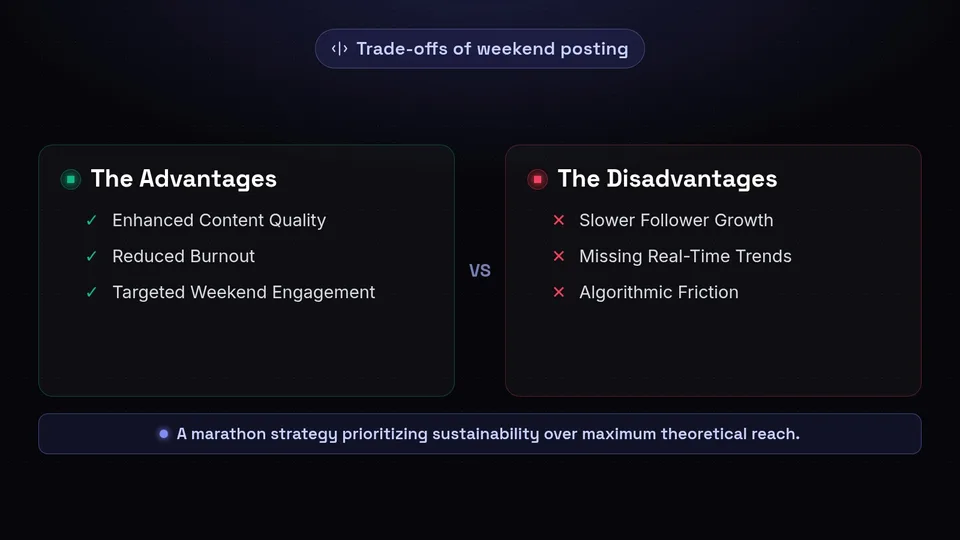
Before committing to a weekend-centric strategy, it is crucial to understand the honest trade-offs. There are distinct advantages, but there are also undeniable compromises you will have to make when you step away from the daily grind.
The Advantages
- Enhanced Content Quality: When you are not rushing to push something out every single day, you have the luxury of time. You can research deeper, edit more meticulously, and design better graphics. Your audience will begin to associate your weekend posts with high value.
- Reduced Burnout: The psychological relief of knowing you do not have to worry about social media from Monday to Friday is immense. This separation allows you to focus fully on your primary career or business operations during the week.
- Targeted Weekend Engagement: For many industries, audiences are actually more relaxed and receptive at the weekend. They have more time to read long-form captions, watch longer videos, and engage in meaningful conversations in the comments.
The Disadvantages
- Slower Follower Growth: Let us be clear: posting less frequently generally results in slower audience growth. Daily posters cast a wider net. By posting only on weekends, you are fishing less often, which naturally means fewer catches over a given period.
- Missing Real-Time Trends: Social media moves at breakneck speed. A meme or audio trend that explodes on a Tuesday might be completely dead by Saturday. A constrained schedule means you will largely have to sit out of rapid-fire trend-jacking.
- Algorithmic Friction: Some platforms, like X (formerly Twitter) or TikTok, thrive on high volume and recency. If you go dormant for five days a week, the algorithm may take a moment to 'warm up' to your content again each weekend, potentially limiting your initial reach.
Mastering Batch Scheduling: A Week's Content in One Session
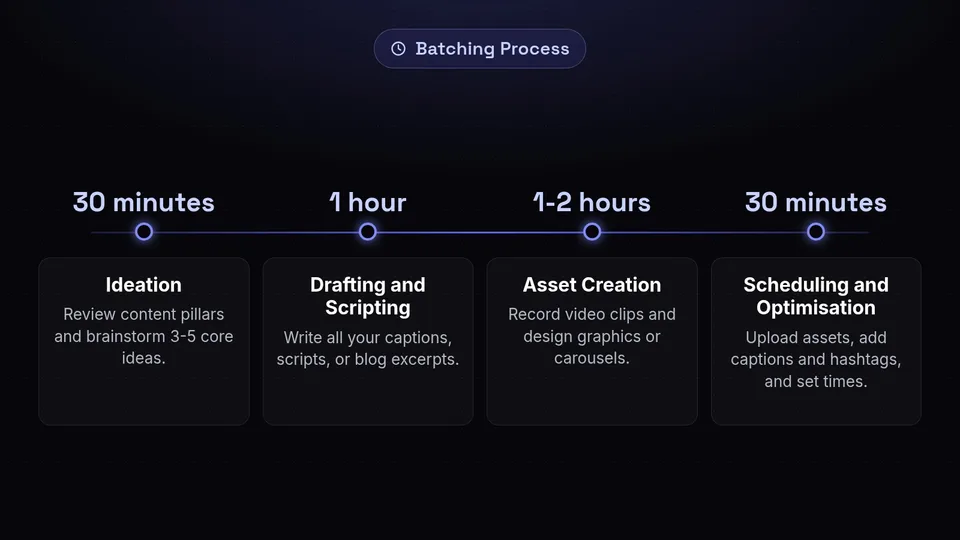
The linchpin of a successful weekend-only strategy is batch scheduling. You cannot afford to wake up on Saturday morning with a blank screen, wondering what to post. To make this work, you must dedicate a specific, focused block of time to ideate, create, and schedule everything in one go.
Batching relies on the psychological principle of flow. When you switch between tasks—for example, writing an email, then designing a post, then taking a client call—you lose cognitive efficiency. By grouping all your social media tasks into a single session, you eliminate context switching and dramatically increase your output speed.
Step-by-Step Batching Process
- Ideation (30 minutes): Start by reviewing your content pillars. Brainstorm 3-5 core ideas that provide value to your audience. Keep a running notes document on your phone during the week so you aren't starting from scratch.
- Drafting and Scripting (1 hour): Write all your captions, scripts, or blog excerpts in one sitting. Do not worry about formatting or hashtags yet; just get the core message down.
- Asset Creation (1-2 hours): Move on to the visual elements. Record all your video clips in one go (perhaps changing your shirt to create visual variety). Design all your graphics or carousels using templates to save time.
- Scheduling and Optimisation (30 minutes): This is where the magic happens. Upload your assets, paste your captions, add your hashtags, and set the publication times.
To make this final step seamless, utilising a robust tool is essential. You can learn more about how to streamline this process by exploring our guide on bulk scheduling. By loading all your weekend posts into a queue in one fell swoop, you completely automate the delivery phase, freeing you up to focus purely on community interaction when the posts go live.
Which Content Formats Survive Advance Creation?
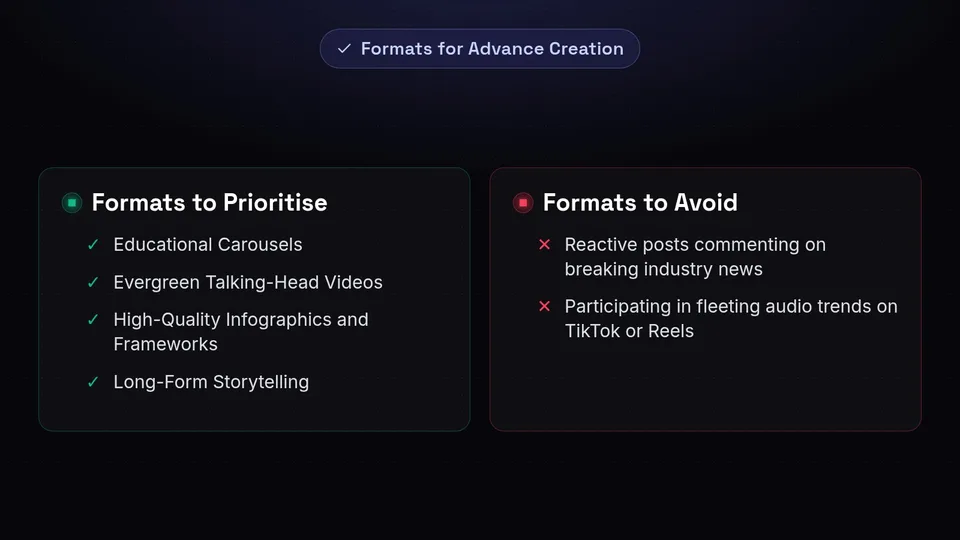
When you are relying on batch scheduling, you must accept that your content is being created days, or sometimes weeks, before it is consumed. Therefore, not all content formats are suitable for this strategy. You must focus on formats that are robust, evergreen, and impervious to the rapid news cycle.
Formats to Prioritise
- Educational Carousels: Deep dives into specific industry problems, how-to guides, and step-by-step tutorials are excellent. They provide immense value and do not expire. A guide on "How to structure a client onboarding process" is just as relevant on a Saturday as it would have been the previous Tuesday.
- Evergreen Talking-Head Videos: Short-form videos where you share a personal insight, a mindset shift, or a foundational business principle work perfectly. Because they are not tied to a trending sound or a daily news event, they can be recorded in batches and dripped out over the weekend.
- High-Quality Infographics and Frameworks: Visual representations of your unique methodology or industry statistics are highly shareable. These take time to design, making them perfect candidates for a dedicated weekend creation session.
- Long-Form Storytelling: Sharing a detailed case study, a personal failure, or a business milestone in a long caption builds deep trust. These require thoughtful writing, which benefits greatly from the unhurried environment of a weekend batching session.
Formats to Avoid
Conversely, you should avoid content that relies on immediate context. Reactive posts commenting on breaking industry news will feel stale if you wait until Saturday to publish them. Similarly, participating in fleeting audio trends on platforms like TikTok or Instagram Reels is risky; by the time your scheduled post goes live, the trend may have already peaked and become annoying to users.
"The secret to a constrained schedule is not trying to do everything in less time, but choosing to do only the things that withstand the test of time."
Managing the Weekday Engagement Gap
One of the biggest anxieties surrounding a weekend-only schedule is the weekday engagement gap. If someone comments on your Saturday post on a Tuesday, and you do not reply until the following Saturday, will they lose interest? Yes, they might. Therefore, managing weekend engagement and setting clear boundaries is paramount.
Setting Expectations
The simplest way to handle the weekday gap is to be transparent with your audience. Utilise your social media bios to set expectations. A simple line such as, "Sharing deep-dive insights every Saturday & Sunday," tells a visitor exactly what your cadence is. They won't expect a Wednesday post if you have already told them you are a weekend creator.
Maximising the Weekend Window
Because you are only active for two days, you must make those two days count. Your goal is to concentrate your audience's attention into a specific window. To do this effectively, you need to know exactly when your audience is online during the weekend. Publishing blindly on a Saturday morning might mean your post gets buried before your audience logs on in the evening. We highly recommend using data-driven insights to pinpoint these exact moments; you can refine your approach by checking out our tool for finding the best time to post.
The 15-Minute Weekday Compromise (Optional)
If you absolutely cannot stomach leaving comments unanswered for five days, implement a strict 15-minute weekday compromise. Do not create content, do not scroll the feed, and do not look at analytics. Simply log in during your morning commute or while the kettle boils, reply to outstanding comments from your weekend posts, and log out. This maintains a pulse on your account without derailing your weekday focus.
A Worked Weekly Plan for Weekend Creators
To move from theory to practice, let us look at a concrete, worked weekly plan. This is designed for someone who works a demanding full-time job Monday to Friday and wants to maintain a high-quality, albeit constrained, presence on platforms like LinkedIn and Instagram.
Monday to Friday: Passive Collection
- Action: No active posting, no forced engagement.
- Task: Keep a digital notepad on your phone. When an idea strikes during a meeting, a commute, or a client conversation, jot down a bullet point. Do not flesh it out; just capture the raw idea.
- Time Commitment: 5 minutes per day.
Saturday: The Engine Room (Creation & Scheduling)
Saturday morning is dedicated to your batch scheduling session. Treat this as an unbreakable appointment with yourself.
- 09:00 - 09:30: Review your notes from the week. Select the two strongest ideas to turn into posts.
- 09:30 - 10:30: Draft the copy for both posts. Ensure the hooks are strong and the formatting is clean.
- 10:30 - 11:30: Create the accompanying assets. This might be designing a carousel in Canva for Sunday's post, and recording a short video for today's post.
- 11:30 - 12:00: Load the assets and copy into your scheduling tool. Schedule the first post to go live on Saturday afternoon (e.g., 14:00) and the second for Sunday morning (e.g., 10:00).
Saturday Afternoon: Active Engagement
- 14:00 - 14:45: Your first post goes live. Be online. Reply to every comment immediately. Leave thoughtful comments on 5-10 accounts within your niche to drive traffic back to your new post.
Sunday: Community Building
- 10:00 - 10:45: Your second post goes live. Repeat the active engagement process. Reply to comments, engage with your peers, and foster conversations.
- Sunday Evening: Spend 15 minutes replying to any late comments from the weekend. Log out, safe in the knowledge that your social media duties are complete for the week.
Conclusion: Making Your Schedule Work for You
A constrained posting schedule is not a sign of failure; it is a strategic choice for sustainability. By embracing weekend only posting, you are choosing to prioritise the quality of your output and the health of your work-life balance over the relentless demand for daily content. It requires discipline to master batch scheduling and a willingness to accept slower, but potentially more meaningful, audience growth.
Remember, the algorithms may favour consistency, but human beings favour value. If your weekend posts consistently deliver exceptional insights, your audience will gladly wait for them. They will learn your posting cadence, and your content will become a valued part of their weekend routine.
If you are ready to take control of your time and implement a sustainable weekend strategy, having the right system in place is crucial. SchedulifyX is designed to support creators and professionals who need to maximise their efficiency. With our advanced automation and scheduling capabilities, you can batch your entire week's presence in a single sitting, leaving you free to focus on what truly matters during the week. Start building a schedule that works for you, not against you.