Instagram SEO Guide: Optimize for Instagram Search Queries
SchedulifyX Team · August 20, 2026
Master Instagram SEO with our practical guide. Learn how to optimize your profile name, bio, captions, and alt text to be found in Instagram search.
For years, the secret to growing an audience on Instagram was simple: take a great photo, apply a nice filter, and paste a block of thirty carefully researched hashtags into the first comment. But if you have noticed a drop in your reach recently, you are not alone. The platform has evolved, and the way users discover content has fundamentally changed. Welcome to the era of Instagram SEO.
Today, mastering instagram search queries optimization is the most effective strategy for sustainable growth. Users are treating Instagram like a search engine, typing specific phrases into the Explore page to find exactly what they want—whether that is "vegan cafes in London," "summer wedding guest dresses," or "social media scheduling tips." If your profile is not optimized for these searches, you are leaving engagement and followers on the table.
In this comprehensive guide, we will explore exactly how to be found on instagram by optimizing your account for search rather than relying solely on hashtags. We will break down how the algorithm indexes your profile, how to conduct keyword research, and provide a 10-minute audit checklist you can use today.
The Shift from Hashtag Discovery to Keyword Search

To understand why instagram seo is so critical today, we have to look at how user behavior and algorithmic machine learning have evolved. Historically, Instagram's search bar was essentially a directory. You could search for accounts (usernames) or you could search for hashtags. If you wanted to find content about home organization, you had to search for #HomeOrganization.
However, as the platform grew, this system became flawed. Hashtags became saturated with spam, and users wanted a more intuitive way to find content. Enter semantic search. Instagram upgraded its search functionality to understand the context and intent behind user queries. Now, when a user types a phrase into the instagram search bar, the algorithm scans a massive database of content to deliver relevant results, even if the specific hashtag wasn't used.
"Search is no longer just about exact matches; it is about context, relevance, and semantic understanding. Instagram is reading your captions, analyzing your images, and categorizing your account based on your overall content pillars."
This shift means that instagram search queries optimization is now a holistic practice. It is not just about tagging; it is about training the algorithm to understand exactly who you are, what you do, and who your content is for. When you align your profile with the exact terms your audience is typing, you unlock a steady stream of highly targeted, high-intent traffic.
How Instagram Indexes Your Profile and Content
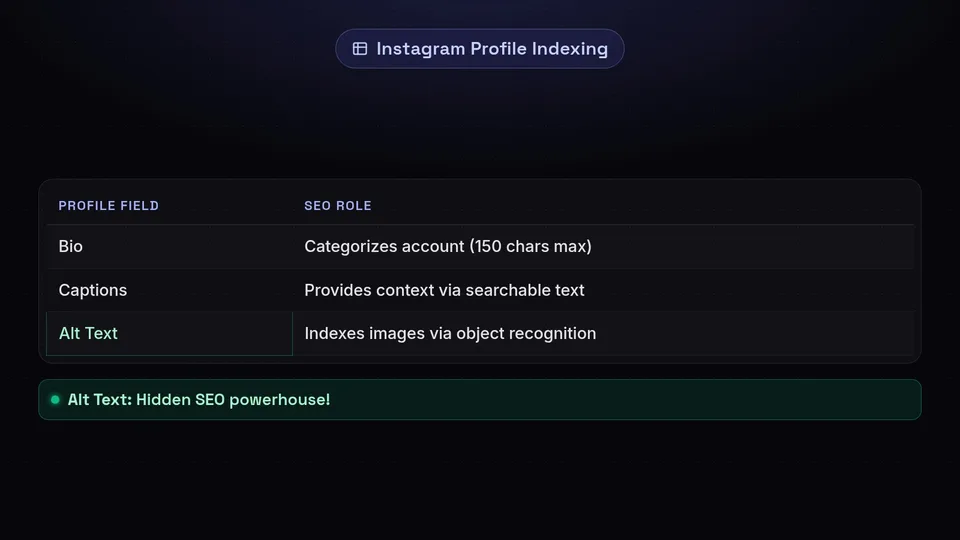
If you want to know how to be found on instagram, you need to understand the specific fields that the algorithm crawls and indexes. Not all text on Instagram is treated equally. The platform prioritizes certain fields over others when determining search rankings.
1. Your Bio
Your bio is prime real estate for Instagram SEO. While it is limited to 150 characters, it plays a massive role in how Instagram categorizes your account. The keywords you include in your bio signal to the algorithm what your entire account is about. If you are a graphic designer, words like "branding," "logo design," and "typography" should naturally appear in your bio.
Because space is limited, every character counts. You can use our free character counter to draft the perfectly optimized bio before updating your profile.
2. Your Captions
In the past, captions were mostly for storytelling or driving engagement in the comments. Today, they are fully searchable text documents. Instagram's algorithm reads your captions to identify keywords and determine the topic of your post. This means writing descriptive, keyword-rich captions is non-negotiable for instagram search queries optimization.
Instead of writing a vague caption like "Monday vibes ✨," an optimized caption would read: "Starting the week with a fresh social media strategy! Here are three tips for scheduling your Instagram content to boost engagement..." The latter gives the algorithm clear context and multiple searchable keywords.
3. Alt Text (The Hidden SEO Powerhouse)
Alternative text (alt text) was originally designed for accessibility, allowing screen readers to describe images to visually impaired users. However, it is also a powerful SEO tool. Instagram uses object recognition technology to "see" what is in your photos, but providing custom alt text gives you direct control over how the image is indexed.
To add custom alt text, tap "Advanced Settings" before publishing a post, and select "Write Alt Text." Describe the image accurately while naturally weaving in your target keywords. For example: "A flatlay of a desk featuring a laptop open to a social media content calendar, a cup of coffee, and a notebook for marketing strategy planning."
The Difference Between Your Name and Username
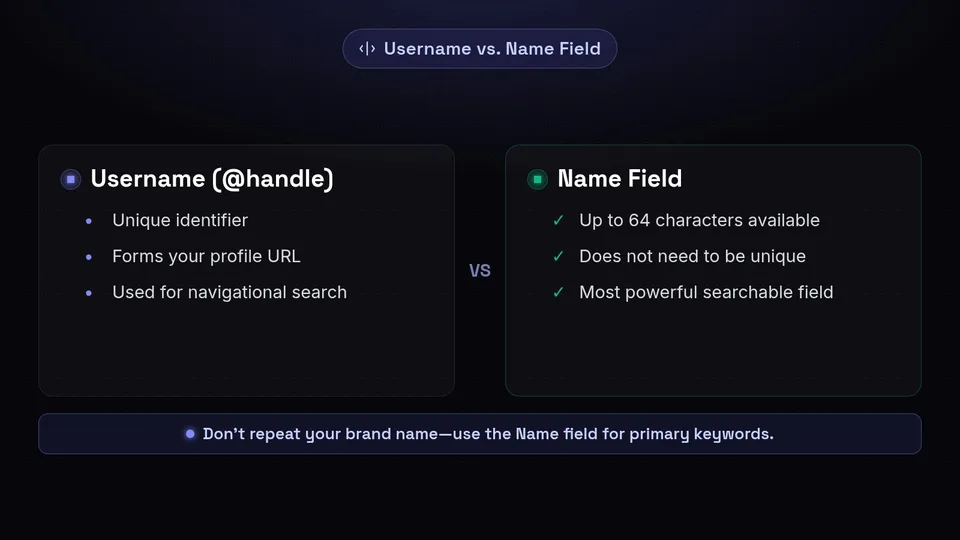
One of the most common mistakes in Instagram SEO is misunderstanding the difference between the Username field and the Name field. Both are heavily weighted in instagram search, but they serve different purposes and behave differently.
The Username (@handle)
Your username is your unique identifier on the platform. It forms your profile URL and is how people tag you. When it comes to search, Instagram indexes your username, but it is primarily used for navigational search (when someone already knows your brand and is looking for you specifically).
Ideally, your username should be your brand name, as clean and memorable as possible. Avoid excessive numbers or underscores, as they make you harder to find. If you are struggling to find an available, SEO-friendly handle, try using our username generator for creative, optimized ideas.
The Name Field (Your Biggest SEO Opportunity)
The Name field (the bold text that appears just above your bio) is entirely separate from your username, and it is the single most powerful, searchable field on your entire profile. You have up to 64 characters here, and unlike your username, it does not need to be unique.
Most people just put their actual name or brand name here again. This is a massive missed opportunity. If your username is already your brand name, you don't need to repeat it. Instead, use the Name field to target your primary keywords.
For example, if your username is @JaneDoe, making your Name field "Jane Doe" doesn't help new people find you. But if you change your Name field to "Jane Doe | NYC Wedding Photographer," you are suddenly indexing for "NYC Wedding Photographer." When a bride-to-be types that into the instagram search bar, your profile has a significantly higher chance of appearing at the top of the results.
Keyword Placement That Reads Naturally
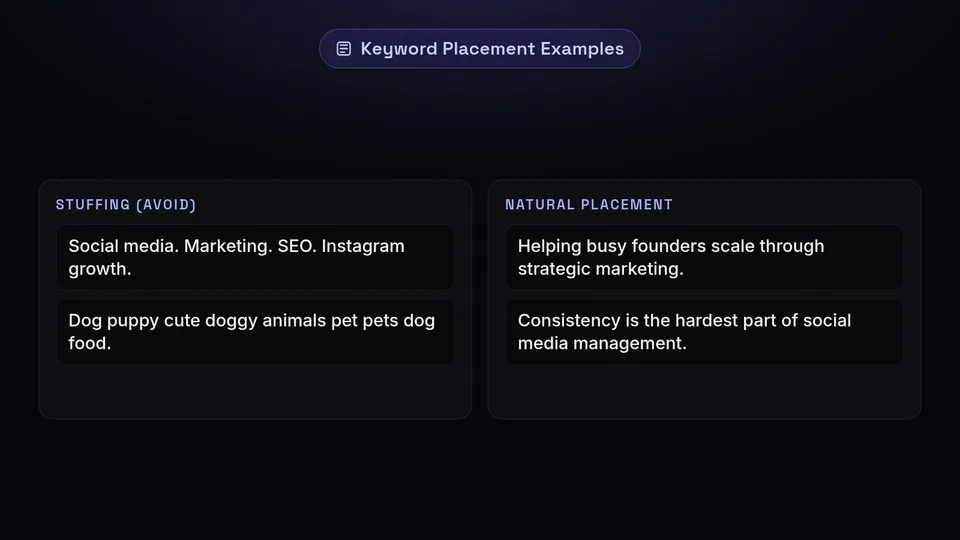
Once you understand the importance of keywords, the temptation is to cram as many as possible into your profile. This is known as "keyword stuffing," and not only does it look spammy to human readers, but algorithms are increasingly smart enough to penalize it.
Effective instagram search queries optimization requires placing keywords naturally so that they enhance the user experience rather than detract from it. The goal is to write for humans first, and algorithms second.
Examples of Keyword Stuffing (What to Avoid)
- Bio: "Social media. Marketing. SEO. Instagram growth. Content creator. Social media manager. Hire me for social media."
- Caption: "Here is a photo of my dog. Dog puppy cute doggy animals pet pets dog training dog food."
Examples of Natural Keyword Placement (What to Do)
- Bio: "Helping busy founders scale their brands through strategic social media marketing and organic Instagram growth. Download my free content calendar below!"
- Caption: "Consistency is the hardest part of social media management. That is why I rely on batch-creating my Instagram content every Sunday. Here is the exact content strategy I use to plan a month of posts in one afternoon..."
Notice how the optimized examples use complete sentences and provide actual value, while still clearly signaling to the algorithm what the content is about.
How to Research Instagram Search Terms
You cannot optimize your profile if you don't know what your audience is actually searching for. Guessing your keywords is a recipe for low visibility. You need to discover the exact phrases and terminology your ideal followers are typing into the search bar.
1. Use the Native Instagram Search Bar
The most accurate tool for Instagram keyword research is the app itself. Go to the Explore page and tap the search bar. Start typing a broad keyword related to your niche (e.g., "fitness"). Before you hit enter, look at the autocomplete suggestions that drop down. Instagram suggests these phrases because they are the most frequently searched terms by real users.
You might see suggestions like "fitness motivation," "fitness routines for beginners," or "fitness meal prep." These are your long-tail keywords. Write them down and start incorporating them into your captions and bio.
2. Analyze Your Analytics and Insights
If you have a Creator or Business account, dive into your Instagram Insights. Look at your top-performing posts. What words did you use in those captions? What topics resonated the most? Often, your past successes leave clues about the semantic terms the algorithm associates with your account.
3. Listen to Your Audience
Pay close attention to the comments and DMs you receive. What specific words do your followers use when asking you questions? If you are a skincare expert, do they ask about "anti-aging routines" or "wrinkle prevention"? Using the exact vocabulary of your target audience is a foolproof way to improve your instagram seo.
4. Cross-Platform Keyword Research
While Instagram's native search is getting better, traditional SEO tools can still provide valuable inspiration. Tools like Google Keyword Planner, AnswerThePublic, or even searching on TikTok or Pinterest can reveal trending topics and questions in your industry that you can adapt for your Instagram strategy.
The Modern Role of Hashtags in Search
With all this talk about keyword optimization, you might be wondering: are hashtags dead? The short answer is no, but their role has fundamentally changed.
Hashtags are no longer the primary engine for discovery, but they act as a supplementary categorization tool. Think of keywords as the main text of a book, and hashtags as the index at the back. Instagram's own creators have stated that you only need 3 to 5 highly relevant hashtags per post, rather than the maximum of 30.
Using hyper-specific hashtags helps the algorithm double-check that its understanding of your content is correct. To streamline this process and ensure you are using the most effective, non-banned tags, you can utilize our hashtag manager to organize and test different hashtag groups alongside your keyword strategy.
The 10-Minute Instagram Profile Audit Checklist
Ready to put this knowledge into action? Set a timer for ten minutes and run your profile through this actionable instagram seo checklist to ensure you are fully optimized for search.
- Check Your Username: Is it clean, memorable, and free of unnecessary numbers or punctuation?
- Optimize Your Name Field: Are you using this 64-character space to include your primary keyword or niche? (e.g., "[Your Name] | [Your Niche/Profession]").
- Review Your Bio Keywords: Does your bio naturally include 2-3 secondary keywords that describe exactly what you do and who you serve?
- Audit Your Recent Captions: Look at your last three posts. Are the captions descriptive? Do they include keywords related to the image and your niche?
- Check Alt Text: Did you add custom, descriptive alt text to your recent image posts? If not, go back and edit them to include alt text.
- Evaluate Hashtag Usage: Are you using 3-5 highly relevant, niche-specific hashtags per post, rather than generic ones like #love or #instagood?
- Remove Keyword Stuffing: Read your profile aloud. Does it sound like a human wrote it? Remove any robotic lists of keywords.
- Check Your Profile Picture: While not directly a text SEO factor, a clear, high-quality profile picture increases click-through rates when you do appear in search results.
- Review Pinned Posts: Ensure your pinned posts are highly representative of your core content pillars and contain optimized captions, as these get the most visibility.
- Consistency Check: Is your messaging consistent? The algorithm favors accounts that consistently post about a specific topic, establishing topical authority.
Conclusion and Next Steps
Understanding how to be found on instagram is no longer about gaming the system with massive blocks of hashtags. It is about embracing the principles of instagram search queries optimization. By treating your profile like a searchable website and optimizing your Name field, bio, captions, and alt text with natural, well-researched keywords, you align yourself with how the algorithm actually works today.
The shift from hashtag discovery to semantic keyword search is an incredible opportunity for creators and brands willing to adapt. It means your content can have a longer lifespan, surface to higher-intent audiences, and drive more meaningful engagement.
Managing a comprehensive Instagram SEO strategy requires consistency, planning, and the right tools. With SchedulifyX, our AI-powered platform helps you seamlessly integrate keywords into your content calendar, analyze your performance, and manage your assets all in one place. Start optimizing your search presence today, and watch your organic reach grow.