Best Hashtags for TikTok: The Truth About the Algorithm
SchedulifyX Team · August 23, 2026
Discover how TikTok hashtags actually work. Learn why the algorithm favors watch time over tags, why #fyp is useless, and how to find niche tags that convert.
Introduction: The Great Hashtag Misconception

If you have spent any amount of time trying to grow an audience on short-form video platforms, you have likely obsessively searched for the best hashtags for TikTok. You have probably read countless articles claiming that finding the perfect combination of tags is the secret key to unlocking viral success. You might have even pasted blocks of trending tiktok hashtags into your captions, crossed your fingers, and waited for the views to roll in—only to be met with the dreaded 200-view jail.
It is time to set the record straight. The way most marketers and creators think about hashtags for TikTok is fundamentally flawed. They are treating TikTok like it is Instagram circa 2015. But TikTok is not a chronological photo-sharing app, and its algorithm does not rely on hashtags as the primary vehicle for content distribution.
In this comprehensive guide, we are going to tear down the myths surrounding TikTok hashtags. We will explain how the For You algorithm actually functions, why your hashtag strategy has significantly less leverage than most "gurus" claim, and what tags genuinely do behind the scenes. More importantly, we will show you where you should actually be focusing your energy (hint: it involves the first three seconds of your video) and how to use tools like our Hashtag Manager to streamline the categorization process without wasting your valuable time.
The Hard Truth: How the TikTok Algorithm Actually Works
To understand why obsessing over the best hashtags for TikTok is a misuse of your time, you first need to understand the underlying mechanics of the TikTok algorithm. The For You Page (FYP) is an interest-graph-driven feed, not a social-graph-driven feed. This means it serves content based on what it predicts a user wants to watch, regardless of who they follow.
The Batch Testing Process
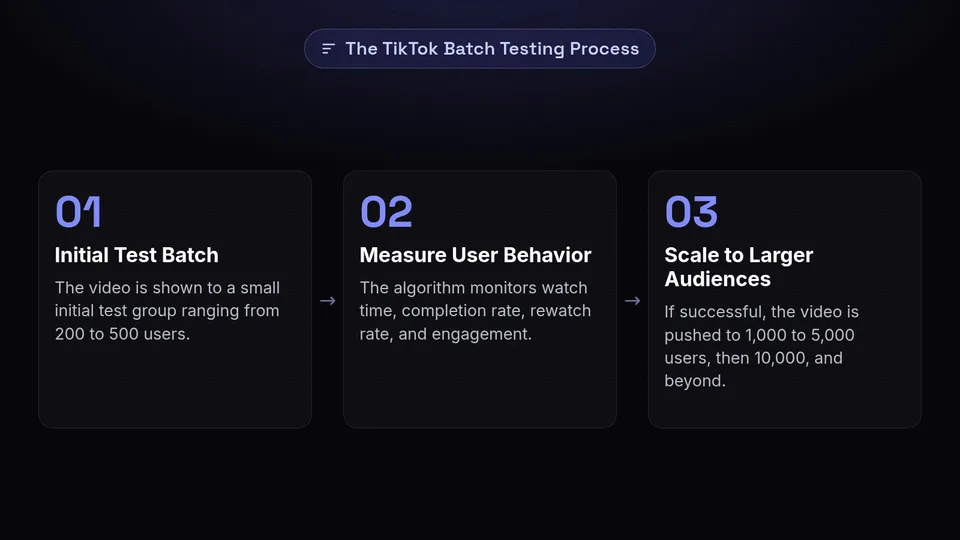
When you publish a video on TikTok, the algorithm does not immediately push it to a massive audience. Instead, it initiates a "batch testing" phase. Your video is shown to a small initial test group—usually ranging from 200 to 500 users. The algorithm then closely monitors how these users interact with your content.
What is the algorithm looking for? It is not checking to see if you used the right tiktok hashtags. It is measuring user behavior. The most critical metrics are:
- Watch Time: How long did the user stay on the video?
- Completion Rate: Did the user watch the video all the way to the end?
- Rewatch Rate: Did the user let the video loop and watch it again?
- Engagement: Did they like, comment, share, or save the video? (Shares and saves are weighted much heavier than likes).
If your video performs exceptionally well in this initial test batch—meaning people are actually watching it—the algorithm pushes it to a larger batch of 1,000 to 5,000 people. If it performs well there, it goes to 10,000, then 50,000, and so on. This is how a video goes viral.
Behavior Over Metadata
Notice what is missing from that equation? Hashtags. The algorithm relies on watch behavior far more than metadata. If your video is boring, poorly lit, or lacks a compelling hook, no combination of the best hashtags for TikTok will save it. The initial test batch will swipe away within the first two seconds, signaling to the algorithm that the content is not engaging, and the video's reach will be capped immediately.
Hashtags do not create virality. They do not magically inject your video into the feeds of millions of people. They are simply a small piece of metadata that helps the algorithm figure out who should be in that initial test batch. If you have the greatest hashtags in the world but terrible retention, your video will fail.
Instagram vs. TikTok: Why Your Old Strategy is Failing
One of the biggest reasons creators misunderstand hashtags for TikTok is because they are applying Instagram logic to a fundamentally different platform. Let's break down the historical context to see why this happens.
The Instagram Hashtag Model
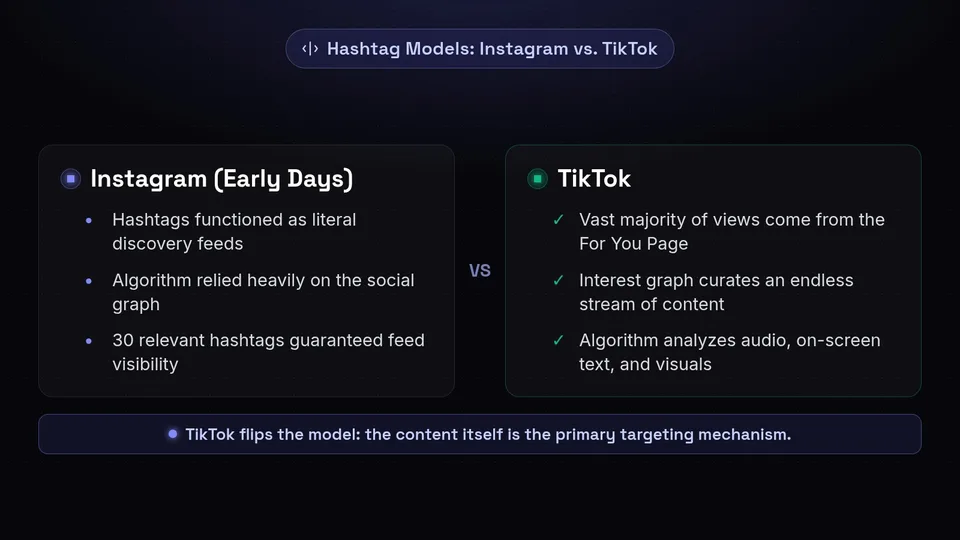
In the earlier days of Instagram, hashtags functioned as literal discovery feeds. Users would search for a hashtag, click on it, and scroll through a chronological feed of photos that used that specific tag. If you used 30 highly relevant, medium-volume hashtags, you could guarantee that your post would appear in those feeds, leading to a steady stream of organic discovery from people browsing those tags.
Because Instagram's algorithm originally relied heavily on the social graph (who you follow) rather than a pure interest graph, hashtags were the primary bridge to reach non-followers.
The TikTok Interest Graph Model
TikTok flipped this model on its head. On TikTok, the vast majority of views come from the For You Page, not from users actively searching for and scrolling through hashtag feeds. While hashtag feeds do exist on TikTok, they account for a minuscule percentage of overall traffic.
When a user opens TikTok, they are immediately dropped into an endless stream of content curated specifically for them. They are not typing "#dogtrainingtips" into a search bar and scrolling; they are simply watching the videos the algorithm feeds them. Therefore, stuffing your caption with 30 trending tiktok hashtags does not place you in front of a massive browsing audience. It just creates a messy caption.
On TikTok, the content itself is the primary targeting mechanism. The algorithm analyzes the video's audio, the text on the screen, the visual elements (via computer vision), and the caption to determine what the video is about. Hashtags are just one small data point in a much larger semantic web.
What TikTok Hashtags Genuinely Do (Categorization & SEO)
If the algorithm relies primarily on watch behavior, and hashtag feeds aren't a major source of traffic, you might be wondering: do hashtags for tiktok do anything at all? Should I just stop using them entirely?
No, you shouldn't stop using them. While they are a lower-leverage variable than your video's hook, they still serve two very specific, genuine purposes: categorization and Search Engine Optimization (SEO).
1. Categorization and Niche Signals
As mentioned earlier, when you post a video, TikTok needs to show it to an initial test batch of users. How does it decide who those 200-500 people should be? It looks for categorization signals.
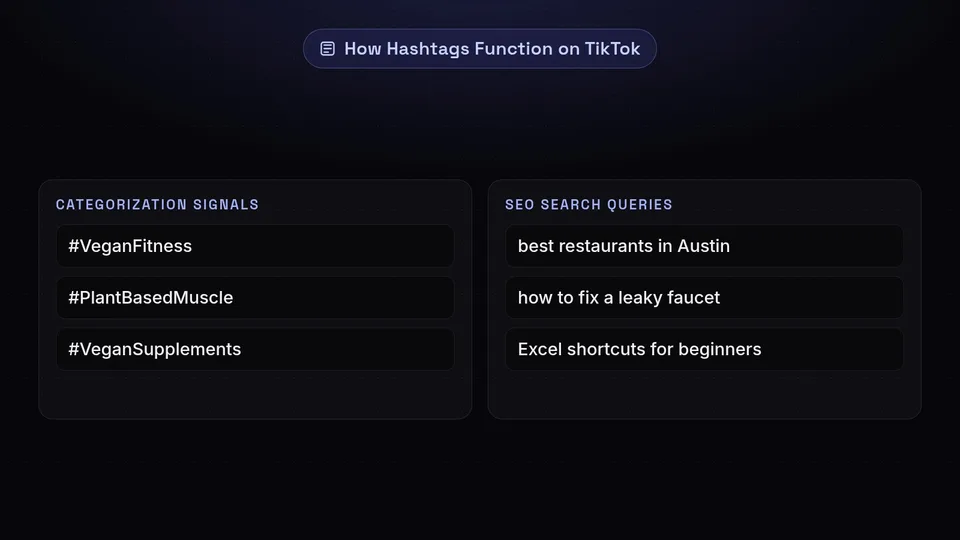
This is where your hashtags come into play. By using targeted, niche-specific tags, you are giving the algorithm a giant hint about who your ideal audience is. If you post a video about a new vegan protein powder and use the tags #VeganFitness, #PlantBasedMuscle, and #VeganSupplements, you are telling TikTok: "Please show this video to people who have previously engaged with vegan fitness content."
If you do this correctly, your initial test batch will be filled with your target audience. Because they are already interested in the topic, they are much more likely to watch the video all the way through, which in turn signals the algorithm to push the video to a wider audience. Hashtags don't make you viral, but they help you find the right test audience so your content has a chance to go viral based on its own merit.
2. TikTok as a Search Engine (TikTok SEO)
The second genuine function of tiktok hashtags is SEO. A massive shift is occurring in how younger generations consume information. Gen Z is increasingly using TikTok as their primary search engine, bypassing Google entirely. They are searching for things like "best restaurants in Austin," "how to fix a leaky faucet," or "Excel shortcuts for beginners."
When a user types a query into the TikTok search bar, the platform's search algorithm scans video captions, on-screen text, and hashtags to deliver the most relevant results. By including the best hashtags for TikTok that align with what your target audience is actively searching for, you increase the likelihood that your video will rank in these search results.
Search traffic on TikTok is incredibly valuable because it is evergreen. A video that ranks well for a specific search term can continue to pull in views, followers, and leads for months or even years after it was originally posted, long after its initial run on the FYP has ended.
The Myth of #FYP, #ForYou, and #Viral
Now that we understand what hashtags actually do (categorization and SEO), it is time to address the most pervasive and damaging myth on the platform: the use of broad, generic tags like #fyp, #foryoupage, #viral, and #trending.
Take a scroll through your For You Page right now, and you will undoubtedly see countless videos with captions that look like this: "Check out this crazy trick! #fyp #foryou #viral #trending tiktok hashtags".
Here is the reality: Using #fyp does absolutely nothing to help your video get on the For You Page.
Why Broad Tags Hurt Your Performance
Think back to the categorization function we just discussed. Your goal with hashtags is to help the algorithm identify the perfect initial test batch for your video. If you use a tag like #VeganFitness, the algorithm knows exactly who to show it to.
But what happens when you use #fyp? The "For You" tag has trillions of views. It encompasses every single topic, demographic, and interest on the platform. It provides zero categorization signals. By using #fyp, you are essentially telling the algorithm: "Show this to literally anyone."
As a result, the algorithm might show your highly specific vegan fitness video to a test batch that includes teenagers who only watch gaming streams, elderly users who watch knitting tutorials, and people who exclusively consume barbecue meat-smoking videos. What will these people do when your video pops up? They will swipe away immediately.
This terrible retention rate will signal to the algorithm that your video is bad, and its reach will be capped instantly. By trying to appeal to everyone using broad tags, you end up appealing to no one. You dilute your categorization signals and sabotage your own content.
Stop wasting valuable caption real estate on #fyp, #viral, and #trending. They are useless.
How Many Hashtags for TikTok Should You Use?
Another holdover from the Instagram era is the belief that more is always better. On Instagram, you were allowed 30 hashtags, and many experts advised using all 30 to maximize your "reach."
On TikTok, this strategy is counterproductive for several reasons.
The Real Estate Problem
First, TikTok captions are meant to be concise and readable. The primary purpose of your caption should be to add context to the video, hook the viewer, or encourage engagement (e.g., "Wait for the twist at the end..."). If your caption is buried under a mountain of 25 hashtags, it looks spammy, desperate, and clutters the user interface on smaller screens.
The Dilution Problem
Second, using too many tags dilutes your core message. If you use 15 different hashtags for tiktok, the algorithm has a harder time pinpointing exactly what the video is about. You want to be laser-focused.
The Sweet Spot
So, what is the ideal number? Data and extensive testing across thousands of accounts suggest that the sweet spot is 3 to 5 highly relevant hashtags.
- Tag 1: The Broad Niche. A tag that defines your overarching industry (e.g., #DigitalMarketing).
- Tag 2: The Sub-Niche. A tag that gets more specific about the video's topic (e.g., #EmailMarketingTips).
- Tag 3: The Specific Problem/Topic. A tag that perfectly describes the exact content of the video (e.g., #ColdEmailStrategy).
- Tag 4 & 5 (Optional): Location or Series. If you are a local business, use a location tag (e.g., #ChicagoRealtor). If the video is part of a series, use your custom series tag.
By sticking to 3-5 hyper-relevant tags, you provide a clear, unambiguous signal to the algorithm without cluttering your caption.
How to Find Niche Tags with Real Volume
If you shouldn't use massive tags like #fyp (which have trillions of views) or obscure tags that no one searches for (which have zero views), how do you find the right balance? You need to find the "Goldilocks" zone of trending tiktok hashtags—tags that have enough volume to prove there is an audience, but aren't so saturated that your specific signal gets lost.
The Goldilocks Zone
When searching for the best hashtags for TikTok, look for tags that have between 10 million and 2 billion total views. (Note: TikTok shows total views for a hashtag, not the number of posts).
- Under 1 Million Views: The niche might be too small, or people aren't actively searching for it.
- 10M - 500M Views: The sweet spot for sub-niches. High relevance, active community.
- 500M - 2B Views: Good for your "Broad Niche" tag.
- Over 10 Billion Views: Highly saturated. Use sparingly, as the categorization signal becomes diluted.
Research Methods
Here is a step-by-step process for finding the right tags:
- The Search Bar Autocomplete: Type your core topic into the TikTok search bar, but do not press enter. Look at the autocomplete suggestions. These are the exact phrases people are actively searching for. Turn these phrases into hashtags.
- Competitor Analysis: Find 5-10 creators in your niche who are consistently getting good views. Look at their most recent successful videos. What 3-5 tags are they using? Do not copy them blindly, but use them for inspiration.
- The "Others Searched For" Section: When you search for a term and scroll through the results, TikTok often inserts a section called "Others searched for." This is an absolute goldmine for finding related long-tail keywords and tags.
To make this process effortless, you can use the Hashtag Manager within SchedulifyX. Our tool allows you to save hashtag groups, analyze their relevance, and insert them into your scheduled posts with a single click, ensuring you maintain a consistent and strategic categorization approach without having to do manual research every time you post.
Examples of Trending TikTok Hashtags by Category
To illustrate the difference between broad, useless tags and highly effective, niche-specific tags, let's look at some examples across various popular categories. Notice how the effective tags clearly communicate the video's content to the algorithm.
1. The Book Niche (BookTok)
- Bad Strategy: #books #reading #fyp #viral
- Good Strategy: #BookTok #FantasyRomanceBooks #EnemiesToLovers #BookRecommendations
- Why it works: "BookTok" is the established community hub. "EnemiesToLovers" specifies the exact trope, signaling the algorithm to show the video to readers who obsess over that specific plot dynamic.
2. The Fitness Niche (FitTok)
- Bad Strategy: #fitness #workout #gym #trending
- Good Strategy: #DumbbellOnlyWorkout #BeginnerGymTips #GluteGrowthWorkout #HomeWorkoutRoutine
- Why it works: The good tags solve a specific problem. Someone searching for a "dumbbell only workout" has a very specific intent, and if your video provides that, they will watch it to the end, boosting your retention metrics.
3. The Small Business Niche
- Bad Strategy: #business #entrepreneur #money #foryou
- Good Strategy: #SmallBizBehindTheScenes #OrderPacking #EtsyShopOwner #HandmadeJewelryBusiness
- Why it works: Small business content thrives on authenticity and process. Tags like #OrderPacking tap into a specific, highly satisfying sub-genre of content that viewers love to watch, signaling the algorithm to find that specific audience.
4. The Tech and Software Niche
- Bad Strategy: #tech #software #computers #fyp
- Good Strategy: #ExcelTipsAndTricks #TechStack #SaaSMarketing #CodingForBeginners
- Why it works: These tags act as perfect SEO keywords. People actively use TikTok as a search engine to learn Excel or coding. By using these tags, you optimize your video for long-term search traffic.
5. The Food and Recipe Niche
- Bad Strategy: #food #yummy #dinner #viralvideo
- Good Strategy: #HighProteinMeals #AirFryerRecipes #VeganDinnerIdeas #MealPrepSunday
- Why it works: "Food" is too broad. "AirFryerRecipes" targets a massive but specific community of appliance owners looking for immediate, actionable utility.
The True Leverage: Hooks and the First 3 Seconds
We have established that while hashtags for tiktok are important for categorization and SEO, they are a low-leverage variable. If you spend 2 hours researching hashtags and 5 minutes writing your script, your priorities are completely backward.
The highest leverage variable on TikTok—the element that truly determines whether your video gets 200 views or 2 million views—is the hook. The first three seconds of your video dictate your retention rate, and your retention rate dictates your algorithmic reach.
Visual and Auditory Hooks
A hook is not just what you say; it is what the viewer sees and hears the moment the video starts. You need to interrupt their scrolling pattern immediately.
- The Auditory Hook: Start speaking immediately. Do not have a 2-second silent intro where you take a breath. Ask a compelling question, state a controversial opinion, or promise a clear benefit. (e.g., "Stop doing your bicep curls like this if you want your arms to grow.")
- The Visual Hook: Have movement on the screen. Change the camera angle, point to a text bubble, or show the end result of the video first before jumping into the tutorial.
- The Text Hook: Use native TikTok text on the screen in the first 3 seconds that reinforces the auditory hook. This caters to users watching with the sound off and provides immediate context. Pro tip: Enhance your text hooks by using visually engaging elements. Check out our TikTok Emojis Tool to ensure your on-screen text pops and captures attention.
The Holistic Strategy
The ultimate hierarchy of TikTok success looks like this:
- The Hook (0-3 seconds): Determines if they stop scrolling.
- The Content/Pacing (3 seconds to end): Determines if they finish the video (Completion Rate).
- The Call to Action: Determines if they engage (Share, Save, Follow).
- The Categorization (Hashtags, Keywords in Caption, On-Screen Text): Determines who the algorithm tests the video on.
If you master the top three, the fourth (hashtags) simply acts as a multiplier. If you fail at the top three, the best hashtag strategy in the world will yield absolutely nothing.
Optimizing Your Strategy with SchedulifyX
Understanding that hashtags are about categorization rather than magical virality should relieve a lot of pressure. You no longer need to stress over finding a secret combination of tags. You simply need to identify your core niche tags and use them consistently.
However, manually typing out these tags, ensuring you don't make typos, and remembering which combination works best for which content pillar can still be tedious. That is where SchedulifyX comes in.
As an AI-powered social media scheduling platform, SchedulifyX is designed to handle the low-leverage, repetitive tasks so you can focus all your energy on the high-leverage tasks: creating incredible content and perfecting your hooks.
With our Hashtag Manager, you can:
- Create Hashtag Groups: Build specific clusters of 3-5 tags for each of your content pillars (e.g., one group for "Tutorials," one for "Behind the Scenes," one for "Industry News").
- One-Click Insertion: When scheduling your TikTok video through our dashboard, simply click your desired hashtag group to instantly append them to your caption.
- Performance Tracking: Monitor which content pillars (and their associated tag groups) are driving the most engagement over time.
By automating the categorization process, you ensure that the algorithm always knows exactly who to show your videos to, giving your carefully crafted hooks the best possible chance to succeed.
Conclusion: Stop Stressing Over Tags and Start Creating
The era of hashtag stuffing is over. The TikTok algorithm is too smart, too advanced, and too focused on actual human behavior to be tricked by a block of metadata.
To summarize the reality of hashtags for TikTok:
- They do not create virality; watch time and completion rate do.
- They serve as categorization signals to help the algorithm find your initial test audience.
- They act as SEO keywords for users treating TikTok as a search engine.
- Broad tags like #fyp and #viral dilute your categorization and actively harm your performance.
- You only need 3-5 highly relevant, niche-specific tags per video.
- Your hook and the first 3 seconds of your video are infinitely more important than your caption.
It is time to shift your focus. Stop agonizing over the "perfect" tags. Do your research once, find the tags that accurately describe your niche, save them in SchedulifyX, and then put 95% of your effort into creating videos that people actually want to watch.
Ready to streamline your TikTok workflow and stop wasting time on manual posting and hashtag formatting? Sign up for SchedulifyX today and let our AI-powered platform handle the logistics while you focus on going viral.