The Ultimate TikTok Strategy Guide for Creators: Formats, Hooks, and Audience Growth
SchedulifyX Team · August 31, 2026
Stop chasing viral hits. Master your TikTok content strategy with our comprehensive guide on repeatable formats, 3-second hooks, retention graphs, and audience building.
For years, the prevailing advice for growing on TikTok was simple: jump on every trending audio, post three times a day, and pray to the algorithmic gods that one of your videos goes viral. But as the platform has matured, the era of accidental, lottery-ticket virality has largely come to an end. Today, the most successful creators don't chase fleeting trends; they build sustainable, data-driven systems.
If you are serious about building a brand, a business, or a full-time career on the platform, you need a robust tiktok strategy. You need to move away from the exhausting hamster wheel of constant content ideation and instead focus on what actually works: repeatable formats, scientifically crafted hooks, strategic posting cadences, and deep community building.
In this comprehensive guide, we are breaking down the best tiktok creator strategies being used by top-tier creators today. Whether you are starting from zero or trying to break through a plateau, this guide will provide you with the blueprint for long-term, compounding success on the world's most powerful discovery engine.
Stop Chasing Virality: The Power of Repeatable Formats
The biggest mistake new creators make is treating every single video as a blank canvas. When you sit down to film and ask yourself, "What should I make a video about today?" you have already lost. This approach leads to creative burnout, inconsistent metrics, and an incredibly confused algorithm.
Instead of chasing individual viral videos, your primary tiktok content strategy should be to develop a repeatable format. A format is a specific, recognizable framework for delivering value to your audience. It is a container that you can pour different topics into time and time again.
Why the Algorithm Loves Formats
TikTok's algorithm is essentially a highly advanced categorization engine. It wants to know exactly who you are, what you make, and who wants to watch it. When you post a dancing video on Monday, a cooking tutorial on Tuesday, and a real estate tip on Wednesday, the algorithm cannot confidently push your content to a specific demographic.
When you utilize a repeatable format, you train the algorithm. You signal, "I am the creator who reviews obscure historical events using hand-drawn stick figures." Once the algorithm identifies the audience for that specific format, it will consistently serve your new videos to that same engaged demographic.
Examples of Highly Successful Formats
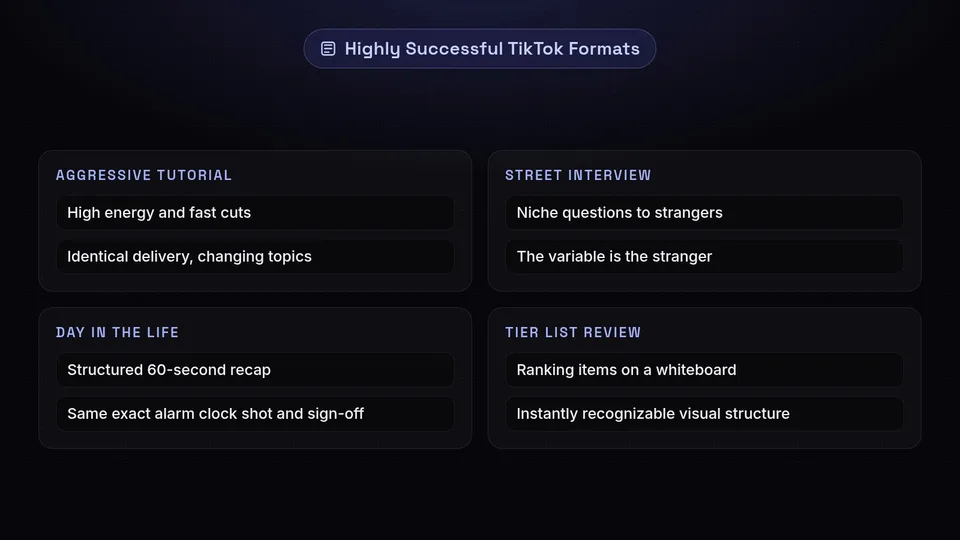
- The "Aggressive Tutorial": Delivering educational content (cooking, coding, fitness) with high energy, fast cuts, and a uniquely intense persona. The topic changes, but the delivery remains identical.
- The "Street Interview with a Twist": Asking strangers a specific, niche question (e.g., "What is your favorite book?" or "Guess the rent of this apartment"). The format is the interaction; the variable is the stranger.
- The "Day in the Life" Micro-Vlog: A heavily structured 60-second recap of a day, starting with the exact same alarm clock shot and ending with the same sign-off phrase.
- The "Tier List" Review: Ranking items (movies, software, snacks) on a whiteboard or green screen. The visual structure is instantly recognizable to viewers as they scroll.
To find your format, look at your past videos. Which ones felt the most natural to create? Which ones had the highest watch time? Take the structural elements of that video and templatize them. Once you have a format, creating content becomes an exercise in filling in the blanks rather than reinventing the wheel.
The Hook: Why the First 3 Seconds Decide Everything
You can have the most profound, life-changing message in the world, but if your hook fails, your video is dead on arrival. On TikTok, the user's thumb is constantly hovering, ready to swipe away at the slightest hint of boredom. The first three seconds of your video dictate up to 80% of its ultimate performance.
Mastering tiktok for creators means mastering the psychology of the scroll. A successful hook must do two things simultaneously: interrupt the user's scrolling pattern and open a curiosity gap that can only be closed by watching the rest of the video.
The Three Pillars of a Perfect Hook
A truly optimized hook operates on three distinct levels:
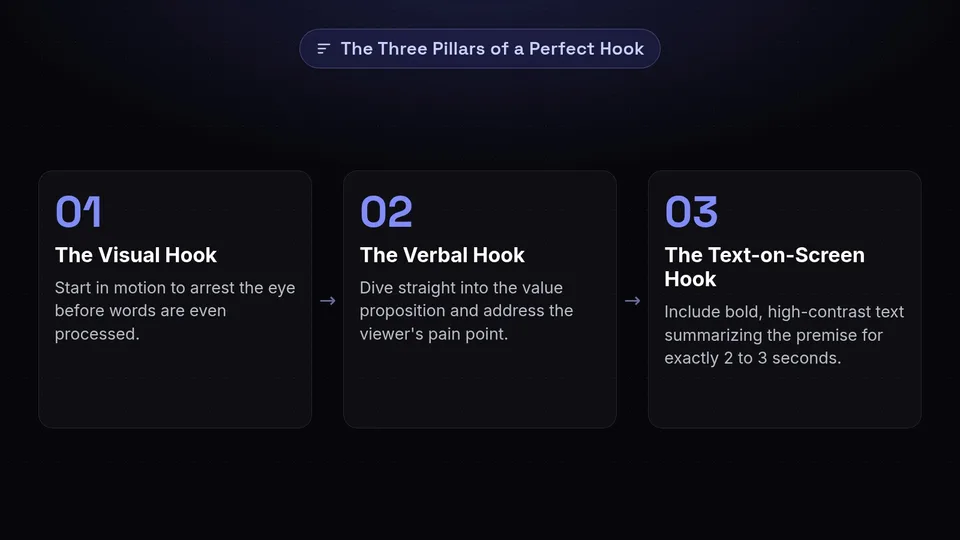
- The Visual Hook: What the viewer sees before they even process what you are saying. Never start a video sitting statically at a desk. Start in motion. Walk towards the camera, drop something on a table, point to a visually striking green-screen image, or use a dynamic transition. Movement arrests the eye.
- The Verbal Hook: The exact words you say in the first three seconds. Avoid weak openings like, "Hey guys, today I want to talk about..." Instead, dive straight into the value proposition. Address the viewer's pain point immediately.
- The Text-on-Screen Hook: Many users watch TikTok on mute or with low volume. Your opening frame must include a bold, high-contrast text sticker that summarizes the video's core premise. This text should remain on screen for exactly 2 to 3 seconds.
Actionable Hook Templates
If you are struggling to craft compelling openings, try adapting these proven frameworks for your niche:
- The Negative Hook: "Stop doing [Common Action] if you want to achieve [Desired Result]. Do this instead." (e.g., "Stop doing crunches if you want abs. Do this instead.")
- The Secret Unveiled: "This is the [Topic] secret that [Industry/Professionals] don't want you to know about." (e.g., "This is the credit card secret that banks don't want you to know about.")
- The Contrarian Take: "Everyone says [Common Belief], but they are completely wrong. Here's why." (e.g., "Everyone says you need 10,000 steps a day, but they are completely wrong.")
- The Specific Case Study: "How [Person/Brand] achieved [Massive Result] in just [Timeframe]." (e.g., "How this indie game made Million in just 30 days.")
- The "I Tried It" Hook: "I spent [Time/Money] testing [Product/Strategy] so you don't have to. Here are the results."
Spend disproportionate time on your hooks. If a video takes you two hours to script, film, and edit, spend at least 45 minutes of that time purely on conceptualizing the first three seconds.
Posting Cadence: What the Evidence Actually Supports

Scheduling 3 to 5 high-quality videos a week maintains momentum without burnout. One of the most pervasive myths in the TikTok creator community is that you must post three to five times a day to grow. In the early days of 2019 and 2020, volume was indeed a viable strategy. But the platform has evolved significantly.
Today, the TikTok algorithm prioritizes retention and satisfaction over sheer volume. Posting low-quality, rushed content multiple times a day will actually harm your account standing. The algorithm will test your videos with a small seed audience; if those videos consistently flop because they lack polish, your account's overall "trust score" may decrease, making it harder for future, higher-quality videos to break out.
Quality + Consistency = Growth
The most effective posting cadence is the highest frequency you can maintain without sacrificing the quality of your hooks, storytelling, and editing. For most solo creators, this translates to 3 to 5 high-quality videos per week.
Consistency is vital because it trains your audience to expect content from you, and it provides the algorithm with a steady stream of data points to refine your audience targeting. If you post 10 times in one week and then disappear for a month, you will lose all algorithmic momentum.
Timing Your Posts
While the quality of your content is the ultimate deciding factor, posting when your specific audience is most active can give your video the initial momentum it needs to pass the algorithm's first "test phase."
To take the guesswork out of your scheduling, we highly recommend using a data-driven approach. You can analyze your audience's historical activity patterns to find the optimal launch windows. Check out our free Best Time to Post Tool to calculate the exact hours your followers are most likely to engage with your content.
By batch-creating your content and scheduling it using a platform like SchedulifyX, you can maintain a flawless posting cadence without having to be glued to your phone 24/7.
Creating Series: How to Compound Your Views

Organizing content into a series taps into the Netflix effect to compound views. If a repeatable format is the foundation of your tiktok strategy, then the "Series" feature is the architecture that builds your empire. A series is a collection of videos connected by a common theme, narrative, or challenge, clearly labeled and linked together.
The Psychology of the Binge
Why do series work so incredibly well? They tap into the "Netflix effect." When a viewer discovers part four of a series on their For You Page (FYP) and finds it compelling, their immediate psychological response is a desire for completion. They will click through to your profile to find parts one, two, and three.
This behavior is algorithmically golden. When a user watches multiple videos of yours in a single session, TikTok registers this as a massive positive signal. It signifies that your content is highly engaging and capable of keeping users on the app—which is TikTok's ultimate goal. Consequently, the algorithm will start pushing your content more aggressively to that user and users with similar profiles.
How to Structure a Winning Series
To implement this strategy effectively, follow these guidelines:
- Clear Titling: Use text on the screen to clearly label the video (e.g., "Rating Gas Station Snacks: Episode 4").
- The Playlist Feature: Utilize TikTok's native Playlist feature to group these videos together at the top of your profile. Make the playlist title descriptive and enticing.
- The Cliffhanger: If you are telling a multi-part story, end each video with an open loop or a cliffhanger that naturally leads the viewer to seek out the next part. (Note: Avoid the manipulative "Like for Part 2" tactic, as TikTok actively suppresses engagement bait. Instead, say, "The rest of the story is already up in the playlist below.")
- Evergreen Topics: Build series around evergreen topics rather than fleeting trends so that new viewers can discover and binge them months after they were originally posted.
By organizing your content into series, you transform individual, isolated views into compounding, long-term profile growth.
Data-Driven Growth: Reading Retention Graphs
Many creators look at their analytics, see a low view count, get discouraged, and move on. Elite creators look at their analytics, specifically the retention graph, to diagnose exactly why the video underperformed and how to fix the next one.
The retention graph is the most important metric in your TikTok analytics dashboard. It shows you exactly what percentage of viewers were still watching your video at any given second. Learning to read this graph is a non-negotiable part of any serious tiktok content strategy.
Decoding the Shapes of Retention
When you open a video's analytics and look at the retention curve, you will typically see one of three shapes. Here is what they mean and how to fix them:
1. The Cliff (The L-Shape)
What it looks like: The graph starts at 100%, but within the first 2 to 3 seconds, it plummets vertically to 20% or 30%, forming an "L" shape. The line then remains relatively flat for the rest of the video.
The Diagnosis: Your hook failed completely. The visual was boring, the text was confusing, or the verbal hook didn't resonate. Viewers instantly realized the video wasn't for them and swiped away.
The Fix: You do not need to change the core content of your video; you need to completely overhaul how you introduce it. Refer back to the hook frameworks in this guide. Make the first three seconds punchier, louder, or more visually dynamic.
2. The Slide (The Gradual Decline)
What it looks like: The graph has a decent hook (retaining maybe 60-70% at the 3-second mark), but then it forms a steady, downward diagonal line, losing viewers consistently throughout the video.
The Diagnosis: Your pacing is too slow, or your script is bloated. You successfully captured their attention, but you failed to hold it. You might be repeating yourself, taking too long to get to the point, or lacking visual changes.
The Fix: Tighten your editing. Cut out all "dead air" (pauses between sentences). Introduce a pattern interrupt every 3 to 5 seconds—this could be a zoom, a sound effect, a text pop-up, or a b-roll overlay. Keep the viewer's brain stimulated.
3. The U-Shape (The Dip and Spike)
What it looks like: The graph dips in the middle but suddenly spikes upward near the very end of the video.
The Diagnosis: Viewers are skipping to the end. This often happens with tutorials, reveals, or "wait for it" style videos where the payoff is delayed.
The Fix: While a spike at the end is good for completion rate, the massive dip in the middle hurts your average watch time. Try to distribute the value more evenly throughout the video rather than backloading it all to the final two seconds.
Calculating Your True Engagement
While retention is king, engagement (likes, comments, shares, saves) acts as the multiplier. A video with 50% retention and high engagement will vastly outperform a video with 50% retention and zero engagement. To truly understand how your audience is interacting with your content across the board, use our Engagement Rate Calculator to benchmark your performance against industry standards.
From Views to True Fans: Building an Actual Audience
Having a video hit 5 million views is an incredible dopamine rush. But if that video results in zero new followers, zero email subscribers, and zero sales, it is nothing more than a vanity metric.
The ultimate goal of tiktok for creators is not to accumulate views; it is to transition those transient FYP viewers into a dedicated, loyal audience. You want to move people from the "For You" feed to the "Following" feed, and eventually, off the platform entirely.
Cultivating Parasocial Relationships
To turn a viewer into a fan, they need to connect with you, not just your information. This is where personality, vulnerability, and community management come into play.
- Inject Your Personality: Even if you are an educational creator, let your quirks show. Use inside jokes, share brief personal anecdotes, and let your authentic voice shine through. People come for the value, but they stay for the creator.
- Aggressive Community Management: In the first hour after posting a video, you should be in the comments section replying to as many people as possible. Pin the most insightful or funniest comment. When you reply, use the "Reply with Video" feature to create spin-off content directly inspired by your community. This makes your followers feel seen and valued.
- Go Live: TikTok Live is an incredibly underutilized tool for audience building. While short-form videos are highly polished and edited, Lives are raw and unscripted. Spending an hour answering Q&As in real-time builds deep parasocial trust that a 60-second video simply cannot achieve.
The Cross-Pollination Strategy
Never build your house entirely on rented land. TikTok's algorithm is volatile, and accounts can be banned or suppressed without warning. Your strategy must include moving your most loyal fans to platforms you own or have more control over.
Use a link-in-bio tool to direct your audience to a weekly newsletter, a private Discord community, or a long-form YouTube channel. Offer a high-value lead magnet (like a free template, guide, or checklist) in exchange for their email address. A creator with 10,000 email subscribers has a much more stable and profitable business than a creator with 1,000,000 TikTok followers but no off-platform presence.
The Honest Truth About TikTok Monetization
Let's have an honest conversation about making money on TikTok. The internet is flooded with screenshots of creators making thousands of dollars a day, but the reality of TikTok monetization is nuanced, and relying on a single revenue stream is a recipe for disaster.
The Creator Rewards Program (Formerly Creator Fund)
TikTok's native monetization program pays creators based on the views their videos generate. However, there are strict caveats. Currently, the program heavily favors videos that are longer than one minute. If your strategy relies on 15-second trending dances, your RPM (Revenue Per Mille, or earnings per 1,000 views) will be fractions of a penny.
Even for longer, high-quality videos, the RPM can fluctuate wildly based on your audience's geography and the time of year. While the Rewards Program is a nice bonus, it should not be the primary pillar of your financial strategy. It is simply too unpredictable.
The Real Money: Brand Deals and Sponsorships
For most mid-sized to large creators, brand sponsorships are the most lucrative revenue stream. Brands are desperate to reach TikTok's highly engaged demographic, and they are willing to pay a premium for creators who can seamlessly integrate their products into organic-feeling content.
To attract brand deals, ensure your email address is highly visible in your bio. Create a media kit that highlights not just your follower count, but your average views, engagement rate, and audience demographics. Focus on pitching brands that align perfectly with your established repeatable formats.
Selling Digital and Physical Products
The most sustainable monetization route is selling your own products. Because you control the pricing and keep the margins, you don't need millions of views to make a full-time living; you just need a dedicated core audience.
- Digital Products: E-books, Notion templates, LUTs, presets, or online courses. These have zero marginal cost of reproduction and can generate passive income.
- Physical Merchandise: Clothing, accessories, or bespoke products related to your niche.
- Consulting/Coaching: If your TikTok focuses on professional skills (marketing, finance, fitness), offer 1-on-1 coaching sessions.
The key to selling on TikTok without alienating your audience is the "Jab, Jab, Jab, Right Hook" method. Provide immense, free value in 80% of your videos, and explicitly pitch your product in the remaining 20%.
Automate Your Success with SchedulifyX
Succeeding on TikTok in 2026 requires more than just a ring light and a catchy song. It requires a meticulous, data-driven tiktok strategy. By developing repeatable formats, obsessing over your 3-second hooks, understanding your retention graphs, and actively transitioning viewers into a loyal community, you can build a sustainable and highly profitable presence on the platform.
However, executing this strategy consistently requires immense organization. Between scripting, filming, editing, and community management, the logistics of content creation can quickly become overwhelming.
That is where SchedulifyX comes in. Our AI-powered social media scheduling platform is designed specifically for modern creators. With SchedulifyX, you can seamlessly batch-schedule your TikTok content, automatically determine the optimal posting times for your specific audience, and cross-post your videos to Instagram Reels and YouTube Shorts with a single click. Stop stressing about the manual labor of uploading and let our AI handle the distribution so you can focus on what you do best: creating incredible content.
Start building your TikTok empire today. Implement these strategies, stay consistent, and let the algorithm work for you.