Social Monitoring vs. Listening: Strategy, Tools & Scaling
SchedulifyX Team · August 25, 2026
Discover the critical differences between social media monitoring and social listening, what to track, and how to scale your strategy without enterprise costs.
In the dynamic world of digital marketing, brands are constantly bombarded with notifications, mentions, tags, and industry chatter. Navigating this vast ocean of data requires precision, strategy, and a clear understanding of the tools at your disposal. Yet, one of the most common pitfalls for growing marketing teams is conflating two distinct, albeit related, disciplines: social media monitoring and social listening.
While they sound interchangeable, treating them as the same process is like confusing a customer service desk with a market research department. Both are vital to your brand's survival, but they require entirely different mindsets, workflows, and software solutions. Monitoring is about the trees—the individual interactions, the direct complaints, the specific praise. Listening is about the forest—the overarching trends, the competitor movements, and the shifts in consumer sentiment.
In this comprehensive guide, we will dissect the fundamental differences between monitoring and listening. We will explore exactly what you should be tracking, how to set up alerts that cut through the noise, and how to establish response time expectations across various platforms. Furthermore, we will delve into crafting escalation rules for small teams, identifying the exact moment manual comment monitoring stops scaling, and building a compelling case for mastering these processes cheaply before investing heavily in enterprise social media listening tools.
Monitoring vs. Listening: The Core Differences
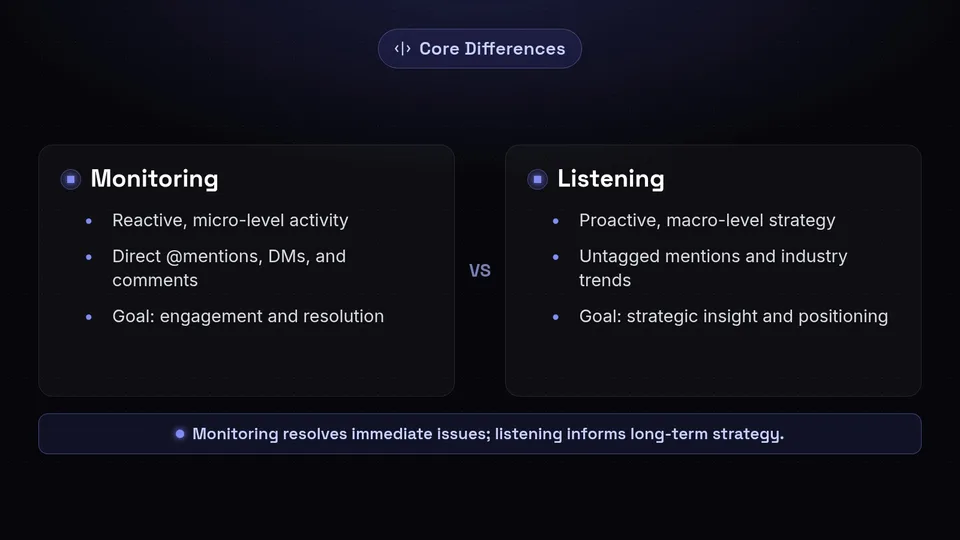
To build an effective social media strategy, you must first understand that social media monitoring and social listening serve two different masters: customer care and strategic marketing.
Social Media Monitoring: The Micro View
Social media monitoring is a reactive, micro-level activity. It involves tracking your own brand's mentions, direct messages, tags, and comments across social platforms. When a customer tweets at your brand asking for a refund, or leaves a glowing review on your latest Instagram post, dealing with those interactions is monitoring.
The primary goal of monitoring is engagement and resolution. It is the digital equivalent of answering the phone when a customer calls. Effective comment monitoring ensures that no customer is ignored, questions are answered promptly, and potential PR crises are squashed before they escalate. The value produced here is immediate: higher customer satisfaction, improved brand loyalty, and direct community building.
Social Listening: The Macro View
Social listening, on the other hand, is a proactive, macro-level strategy. It requires pulling back the lens to look at the wider conversation surrounding your brand, your competitors, and your entire industry category. Instead of just looking at direct @mentions, social listening involves analyzing untagged brand mentions, industry keywords, and broader consumer trends.
For example, if you sell vegan protein powder, social media monitoring tells you that a customer loved their recent vanilla order. Social listening tells you that consumers in the fitness space are increasingly complaining about the chalky texture of pea protein, presenting a massive product development opportunity for your brand.
The value produced by social listening is strategic insight. It informs product development, content strategy, and competitive positioning. Because of these distinct goals, social media listening tools are often built differently than monitoring tools. Monitoring requires a fast, unified inbox for rapid replies, whereas listening requires data aggregation, sentiment analysis, and trend visualization.
What to Track: Building Your Radar
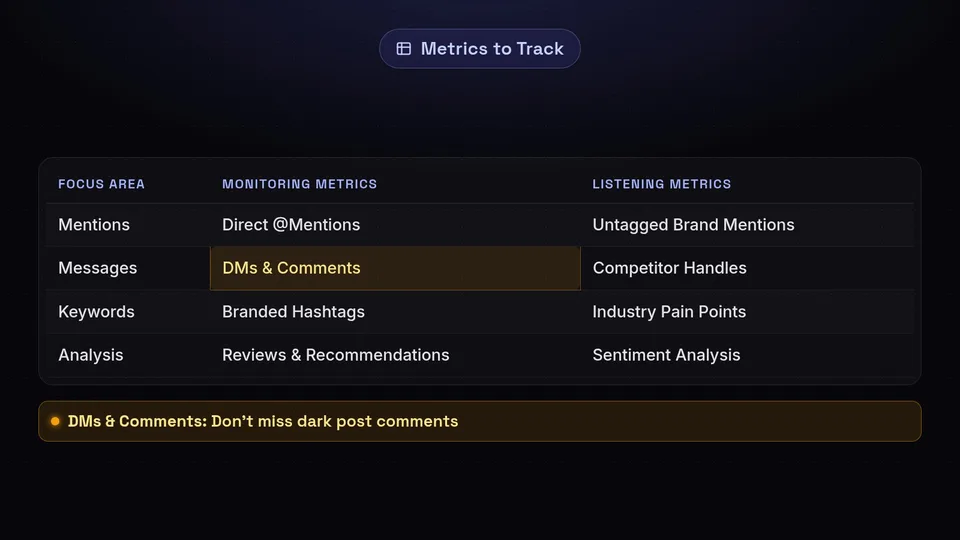
Setting up your tracking parameters correctly is the foundation of both monitoring and listening. If your net is too wide, you will drown in irrelevant data. If it is too narrow, you will miss critical conversations.
Metrics for Social Media Monitoring
When configuring your monitoring setup, your focus should be on direct interactions that require a response. You should track:
- Direct @Mentions: Any time a user explicitly tags your brand handle on Twitter, Instagram, LinkedIn, Facebook, or TikTok.
- Direct Messages (DMs): Private inquiries, support requests, or partnership opportunities sent directly to your brand's inbox.
- Comments on Your Posts: Active comment monitoring is essential. This includes replies to your posts, ads, and promoted content. (Dark post comments are notorious for being missed).
- Branded Hashtags: Hashtags specifically created for your brand or specific marketing campaigns (e.g., #SchedulifyXLife).
- Reviews and Recommendations: Facebook reviews, Google My Business reviews, and native platform recommendations.
Metrics for Social Listening
Listening requires a broader approach. You are not looking for things to reply to; you are looking for things to analyze. Your listening parameters should include:
- Untagged Brand Mentions: People talking about your brand without using your handle (e.g., "I tried schedulifyx today" instead of "@SchedulifyX").
- Competitor Names and Handles: Track your top 3-5 competitors. What are their customers complaining about? What features are they praising?
- Industry Keywords and Pain Points: Broad terms related to your category. If you are a coffee brand, track "best morning coffee," "acidic coffee," or "coffee alternatives."
- Key Personnel: Mentions of your CEO, founders, or highly visible public spokespeople.
- Sentiment Analysis: Categorizing the mood of the conversations (positive, negative, neutral) to gauge overall brand health over time.
Setting Up Alerts That Aren't Just Noise
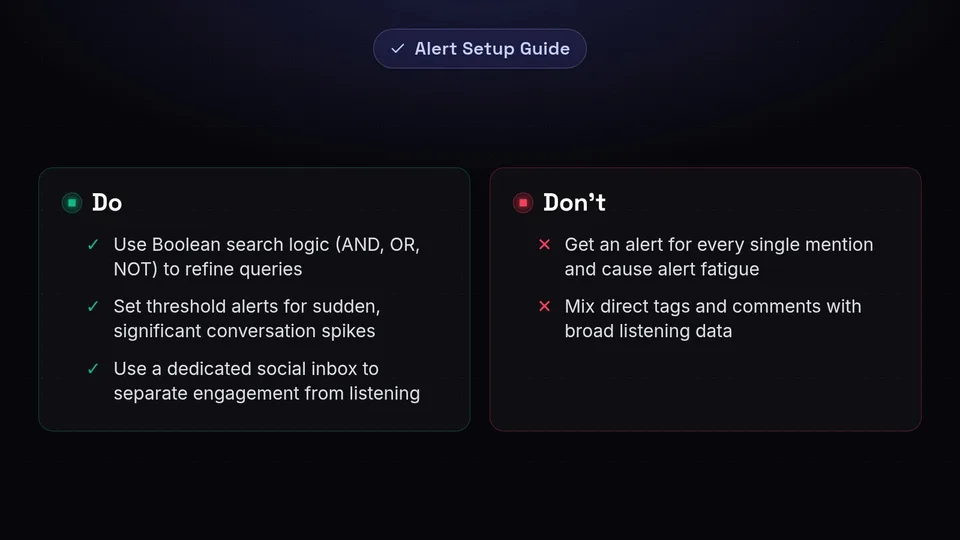
One of the fastest ways to kill your team's productivity is "alert fatigue." If your phone or Slack channel buzzes every time someone likes a post, you will quickly start ignoring the alerts entirely. To make social media monitoring effective, you must separate the signal from the noise.
Mastering Boolean Search Logic
When setting up social media listening tools, Boolean search logic is your best friend. Boolean uses operators like AND, OR, and NOT to refine your searches. For instance, if your brand is named "Apple," you need to filter out conversations about the fruit.
A good Boolean query looks like this: "Apple" AND ("iPhone" OR "Mac" OR "tech") NOT ("pie" OR "orchard" OR "tree"). By refining your queries, you ensure that the data feeding into your listening dashboards is highly relevant to your business category.
Threshold and Spike Alerts
Instead of getting an alert for every single mention, set up threshold alerts. A threshold alert triggers only when there is a sudden, statistically significant spike in conversation volume. If your brand usually gets 50 mentions a day, and suddenly receives 500 in an hour, an alert should fire. This is a critical feature for crisis management, allowing you to react to viral complaints or sudden PR issues instantly.
Separating Engagement from Listening
To maintain sanity, separate your engagement notifications from your listening data. Use a dedicated tool to manage your incoming messages. By utilizing a comprehensive social inbox, you can consolidate all your direct tags, DMs, and comments into one manageable feed. This ensures your community managers are focused on responding to real people, while your marketing strategists can review the listening data in weekly or monthly reports rather than real-time alerts.
Response Time Expectations by Platform
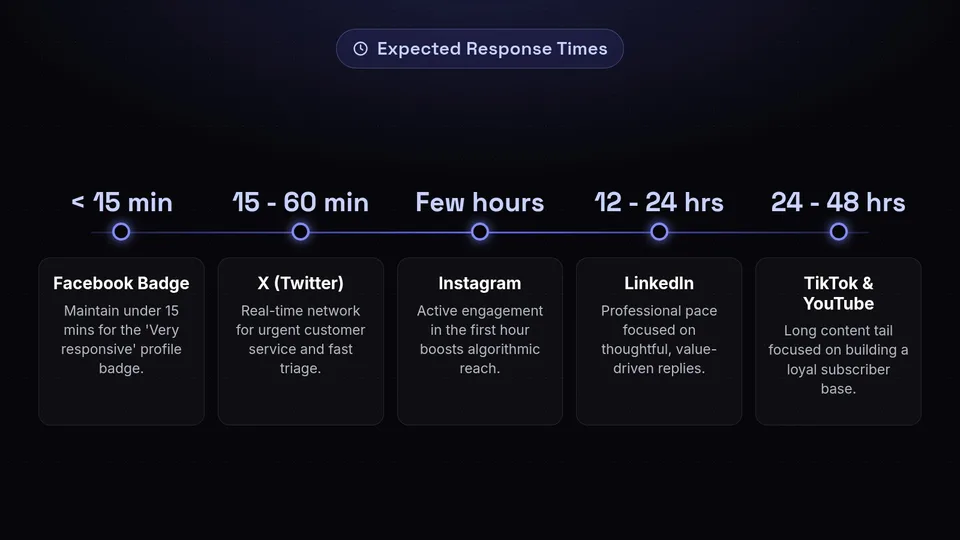
Not all social platforms are created equal, and consumer expectations vary wildly depending on where the interaction takes place. A successful comment monitoring strategy must account for the unique culture and pacing of each network.
X (formerly Twitter): The Real-Time Network
X is the digital equivalent of a 911 call for customer service. When users take to X to complain or ask a question, they expect an almost immediate response. Studies show that over 40% of consumers expect a response on X within one hour, and many expect it within 15 minutes. If you are monitoring X, it requires high-frequency checking and rapid triage.
Facebook and Instagram: The Middle Ground
On Meta platforms, expectations are slightly more relaxed, but still demanding. Users typically expect a response to a direct message or a comment within a few hours. Facebook even publicly displays a "Very responsive to messages" badge on brand pages that maintain a response rate of 90% and a response time of under 15 minutes. For Instagram, active engagement on your posts within the first hour can also boost algorithmic reach, making swift comment monitoring doubly important.
LinkedIn: The Professional Pace
LinkedIn operates on business hours. Conversations are more formal, and users generally understand that they are interacting with professionals who have other duties. A response time of 12 to 24 hours is perfectly acceptable on LinkedIn. Monitoring here should focus on thoughtful, value-driven replies rather than split-second reactions.
TikTok and YouTube: The Content Tail
Video platforms have a long "content tail." A video posted months ago can suddenly go viral, bringing a flood of new comments. Response times here are less about immediacy and more about community building. Replying to comments within 24-48 hours helps foster a loyal subscriber base, but missing a comment by a few hours won't trigger a customer service crisis.
Escalation Rules for a Small Team
When you have a small team—perhaps just a single social media manager or a shared marketing department—you cannot afford bottlenecks. If the social manager doesn't know how to answer a technical support question, the customer is left waiting. Establishing clear escalation rules is vital for efficient social media monitoring.
Step 1: Triage and Categorization
Every incoming comment, message, or mention should be instantly categorized. Common categories include:
- Praise/Engagement: Positive feedback or general community chatter.
- FAQ/Basic Support: Questions about hours, pricing, or basic features.
- Technical Issues: Bugs, account lockouts, or complex product failures.
- Crisis/PR Risk: Severe complaints, legal threats, or offensive behavior.
Step 2: The Tiered Response Matrix
Create a matrix that dictates who handles what. For a small team, it might look like this:
- Tier 1 (Social Media Manager): Handles all Praise/Engagement and FAQs. They have pre-approved brand guidelines and templates to resolve these instantly.
- Tier 2 (Customer Support/Product Team): Handles Technical Issues. The social manager acknowledges the message ("Hi there, I'm sending this to our tech team to look into!") and internally routes the ticket to the appropriate department.
- Tier 3 (Management/PR): Handles Crisis/PR Risks. If a tweet threatening legal action gains traction, the social manager does not reply. They immediately escalate it to the CEO or PR lead via a high-priority internal channel.
Step 3: Service Level Agreements (SLAs)
Even small teams need internal SLAs. If the social manager passes a technical issue to the product team, there must be an agreed-upon timeframe for the product team to provide an answer (e.g., within 4 hours). This ensures the social manager can close the loop with the customer promptly, maintaining the brand's public reputation.
When Manual Monitoring Stops Scaling
In the early days of a startup or small business, manual monitoring is standard practice. You log into the Twitter app, check your notifications, switch to the Instagram app, reply to comments, and then check your Facebook page. However, there is a distinct tipping point where this manual process becomes a liability.
The Symptoms of Outgrowing Native Apps
How do you know when manual monitoring has stopped scaling? Look for these red flags:
- The "Tab Fatigue": Your social media manager spends more time logging in, logging out, and switching between browser tabs than actually talking to customers.
- Missed Comments: You start discovering angry customer complaints days after they were posted because they were buried under a pile of generic "likes" in your native notification feed.
- Lack of Context: A customer complains on Twitter, but your team doesn't realize that the same customer already emailed support three times that week. Native apps provide zero cross-channel context.
- Inability to Track Dark Posts: You are running paid social ads, but you cannot easily see or reply to the comments on those ads without navigating through the clunky Ads Manager interfaces.
The Transition to Dedicated Tools
When these symptoms appear, manual monitoring is actively harming your brand. This is the exact moment you must transition to a dedicated tool with a unified social inbox. By aggregating all comments, messages, and mentions into a single feed, you eliminate context switching, ensure zero missed messages, and dramatically increase your team's efficiency.
The Case for Starting Lean Before Enterprise Tools
Once a brand realizes they need better tracking, there is often a temptation to jump straight into purchasing massive, enterprise-grade social media listening tools. These platforms are incredibly powerful, offering AI-driven sentiment analysis, global trend mapping, and predictive analytics. They also cost tens of thousands of dollars a year.
For 90% of growing brands, buying an enterprise listening tool on day one is a massive mistake. You will end up paying for a Ferrari when all you need is a reliable commuter car. Here is the case for doing it cheaply and effectively first.
Mastering the Basics First
Before you can analyze global industry sentiment, you need to prove that you can reply to a customer complaint on Instagram within an hour. Enterprise tools provide complex data, but if your team lacks the bandwidth or processes to act on that data, the investment is wasted. Starting lean forces your team to build the foundational habits of consistent comment monitoring and basic triage.
Leveraging Free and Low-Cost Alternatives
You can achieve highly effective monitoring and basic listening without breaking the bank. Consider these lean strategies:
- Native Advanced Search: Platforms like X and LinkedIn have incredibly powerful native advanced search features. You can run complex Boolean queries for free to track industry keywords.
- Google Alerts: Set up free Google Alerts for your brand name, competitor names, and key executives to catch web mentions and PR coverage.
- Affordable Unified Platforms: Instead of buying a standalone ,000/month listening tool, invest in an affordable, all-in-one scheduling platform that includes a robust social inbox. This solves the immediate pain point of scaling your monitoring efforts without the enterprise price tag.
Proving ROI to Unlock Budget
By starting lean, you can build a track record of success. When you use an affordable tool to catch a customer complaint, resolve it, and turn that customer into a brand advocate, you generate measurable ROI. Once you have maximized the capabilities of your lean setup and your team is hungry for deeper, macro-level industry data, you will have the documented business case required to justify the budget for an enterprise listening platform.
Conclusion: Unifying Your Social Strategy
Understanding the distinction between social media monitoring and social listening is the first step toward social media maturity. Monitoring is your frontline defense and customer care engine; it requires speed, empathy, and a unified inbox. Listening is your strategic radar; it requires broad data collection, analytical thinking, and an eye for industry trends.
As your brand grows, the sheer volume of digital noise will increase. By knowing exactly what to track, setting up intelligent alerts, respecting platform-specific response times, and establishing clear escalation rules, your team can maintain control over the conversation. Most importantly, recognize when manual processes are holding you back, but resist the urge to overspend on enterprise software before you have mastered the fundamentals.
If you are experiencing the pain of "tab fatigue" and missed messages, it is time to upgrade your workflow. With SchedulifyX, you can stop jumping between native apps and start managing your brand's reputation from one powerful dashboard. Explore our comprehensive social inbox to streamline your comment monitoring, and discover how our engagement tools can help you build a more responsive, loyal community today. Master the micro-interactions now, and you'll be perfectly positioned to conquer the macro-conversations tomorrow.