Facebook Algorithm 2026: How Ranking Works & Best Practices
SchedulifyX Team · October 5, 2026
Discover exactly how the Facebook algorithm works in 2026. Learn Meta's official ranking signals, what suppresses reach, and proven practitioner strategies.
If you have been managing a brand page recently, you have likely noticed that achieving consistent organic visibility feels vastly different than it did just a few years ago. The days of simply posting a link with a clever caption and watching the traffic roll in are long gone. Understanding how Facebook algorithm works in 2026 requires a fundamental shift in how we view content distribution, user psychology, and machine learning. Meta has aggressively evolved its systems to prioritize user retention, meaningful interactions, and AI-driven discovery over simple chronological feeds or basic follower graphs.
For social media managers, marketers, and business owners, navigating this landscape can feel like trying to hit a moving target blindfolded. However, the situation is far from hopeless. By separating official Meta documentation from persistent industry folklore, we can map out exactly what drives facebook reach 2026. In this comprehensive guide, we will explore the core signals Meta has publicly confirmed, the practitioner observations that reveal what demonstrably suppresses reach, and the actionable facebook algorithm best practices you need to implement today.
Understanding the 2026 Facebook Algorithm Landscape
To understand the current state of Facebook's ranking system, we must first look at the overarching goals of Meta as a company. In 2026, Facebook is no longer just a digital address book or a simple timeline of updates from friends and family. It is a highly sophisticated, multi-surface entertainment and connection engine. The platform is fighting a multi-front war for user attention against competitors like TikTok, YouTube, and rapidly emerging decentralized platforms. Consequently, the algorithm's primary directive is singular and ruthless: keep users on the platform for as long as possible.
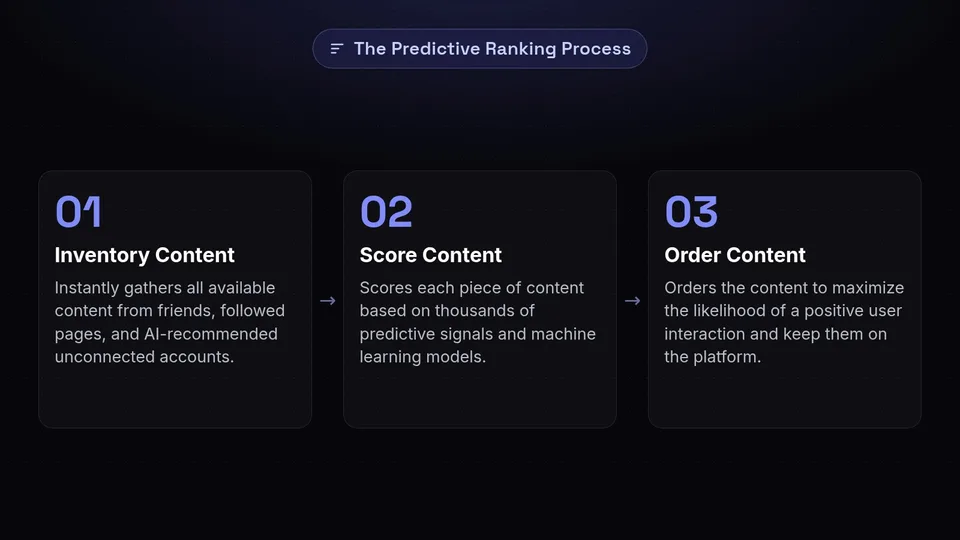
The algorithm is not a single, monolithic entity. Instead, it is a complex web of multiple machine learning models working in tandem. There is an algorithm for the main Feed, a different one for Reels, another for Stories, and yet another for the Groups tab. Each of these surfaces has a unique ranking system tailored to how users consume content in that specific format. However, they all share a foundational architecture based on predicting user behavior. When a user opens the app, the system instantly inventories all available content (from friends, followed pages, and AI-recommended unconnected accounts), scores each piece of content based on thousands of signals, and then orders them to maximize the likelihood of a positive user interaction.
This shift toward AI-recommended content—often referred to as the "discovery engine" model—means that a significant portion of what users see in 2026 comes from pages they do not actively follow. While this presents a challenge for traditional audience retention, it opens up massive opportunities for viral reach if your content aligns with the algorithm's predictive models. To capitalize on this, we must dive into the specific signals that dictate these predictive scores.
Publicly Confirmed Signals: What Meta Actually Says
In an industry plagued by rumors and anecdotal evidence, it is crucial to ground our strategies in facts. Over the years, Meta has released engineering blogs, transparency reports, and creator guidelines that explicitly detail certain ranking signals. These are the foundational elements of how Facebook algorithm works, straight from the source.
Meaningful Social Interactions (MSI)
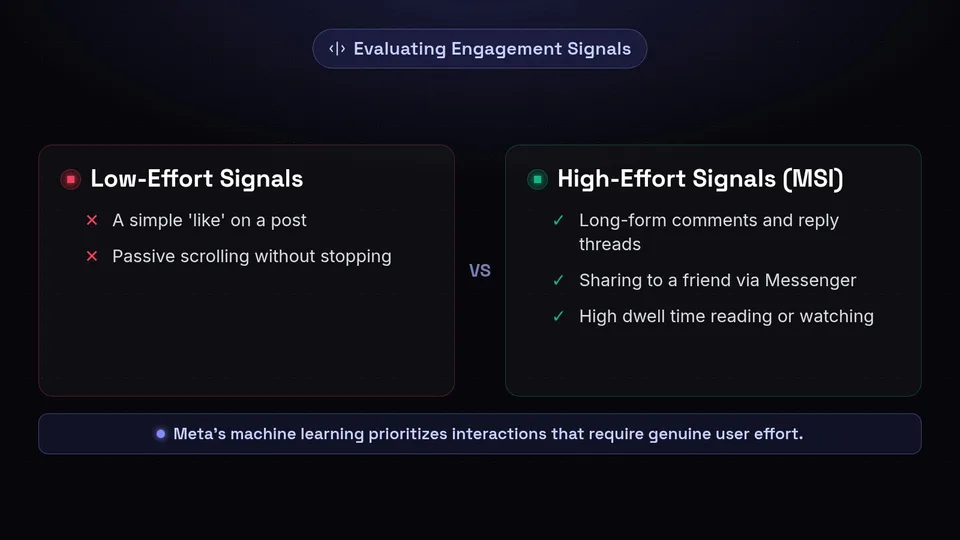
Since the major algorithm overhaul in 2018, Meta has continuously emphasized "Meaningful Social Interactions" (MSI). In 2026, MSI remains the bedrock of Feed ranking, but the definition of "meaningful" has matured. Meta publicly states that the algorithm heavily weights interactions that require more user effort and indicate genuine connection. A simple "like" is considered a low-effort signal and carries minimal weight. Conversely, a long-form comment, a back-and-forth reply thread, or a share to a friend via Messenger are considered high-effort, high-value signals.
Meta's engineering teams have confirmed that the system predicts the probability of an MSI occurring before showing a post. If the algorithm believes a post will spark a conversation between a user and their friends, it will push that post to the top of the Feed. This is why content that asks thoughtful questions, challenges conventional wisdom, or taps into deep-seated community passions tends to perform exceptionally well. The algorithm is literally designed to reward content that turns passive scrollers into active participants.
Dwell Time and Content Consumption
Not all engagement is active. Meta has explicitly confirmed that "time spent" or "dwell time" is a critical ranking factor. The platform's machine learning models track exactly how long a user pauses their scrolling to look at an image, read a text post, or watch a video. If a user stops to read a long-form text post but does not like, comment, or share it, the algorithm still registers that as a positive signal. The system interprets this dwell time as an indicator that the content was valuable enough to capture attention.
For video content, particularly Reels and native Feed videos, Meta emphasizes "retention graphs" and completion rates. A video that keeps viewers watching until the very end—or prompts them to loop the video—will receive a massive algorithmic boost. The platform has publicly stated that they prioritize videos that inspire original sharing and high retention, as these metrics directly correlate with overall app session length.
Relationship Strength and Affinity
Who posts the content is just as important as what the content is. Meta's documentation outlines the concept of "affinity" or relationship strength. The algorithm looks at a user's historical interactions with a page or person. If a user frequently watches a specific page's videos, clicks on their photos, or comments on their posts, the algorithm builds a high affinity score between that user and the page. Consequently, future posts from that page are practically guaranteed to appear at the top of that user's Feed.
This is why building a loyal, highly engaged core audience is vital for facebook reach 2026. Even as the platform shifts toward unconnected discovery, your core audience serves as the initial testing ground for your content. If your most loyal followers do not engage with a post, the algorithm will not risk showing it to a broader, unconnected audience.
Practitioner Observations vs. Meta Folklore

While Meta provides the blueprint, the actual construction of a successful Facebook strategy relies heavily on practitioner observation. Social media professionals managing thousands of pages and millions of dollars in ad spend notice patterns that Meta may not explicitly publicize. It is essential, however, to distinguish between rigorous practitioner observation and outdated folklore.
The Truth About Outbound Links in the Post Body
The Folklore: "Facebook hates links because they take people off the platform, so you should never post links."
The Meta Stance: Meta officially states that they want to connect users with high-quality, informative content, whether it lives on or off the platform. They claim they only demote links that lead to slow-loading sites, spam, or low-quality ad-farm pages.
The Practitioner Observation: Despite Meta's diplomatic stance, extensive testing across thousands of pages in 2026 unequivocally shows that placing an outbound link directly in the body of a post severely suppresses organic reach. Posts with native text, images, or video consistently outperform posts containing external links by margins of 300% to 500%.
To combat this, practitioners have developed workarounds. The most common is the "link in comments" strategy, where the primary post is highly engaging native content (like a compelling image or a short video), and the outbound link is placed in the first comment. While Meta has occasionally tweaked the algorithm to detect and slightly devalue this tactic, it still demonstrably outperforms placing the link in the main post body. Another effective strategy is using Facebook Stories to drive traffic, utilizing the native link sticker which does not suffer the same algorithmic penalty as Feed posts.
Engagement Bait and the "Comment Below" Penalty
The Folklore: "You need to tell people exactly what to do to get engagement, like asking them to 'Tag a friend who needs this' or 'Comment YES if you agree!'"
The Meta Stance: Meta is explicitly clear on this: they actively penalize engagement bait. Their machine learning models are trained to detect and demote posts that artificially inflate engagement through tactics like vote baiting (e.g., "React with a heart for A, wow for B"), react baiting, share baiting, and comment baiting.
The Practitioner Observation: Meta's detection of engagement bait in 2026 is incredibly sophisticated. Using phrases like "comment below," "tag a friend," or "share this post" will trigger an immediate algorithmic demotion. Practitioner testing shows that even subtle variations of these phrases can flag a post.
Instead of relying on cheap tricks, the best practice is to generate engagement organically. Ask open-ended, thought-provoking questions. Present a mildly controversial industry opinion and invite debate. Tell a compelling story that naturally elicits an emotional response. The goal is to inspire users to comment because they genuinely have something to say, not because you explicitly commanded them to do so.
The Downfall of Reposted Third-Party Content
The Folklore: "Content curation is a great way to grow your page. Just download viral TikToks or YouTube shorts and re-upload them to your Facebook page."
The Meta Stance: Meta has publicly stated that they prioritize "Original Content" and will actively demote unoriginal, repurposed, or heavily aggregated content, particularly in Reels.
The Practitioner Observation: The era of the aggregation page is over. In 2026, Meta's content matching algorithms are incredibly adept at identifying videos and images that have previously appeared elsewhere on the internet. Pages that rely on downloading viral clips, slapping a new border on them, and reposting them are seeing their reach decimated. Even heavily edited third-party clips struggle to gain traction.
To succeed, pages must invest in original content creation. If you must use third-party assets, they must be transformed significantly. This means adding substantial original commentary, conducting a video reaction where you are on-screen, or using the content as a small piece of a much larger, original narrative. Originality is no longer a best practice; it is a baseline requirement for visibility.
Facebook Algorithm Best Practices for 2026

Now that we have separated fact from fiction and outlined the core signals, how do we translate this into a winning strategy? Implementing facebook algorithm best practices requires a disciplined, data-driven approach to content creation and distribution.
Optimizing Your Content Strategy
Your content strategy must align with the algorithm's preference for meaningful interactions and high dwell time. Here are the specific tactics that are dominating in 2026:
- Embrace Native Video and Reels: Short-form vertical video (Reels) remains the most heavily pushed format for unconnected discovery. Focus on creating highly engaging hooks within the first three seconds to maximize retention. For the main Feed, longer native videos (3+ minutes) that tell a complete story and keep users watching perform exceptionally well due to the dwell time signal.
- Leverage Long-Form Storytelling: Do not underestimate the power of text. Long-form text posts that read like micro-blogs are highly effective at capturing dwell time. Break up the text with emojis, use compelling formatting, and focus on delivering genuine value, whether it is an industry insight, a personal anecdote, or a detailed tutorial.
- Foster Community in Groups: The Groups algorithm operates differently than the Feed algorithm, heavily prioritizing community discussion. If it makes sense for your brand, establish and nurture a Facebook Group. Content posted within highly active groups often sees significantly higher organic reach among members than content posted on a traditional business page.
- Prioritize Visual Excellence: High-resolution, original photography stops the scroll. Avoid stock photos at all costs; the algorithm and users alike can spot them instantly. Authentic, slightly unpolished behind-the-scenes photos often outperform highly stylized graphic design assets because they feel native to the social experience.
Timing and Consistency: The Velocity Factor
While the algorithm is not strictly chronological, timing still plays a crucial role in a post's initial velocity. When you publish a post, the algorithm shows it to a small segment of your most active followers. The engagement it receives in those first few minutes and hours dictates whether it will be pushed to a wider audience. If you post when your audience is asleep or offline, the post will lack that initial engagement velocity and will likely die in the feed.
Therefore, posting when your specific audience is most active is essential. Because optimal times vary wildly depending on your industry, timezone, and demographic, you cannot rely on generic "best times to post" infographics. You need data tailored to your page. We highly recommend utilizing our comprehensive guide on finding the best times to post on Facebook to ensure your content hits the feed precisely when your audience is ready to interact. Combining optimal timing with a consistent posting schedule trains both your audience and the algorithm to expect and engage with your content regularly.
Measuring Your Facebook Reach 2026 Success
Implementing these strategies is only half the battle; you must also rigorously measure your results. The metrics you focused on in 2020 are not the metrics that matter in 2026. Vanity metrics like total follower count or raw "likes" provide very little insight into algorithmic success.
Tracking the Right Metrics
To truly understand if your adaptations to the algorithm are working, you need to look beneath the surface. Focus on the following key performance indicators:
- Engagement Rate by Reach: This is the ultimate metric for content quality. Instead of looking at total engagements, look at the percentage of people who engaged out of the total number of people who saw the post. A high engagement rate by reach indicates that your content is resonating with the people the algorithm is serving it to.
- Share Rate: Shares are the holy grail of MSI. Track how often your content is being shared compared to your total reach. A high share rate is a direct signal to the algorithm that your content is valuable enough to be distributed further.
- Video Retention Curves: For video content, dive into Meta's creator studio and analyze the retention graphs. At what exact second do viewers drop off? Are they making it past the 3-second mark? Use this data to refine your video hooks and pacing.
- Negative Feedback: Keep a close eye on metrics like "hide post," "unfollow," or "report as spam." The algorithm weighs negative signals incredibly heavily. Even a small spike in negative feedback can severely throttle a page's overall reach.
Benchmarking your performance can be complex, but it is necessary for continuous improvement. To make this process seamless, utilize our engagement rate calculator. This tool allows you to input your post data and instantly see how your engagement rate stacks up, helping you quickly identify which content pillars are satisfying the algorithm and which are falling flat.
Conclusion: Mastering the Algorithm with SchedulifyX
Understanding how Facebook algorithm works in 2026 is an ongoing process of adaptation and refinement. By focusing on the publicly confirmed signals of Meaningful Social Interactions, dwell time, and relationship affinity, you align your strategy with Meta's core business goals. By heeding practitioner observations—avoiding outbound links in the body, shunning engagement bait, and prioritizing original content—you avoid the hidden pitfalls that suppress facebook reach 2026.
The key to long-term success on Facebook is consistency, quality, and data-driven iteration. It requires publishing the right content, in the right format, at the exact right time. Managing this complex ecosystem manually is a recipe for burnout. That is where SchedulifyX comes in. As an AI-powered social media scheduling platform, SchedulifyX takes the guesswork out of your Facebook strategy. With advanced scheduling features, AI-driven optimal timing recommendations, and deep analytics integrations, SchedulifyX empowers you to implement these facebook algorithm best practices flawlessly. Stop fighting the algorithm and start leveraging it. Elevate your organic reach, build deeper community connections, and take control of your social media presence with SchedulifyX today.