How to Get More Views on YouTube: The Complete 2026 Algorithm Guide
SchedulifyX Team · August 27, 2026
Struggling to get views on YouTube? Discover how the 2026 YouTube algorithm works, from packaging and CTR to the difference between long-form and Shorts.
- Introduction: The New Era of YouTube Growth
- Understanding the 2026 YouTube Algorithm
- Long-Form vs. Shorts: Two Different Distribution Systems
- Packaging: The Secret to High Click-Through Rates (CTR)
- Average View Duration (AVD) and the Crucial First 30 Seconds
- Traffic Sources: Browse, Search, and Suggested Explained
- The Compounding Power of Suggested Traffic
- Why Subscriber Count is a Weak Predictor of Views
- Essential Tools for YouTube Channel Strategy
- A Note on Creator Tools: SchedulifyX and VEED
- Conclusion: Your Next Steps to Get Views on YouTube
Introduction: The New Era of YouTube Growth
If you are a content creator, brand, or marketer in 2026, you have likely asked yourself one burning question: how to get more views on YouTube? The platform has evolved dramatically over the past few years, moving away from simple keyword stuffing and chronological feeds into an era of hyper-personalized, AI-driven content distribution. To succeed today, you cannot just guess what works; you need to deeply understand the mechanics driving viewer behavior and algorithmic preferences.
Getting consistent youtube views is no longer just about hitting publish and crossing your fingers. It requires a strategic mastery of packaging, audience psychology, retention metrics, and an understanding of how different video formats are distributed. Whether you are producing deep-dive documentaries or snappy vertical videos, the rules of engagement have changed. In this comprehensive guide, we will break down exactly how to get views on youtube by leveraging the most up-to-date data on the youtube algorithm.
From the critical importance of your video's first 30 seconds to the compounding power of topic clustering, this article will serve as your ultimate blueprint for YouTube success in 2026. Let us dive into the mechanics of what actually drives views on the world's largest video platform.
Understanding the 2026 YouTube Algorithm
To master how to get more views on YouTube, you must first understand how the platform evaluates and distributes your content. The YouTube algorithm is not a single, monolithic entity that decides the fate of your channel. Rather, it is a complex, multi-layered system designed with one primary goal: to match viewers with videos they want to watch, keeping them on the platform for as long as possible in a highly satisfied state.
The 48-Hour Seed Audience Test
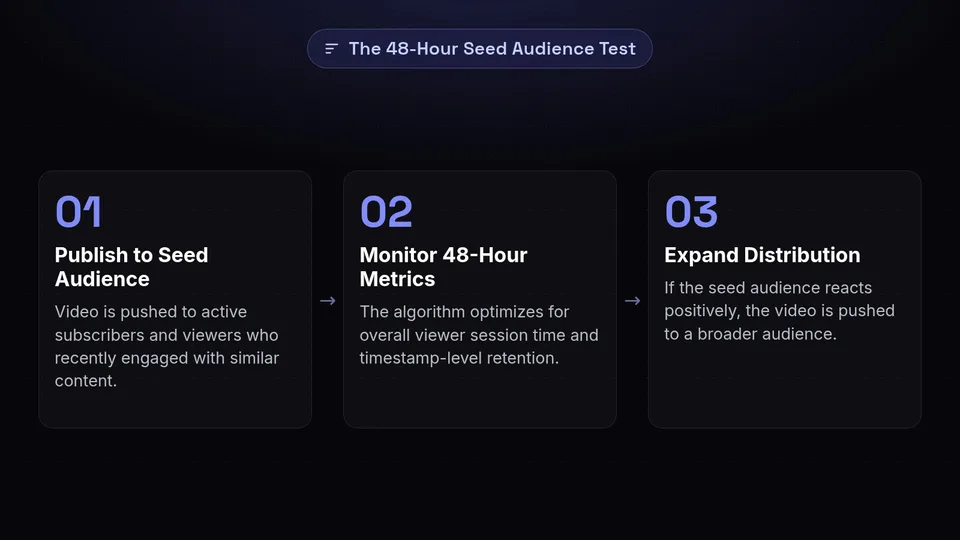
Recent platform analyses have shed light on exactly how YouTube tests new uploads. According to an algorithm breakdown published by VEED on August 11, 2026, YouTube's distribution model evaluates new videos via an initial "seed audience" test during the first 48 hours after publication. When you hit publish, YouTube pushes your video to a small, highly targeted group of viewers—typically your most active subscribers and viewers who have recently engaged with similar content.
During this critical 48-hour window, the algorithm is not just looking at raw view counts. It is optimizing for overall viewer session time, timestamp-level retention, and (in the case of Shorts) completion rates. The system closely monitors how this seed audience reacts. If they click quickly, watch deeply, and continue watching other videos on the platform afterward, YouTube takes this as a strong positive signal. The video is then pushed to a slightly larger, broader audience. This concentric circle of distribution continues as long as the video maintains strong performance metrics relative to the broader audience it is being served to.
This means that early momentum is crucial, but it is driven by the quality of the engagement rather than just the quantity of clicks. The algorithm evaluates whether your video contributed to a longer overall viewing session, proving that your content is valuable to the platform's ecosystem.
Long-Form vs. Shorts: Two Different Distribution Systems
One of the most common mistakes creators make when trying to get views on YouTube is treating all video formats the same. In reality, long-form videos and YouTube Shorts are governed by entirely different distribution systems, each with its own unique set of rules and performance metrics.
The Long-Form System
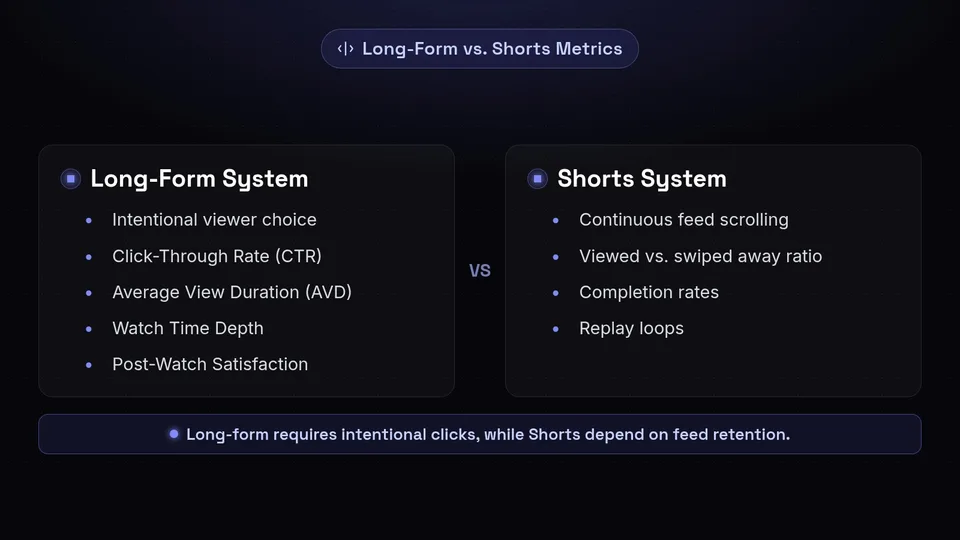
The long-form video distribution system is fundamentally driven by intentional viewer choice. When a viewer is on the homepage or searching for a topic, they are presented with impression previews (a thumbnail and a title). They must make a conscious, active decision to click on your video over dozens of other options.
Because of this intentionality, the long-form system prioritizes the following metrics:
- Click-Through Rate (CTR): The percentage of people who clicked your video after seeing the thumbnail.
- Average View Duration (AVD): How long viewers stay once they start watching.
- Watch Time Depth: The overall percentage of the video consumed.
- Post-Watch Satisfaction: Measured through likes, comments, shares, and whether the viewer continued watching more videos on YouTube after yours.
In the long-form ecosystem, a video with a lower initial CTR but incredibly high watch time depth and satisfaction can still go viral over weeks or months, as YouTube recognizes its value in keeping viewers on the platform.
The Shorts System
Conversely, the YouTube Shorts system is driven by continuous feed scrolling. Viewers do not typically choose to click on a specific Short from a thumbnail; instead, the content is served directly into their feed as they swipe. Because the element of intentional choice is removed, the metrics for success change drastically.
The Shorts algorithm evaluates performance based primarily on the "viewed vs. swiped away" ratio. When a Short enters a viewer's feed, do they stop and watch, or do they immediately swipe to the next video? Furthermore, the system looks heavily at completion rates and replay loops rather than traditional long-form watch duration. A 15-second Short that is looped three times is incredibly valuable to the Shorts algorithm.
It is also important to note how YouTube measures these views. As of March 2025, YouTube updated its Shorts view measurement logic so that any playback duration counts as a view, and every repeat loop registers as a separate view. This systemic update yielded an estimated 30% increase in platform-wide reported Shorts view metrics. To succeed in Shorts, your focus must be on immediate visual hooks, rapid pacing, and creating content that naturally encourages the viewer to let the video loop.
Packaging: The Secret to High Click-Through Rates (CTR)
If you want to know how to get more views on YouTube for long-form content, the answer almost always starts with packaging. In YouTube terminology, "packaging" refers to your title and thumbnail acting together as a single, cohesive unit to attract clicks. You can have the greatest video in the world, but if your packaging fails to generate curiosity or clearly communicate value, no one will ever watch it.
The Highest-Leverage Variable
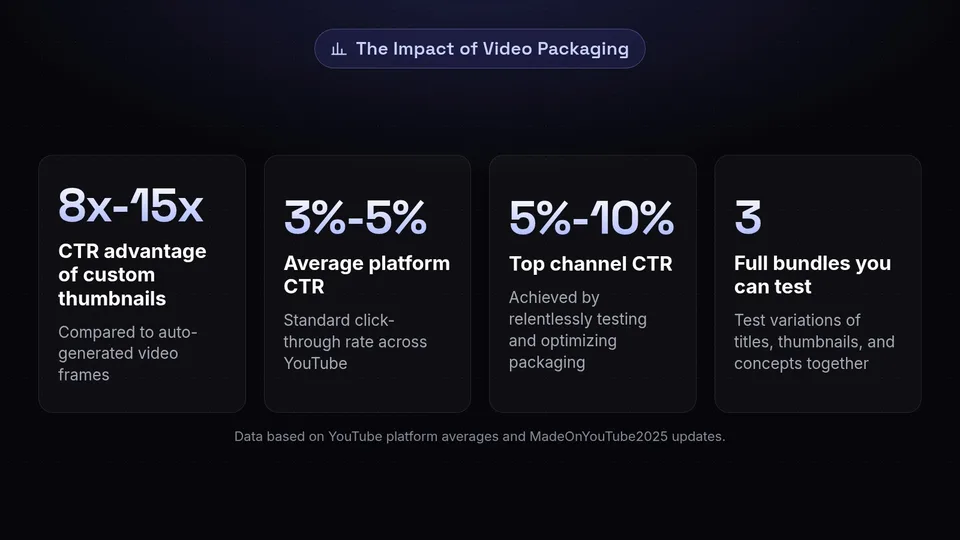
Your thumbnail is arguably the highest-leverage factor in your entire YouTube strategy. According to platform data, custom thumbnails deliver an incredible 8x to 15x CTR advantage over auto-generated video frames. Relying on YouTube to pick a random still from your video is a guaranteed way to suppress your views.
To put this into perspective, the average platform CTR sits between 3% and 5%. However, top-performing channels routinely reach 5% to 10% CTR by relentlessly testing and optimizing their packaging. A jump from a 4% to an 8% CTR does not just double your views; it often exponentially increases them because the algorithm recognizes the high engagement and pushes the video to vastly larger audiences.
The Power of "Test & Compare"
YouTube has recognized the critical importance of packaging and has rolled out native tools to help creators optimize it. On June 11, 2024, YouTube officially initiated the rollout of the "Thumbnail Test & Compare" feature to creators with Advanced Features enabled. This tool allows creators to distribute up to 3 thumbnail options evenly to select a winning variation based on total watch time share.
This feature was so successful that on July 16, 2025, YouTube expanded its experimental creator cohort for the feature inside YouTube Studio. But the innovation did not stop there. During the `#MadeOnYouTube2025` event on September 16, 2025, YouTube announced massive updates to YouTube Studio. They expanded the A/B testing capabilities to allow packaging testing for up to 3 full bundles—meaning you can now test variations of titles, thumbnails, and concepts together as a single unit.
Other incredible features announced during `#MadeOnYouTube2025` included Ask Studio (a conversational AI analytics tool to help you understand your data), Collaborations (allowing you to tag up to 5 creators per video to share audiences), Auto-Dubbing with lip-sync for global reach, and Dynamically Inserted Brand Segments. Leveraging the Test & Compare feature for your packaging is now a non-negotiable step for creators serious about maximizing their youtube views.
Average View Duration (AVD) and the Crucial First 30 Seconds
While packaging gets the viewer through the door, Average View Duration (AVD) keeps them in the room. AVD measures the exact time watched per view, and YouTube prioritizes this watch duration depth and its contribution to the overall viewer session over initial click volume. A high CTR with a terrible AVD signals to YouTube that your packaging is "clickbait"—misleading or failing to deliver on its promise. The algorithm will quickly bury such videos.
Winning the First 30 Seconds
The battle for high AVD is almost entirely won or lost at the very beginning of your video. The first 30 seconds of your video holds approximately 40% weight in early retention impact. This is the window where the viewer decides if you are going to deliver on the promise made by your title and thumbnail.
What does success look like here? Benchmark retention for top creators reaches an impressive 75% to 85% at the 30-second mark. Compare this to the platform's average solid retention rate, which sits between 60% and 70%. If you are seeing sharp drop-offs in the first 30 seconds of your audience retention graphs, it is a massive red flag. It signals to the algorithm that you have weak hooks, poor pacing, or misleading packaging.
To fix this, eliminate long, self-indulgent intro sequences. Do not spend 20 seconds asking people to subscribe before you have provided any value. Start your video by immediately validating the viewer's reason for clicking, introducing the core conflict or value proposition, and visually engaging them right away.
Traffic Sources: Browse, Search, and Suggested Explained
To systematically get views on YouTube, you must understand where those views are coming from. YouTube distributes content across three primary traffic sources, and each source rewards entirely different types of content and viewer behaviors.
Browse Features (The Home Feed)
Browse Features—primarily the YouTube Home Feed—is the holy grail of YouTube traffic, generating approximately 70% of total platform watch time. When viewers open the YouTube app or navigate to the homepage, they are presented with a highly personalized feed of content.
The Browse system rewards strong homepage packaging (broadly appealing titles and high-contrast thumbnails), high CTR, content freshness, and broad viewer satisfaction. Videos that succeed in Browse are usually those that appeal to a wide audience and trigger immediate curiosity. If you want a video to "go viral," it must succeed in Browse.
YouTube Search
YouTube Search operates much like traditional Google SEO. It is driven by explicit user intent. Viewers type in a specific query (like "how to change a tire" or "best camera for vlogging 2026"), and YouTube serves the most relevant results.
The Search system rewards title and description keyword alignment, explicit query intent match, and high watch satisfaction. While Search traffic might not bring in millions of views overnight like Browse can, it provides highly consistent, evergreen traffic that can slowly build your channel's authority and baseline viewership over years.
Suggested Videos (Up Next / Sidebar)
Suggested traffic comes from the videos recommended alongside or immediately after the video a viewer is currently watching. This is the algorithm's way of keeping the viewer engaged in a continuous viewing session.
The Suggested system rewards co-visitation patterns (if viewers who watch Video A frequently go on to watch Video B, YouTube will start suggesting Video B next to Video A). It also heavily rewards topical adjacency and videos that successfully extend a viewer's watch session time. Getting suggested next to massive videos in your niche is a primary way small channels break out.
The Compounding Power of Suggested Traffic
Understanding the Suggested traffic source leads us to one of the most powerful strategies for channel growth: compounding suggested traffic through topic clustering.
Many creators make the mistake of jumping wildly between different topics, hoping one will stick. However, the YouTube algorithm rewards channels that build deep authority in specific areas. By publishing multiple videos—typically a cluster of 20 or more—within a highly focused topic, you create an interconnected loop of content.
When a viewer watches one video in your topic cluster, the algorithm naturally suggests your other videos on the same topic in the sidebar and Up Next slots. As viewers watch two, three, or four of your videos in a row, you build a compounding growth effect. This not only skyrockets your overall channel views but massively boosts your channel-wide session duration. Because YouTube's ultimate goal is to increase session time, channels that successfully create these interconnected viewing loops are heavily favored by the algorithm and are pushed more aggressively in Browse features.
Why Subscriber Count is a Weak Predictor of Views
One of the most persistent myths on the platform is that you need a massive subscriber base to get views on YouTube. In 2026, this could not be further from the truth. In fact, subscriber count is a notoriously weak predictor of video performance.
Why? Because the YouTube algorithm evaluates each upload completely independently. The system does not care if you have 10 subscribers or 10 million subscribers; it only cares about how viewers react to the specific video in question. When you upload a video, it goes through the 48-hour seed audience test we discussed earlier. If your video generates high CTR, strong retention, and high viewer satisfaction signals, YouTube will push it to millions of people, regardless of your subscriber count.
Conversely, a channel with 5 million subscribers that uploads a poorly packaged video with weak retention will see that video flop. Subscribers are essentially a guaranteed seed audience, but they are not a free pass to algorithmic success. Focus entirely on the quality of the individual video, the strength of its packaging, and the satisfaction it delivers to the viewer. The subscribers—and the views—will follow.
Essential Tools for YouTube Channel Strategy
Growing a channel requires more than just great video editing; it requires strategic planning, branding, and consistency. To help you optimize your channel presence and upload strategy, utilizing the right tools is essential.
- Channel Branding: Your channel name is the first step in establishing your niche authority. If you are struggling to find the right identity that stands out in the YouTube ecosystem, use our YouTube Name Generator to discover catchy, memorable, and SEO-friendly names for your brand.
- Upload Strategy: While the algorithm evaluates content on its own merits, posting when your target audience is most active can give your video the best possible start during that critical 48-hour seed test. Optimize your publishing schedule by checking out our guide on the Best Time to Post.
A Note on Creator Tools: SchedulifyX and VEED
As you build your YouTube strategy, you will likely evaluate various software platforms to help you create and distribute content. As of 2026-08-27, VEED (which published the insightful August 11 algorithm breakdown referenced earlier in this article) provides an excellent suite of creator tools.
To be completely transparent, VEED is significantly stronger than SchedulifyX when it comes to timeline-based video editing, auto-subtitling, and direct video manipulation. If you need a robust, browser-based video editor to cut your long-form content or Shorts, VEED is a superb choice. SchedulifyX does not offer a timeline video editor; instead, our platform is purpose-built for AI-powered social media scheduling, deep analytics, and cross-platform calendar management.
Both tools serve different, highly valuable parts of a creator's workflow—VEED for creation, and SchedulifyX for distribution and scheduling. Please note that platform features and pricing models change over time, so we always recommend confirming current capabilities directly on the vendor's own page.
Conclusion: Your Next Steps to Get Views on YouTube
Learning how to get more views on YouTube in 2026 is an exercise in understanding human psychology as much as it is understanding code. The YouTube algorithm is simply a reflection of viewer behavior. By mastering the art of packaging to drive high CTR, optimizing your first 30 seconds for maximum retention, understanding the nuances of the Shorts vs. long-form systems, and building compounding topic clusters, you align your content with exactly what the platform wants: satisfied viewers who keep watching.
Stop worrying about your subscriber count and start focusing on the metrics that actually move the needle. Test your thumbnails, study your retention graphs, and always aim to extend the viewer's session.
Ready to take your content distribution to the next level? Consistency is key to building authority on YouTube and across all your social channels. Let SchedulifyX handle your content calendar, AI-driven scheduling, and cross-platform analytics so you can focus on what you do best: creating incredible videos. Start scheduling smarter with SchedulifyX today!
Sources
Facts checked against the sources below on August 27, 2026.
- youtube.com
- youtube.com
- Youtube Feature Test And Compare Titles Thumbnails — tubefilter.com
- Shorts Retention Blueprint Ai Data Signals — virvid.ai
- Thumbnail Test Compare Rolling Out For All Creators In The Coming Weeks 🥳 — support.google.com
- youtube.com
- The Youtube Algorithm How It Works In 2026 — gyre.pro
- Youtube Traffic Sources 2026 Browse Search Suggested System — miraflow.ai
- Youtube Algorithm Updates — outlierkit.com
- Youtube Seo Video Ranking Optimization Guide 2026 — digitalapplied.com