What is a KOL? Key Opinion Leader vs. Influencer Explained
SchedulifyX Team · September 28, 2026
Discover the true KOL meaning, the origins of Key Opinion Leaders, and how a KOL differs from an influencer to elevate your brand's marketing strategy.
In the rapidly evolving landscape of digital marketing, industry terminology is often thrown around interchangeably, leading to widespread confusion among marketers, agency executives, and brand strategists. One of the most common and costly mix-ups is the conflation of a Key Opinion Leader (KOL) and a social media influencer. While both play pivotal roles in modern communication strategies, understanding the true KOL meaning and how a KOL vs influencer dynamic impacts your campaign is crucial for allocating budgets effectively and achieving your marketing objectives.
Whether you are launching a complex B2B software solution, introducing a scientifically backed skincare line, or pushing a new consumer packaged good to the masses, selecting the right digital partner can make or break your campaign. The distinction lies not just in follower counts or aesthetic appeal, but in the fundamental source of the creator's authority. In this comprehensive guide, we will explore the origins of the Key Opinion Leader, dissect the core differences between KOLs and influencers, examine when each is the right strategic fit, and break down how briefing and measurement strategies must adapt depending on who you hire.
The Surprising Origins of the Key Opinion Leader
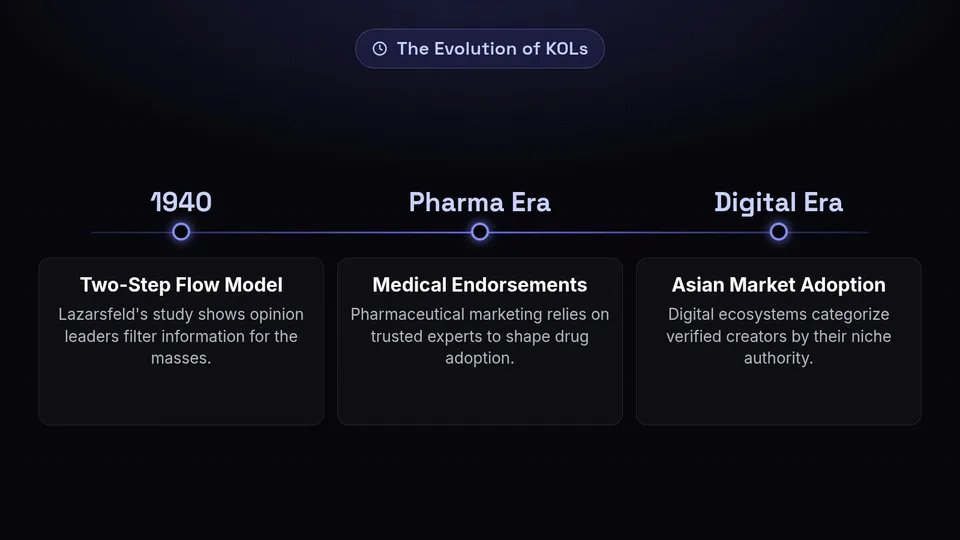
To fully grasp the KOL meaning, it is essential to look back at the term's origins. Unlike the word "influencer," which was born out of the social media boom of the 2010s, the concept of a Key Opinion Leader has deep historical and academic roots.
Pharmaceutical Marketing and Academic Research
The term "Key Opinion Leader" originally gained traction in pharmaceutical marketing. Long before Instagram or TikTok existed, pharmaceutical companies needed a way to encourage the adoption of new drugs and medical devices among healthcare professionals. They realized that traditional advertising was ineffective when targeting highly educated doctors. Instead, they relied on physicians, clinical researchers, and medical specialists whose endorsements and peer-reviewed research shaped drug adoption among their healthcare peers. These trusted experts became known as Key Opinion Leaders.
The theoretical foundation for this approach, however, dates back even further. The underlying framework is known as the "Two-Step Flow of Communication" model. This theory was developed from Paul Lazarsfeld's famous 1940 election study, which was subsequently published in 1944. Lazarsfeld's research demonstrated that most people form their opinions under the influence of opinion leaders, who in turn are influenced by the mass media. This established the foundational principle of a Key Opinion Leader: a person whose authority filters and validates information for a broader audience.
Adoption and Evolution in Asian Digital Markets
While the West popularized the term "influencer" alongside the rise of platforms like YouTube and Instagram, the term "KOL" became standard terminology across Asian digital ecosystems. In markets like China, platforms such as WeChat, Douyin, and Xiaohongshu (Little Red Book) adopted the KOL framework to categorize verified creators.
In these highly competitive and saturated digital landscapes, consumers grew skeptical of traditional advertising and purely aesthetic content. As a result, creators were evaluated by their niche authority, professional domain expertise, and verified trust signals rather than pure entertainment value. A KOL on Xiaohongshu, for example, is often expected to provide deep, analytical reviews of products, backing up their claims with professional credentials or extensive category experience. This Asian market evolution cemented the modern digital KOL meaning as someone whose influence is inextricably linked to their real-world expertise.
Core Distinctions: Authority Versus Audience Size
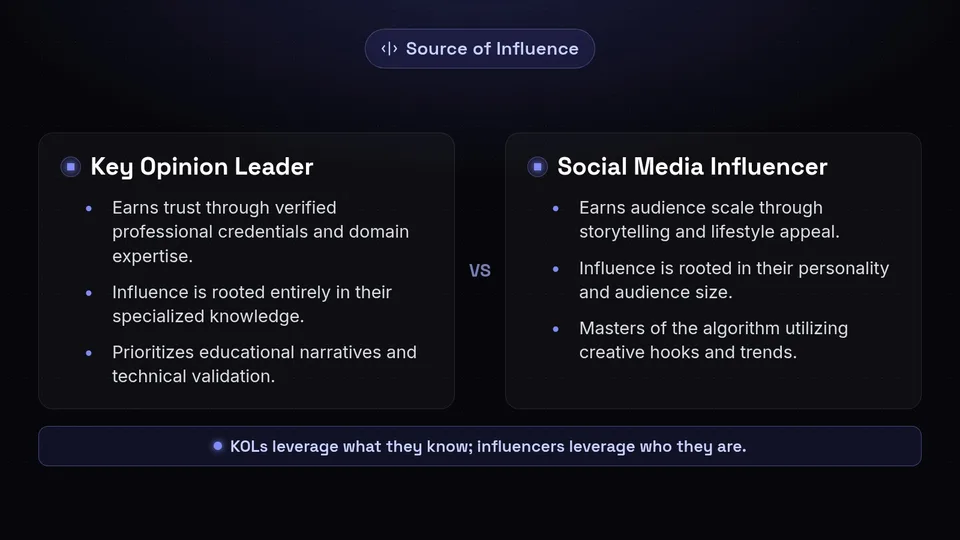
When analyzing the KOL vs influencer debate, the most critical distinction boils down to the source of their influence: authority versus audience size. Understanding this dichotomy is the key to selecting the right partner for your brand.
What Makes a Key Opinion Leader (KOL)?
A Key Opinion Leader earns trust through verified professional credentials, career experience, and undeniable domain expertise. Examples of true KOLs include board-certified dermatologists, financial analysts, software engineers, and specialized industry consultants. Their influence is rooted entirely in what they know.
Because their authority is derived from their profession and education, a KOL does not necessarily need to post content every single day, nor do they need millions of followers to be highly effective. A cybersecurity expert with 5,000 followers comprised entirely of Chief Information Security Officers (CISOs) is a highly valuable KOL. Their audience trusts their recommendations because their career depends on their accuracy and integrity. They prioritize educational narratives and technical validation over viral trends.
What Makes a Social Media Influencer?
Conversely, a social media influencer earns their audience scale through consistent storytelling, personal branding, lifestyle appeal, and relatable content creation. Influencers thrive on platforms like TikTok, Instagram, and YouTube, where their influence is rooted in who they are and the size of their audience.
An influencer's primary asset is their ability to capture attention, entertain, and build parasocial relationships with a large demographic. While they may have a niche (such as travel, fashion, or gaming), their authority comes from their aesthetic, their personality, and their content creation skills rather than formal professional credentials. They are masters of the algorithm, utilizing creative hooks and visual trends to maximize reach and engagement.
KOL vs. Influencer: A Comprehensive Comparison
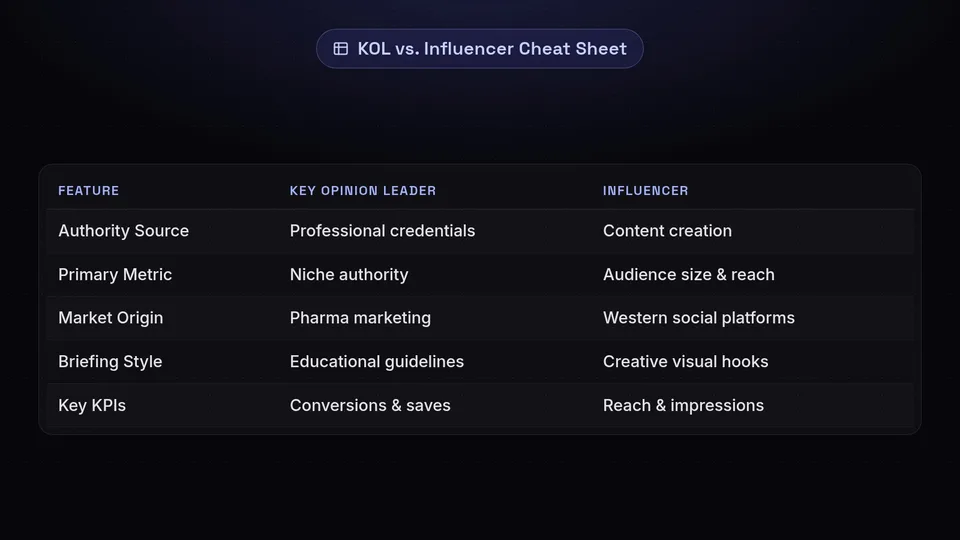
To further clarify the differences, we have compiled a side-by-side comparison based on the latest industry research. This table highlights the fundamental divergences between a Key Opinion Leader and a traditional social media influencer.
| Feature | Key Opinion Leader (KOL) | Social Media Influencer |
|---|---|---|
| Primary Source of Authority | Professional credentials, degrees, industry trajectory | Content creation, personal branding, lifestyle appeal |
| Primary Metric | Niche authority and domain credibility | Audience size, reach, and impression volume |
| Market Origin | Pharmaceutical marketing & communications research | Western social platforms (Instagram, YouTube) |
| Primary Sector Fit | Pharma, B2B tech, finance, scientific skincare | Lifestyle, fashion, gaming, mass CPG |
| Briefing Style | Educational, technical guidelines, domain autonomy | Creative hooks, visual guidelines, call-to-action |
| Key KPIs | Conversions, post saves, branded search lift | Reach, total impressions, macro engagement rate |
Strategic Fit: When to Partner with Each

Choosing between a Key Opinion Leader and an influencer is not about which one is inherently "better"; it is about which one aligns with your specific product, target audience, and campaign goals. Misaligning your product with the wrong type of creator can result in wasted budget and zero return on investment.
When to Hire a Key Opinion Leader
You should partner with a KOL when your product requires trust, explanation, and professional validation. KOLs are the ideal choice for high-consideration purchases, where the buyer journey is long and heavily researched. Specific scenarios include:
- Complex B2B Solutions: Selling enterprise software, cloud infrastructure, or specialized SaaS products requires the endorsement of industry analysts or veteran engineers who can validate the technical specifications.
- Healthcare and Medical Products: Promoting medical devices, pharmaceuticals, or scientifically formulated skincare requires regulatory compliance and scientific validation that only credentialed professionals (like doctors or chemists) can provide.
- Financial Infrastructure: Fintech products, investment platforms, and B2B payment gateways require a high degree of consumer trust, making financial advisors or economic analysts the perfect KOL partners.
When to Hire an Influencer
You should partner with an influencer when your primary goal is rapid reach, viral engagement, and high impression volume. Influencers excel at driving impulse purchases and building brand awareness for accessible consumer goods. Specific scenarios include:
- Consumer Packaged Goods (CPG): Snacks, beverages, and household items benefit from the mass reach and relatable lifestyle integration that influencers provide.
- Lifestyle Apparel and Fast Fashion: Clothing brands thrive on visual aesthetics and trend cycles, making fashion influencers and style vloggers the perfect fit.
- Mass-Market Launches: If you are launching a broad-appeal app, a new video game, or a consumer tech gadget and need millions of eyeballs on it within 48 hours, a roster of macro-influencers is your best strategy.
Briefing and Measurement: Tailoring Your Approach
Once you have selected the right partner, you must adapt your campaign management style. Treating a KOL like an influencer—or vice versa—will lead to friction, inauthentic content, and poor campaign performance. The briefing and measurement processes must be customized to fit the creator's specific style of influence.
The Briefing Approach
KOL Briefing: When briefing a Key Opinion Leader, the focus must be on accuracy and autonomy. The brief should outline key technical specs, regulatory parameters, clinical or expert messaging, and educational narratives. Because a KOL's reputation is built on their professional credibility, you must allow them the autonomy to explain the product in their own words. Forcing a script on a KOL will damage their credibility and result in a stiff, inauthentic delivery. Trust their expertise.
Influencer Briefing: When briefing an influencer, the focus shifts to aesthetics and engagement. The brief should clearly outline the visual aesthetic, creative hooks, brand guidelines, campaign hashtags, and specific call-to-action prompts for audience participation. Influencers appreciate clear direction on the mood board and the specific trends you want them to leverage to capture their audience's attention.
Measurement Metrics and KPIs
KOL Measurement: Evaluating a KOL requires looking past superficial vanity metrics. Instead, focus on qualitative engagement. Look at the depth of technical comments—are followers asking detailed questions about the product's functionality? Track "saved posts," as this indicates the audience found the information highly valuable and educational. Monitor branded search volume lift, as KOL audiences will often leave the platform to research the product further. Finally, track high-intent lead conversions. To ensure you are vetting authentic audience interaction before hiring a KOL, we highly recommend using our engagement rate calculator.
Influencer Measurement: Evaluating an influencer is more quantitative. The primary KPIs are total impressions, reach, macro-engagement rate (likes, shares, simple comments), and clicks. Influencer campaigns are often tied directly to immediate promo-code redemptions to track direct sales. If you are navigating the fast-paced world of influencer marketing and need help understanding the terminology used across different creator niches, consult our comprehensive social media slang guide.
The Future of KOL Marketing
The distinction between KOLs and influencers is becoming increasingly important as the creator economy matures. Brands are recognizing that while influencers offer unparalleled reach, KOLs offer unparalleled trust. According to recent market research, the global KOL marketing market reached a staggering $73.25 billion in 2024 and is projected to skyrocket to $237.68 billion by 2033. This exponential growth underscores the rising demand for credentialed, authoritative voices in an internet landscape often cluttered with misinformation and superficial content.
As consumers become more discerning, the demand for verified expertise will only grow. Brands that master the art of blending influencer reach with KOL authority will dominate their respective industries in the years to come.
Conclusion: Elevate Your Strategy with SchedulifyX
Understanding the KOL meaning and the nuances of the KOL vs influencer dynamic is essential for crafting a modern, effective marketing strategy. Whether you need the deep domain expertise of a Key Opinion Leader to validate a complex B2B product, or the massive reach of a lifestyle influencer to launch a new consumer brand, choosing the right partner dictates your success. Remember to tailor your briefs, adjust your KPIs, and always respect the unique source of authority that each creator brings to the table.
Managing campaigns across multiple KOLs and influencers requires precision, timing, and robust organization. That is where SchedulifyX comes in. As an AI-powered social media scheduling platform, SchedulifyX helps you coordinate your creator content, optimize posting times, and manage your brand's digital presence seamlessly. Start scheduling with SchedulifyX today and take your influencer and KOL marketing campaigns to the next level!
Sources
Facts checked against the sources below on September 28, 2026.
- Kol Vs Influencer — bizkol.ai
- Key Opinion Leader Kol — arfadia.com
- Kol Vs Influencer Key Differences Every Brand Needs To Know In 2026 — influenconnect.com
- Kol And Influencer What Is The Difference — digitalcrew.agency
- Kols Vs Influencers Understanding The Key Opinion Leader In B2b — influencity.com