The Ultimate 2026 Guide to LinkedIn: Algorithms, Algorithms, and Authentic Reach
SchedulifyX Team · September 21, 2026
Master LinkedIn in 2026 with our comprehensive guide on the 360Brew AI algorithm, profile optimization, feed rewards, and posting cadence for maximum reach.
If you are wondering how to use LinkedIn effectively in the current digital landscape, you are not alone. The platform has undergone a massive transformation over the past two years. The days of viral "broetry," transparent engagement bait, and algorithmic manipulation via automated comment pods are officially over. Welcome to the era of authentic professional knowledge sharing.
For professionals and brands looking to maximize their impact, understanding the underlying mechanics of the platform is no longer optional. Whether you are exploring LinkedIn for beginners or you are a seasoned executive refining your LinkedIn marketing 2026 strategy, the rules of engagement have shifted dramatically. This guide will walk you through verified, data-backed insights into how LinkedIn's search and feed algorithms currently operate, what behaviors are rewarded or punished, and how to maintain a consistent, high-performing presence without alienating your network.
The 2026 LinkedIn Algorithm Architecture: 360Brew and Authenticity
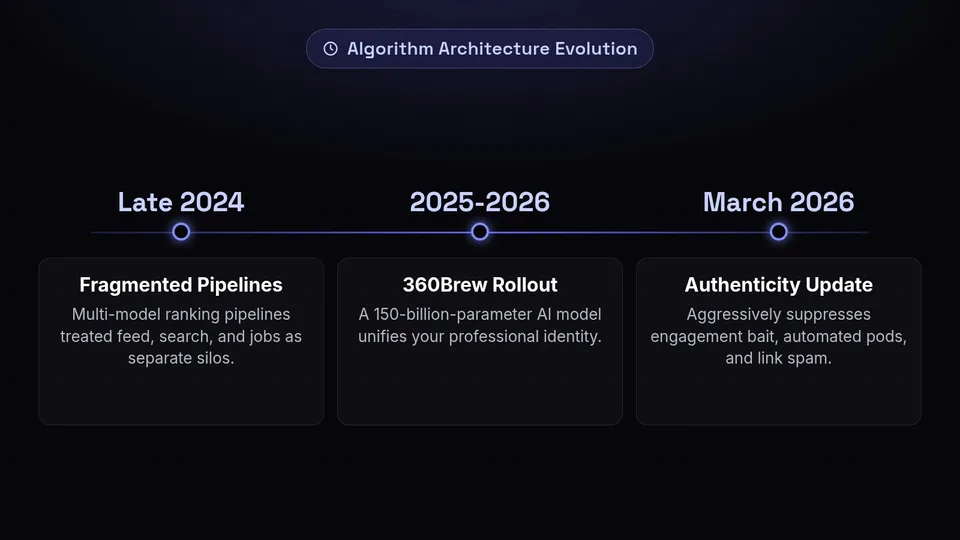
To succeed on the platform today, you must first understand the engine driving it. Between late 2024 and mid-2026, LinkedIn completely overhauled its algorithmic infrastructure, moving away from fragmented, multi-model ranking pipelines toward a unified, highly sophisticated artificial intelligence system.
The 360Brew AI System
At the core of this transformation is the "360Brew" AI system. Rolled out progressively through 2025 and fully integrated by 2026, 360Brew is a 150-billion-parameter foundation AI model. Unlike previous iterations that treated your feed, your search results, job recommendations, and connection suggestions as separate silos, 360Brew unifies them into a single, cohesive understanding of your professional identity.
This massive model analyzes topic relevance and dwell time, but its most revolutionary feature is how it maps user learning trajectories over a 90-day window. The algorithm evaluates not just what you click on today, but how your content consumption builds your professional knowledge over a three-month period. If you are a creator, this means your content is being evaluated on its long-term educational value to your specific niche, rather than its ability to generate a quick, cheap click.
Note: The sheer complexity of 360Brew was initially detailed in an academic paper (arXiv 2501.16450), which was unfortunately withdrawn by arXiv administrators in 2025 due to a licensing-rights issue. However, the observable effects on the platform are undeniable.
The March 2026 Authenticity Update
In March 2026, LinkedIn rolled out the "Authenticity Update." This was a major escalation designed to aggressively suppress behaviors that degraded the user experience. The update specifically targeted and neutralized engagement bait (e.g., "Comment YES if you agree"), automated comment pods, third-party automation tools that violate terms of service, and external link spam.
This update fundamentally changed LinkedIn tips and best practices. Marketers who previously relied on artificial engagement inflation saw their reach plummet overnight. The Authenticity Update serves as a strict enforcer of the platform's overarching philosophy.
Knowledge and Advice Prioritization
The philosophical shift driving these technical changes was originally announced by LinkedIn CEO Ryan Roslansky in 2024. The stated goal was to "maximize professional learning and connection, not just time spent." The platform replaced its viral, engagement-first ranking system with a "knowledge and advice" scoring mechanism. Content that shares unique, professional insights, lived experiences, and actionable advice is now heavily prioritized over generic motivational quotes or repurposed memes.
Profile Optimization That Affects Search Visibility
Your profile is your foundational asset. Before you worry about feed dynamics, you must ensure your profile is optimized for LinkedIn's search infrastructure, particularly if you want to be discovered by recruiters, partners, or potential clients.
Mastering the Headline Weight
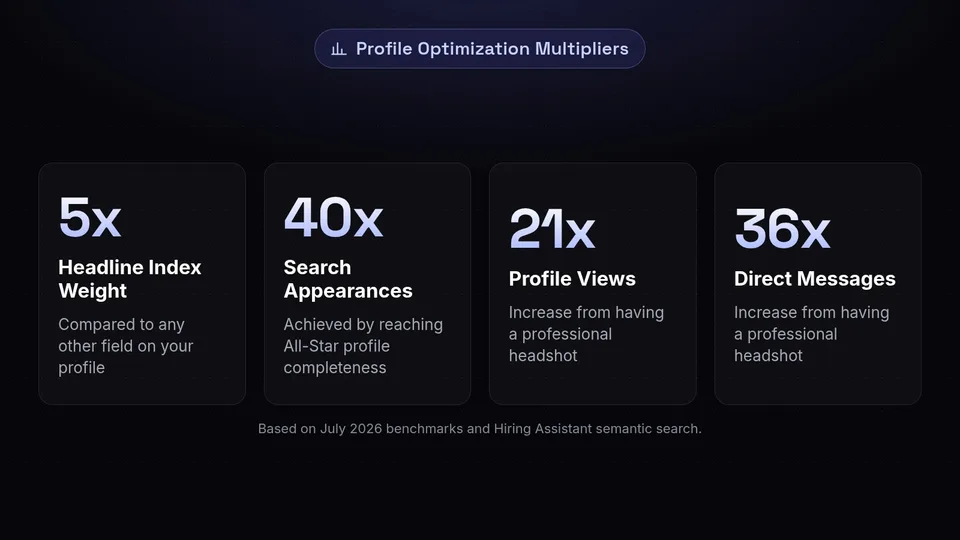
As of June 2026, search indexing weights have been explicitly calibrated to favor the headline field. In fact, for recruiter search algorithms, the headline field is indexed at 5x the weight of any other field on your profile (including your summary or experience sections). If you want to rank for specific industry terms, they must be seamlessly integrated into your headline. A headline that merely says "Manager at Company X" is a massive wasted opportunity compared to "Product Marketing Manager | B2B SaaS Go-To-Market Strategy | Positioning & Messaging."
The Power of All-Star Completeness and Visual Verification
Profile completeness is not just a vanity metric; it is a critical algorithmic multiplier. Achieving "All-Star" profile completeness increases your search appearances by a staggering 40x. This means filling out every section: education, experience, skills, summary, and securing recommendations.
Visuals play an equally vital role, as confirmed by July 2026 benchmarks. Having a professional headshot increases profile views by 21x (with some reports suggesting a range of 14x to 20x) and increases direct messages by 36x. In an era where AI-generated profiles are a concern, a clear, professional, and verified image signals trust and authenticity to the 360Brew system.
Semantic Search vs. Keyword Stuffing
One of the most critical LinkedIn tips for 2026 is understanding the death of keyword stuffing. In June 2026, the impact of LinkedIn's AI recruiting agent, known as the "Hiring Assistant," became fully apparent. This AI evaluates profiles based on semantic "skill neighborhoods" rather than exact phrase repetition.
For example, if a recruiter is looking for a data scientist, the AI does not just count how many times you wrote "Python." It looks for the semantic neighborhood surrounding that skill—pairing "Python" with related tools like "Pandas," "NumPy," or "TensorFlow." The Hiring Assistant understands the context of your experience.
The efficiency of this system is remarkable: sourcing recruiters using these AI agents now review 81% fewer profiles before shortlisting candidates. If your profile is just a stuffed list of buzzwords without contextual skill neighborhoods, you will be filtered out before a human ever sees your page.
Feed Dynamics: What the LinkedIn Feed Rewards

Once your profile is optimized, your next focus is content distribution. The 360Brew algorithm utilizes a "Depth Score" to determine how far your content travels. Here is exactly what the algorithm rewards in 2026.
Dwell Time and Document Carousels
Dwell time—the amount of time a user spends looking at your post—is a massive positive signal. Currently, document carousels (PDF uploads that users swipe through) generate 2x to 3x higher dwell time than standard text or static image posts. By designing visually engaging, multi-page carousels that break down complex topics into digestible slides, you force the user to stop scrolling and interact with your content, sending a strong positive signal to the algorithm.
Saves, Sends, and the New Distribution Signals
While likes and reactions are nice, they are no longer the primary currency of reach. Under the 360Brew system, content saves and direct message sends serve as the primary distribution signals. If a user finds your post valuable enough to bookmark it for later (Save) or share it privately with a colleague (Send via DM), the algorithm interprets this as high-value "knowledge and advice" and significantly amplifies your reach.
Early Comment Velocity
The speed at which your post generates meaningful conversation is critical. Data shows that 70% of a post's total organic reach is determined in the initial 60 to 90-minute window after publishing.
Specifically, posts that receive 3 or more meaningful comments (not just "Great post!" or a thumbs-up emoji) in the first 60 minutes yield approximately 5.2x reach amplification. This underscores the importance of posting when your audience is active and fostering immediate, genuine dialogue.
Native Content and Short-Form Vertical Video
LinkedIn wants users to stay on LinkedIn. Consequently, native posts (content that does not link away from the platform) receive 3x higher reach than posts containing outbound links.
Furthermore, video is experiencing a massive renaissance. Dedicated short-form vertical video (15 to 90 seconds in length, shot in portrait orientation) is heavily favored. Through Q1 2026, vertical video experienced three consecutive quarters of double-digit upload growth. If you are looking to humanize your brand, short, insightful vertical videos are a highly rewarded format.
Feed Dynamics: What the LinkedIn Feed Punishes
Just as important as knowing what to do is knowing what to avoid. The Authenticity Update introduced severe penalties for behaviors deemed detrimental to the user experience.
The Penalty for Outbound Links
As mentioned, LinkedIn protects its ecosystem fiercely. Including external links directly in the body of your post reduces organic reach by approximately 40%.
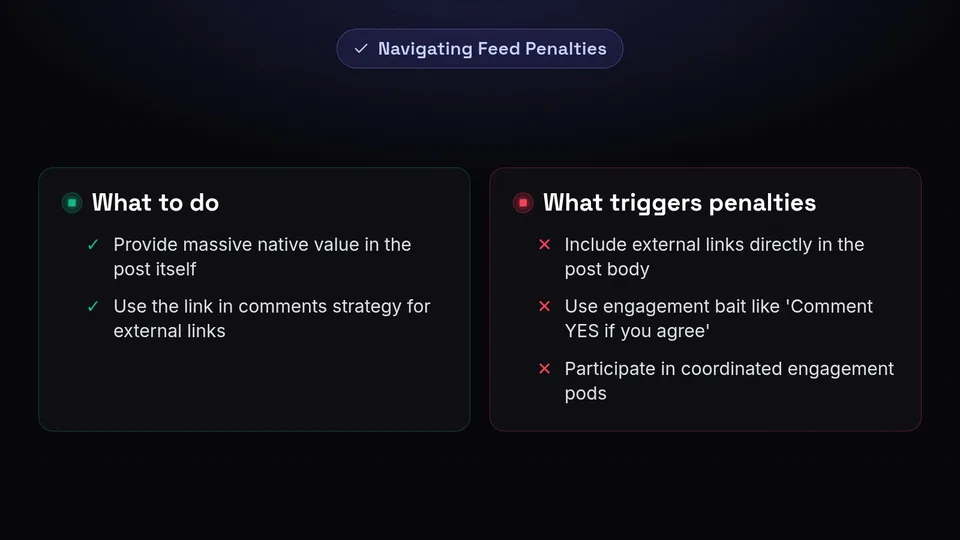
To navigate this, many creators use the "link in comments" strategy or edit the post to add the link after it has gained initial traction. However, the most effective strategy in 2026 is to provide so much native value in the post itself that users naturally navigate to your featured profile section to find your external links.
Suppression of Engagement Bait and Pods
The days of hacking the algorithm are over. Phrases explicitly designed to farm engagement, such as "Comment YES if you agree," or using reaction polls for trivial matters, now trigger active suppression via Depth Score penalties.
Even more severe is the punishment for engagement pods (groups of users who coordinate to like and comment on each other's posts). The 360Brew AI easily detects these unnatural, coordinated interaction patterns. Participating in engagement pod coordination now results in account shadowbans, rendering your content virtually invisible to anyone outside the pod.
Posting Cadence, Timing, and Formatting
Strategy and content quality must be paired with operational consistency to yield results.
Consistency and Engagement Lift
According to May 2026 cadence benchmarks, sporadic posting is highly ineffective. Accounts that post at least once per week achieve a 2x engagement lift compared to those with irregular posting schedules. The 90-day learning trajectory of the 360Brew algorithm relies on consistent data inputs to map your authority in a specific niche. If you disappear for weeks at a time, the algorithm loses the thread of your professional narrative.
Optimal Scheduling Windows
Timing matters, especially given the importance of early comment velocity. Peak user activity on the platform occurs mid-week mornings. Specifically, the optimal publishing windows are Tuesday through Thursday between 8 AM and 11 AM local time. To calculate the exact best times for your specific audience timezone and industry, utilize our free utility: determine custom posting slots here.
The 210-Character Truncation Point
Formatting your text for maximum readability is crucial. In the LinkedIn feed, posts truncate prior to the "see more" prompt at exactly the 210-character mark. Your first 210 characters serve as your headline and hook; if they do not compel the user to click "see more," the rest of your post will go unread, severely hurting your dwell time metrics. To ensure your hooks are perfectly optimized before publishing, you can check your draft text lengths using our character counter tool.
Personal Profiles vs. Company Pages
A common point of confusion in LinkedIn marketing 2026 is the differing roles of personal profiles and company pages. Because LinkedIn is fundamentally a professional networking site for humans, personal profiles naturally receive significantly higher organic reach than company pages.
The 360Brew algorithm prioritizes human-to-human interaction. A company page should serve as an authoritative hub—a place for official announcements, product releases, job postings, and corporate validation. However, the actual distribution of your brand's narrative should be driven by employee advocacy.
When founders, executives, and team members share insights from their personal profiles (while tagging or referencing the company), the reach and engagement will exponentially outperform the same content posted solely on the corporate page. A modern strategy requires a symbiotic relationship: the company page provides the anchor, while personal profiles provide the sail.
How to Use LinkedIn Without Becoming Insufferable
With all these rules and algorithms, it is easy to fall into the trap of writing robotic, overly polished, or painfully dramatic content. To use LinkedIn without becoming insufferable, you must anchor your strategy in the "Knowledge and Advice" mandate.
- Avoid the "Broetry": Stop writing single-sentence paragraphs that artificially drag out a mundane story about buying a cup of coffee. Get to the point.
- Share the "How," Not Just the "What": Instead of just announcing a successful project, break down the three specific hurdles you overcame to achieve it.
- Be a Practitioner, Not a Preacher: The most engaging content comes from people who are actively doing the work, sharing their real-time learnings, failures, and pivots.
- Engage Genuinely: When you leave comments on other people's posts, add to the conversation. A thoughtful, two-paragraph comment on an industry peer's post can often drive more profile views than a mediocre original post on your own feed.
Managing Your Strategy: SchedulifyX vs. Native Tools
Maintaining a consistent presence during optimal mid-week windows requires robust scheduling. When comparing a dedicated platform like SchedulifyX to LinkedIn's native scheduling tools, we must be completely transparent about where the native platform is stronger.
As of 2026-09-21, LinkedIn's native scheduler is stronger than SchedulifyX when it comes to zero-latency native tagging and immediate access to brand-new, experimental post formats the very moment they are released by LinkedIn's engineering team. Because third-party platforms rely on API integrations, there can occasionally be friction or delays in supporting highly specific native features. Furthermore, LinkedIn's native scheduling tools are completely free to use within their platform, whereas SchedulifyX operates on a paid per-seat or per-channel pricing model.
However, where SchedulifyX excels is in cross-platform aggregation, advanced analytics, and team collaboration workflows. If you are managing a multi-channel social strategy, relying solely on LinkedIn's native tool creates a siloed workflow. SchedulifyX allows you to orchestrate your LinkedIn strategy alongside your other networks, providing unified reporting that native tools simply cannot offer.
Please note that platform features and API pricing models change frequently; always confirm current capabilities and costs directly on the vendor's own page.
Conclusion: Thriving on LinkedIn in 2026
Succeeding on LinkedIn in 2026 requires a blend of technical optimization and genuine human authenticity. By aligning your profile with the semantic expectations of the Hiring Assistant, formatting your content to maximize dwell time and early comment velocity, and respecting the 360Brew algorithm's preference for sustained knowledge sharing, you can build a highly influential presence.
Remember to post consistently, leverage document carousels and vertical video, and strictly avoid engagement bait and outbound links in your main text. If you are ready to streamline this entire process, ensure you are hitting those critical mid-week publishing windows by managing your content calendar with SchedulifyX. Start planning your optimized LinkedIn strategy today, and let the algorithm work for you, not against you.
Sources
Facts checked against the sources below on September 21, 2026.
- expandi.io
- saleshigher.com
- Linkedin Changed Its Algorithm Heres What Changed And What To Do About It — professionalpunch.com
- Linkedin Algorithm February 2026 Whats Working Now — dataslayer.ai
- Linkedins Algorithm In 2026 What Changed — readcrucible.com
- Linkedin Profile Optimization Guide — careerbldr.com
- Linkedin Profile Optimization — skrapp.io
- Linkedin Profile Optimization 2026 — simplify.jobs
- The Comprehensive Linkedin Optimization — cyberwarrior76.substack.com
- Linkedin Algorithm 2026 Engagement Strategy Guide — digitalapplied.com