The Quiet Power of Instagram Story Stickers: A Guide
SchedulifyX Team · October 29, 2026
Discover how to transform passive viewers into active participants using Instagram story stickers. Explore polls, sliders, and question boxes for engagement.
The landscape of social media is in a state of perpetual motion, shifting away from the highly curated, static grids of the past towards raw, ephemeral, and interactive content. In this dynamic environment, capturing attention is only half the battle; the true measure of success lies in retaining that attention and prompting an action. This is where the quiet power of instagram story stickers comes into play. Far from being mere decorative elements or playful afterthoughts, these tools represent one of the most potent mechanisms for driving meaningful interaction on the platform.
When an audience watches a story, they are often in a state of passive consumption, tapping mindlessly through a never-ending queue of content. To break this trance, creators and brands must introduce elements of friction—positive friction that invites the viewer to pause, consider, and participate. Interactive stories serve this exact purpose. By deploying polls, sliders, and question boxes strategically, you transition your audience from passive spectators to active participants. This comprehensive guide will explore the psychological mechanics behind these features, provide actionable story engagement ideas, and demonstrate how to leverage interactive stories to build a more dedicated and vocal community.
The Evolution of Ephemeral Content
To understand the efficacy of instagram story stickers, we must first examine the environment in which they exist. Ephemeral content—media that disappears after a set period, typically twenty-four hours—fundamentally changed how users interact with social platforms. Because the content is temporary, the pressure for perfection is significantly reduced. This creates a more casual, authentic space where brands can show behind-the-scenes glimpses, unpolished thoughts, and real-time updates.
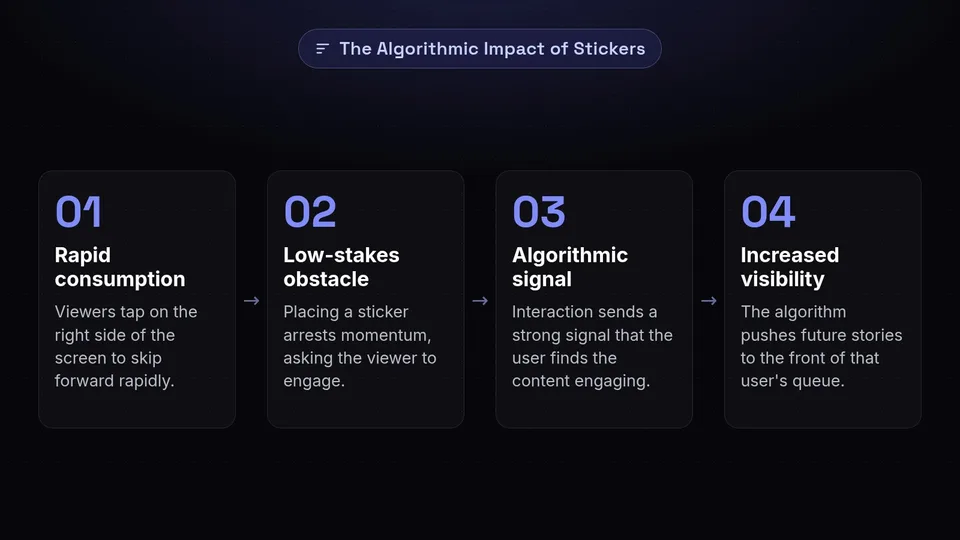
However, the temporary nature of stories also means that viewers consume them rapidly. The user interface is designed for speed: a simple tap on the right side of the screen propels the viewer forward. This rapid-fire consumption model makes it incredibly easy for your content to be skipped or ignored. To combat this, the platform introduced interactive elements designed to arrest the viewer's momentum. By placing a sticker on a story, you are essentially placing a small, low-stakes obstacle in the viewer's path, asking them to engage before they move on.
The algorithm takes careful note of these interactions. When a user interacts with your instagram story stickers, it sends a strong signal to the platform's underlying architecture that this specific user finds your content engaging. Consequently, the algorithm is more likely to push your future stories to the front of that user's queue. Therefore, mastering interactive stories is not merely about making your current post look interesting; it is a long-term strategy for maintaining visibility in a highly competitive digital ecosystem.
The Psychology Behind Interactive Stories
Why do people feel compelled to tap a poll or slide an emoji? The answer lies in human psychology and the concept of micro-commitments. In the physical world, asking someone for a significant favour right away often results in rejection. However, if you first ask for a very small, easily granted favour, the likelihood of them agreeing to a larger request later increases. This is known as the 'foot-in-the-door' technique.
Cognitive Load and Micro-Commitments
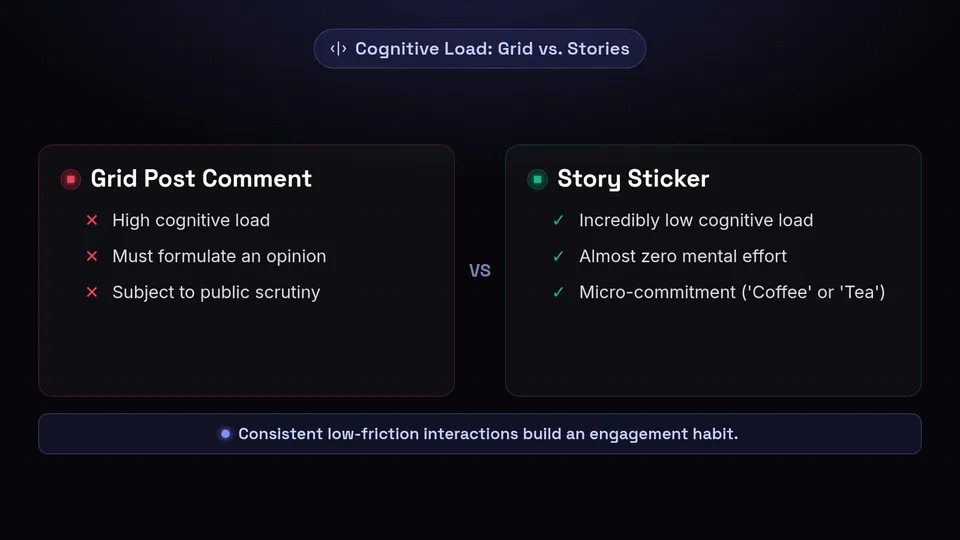
In the digital realm, leaving a thoughtful comment on a grid post requires a relatively high cognitive load. The user must formulate an opinion, type it out, and subject it to public scrutiny. In contrast, instagram story stickers demand an incredibly low cognitive load. Tapping a button to choose between 'Coffee' or 'Tea' requires almost zero mental effort. It is a micro-commitment. By consistently offering these low-friction opportunities for interaction, you train your audience to engage with your brand. Over time, this habit of engagement can translate into higher-value actions, such as clicking a link, replying to a story via direct message, or ultimately making a purchase.
The Reward Mechanism of Instant Feedback
Furthermore, interactive stories tap into our innate desire for validation and curiosity. When a user votes in a poll, they are instantly rewarded with the current results, allowing them to see how their opinion aligns with the majority. This instant gratification creates a positive feedback loop. Similarly, question boxes offer a direct line of communication to a brand or creator, fulfilling the user's desire to be heard and acknowledged. Understanding these psychological triggers is essential for generating effective story engagement ideas.
Deep Dive: The Binary Brilliance of Polls

The poll sticker is arguably the most straightforward yet effective tool in your interactive arsenal. By presenting a simple binary choice, you force a decision, no matter how trivial. This simplicity is its greatest strength.
Strategic Applications for Polls
Polls can be deployed in a multitude of ways to serve different strategic objectives. One of the most common and effective uses is for market research and product development. Instead of guessing what your audience wants, you can simply ask them. An independent clothing retailer, for instance, might use a poll to ask whether their followers prefer a new design in blue or green. Not only does this provide valuable data to inform purchasing decisions, but it also makes the audience feel invested in the product before it even launches. When the product is finally released, those who voted feel a sense of ownership, which can drive conversions.
Another strategic application is audience segmentation. By asking targeted questions, you can gain insights into the demographics and preferences of your most engaged followers. A fitness coach might ask, 'Do you prefer morning workouts or evening sessions?' The insights gathered from such polls can then be used to tailor future content, ensuring that the material you produce resonates deeply with the people who actually consume it.
Crafting the Perfect Poll Question
The key to a successful poll lies in the framing of the question and the options provided. The choices should be distinct and easily understandable at a glance. Avoid overly complex scenarios that require the viewer to read a paragraph of text. Keep it punchy. The classic 'This or That' format remains highly effective because it relies on visual comparisons rather than textual analysis.
Furthermore, consider the emotional resonance of the options. While 'Yes' and 'No' are functional, they are often uninspiring. Replacing them with more expressive language—such as 'Absolutely!' versus 'Not for me'—can make the interaction feel more conversational and less like a clinical survey. The goal is to make the act of voting feel like a natural extension of the viewer's internal monologue.
The Nuance of the Emoji Slider
While polls are excellent for binary decisions, they lack nuance. They cannot capture the degree to which someone feels about a topic. This is where the emoji slider sticker excels. It provides an analogue feedback mechanism in a digital space, allowing users to express sentiment on a sliding scale.
Capturing Sentiment Beyond Yes/No
The slider is inherently playful. The visual animation of the emoji growing larger as it is dragged across the screen provides a satisfying micro-interaction that encourages participation. This sticker is particularly useful for gauging enthusiasm. If you are teasing a new project or sharing a behind-the-scenes look at an upcoming event, a slider with a 'fire' or 'heart eyes' emoji allows your audience to demonstrate their anticipation.
However, the slider can also be used creatively beyond simple sentiment analysis. You can use the physical space of the slider to represent different outcomes or answers. For example, if you are sharing a recipe, you could use a slider to ask, 'How spicy do you like your food?' with the left side representing 'Mild' and the right side representing 'Extra Hot'. This transforms a generic engagement tool into a specific, context-relevant question.
Visual Mechanics and Dwell Time
From an algorithmic perspective, the slider has an additional benefit: it increases dwell time. Interacting with a slider requires a fraction of a second longer than simply tapping a poll. The user must place their finger on the screen, drag the emoji to their desired position, and release it. This physical action forces the viewer to pause their rapid scrolling, increasing the total time spent on your story. In the eyes of the platform's algorithm, increased dwell time is a strong indicator of quality content, which can positively impact your overall reach.
Unlocking Qualitative Data with Question Boxes
If polls and sliders represent quantitative data, the question box sticker is your gateway to qualitative insights. This sticker invites open-ended responses, allowing your audience to share their thoughts, ask for advice, or provide detailed feedback. Because it requires the highest cognitive load of the three primary stickers—the user must actually type out a response—it typically receives fewer total interactions than a poll. However, the interactions it does receive are significantly higher in value.
Prompting Meaningful Responses
The success of a question box relies entirely on the prompt. A generic 'Ask me anything' can sometimes fall flat because it places the burden of creativity entirely on the audience. If they cannot immediately think of a compelling question, they will simply swipe past. To generate robust story engagement ideas, you must provide a specific, focused prompt that lowers the barrier to entry.
Instead of a broad AMA, try asking for recommendations, sharing a vulnerability, or soliciting opinions on a highly specific topic. For example, a travel blogger might ask, 'What is the one item you never travel without?' This prompt is specific, easy to answer, and taps into the audience's desire to share their own expertise. Alternatively, a business consultant could ask, 'What is your biggest struggle with time management this week?' This not only generates engagement but also provides a wealth of pain points that can be addressed in future content or services.
Flipping the Script: AMAs and Expert Positioning
When used effectively, the question box is an incredible tool for establishing authority and building trust. When you invite questions on a topic within your niche, you position yourself as an accessible expert. Taking the time to answer these questions thoughtfully—either by sharing the response in subsequent stories or replying directly via direct message—demonstrates that you value your audience's input.
Sharing the best responses publicly (anonymously or with permission) serves a dual purpose. Firstly, it provides you with ready-made content for your stories. Secondly, it shows the rest of your audience that real people are engaging with you, which provides social proof and encourages others to participate in the future. This creates a virtuous cycle of interaction that lies at the heart of successful interactive stories.
Advanced Story Engagement Ideas and Combinations
While using individual instagram story stickers is a great starting point, their true power is unlocked when they are combined to create a narrative arc. A single story is a fleeting moment; a sequence of stories is an experience.
The Story Sequence Strategy
Consider structuring your stories like a traditional narrative, with a distinct beginning, middle, and end. The first story should serve as the hook, setting the context without immediately demanding interaction. The second story can introduce a low-friction interactive element, such as a poll, to draw the viewer in. The third story can escalate the interaction by using a slider or a question box, building upon the theme established in the previous frames.
For instance, a bakery could start with a visually appealing video of dough being kneaded (the hook). The next story could feature a poll asking, 'Sweet or Savoury?' (low friction). The final story could feature a question box saying, 'Tell us your dream pastry flavour combination, and we might just bake it!' (high friction, high reward). This sequential approach gradually warms up the audience, making them more likely to engage with the more demanding stickers.
Creating Interactive Quizzes
Beyond the core three stickers, the 'Quiz' sticker offers another excellent avenue for engagement, particularly for educational or informative accounts. Quizzes gamify the viewing experience. By presenting a multiple-choice question with a definitive right answer, you challenge your audience's knowledge. When they select an answer, they immediately find out if they were correct, complete with a celebratory animation for a right guess.
Quizzes are fantastic for highlighting product features, sharing industry trivia, or simply entertaining your audience. They encourage viewers to pay closer attention to your content, as they want to get the answer right. Furthermore, you can use the subsequent stories to explain the correct answer in more detail, providing value and reinforcing your expertise.
The 'Add Yours' and Countdown Stickers
To further diversify your interactive stories, consider integrating the 'Add Yours' and Countdown stickers. The 'Add Yours' sticker is a powerful community-building tool that prompts users to share their own content based on a specific theme. When a user participates, the sticker is added to their story, creating a chain reaction that can significantly expand your reach beyond your immediate followers. It is a brilliant way to foster user-generated content and build a sense of shared experience.
The Countdown sticker, on the other hand, is designed to build anticipation. Whether you are launching a new product, hosting a live stream, or announcing a special event, the countdown acts as a visual reminder. Crucially, viewers can tap the sticker to turn on reminders for the event, ensuring they are notified when the countdown reaches zero. This transforms a passive announcement into an active subscription, driving highly motivated traffic to your ultimate destination.
Designing for Interaction: Best Practices
The effectiveness of instagram story stickers is not solely determined by the questions you ask; the visual presentation plays a critical role. If your stickers are hard to read, poorly placed, or visually overwhelming, viewers will simply skip them.
Safe Zones and Placement
One of the most common mistakes creators make is placing stickers outside of the platform's 'safe zones'. The Instagram interface includes various overlays, such as the user's profile picture at the top, the message box at the bottom, and the navigation taps on the left and right edges. If you place a poll or a question box too close to these areas, viewers may accidentally interact with the interface instead of your sticker, leading to frustration and abandoned engagement.
Always centre your most important interactive elements and keep them within the middle third of the screen. This ensures they are easily accessible to the user's thumb and completely unobstructed by the app's native UI.
Visual Context and Backgrounds
The background against which you place your stickers must provide sufficient contrast. If you place a white question box over a bright, busy photograph, the text will be illegible. Use the platform's drawing tools to create solid colour blocks behind your stickers, or use the semi-transparent text background feature to ensure the prompt stands out clearly against the media behind it.
Furthermore, ensure that the background media provides context for the interaction. If you are asking a question about a specific product, that product should be clearly visible in the background. The visual and the interactive element should work in harmony to convey a single, cohesive message.
Analysing the Impact of Instagram Story Stickers
To continuously improve your story engagement ideas, you must move beyond simply posting and hoping for the best. You need to analyse the performance of your interactive stories to understand what resonates with your audience.
Moving Beyond Vanity Metrics
While it is tempting to focus solely on the total number of views your stories receive, this is largely a vanity metric. A high view count means little if the audience is tapping through without absorbing the content. Instead, focus on the specific interactions generated by your stickers. Track the number of votes on your polls, the average position of your emoji sliders, and the volume and quality of responses to your question boxes.
Pay close attention to which types of prompts generate the most activity. Do your followers prefer lighthearted trivia or deep, industry-specific questions? Do they engage more with visual 'This or That' polls or with open-ended text boxes? By systematically reviewing this data, you can identify patterns and refine your strategy over time.
Understanding Completion Rates and Taps Forward/Back
In addition to direct sticker interactions, analyse your navigation metrics. The 'Taps Back' metric is a strong indicator of highly engaging content; it means a viewer found a story so interesting that they navigated backward to watch it again or to read the text more carefully. Conversely, a high number of 'Exits' or 'Taps Forward' on a specific story indicates a point of friction where you lost the audience's interest.
If you notice that viewers are consistently exiting your stories right before an interactive sticker, it may suggest that the prompt is too demanding, lacks context, or is visually unappealing. By correlating your navigation metrics with your sticker placement, you can fine-tune the pacing and structure of your narrative arcs.
Integrating Stickers into Your Wider Strategy
Interactive stories should not exist in a vacuum. They are most effective when integrated into a holistic social media strategy. Your stories should complement the content on your main grid, providing a more intimate, real-time perspective on the polished posts you share permanently.
Aligning Stories with Grid Posts
When you publish a new piece of content to your feed, use your stories to drive traffic towards it. However, rather than simply sharing the post with a generic 'New Post' sticker, use interactive elements to create curiosity. If you have published a carousel post detailing five tips for better productivity, you could create a story poll asking, 'Which productivity method do you struggle with the most?' Once they vote, the subsequent story can direct them to the feed post for the solution.
This approach transforms a simple promotional announcement into a two-way conversation, increasing the likelihood that the viewer will actually click through to the main content.
Consistency and Planning
The secret to sustained engagement on any social platform is consistency. If you only post interactive stories sporadically, your audience will not develop the habit of engaging with your content. You need to show up regularly, offering consistent opportunities for micro-commitments.
This level of consistency requires planning. Attempting to conceptualise, design, and publish interactive sequences on the fly is a recipe for burnout and erratic posting schedules. To truly harness the quiet power of instagram story stickers, you must approach them with the same strategic rigor as your permanent content. By mapping out your story narratives in advance, you ensure a steady drumbeat of engagement that keeps your brand top-of-mind.
Conclusion
The ephemeral nature of social media stories represents a unique opportunity to connect with your audience on a more authentic, immediate level. However, to prevent your content from becoming just another blur in a rapid-fire sequence of taps, you must actively invite participation. The quiet power of instagram story stickers—from the binary simplicity of polls to the nuanced feedback of sliders and the qualitative depth of question boxes—lies in their ability to seamlessly integrate positive friction into the viewing experience.
By understanding the psychological drivers of micro-commitments, crafting thoughtful prompts, and designing cohesive narrative sequences, you can transform passive scrollers into an active, vocal community. Remember that every tap, slide, and typed response is a signal to both you and the algorithm that your content matters.
Executing a consistent, highly engaging interactive strategy requires foresight and organisation. By planning your story engagement ideas in advance, you can ensure that your ephemeral content works tirelessly to support your broader marketing objectives. Start organising your interactive stories and elevate your overall social media strategy today by planning your content seamlessly with SchedulifyX.
