The True Cost of Posting Manually: An Hours-per-Week Audit Method
SchedulifyX Team · September 15, 2026
Discover the hidden financial and productivity drain of manual social media management. Learn how to conduct an hours-per-week audit to reveal your true costs.
When managing a brand's digital presence, the daily routine of sharing updates can easily feel like a minor administrative task. After all, tapping a screen or clicking a button takes mere seconds. However, this perception is a well-disguised illusion. If you were to rigorously measure the total time spent social media posting, you would likely uncover a significant drain on your most valuable resources: time, focus, and budget.
Many businesses and solo professionals operate under the assumption that manual posting is essentially free because it does not require a software subscription. Yet, time is inextricably linked to money. Every minute spent toggling between tabs, searching for assets, and dealing with platform-specific quirks carries a tangible financial weight. To truly understand this burden, you must move beyond estimations and conduct a precise, data-driven audit of your weekly activities.
In this comprehensive guide, we will explore how to implement an hours-per-week audit method. By tracking your workflow meticulously, you can calculate your exact manual posting cost and determine the precise automation time savings you stand to gain by upgrading your approach.
The Illusion of Quick Updates
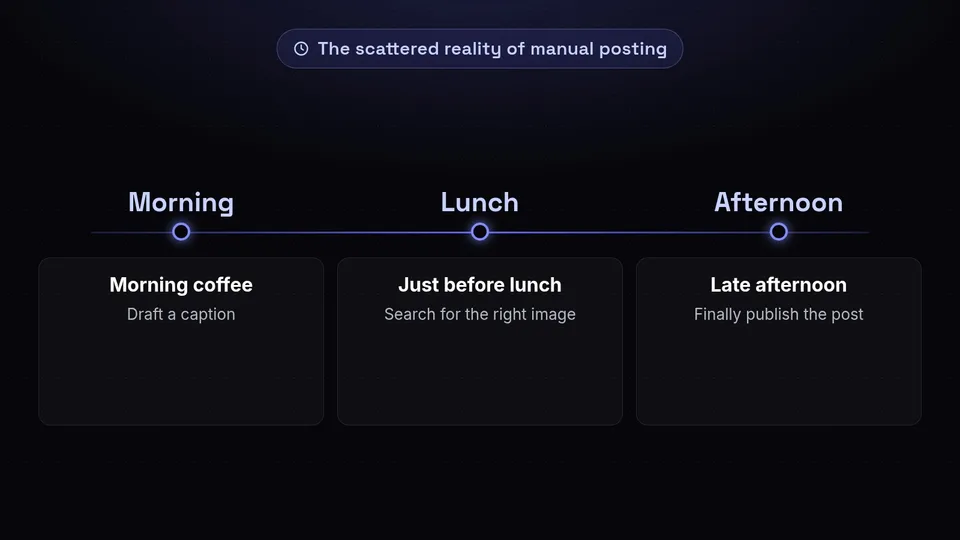
The fundamental problem with manual social media management is that the tasks are highly fragmented. You rarely sit down to 'do social media' for five uninterrupted minutes. Instead, the process is scattered throughout your day. You might draft a caption over your morning coffee, search for the right image just before lunch, and finally publish the post in the late afternoon.
Because these actions are dispersed, your brain categorises them as fleeting moments rather than a continuous block of labour. This cognitive bias prevents you from recognising the cumulative toll. When you evaluate the time spent social media posting without a tracking mechanism, your memory isolates only the final act of clicking 'Publish'. It conveniently forgets the preparation, the troubleshooting, and the inevitable distractions that occur when you log into a platform designed to capture and hold your attention.
To overcome this bias, you must treat social media posting not as a series of casual interactions, but as a formal business process. Like any business process, it requires a supply chain: ideation, asset creation, copywriting, formatting, publishing, and monitoring. When you perform all these steps manually, day in and day out, the inefficiencies compound rapidly.
Deconstructing the Manual Posting Process
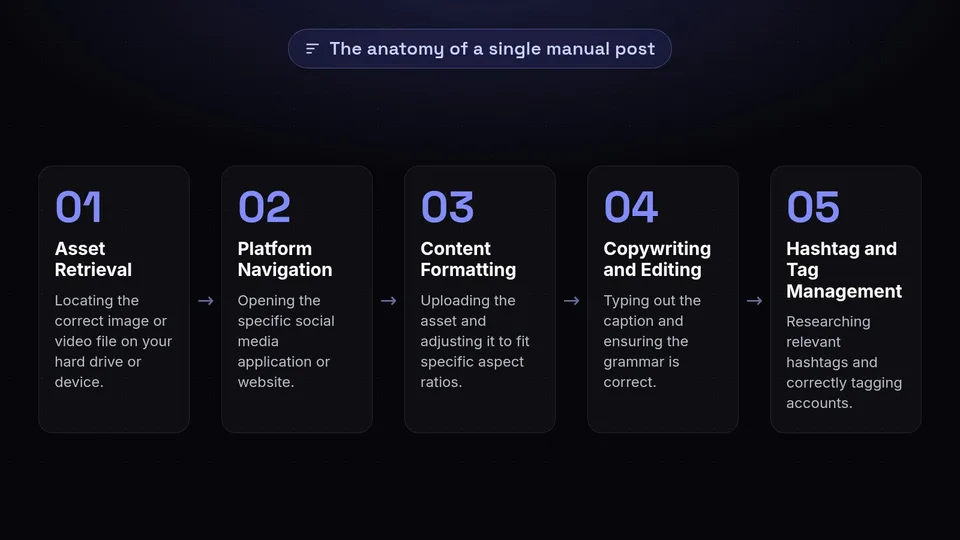
Before you can audit your time, you must understand exactly what you are timing. Manual posting is rarely a single, fluid motion. It is a sequence of micro-tasks, each carrying its own potential for delays and friction. Let us break down the anatomy of a single manual post.
- Asset Retrieval: Locating the correct image or video file on your hard drive, cloud storage, or mobile device.
- Platform Navigation: Opening the specific social media application or website and navigating to the creation interface.
- Content Formatting: Uploading the asset and adjusting it to fit the platform's specific aspect ratios or file size limits.
- Copywriting and Editing: Typing out the caption, adjusting the tone, and ensuring the grammar is correct.
- Hashtag and Tag Management: Researching relevant hashtags, retrieving them from a saved document, and correctly tagging partner accounts or locations.
- Publishing: Executing the post and waiting to confirm that it has gone live without errors.
- Immediate Monitoring: Checking the live post to ensure the formatting held up and that there are no glaring typos.
When you multiply this sequence by the number of platforms you manage, and then multiply that by the number of days in a week, the sheer volume of manual interventions becomes staggering. Each step is an opportunity for friction—a slow internet connection, a platform glitch, or a missing file can instantly double the time required for a single update.
The Hours-per-Week Audit Method

To move from assumption to verifiable fact, you need to conduct an hours-per-week audit. This method requires you to track your time meticulously for a standard seven-day period. You do not need complex software to do this; a simple stopwatch app on your phone and a spreadsheet will suffice. The goal is to capture every single minute dedicated to the mechanical act of posting.
Phase One: Tracking the Preparation
Your audit begins the moment you start preparing a post. Start your timer when you begin searching for the image or video you intend to use. Keep the timer running as you draft the caption, hunt for emojis, and compile your hashtags. If you have to pause to answer an email or take a phone call, stop the timer. You only want to record active time spent preparing the content.
Record this time in your spreadsheet under a 'Preparation' column. You will likely notice that gathering the necessary components takes significantly longer than you previously estimated, especially if your digital files are disorganised or if you are writing copy on the fly.
Phase Two: Timing the Execution
The next phase of the audit covers the physical act of publishing. Start your timer when you open the social media platform. Keep it running while you upload the media, paste your caption, apply formatting, add tags, and hit publish. Do not stop the timer until you have visually confirmed that the post is live and correct.
If you are posting the same content across multiple platforms (for example, adapting a post for both a professional network and a visual-first platform), you must time the process for each individual platform. Log these durations in an 'Execution' column. This phase often highlights the redundancy of manual work, as you find yourself repeating nearly identical actions across different interfaces.
Phase Three: Measuring the Distraction Tax
This is perhaps the most critical, yet frequently overlooked, aspect of the audit. Social media platforms are engineered to distract you. When you log in to post an update for your business, you are immediately confronted with notifications, trending topics, and a highly curated feed of content.
For the duration of your audit week, you must be ruthlessly honest with yourself. If you log in to post, but spend five minutes scrolling through your timeline or reading unrelated comments before or after you publish, that time must be recorded. Log this in a 'Distraction' column. This is a direct byproduct of the manual posting method; if you were not forced to log into the platform to publish, you would not be exposed to the distraction.
The Context Switching Penalty

Beyond the direct minutes logged in your spreadsheet, there is an invisible cost to manual posting known as the context switching penalty. In cognitive psychology and productivity studies, context switching refers to the mental effort required to shift your focus from one task to a completely different one.
Imagine you are engaged in deep, focused work—perhaps writing a project proposal, analysing financial data, or coding a new feature. You suddenly remember that you need to publish a social media update for the afternoon peak time. You stop your deep work, switch your mental context to marketing and communication, execute the post, and then attempt to return to your original task.
The human brain does not pivot seamlessly. The time it takes to regain your previous level of deep focus can be substantial. While this cognitive recovery time is difficult to measure perfectly with a stopwatch, you can observe its effects during your audit week. Note down how you feel when you interrupt your primary work to manage a manual post. The loss of momentum is a very real component of your overall time spent social media posting.
Calculating Your Manual Posting Cost
At the end of your seven-day audit, tally up the minutes from your Preparation, Execution, and Distraction columns. Convert this total into hours. This figure represents your weekly time spent social media posting.
To translate this time into a financial metric, you must determine the hourly value of the person performing the task. If you are a solo entrepreneur, this is your personal hourly rate—the amount you would charge a client for an hour of your core services. If you employ a team member to handle this, use their hourly wage (factoring in overheads and benefits for a true reflection of cost).
The formula is straightforward:
(Total Hours per Week) x (Hourly Rate) = Weekly Manual Posting Cost
To understand the long-term impact, multiply that weekly figure by 52. The resulting annual manual posting cost is often a sobering revelation. What felt like a series of quick, free updates is suddenly exposed as a significant line item in your hidden operational expenses. When you view this figure, you are no longer relying on industry averages or external claims; you are looking at undeniable data generated by your own workflow.
The Opportunity Cost of Lost Time
The financial calculation above only tells half the story. The true cost of manual posting must also account for opportunity cost—the value of what you could have achieved if you had directed those hours elsewhere.
Consider the hours you tallied in your audit. If those hours were suddenly returned to your schedule, how could you deploy them to generate actual growth? You might use that time to engage meaningfully with your audience, responding to comments and building community relationships. You might dedicate it to high-level strategic planning, analysing which types of content actually drive conversions. Alternatively, you might invest that time into product development, client acquisition, or simply resting to prevent burnout.
When you are bogged down in the mechanical execution of manual posting, you are trapped in a reactive state. You are merely maintaining the status quo rather than actively advancing your business objectives. The opportunity cost is the growth you sacrifice in order to act as a human publishing button.
Realising Automation Time Savings
Once you have quantified the problem, the solution becomes remarkably clear. The antidote to the high cost of manual execution is strategic batching and scheduling. By adopting a system where you prepare and queue your content in advance, you fundamentally alter the mechanics of your workflow.
This is where automation time savings become a verifiable reality. Instead of interrupting your day five times a week to post manually, you can allocate a single, dedicated block of time—perhaps one hour on a Monday morning—to schedule all your content for the upcoming week. Because you are performing the same type of task continuously (gathering assets, writing copy, setting dates), you benefit from economies of scale. You enter a state of flow, completely eliminating the daily context switching penalty.
Furthermore, by using a dedicated scheduling environment, you bypass the distraction tax entirely. You are not logging into the native social media platforms to publish, which means you are not exposed to the algorithmic feeds designed to derail your attention. You execute your strategy and log out, preserving your focus for your core business activities.
Reclaiming Your Schedule with SchedulifyX
Conducting an hours-per-week audit is an empowering exercise. It replaces vague assumptions with concrete data, allowing you to make informed decisions about your operational efficiency. If your audit reveals that your manual posting cost is unacceptably high, it is time to transition to a more intelligent workflow.
By leveraging an AI-powered social media scheduling platform like SchedulifyX, you can centralise your content management, schedule updates across multiple channels simultaneously, and reclaim the hours you currently lose to manual repetition. The platform is designed to streamline the exact micro-tasks that your audit will identify as the biggest time drains.
Do not let the illusion of the 'quick update' continue to quietly drain your resources. Conduct your time audit this week, calculate your true costs, and then take control of your digital strategy. Sign up for SchedulifyX today to experience the profound impact of true automation time savings and get back to the work that truly matters.