Setting Up Best-Time Slots from Your Own Engagement Data
SchedulifyX Team · October 8, 2026
Stop guessing when to post. Learn how to use your historical analytics and a best time to post tool to discover and schedule your optimal posting times.
Every digital marketer, content creator, and business owner is familiar with the frustration of crafting the perfect social media post, hitting publish, and watching it vanish into the digital abyss. You have invested time in writing compelling copy, designing striking visuals, and ensuring your message is clear, yet the interaction remains minimal. Often, the quality of the content is not the issue; rather, the timing is to blame. Publishing content when your specific audience is offline or inactive guarantees a lacklustre response, regardless of how brilliant the post may be.
For years, the industry has relied on generic advice to solve this problem. A quick search will yield countless articles claiming to possess the definitive answer for when you should publish. However, relying on broad, global averages is a fundamentally flawed strategy. Your audience is entirely unique to your brand, possessing their own distinct daily routines, time zones, and browsing habits. To truly maximise your reach, you must pivot away from universal guesswork and embrace engagement data scheduling. By utilising a reliable best time to post tool, you can analyse your historical performance and establish a publishing calendar that aligns perfectly with your followers' actual behaviour.
In this comprehensive tutorial, we will explore the mechanisms behind audience behaviour, the algorithms that dictate content visibility, and provide a detailed, step-by-step guide on how to configure your own best-time slots using SchedulifyX. By the end of this guide, you will possess the knowledge required to transform your raw analytics into a highly optimised, automated publishing strategy.
The Illusion of Universal Optimal Posting Times
The concept of a single, universal best time to post is one of the most persistent myths in social media marketing. It is easy to understand why this myth endures; marketers crave simplicity and clear directives. However, adhering to generic timeframes ignores the complex reality of global digital consumption.
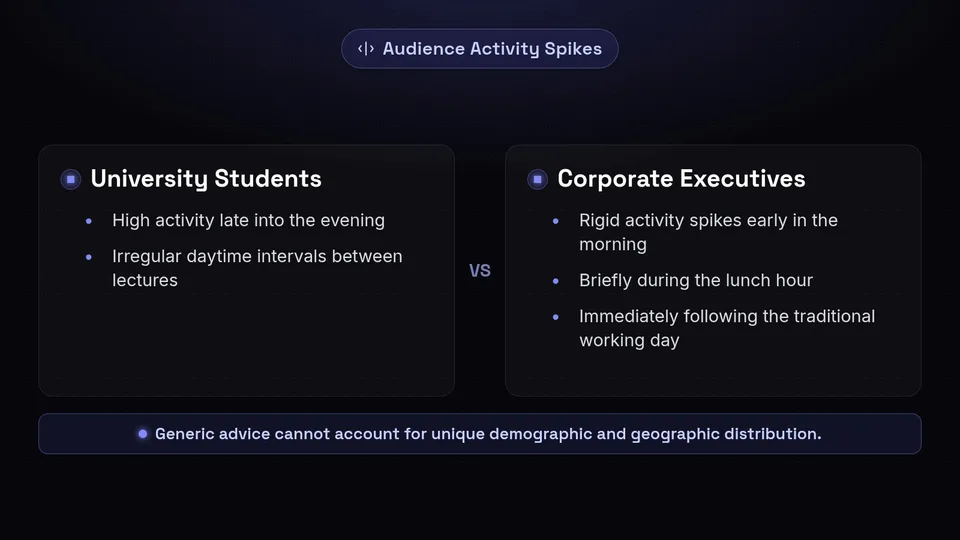
Consider the fundamental differences in audience demographics. A brand targeting university students will observe vastly different peak activity hours compared to a business-to-business enterprise targeting corporate executives. The student demographic might exhibit high activity late into the evening and during irregular daytime intervals between lectures. Conversely, the corporate audience may demonstrate rigid activity spikes early in the morning during their commute, briefly during the lunch hour, and immediately following the close of the traditional working day.
Furthermore, geographical distribution plays a critical role. If your brand operates in the United Kingdom but has steadily acquired a following in North America or Australia, adhering strictly to Greenwich Mean Time will inevitably alienate a substantial portion of your readership. Generic advice cannot account for the unique geographical distribution of your specific follower base. Therefore, the only reliable method for discovering your true optimal posting times is to look inward at the data generated by your own accounts.
Decoding Engagement Data Scheduling

To move beyond guesswork, we must understand the core principles of engagement data scheduling. This methodology involves the systematic analysis of your past posts to identify correlations between the time of publication and the volume of interaction received. Interaction, in this context, encompasses likes, comments, shares, saves, and overall impressions.
Engagement data scheduling operates on the premise that past behaviour is the most accurate predictor of future behaviour. If your audience consistently demonstrates a higher propensity to engage with your content on Thursday evenings, a data-driven scheduling approach will automatically prioritise Thursday evenings for your most important announcements. This shifts the burden of timing from human intuition to empirical evidence.
However, manually tracking this data is an arduous and prone-to-error process. It requires cross-referencing the timestamps of hundreds of posts with their corresponding performance metrics, accounting for anomalies, and continuously updating the findings as audience habits evolve. This is precisely where a dedicated best time to post tool becomes an indispensable asset in your marketing toolkit, automating the complex calculations and presenting you with actionable publishing windows.
The Mechanics of Audience Behaviour
To fully appreciate the value of optimal posting times, it is helpful to examine the mechanics of audience behaviour. Social media consumption is rarely random; it is deeply intertwined with the daily routines of the users. People integrate digital browsing into the transitional moments of their day.
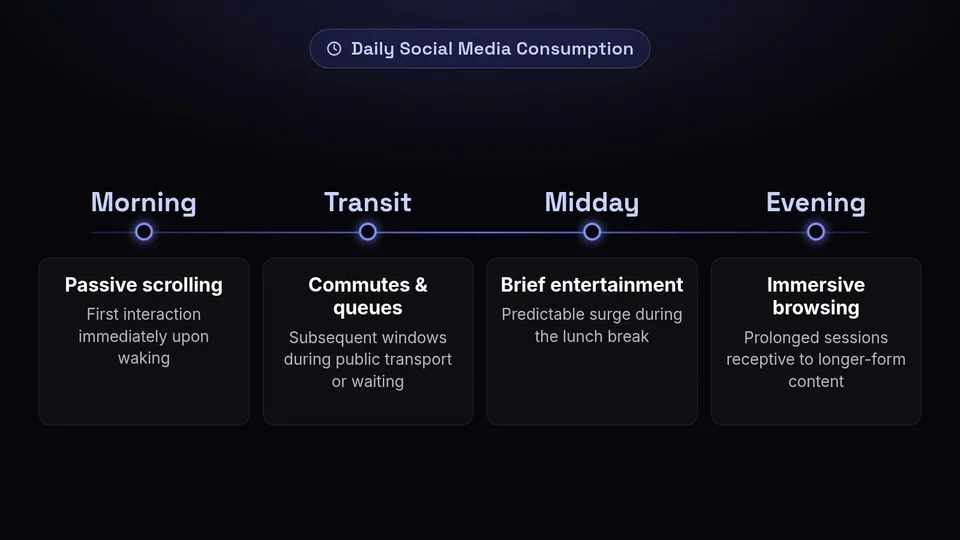
For many, the first interaction with their mobile device occurs immediately upon waking. This creates a distinct morning window characterised by passive scrolling and content consumption. Subsequent windows often emerge during transit, whether that involves public transport commutes or waiting in queues. The midday break provides another predictable surge in activity, often characterised by a desire for brief entertainment or networking.
The evening presents perhaps the most significant shift in behaviour. As individuals conclude their daily responsibilities and transition into relaxation, their social media usage frequently shifts from brief, fragmented sessions to prolonged, immersive browsing. During these evening hours, users are generally more receptive to longer-form content, detailed videos, and interactive discussions.
By understanding these behavioural mechanisms, you can begin to see why timing is so crucial. If you publish a detailed, thought-provoking piece of content during a brief morning commute window, your audience may not have the time to fully digest or interact with it. By reserving that content for an evening slot, identified through your engagement data, you align the nature of your post with the mindset and availability of your audience.
Algorithmic Mechanisms: The Role of Early Engagement Velocity
The importance of timing extends beyond simply being visible when your audience is online; it is fundamentally tied to how social media algorithms evaluate and distribute content. While each platform utilises a proprietary algorithm, they all share a common mechanism: the measurement of early engagement velocity.
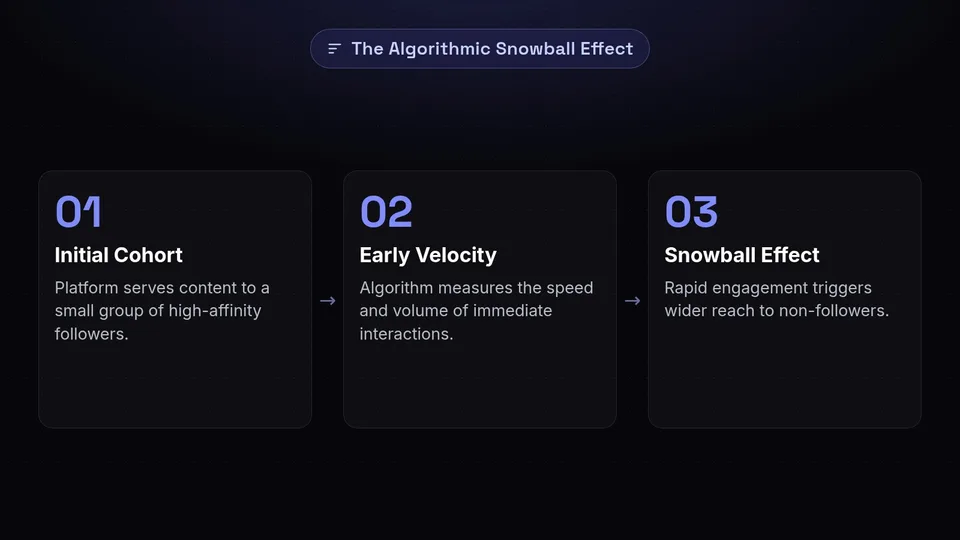
When you publish a post, the platform does not immediately display it to your entire follower base. Instead, it serves the content to a small, initial cohort of users who have previously demonstrated a high affinity for your account. The algorithm then closely monitors how this initial group reacts to the post. It measures the speed and volume of interactions—how quickly they like, comment, or share the content relative to the time it was published.
If the post generates a rapid influx of engagement from this initial cohort, the algorithm interprets this as a strong signal of relevance and quality. Consequently, it triggers a snowball effect, expanding the reach of the post to a wider segment of your audience and, potentially, to non-followers through discovery feeds and algorithmic recommendations.
Conversely, if you publish when your audience is largely offline, the initial cohort will not see the post immediately. The crucial window for early engagement velocity closes without sufficient interaction. By the time your followers eventually log in, the algorithm has already deemed the post to be of low interest due to the lack of immediate response, effectively burying it beneath newer, more rapidly engaging content from other creators. Utilising a best time to post tool ensures your content lands exactly when that initial cohort is active and ready to trigger the algorithmic snowball effect.
Preparing Your Content Strategy for Data-Driven Scheduling
Before you can effectively leverage a best time to post tool, it is essential to prepare your underlying content strategy. Data-driven scheduling amplifies the reach of your content, but it cannot compensate for poor quality or a lack of strategic alignment.
Begin by ensuring you have a sufficient volume of historical data. If you have only published a handful of posts, any tool will struggle to identify statistically significant patterns. A robust baseline requires consistent posting over a period of several weeks or months. This historical archive provides the raw material from which the tool will extract its insights.
Next, categorise your content by format and purpose. Different types of content may perform better at different times. For instance, quick, visually appealing updates might resonate well during brief midday breaks, whereas comprehensive tutorials or long-form videos might require the focused attention available during weekend mornings or late evenings. By understanding the diverse nature of your content pillars, you can more effectively map them to the optimal posting times identified by your analytics.
How a Best Time to Post Tool Processes Your History
Understanding the internal processes of a best time to post tool demystifies the technology and builds confidence in its recommendations. When you connect your social media profiles to a platform like SchedulifyX, the system initiates a comprehensive audit of your historical activity.
The tool ingests the metadata associated with every post you have published. This includes the exact timestamp of publication, the day of the week, and the aggregate engagement metrics (likes, comments, shares, clicks, and impressions). The system then plots this data to identify recurring patterns.
It looks for intersections between time and high engagement. For example, the tool might observe that posts published on Tuesdays between 14:00 and 15:00 consistently achieve higher median reach than posts published on Wednesday mornings. It applies statistical weighting to account for the recency of the data, ensuring that current audience behaviour is prioritised over outdated habits from years past.
Furthermore, a sophisticated tool filters out statistical noise. It recognises that a single viral post can skew the averages if not handled correctly. By focusing on median performance and consistent trends rather than isolated spikes, the tool generates a reliable map of your audience's active hours, translating this complex analysis into simple, actionable time slots.
Tutorial: Setting Up Best-Time Slots in SchedulifyX
Transitioning from theory to practice, let us walk through the exact process of configuring your optimal posting times using SchedulifyX. This step-by-step tutorial will guide you through activating the engagement data scheduling features and applying them to your content calendar.
Step 1: Connect and Synchronise Your Profiles
To begin, log in to your SchedulifyX dashboard. Navigate to the integrations or accounts section and ensure that all the social media profiles you wish to manage are securely connected. Once connected, SchedulifyX requires time to synchronise with the respective platforms and download your historical post data. Depending on the volume of your past activity, this initial synchronisation may take a short while. Allow the system to fully complete this process to ensure the subsequent analysis is based on a complete dataset.
Step 2: Access the Best Time to Post Settings
Once the data synchronisation is complete, navigate to your calendar or scheduling settings within SchedulifyX. Look for the feature dedicated to optimal posting times or automated time slots. When you activate this module, SchedulifyX will immediately begin processing the historical data it just retrieved.
Step 3: Review the Suggested Time Slots
The tool will present you with a visual breakdown of your most effective publishing windows, typically organised by day of the week. You will see specific time ranges highlighted as peak opportunities. Take a moment to review these suggestions. You may notice that the optimal times vary significantly from day to day; for example, your Saturday audience might be highly active in the morning, while your Tuesday audience prefers late afternoon. This variance perfectly illustrates why universal posting times are ineffective.
Step 4: Configure Your Weekly Posting Schedule
With the suggested slots clearly displayed, you can now construct your automated weekly schedule. SchedulifyX allows you to create predefined time slots on your calendar based on these recommendations. Select the days you intend to publish and assign the tool's suggested peak times to those days. You can create multiple slots per day if your strategy involves high-frequency posting, ensuring that every piece of content aligns with a period of high audience activity.
Step 5: Apply the Slots to Your Content Queue
Once your optimal schedule is configured, the daily workflow becomes incredibly streamlined. As you create new content or upload assets into SchedulifyX, you no longer need to manually select a date and time for each individual post. Instead, you simply add the finished post to your queue. SchedulifyX will automatically assign the post to the next available best-time slot on your calendar. This ensures your content is consistently distributed during peak engagement windows without requiring manual intervention for every single update.
Identifying and Handling Data Outliers
While a best time to post tool is highly sophisticated, it is important for the user to maintain a critical eye, particularly regarding data outliers. Outliers are anomalous events that produce engagement metrics far outside your normal baseline, potentially skewing the perception of optimal posting times.
A common example of an outlier is a post that unexpectedly achieves viral status. The sheer volume of engagement generated by a viral post can make the specific time it was published appear artificially optimal. Similarly, posts related to major, unprecedented industry news or significant global events may generate massive interaction due to the subject matter rather than the time of day.
Holidays and seasonal shifts also introduce temporary anomalies. Audience behaviour during a major festive period will look drastically different from a standard working week in mid-February. When reviewing the time slots suggested by your tool, consider whether any recent anomalies might be influencing the data. While SchedulifyX is designed to smooth out these irregularities by focusing on sustained trends, maintaining an awareness of your own major content spikes ensures you understand the context behind the recommendations.
Adapting to Network-Specific Audience Behaviour
A critical aspect of engagement data scheduling is recognising that audience behaviour is not uniform across different social media platforms. Users log into different networks with entirely different mindsets and intentions, which directly impacts when they are most likely to engage with your content.
Consider the environment of a professional networking platform. Users typically access these networks with a career-oriented mindset, often during traditional business hours. They may browse during their morning commute to catch up on industry news, or during the working day as part of their professional duties. Consequently, the optimal posting times for these platforms often align closely with the standard corporate workday.
In contrast, platforms focused on highly visual, entertaining, or short-form video content cater to a different psychological need. Users frequently turn to these platforms for escapism, relaxation, or casual socialising. As a result, the peak engagement windows for these networks often occur outside of working hours—during late evenings, weekends, or late-night scrolling sessions.
Because of these distinct behavioural patterns, you must never apply the optimal posting times from one platform to another. SchedulifyX addresses this by calculating separate best-time slots for each individual profile you connect. By maintaining strict separation between the datasets, the tool ensures that your professional updates are scheduled for business hours, while your more casual, visual content is reserved for evening relaxation periods, perfectly matching the specific rhythm of each network.
The Lifecycle of an Optimal Posting Window
It is crucial to understand that optimal posting times are not static; they possess a natural lifecycle and will evolve over time. The schedule that yields exceptional results today may become less effective six months from now. Several factors contribute to the shifting nature of audience behaviour.
Firstly, as your brand grows, the demographic makeup of your audience will inevitably change. A successful marketing campaign might attract a large influx of followers from a new geographic region, introducing an entirely new time zone into your audience analytics. As this new segment interacts with your content, the median optimal time will gradually shift to accommodate their presence.
Secondly, seasonal changes exert a powerful influence on daily routines. During the summer months, daylight hours are longer, and people frequently spend more time outdoors in the evenings, potentially delaying their primary social media consumption until much later at night. Conversely, winter months often see an earlier transition to indoor, screen-based activities. Furthermore, school holidays and major cultural events disrupt standard routines, causing temporary but significant shifts in engagement patterns.
Finally, the social media platforms themselves frequently alter their algorithms and user interfaces, which can subtly change how and when users interact with content. Because the landscape is constantly in flux, engagement data scheduling must be treated as an iterative process. SchedulifyX continuously monitors your latest performance data in the background, subtly adjusting and refining your suggested time slots to ensure your strategy remains aligned with the current reality of your audience's behaviour.
Common Pitfalls to Avoid in Automated Scheduling
While utilising a best time to post tool dramatically improves the efficiency and impact of your social media strategy, there are several common pitfalls that users must actively avoid to maintain a healthy online presence.
The most frequent error is over-optimisation at the expense of content cadence. If your tool indicates that your absolute peak engagement window is between 18:00 and 19:00 on a Wednesday, it can be tempting to schedule all of your weekly content within that single hour. This is a severe misstep. Flooding the feed with multiple posts in a short timeframe overwhelms your audience and forces your own content to compete against itself for algorithmic visibility. It is vital to balance optimal timing with a reasonable distribution of content throughout the week.
Another pitfall is relying solely on timing while neglecting content quality. A best-time slot will guarantee that your post is presented to an active audience, but it cannot force them to engage with mediocre material. Timing acts as a multiplier for quality; it amplifies the reach of good content, but it will only expose the flaws of poor content more rapidly. You must continue to invest time in crafting compelling narratives, high-quality visuals, and clear calls to action.
Lastly, users sometimes fail to review their automated schedules periodically. While SchedulifyX automatically updates its recommendations based on fresh data, it is good practice for the user to manually review the calendar configuration every few months. This ensures that the automated slots still align with broader marketing goals, upcoming product launches, and the overarching strategic direction of the brand.
Conclusion
Publishing content into the digital void is a frustrating and inefficient use of your valuable resources. By abandoning the myth of universal posting times and embracing the reality of your own unique audience metrics, you can dramatically increase the visibility and impact of your social media efforts. Understanding the mechanics of audience behaviour and the algorithmic importance of early engagement velocity provides the strategic foundation necessary to succeed in a crowded digital landscape.
Engagement data scheduling represents the evolution of social media management, moving away from intuition-based guessing towards a strictly empirical, evidence-based approach. By continuously analysing your historical performance, you ensure that every piece of content is positioned for maximum success.
Stop leaving your reach to chance. Implement a data-driven strategy today and let the analytics dictate your calendar. Log in to your SchedulifyX dashboard now, connect your profiles, and activate the best time to post tool to automatically generate your optimal publishing schedule.