Why Engagement Rate Comparisons Between Platforms Mislead
SchedulifyX Team · September 25, 2026
Discover why comparing engagement rate by platform is fundamentally flawed, and learn how to measure social media success beyond misleading vanity metrics.
In the modern landscape of digital marketing, data is often heralded as the ultimate arbiter of success. Social media managers and marketing directors alike stare at expansive dashboards, attempting to distil the complex, vibrant, and often chaotic world of social media into neat, digestible percentages. Among these figures, one metric is frequently elevated above the rest: the engagement rate. However, a common and fundamentally flawed practice continues to plague marketing reports globally—the act of comparing engagement rate by platform as if these percentages represent a universal currency of success.
When a marketing team looks at a report and concludes that their strategy on LinkedIn is vastly superior to their strategy on X (formerly Twitter) simply because the engagement rate is higher, they are falling into a dangerous analytical trap. The architecture, user psychology, and algorithmic mechanisms of each social network are so distinct that comparing engagement metrics across them is not merely comparing apples to oranges; it is comparing apples to bicycles.
This comprehensive guide explores the structural, psychological, and mathematical reasons why cross-platform engagement comparisons mislead marketers, how the pursuit of these numbers often leads to an obsession with vanity metrics, and how you can establish a more rigorous, context-aware framework for measuring your social media success.
Understanding the Mechanics of the Metric

To understand why comparing engagement rate by platform is a flawed exercise, we must first deconstruct how the metric is calculated. At its most basic level, an engagement rate is a fraction. The numerator consists of the total number of interactions a piece of content receives—this typically includes likes, comments, shares, and saves. The denominator is the audience size, which is usually measured either by total followers or by total reach (the number of unique users who saw the content) or impressions (the total number of times the content was displayed).
The mathematical formula itself reveals the first layer of the problem: there is no universally agreed-upon standard for either the numerator or the denominator.
If Platform A calculates engagement based on your total follower count, and Platform B calculates it based on the specific reach of an individual post, any comparison between the two is immediately void. A mature account with a massive, historically accumulated follower base will almost always show a lower follower-based engagement rate because a significant portion of those older followers may no longer be active on the platform. Conversely, a reach-based calculation can fluctuate wildly. If a post goes viral and is shown to a vast, broad audience outside of your core demographic, the sheer volume of the denominator (reach) will dilute the engagement rate, making a highly successful post look mathematically poor.
The Numerator Nuance: Not All Interactions Are Equal

The complications compound when we examine the numerator. When comparing engagement metrics, we must ask ourselves: what exactly constitutes an engagement?
On X, a 'like' is a low-friction action. A user can rapidly double-tap or click a heart icon while scrolling at high speed. It requires minimal cognitive load and often serves as a simple acknowledgement rather than a deep endorsement. On LinkedIn, however, the platform's architecture and professional context mean that interactions carry more weight. Because a user's network is notified of their activity, leaving a comment or sharing a post on LinkedIn is a public endorsement tied to their professional reputation. The psychological friction is higher.
Furthermore, platforms heavily weight different types of interactions based on their unique business goals. Instagram's algorithm, for instance, has evolved to heavily prioritise 'saves' and 'shares' (particularly via direct message) over simple likes. This reflects a shift towards private, 'dark social' sharing. If you are comparing an Instagram engagement rate—where the most valuable interactions are hidden in direct messages and thus sometimes excluded from basic public metric calculations—with a platform that relies entirely on public replies, you are operating on incomplete data.
How Platform Architecture Dictates User Behaviour
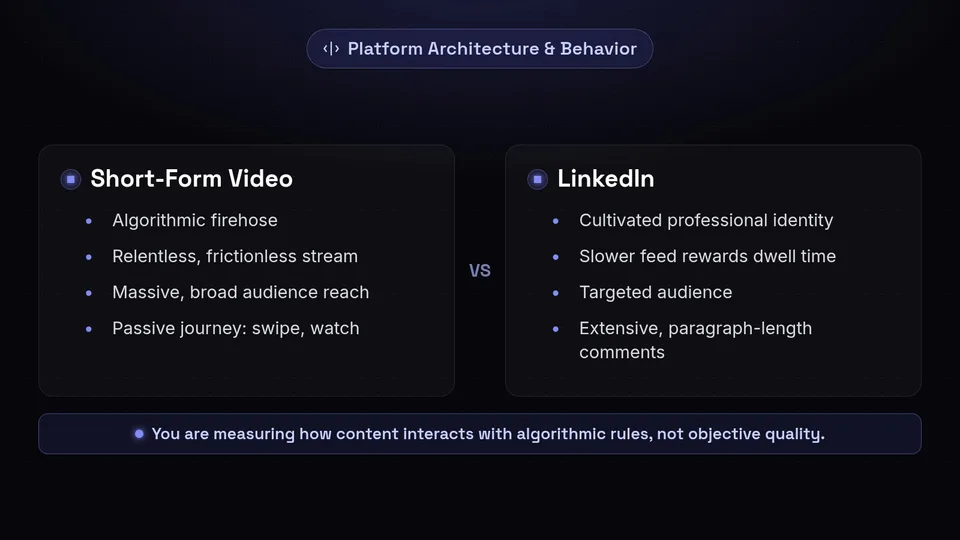
The most significant reason why you cannot reliably evaluate engagement rate by platform is that the fundamental architecture of each network dictates how users behave. You are not measuring the objective quality of your content; you are measuring how your content interacts with a specific set of algorithmic rules and user interfaces.
The Algorithmic Firehose: Short-Form Video Platforms
Consider platforms built around short-form, full-screen vertical video, such as TikTok or Instagram Reels. The primary mechanism of these platforms is the algorithmic feed (like the 'For You' page). Users are served a relentless, frictionless stream of content from creators they do not follow. The user journey is highly passive: swipe, watch, swipe, watch.
Because the algorithm is so adept at serving content to massive, broad audiences, the denominator (views/reach) is often extraordinarily high. However, because the interface encourages continuous swiping rather than stopping to type a comment, the numerator (interactions) does not scale at the same rate. Consequently, the standard engagement rate on these platforms might look lower on paper, even if the content successfully built immense brand awareness and captured prolonged attention.
The Professional Echo Chamber: LinkedIn
LinkedIn operates on an entirely different paradigm. It is a networking platform where users cultivate a professional identity. The feed is slower, and the algorithm heavily rewards dwell time and extensive, paragraph-length comments. When a user engages on LinkedIn, they are often doing so to build their own personal brand, to network, or to demonstrate thought leadership.
Because the audience on LinkedIn is generally more targeted and the algorithm promotes highly engaged posts to the extended networks of those who comment, the engagement rates can appear artificially inflated compared to other platforms. A 5% engagement rate on a LinkedIn post cannot be equated to a 5% engagement rate on a TikTok video; the intent, the effort, and the business value of those interactions are entirely distinct.
The Real-Time Town Square: X (Formerly Twitter)
X is built for velocity and volume. The lifespan of a post on X is notoriously short, often measured in minutes or hours rather than days. The platform encourages rapid-fire conversation, quote-posting, and real-time reactions to unfolding events. Due to the high volume of posts a user sees in a single session, the likelihood of engaging with any single piece of content is statistically lower. If a brand attempts to benchmark its X engagement rate against its Instagram engagement rate, it will almost certainly view its X strategy as a failure, completely missing the platform's actual value as a tool for real-time customer service, PR, and trend monitoring.
The Danger of Chasing Vanity Metrics
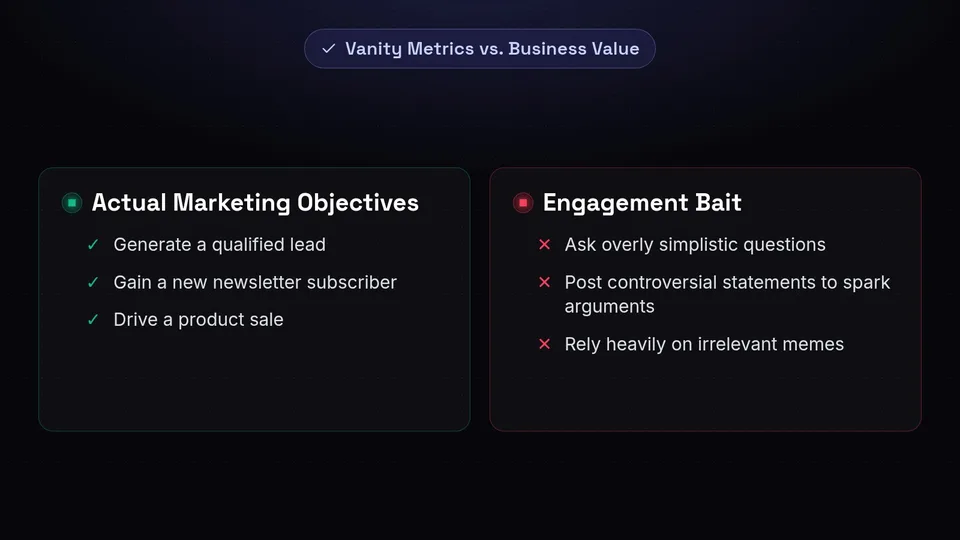
When marketing teams insist on comparing engagement metrics across platforms to create a unified 'average' engagement rate, they inevitably begin optimising for vanity metrics. Vanity metrics are data points that look impressive on a surface-level report but offer little to no actionable insight into the actual health or financial success of a business.
If a social media manager is told that their primary KPI is to raise the overall, cross-platform engagement rate, human nature and basic incentives dictate that they will alter their content strategy to achieve that specific number. This often leads to the deployment of engagement bait: asking overly simplistic questions, posting controversial statements solely to spark arguments in the comments, or relying heavily on memes that have nothing to do with the core product or service.
While these tactics might successfully inflate the numerator and drive the engagement rate up, they do not drive business value. A thousand comments debating a trivial topic do not equate to a single qualified lead, a new newsletter subscriber, or a product sale. By treating all engagement as inherently positive and comparable, brands lose sight of their actual marketing objectives.
Context is King: User Mindset and Intent
Beyond the algorithms and the mathematics, marketers must consider the psychological state of the user. The mindset of a consumer dictates their propensity to engage, and this mindset shifts dramatically depending on the app they have opened.
When a user opens a visually driven platform like Pinterest, they are often in a planning or purchasing mindset. They are looking for inspiration for a wedding, a home renovation, or a wardrobe update. An engagement here—such as saving a pin to a board—shows high commercial intent. The volume of these interactions might be low, but their value is immense.
Conversely, when a user opens a platform dedicated to entertainment or messaging, they are in a state of relaxation or distraction. They might 'like' dozens of posts in a single session without remembering a single brand they interacted with. If you are comparing engagement rate by platform without factoring in user intent, you are assigning equal value to a passive scroll-by 'like' and a highly intentional 'save' for future purchase. This lack of contextual analysis is what makes cross-platform comparisons so deeply misleading.
The Algorithm Penalty and Off-Platform Goals
Another crucial factor that distorts comparative engagement rates is how different platforms handle external links. Most social media networks operate on an advertising-based revenue model. Their primary goal is to keep users on their platform for as long as possible so they can serve them more advertisements. Consequently, algorithms frequently penalise posts that contain external links, reducing their reach.
If your business goal is to drive traffic to a landing page, a blog, or an e-commerce store, you must post links. These posts will naturally receive less reach and, often, less on-platform engagement because the desired user action is to click away from the network entirely. If you compare the engagement rate of a link-driven promotional post on Facebook to a native, text-only engagement-bait post on LinkedIn, the data will tell you the Facebook post failed. However, if that Facebook post drove a substantial number of conversions on your website, it was actually a massive success. The on-platform engagement rate simply failed to capture the off-platform business value.
How to Effectively Measure Social Media Success
If comparing engagement rate by platform is a fundamentally flawed practice, how should marketers measure their social media success? The answer lies in internal benchmarking, contextual goal-setting, and moving beyond vanity metrics.
1. Benchmark Against Yourself, Not the Platform Next Door
The most reliable way to use engagement rates is for internal, historical benchmarking within a single platform. Instead of comparing your Instagram performance to your LinkedIn performance, compare your Instagram performance this quarter to your Instagram performance last quarter. By keeping the platform constant, you control for the algorithmic and architectural variables. If your engagement rate on a specific platform is trending upwards over time, it indicates that you are successfully refining your content to resonate with that specific audience and that specific algorithm.
2. Align Metrics with Platform-Specific Goals
Stop expecting every platform to deliver the same results. Assign specific, distinct business goals to each channel based on its unique strengths, and measure the metrics that align with those goals.
- For visual platforms (Instagram, Pinterest): Focus on saves, direct message shares, and click-through rates to your product pages.
- For professional networks (LinkedIn): Focus on the quality of comments, lead generation form fills, and direct messages from qualified prospects.
- For real-time platforms (X): Focus on response times, sentiment analysis, and the volume of customer service resolutions.
- For video platforms (TikTok, YouTube): Focus on average view duration, retention rates, and audience growth.
3. Track the Full Funnel
Do not allow your analysis to stop at the edge of the social media platform. True marketing success is measured by how social media activity impacts the broader business. Utilise robust tracking parameters (such as UTM codes) on all your links to follow the user journey from the initial social media interaction to the final conversion on your website. An engagement rate is only a leading indicator; the ultimate metric of success is whether that engagement translates into meaningful business outcomes.
Moving Forward with Intelligent Scheduling
Navigating the complexities of multiple social media platforms requires more than just a shift in mindset; it requires a sophisticated approach to content management. Because each platform demands a unique strategy, a unique content format, and a unique set of success metrics, attempting to manage them all manually or with a one-size-fits-all approach is a recipe for inefficiency and frustration.
This is where leveraging an AI-powered social media scheduling platform becomes invaluable. By using a dedicated system to plan, tailor, and distribute your content, you can ensure that you are respecting the unique architecture and audience expectations of each network. Rather than blasting the exact same message across every channel and wondering why the engagement rates wildly differ, you can strategically adapt your tone, format, and timing for each specific environment.
Stop falling into the trap of comparing engagement rate by platform. Embrace the nuances of each network, ditch the obsession with vanity metrics, and start measuring what actually moves the needle for your business. With a tailored strategy and the right tools in place, you can turn your social media presence from a confusing array of percentages into a powerful engine for genuine growth.
Ready to take control of your multi-platform strategy? Discover how SchedulifyX can streamline your workflow, help you tailor your content for every unique audience, and provide the clarity you need to succeed in today's complex digital landscape. Visit the SchedulifyX homepage today to transform your social media management.