YouTube SEO in 2026: Titles, Descriptions & The Algorithm
SchedulifyX Team · October 19, 2026
Discover how YouTube search and suggested traffic actually work in 2026. Learn the truth about YouTube SEO titles, descriptions, tags, and custom thumbnails.
The New Era of YouTube SEO in 2026
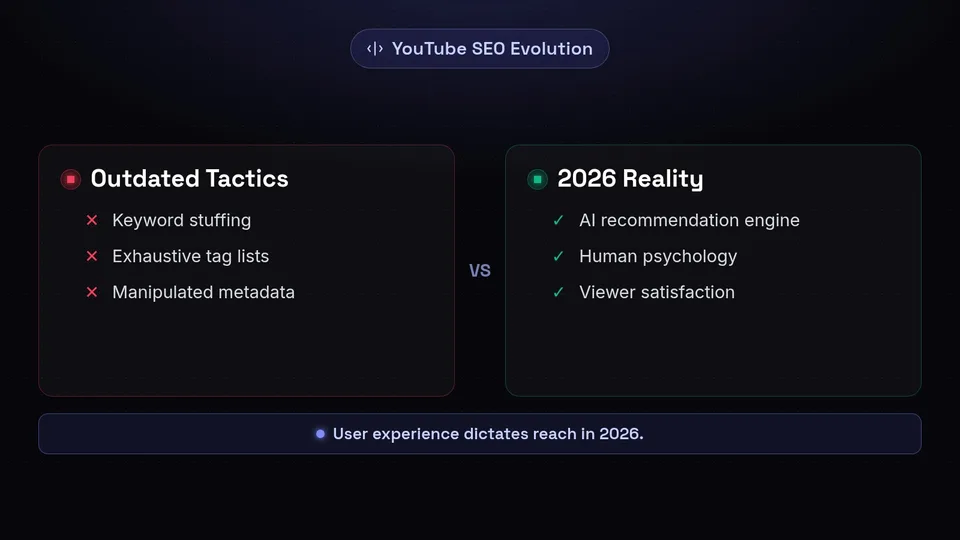
For years, creators and digital marketers have treated YouTube as a traditional search engine, relying heavily on keyword stuffing, exhaustive tag lists, and manipulated metadata to game the system. However, as we navigate through 2026, the landscape of youtube seo has fundamentally shifted. The platform has evolved from a metadata-dependent index into a highly sophisticated, AI-driven recommendation engine that prioritizes human psychology and viewer satisfaction above all else.
Understanding how to rank and grow on YouTube today requires unlearning outdated tactics. It demands a deep comprehension of how YouTube's dual-engine traffic system works, what specific pieces of metadata actually influence the algorithm, and which elements have been rendered obsolete by advanced machine learning. Recent updates, particularly those announced at the Made on YouTube 2026 event, have further cemented the reality that user experience dictates reach.
In this comprehensive guide, we will break down exactly how YouTube search and suggested traffic operate. We will explore what a youtube seo title needs to carry in its crucial first 50 characters, dissect what the youtube description actually influences versus what it does not, and answer the persistent question of whether youtube tags still matter. By correcting common myths and focusing on high-leverage variables like thumbnails and retention, you will be equipped to build a sustainable, growth-oriented channel in 2026.
How YouTube Traffic Actually Works: Search vs. Suggested
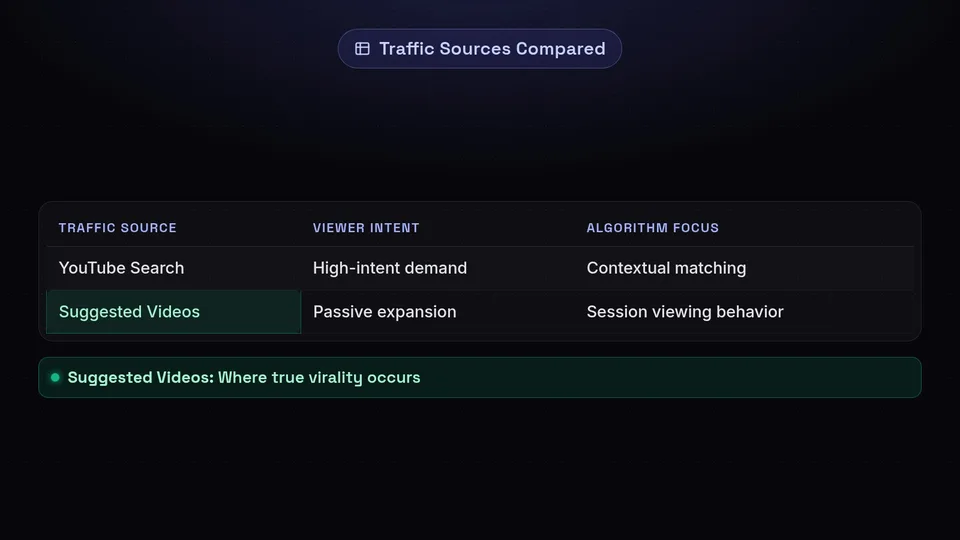
To master YouTube SEO, you must first understand that YouTube is not a monolithic algorithm. It is a collection of distinct traffic sources, each with its own set of rules, algorithms, and viewer behaviors. The two most critical pillars of YouTube traffic are Search and Suggested. Knowing the difference between them—and how they interact—is the foundation of any successful video strategy.
YouTube Search: Serving High-Intent Demand
YouTube Search is the mechanism designed to serve high-intent demand. When a user types a query into the search bar, they are actively looking for a solution, an answer, or a specific piece of entertainment. They have a problem, and they want a video to solve it.
To serve this demand, the YouTube Search algorithm indexes several key elements. It looks at video titles, descriptions, and, increasingly, the automated audio transcripts generated by YouTube's internal speech-to-text engines. When a user searches for "how to bleed mountain bike brakes," the algorithm scans its massive database for videos that contextually match that exact intent.
However, ranking in search is only the beginning. Search is often considered the "gateway" traffic source for new channels. It allows you to get discovered by viewers who have never heard of you before. But search traffic is inherently limited by the volume of people actively typing that specific query. To achieve exponential growth, your video must graduate from Search to Suggested.
Suggested Videos: Driving Demand Expansion
While Search serves existing demand, Suggested Videos serve demand expansion. The Suggested feed—which includes the videos recommended alongside the player, on the YouTube homepage, and in the "Up Next" queue—is where true virality and massive channel growth occur.
Suggested traffic is passive. The viewer is not actively searching; instead, YouTube is predicting what they want to watch next based on their session viewing behavior, historical watch patterns, and topic proximity. If a viewer just watched a video about fixing a mountain bike, the Suggested algorithm will likely offer them another video about mountain bike maintenance, or perhaps a video from the same creator, or even a video about mountain biking trails that similar viewers enjoyed.
Getting your video into the Suggested feed requires proving to YouTube that your content can hold a viewer's attention and keep them on the platform longer. This transition from Search to Suggested relies entirely on core algorithmic signals.
The Core Algorithm Signals That Actually Matter
Historically, creators believed that if they optimized their metadata perfectly, YouTube would push their video. Today, the search and suggested algorithms rely almost entirely on viewer engagement metrics rather than raw metadata. The algorithm is asking one question: Are people enjoying this video?
To answer that, YouTube tracks specific core signals:
- Click-Through Rate (CTR): When YouTube presents your video to a viewer (an impression), do they click on it? CTR is the initial barrier to entry. If your CTR is abysmal, YouTube will stop showing the video, regardless of how well-optimized the metadata is.
- Watch Time and Retention: Once a viewer clicks, how long do they stay? Average View Duration (AVD) and relative retention graphs tell YouTube whether your video delivers on the promise made by the title and thumbnail.
- Post-Watch Satisfaction: YouTube uses surveys and behavioral signals (like whether the viewer watched another video, liked, commented, or shared) to gauge if the viewer was genuinely satisfied with the content.
These signals dictate success. Metadata gets your foot in the door by providing context; viewer satisfaction blows the door wide open.
The Truth About YouTube Metadata in 2026

If engagement signals are the ultimate decider of a video's success, what role does metadata play? Metadata—your titles, descriptions, tags, and chapters—provides the initial contextual indexing. It tells YouTube's machine learning models who might be interested in the video so the algorithm knows where to run its initial "test" impressions.
Crafting the Perfect YouTube SEO Title
The youtube seo title is arguably the most critical piece of text associated with your video. It serves a dual purpose: it must contain the keywords necessary for search indexing, and it must evoke the curiosity and human psychology required to generate a high Click-Through Rate.
YouTube allows up to 100 characters for a video title. However, maximizing this limit is often a mistake. Titles truncate—meaning they get cut off and replaced with an ellipsis (...)—depending on the device the viewer is using. On mobile screens, which account for the vast majority of YouTube consumption, titles typically truncate around 45 to 50 characters. On desktop, they may stretch to 55 or 65 characters.
Because of this truncation, the golden rule of a modern youtube seo title is to front-load your primary keyword and your "hook" into the first 50 characters. If your target keyword is buried at the end of an 80-character title, mobile users will never see it, and their likelihood of clicking plummets. Your title must be immediately readable, compelling, and contextually clear before the cut-off.
For example, instead of naming a video: "A Complete and Thorough Guide on How to Optimize Your YouTube SEO Title in 2026," a better, front-loaded title would be: "YouTube SEO Title Optimization: 2026 Complete Guide."
To ensure your titles are perfectly optimized for length and truncation, you should regularly check your character counts before publishing. You can use our free character counter tool to test your title lengths. Additionally, if you are building a new channel and want a brand name that stands out in search, try our YouTube name generator.
What the YouTube Description Influences (and What It Doesn't)
The youtube description is heavily misunderstood. Many creators treat it as a dumping ground for keywords, hoping to trick the algorithm into ranking the video higher. In reality, the description has very specific, limited use cases.
What the Description Influences:
- Contextual Indexing: YouTube and Google Search use the description to understand the broader context of your video. It helps with initial categorization before the video has generated enough watch-time data.
- Google SERP Snippets: The first 1 to 2 lines of your description (approximately the first 125 characters) are crucial. This text often displays as the snippet on Google Search Engine Results Pages (SERPs) and above the "Show More" fold on YouTube. This area should read like a compelling meta description, naturally incorporating your target keywords while convincing the reader to watch.
What the Description Does Not Influence:
- Overriding Bad Metrics: A perfectly crafted, keyword-rich youtube description will absolutely not save a video with a low CTR, poor watch retention, or bad thumbnail packaging. YouTube will not push a video that viewers abandon after ten seconds, no matter how beautifully written the description is.
Do YouTube Tags Still Matter? (Spoiler: Largely No)
Let's address the most persistent myth in video marketing: youtube tags. For years, creators spent hours researching and inputting dozens of hidden tags into their video settings. In 2026, we can state this plainly: YouTube tags are largely irrelevant for video ranking and discovery.
You do not have to take our word for it. Official YouTube Creator Help documentation explicitly states: "Tags play a minimal role in helping viewers to find your video."
Why did tags die? Because YouTube's artificial intelligence became vastly superior to manual human input. YouTube now relies on highly accurate speech-to-text audio transcripts, advanced Large Language Models (LLMs), titles, and descriptions to understand what a video is about. The algorithm literally "listens" to the words spoken in your video. It no longer needs you to manually type a list of keywords to understand the content.
The primary, actual function of youtube tags today is addressing common user misspellings or highly ambiguous terms. For example, if you are making a video about the technology brand "Apple," adding tags might help differentiate it from the fruit, or if your brand name is frequently misspelled (e.g., "SchedulifyX" vs "ScheduleifyX"), a tag can bridge that gap. Beyond correcting typos, spending time on tags is a waste of resources.
Video Chapters and Google Search Integration
While tags have faded into obscurity, Video Chapters have become increasingly vital. Chapters are created by adding timestamps to your description (e.g., "0:00 Intro", "1:30 The Problem").
Chapters serve two massive SEO and user-experience functions. First, they format the video structure, allowing viewers to navigate directly to the information they care about most. Counterintuitively, giving viewers the ability to skip around actually improves overall session retention, as they are less likely to abandon the video entirely if they can easily find the specific segment they need.
Second, chapters enable Google Search "Key Moments" snippets. When someone searches for a query on Google, Google can surface your video and link directly to the specific chapter timestamp that answers their question. This creates a massive influx of external search traffic directly into the most relevant parts of your content.
Thumbnails: The Single Highest-Leverage Variable

If metadata provides the context, the thumbnail provides the click. In the modern YouTube ecosystem, thumbnails are the single highest-leverage variable you can control. They are the primary driver of Click-Through Rate (CTR).
Think of your thumbnail as the packaging on a product on a grocery store shelf. It doesn't matter if the product inside (the video) is the best in the world; if the packaging is dull, confusing, or unappealing, no one will pick it up. Official YouTube Creator guidance notes that a staggering 90% of top-performing videos across the platform use custom thumbnails.
A great thumbnail works in tandem with your youtube seo title. The thumbnail should grab attention visually and spark curiosity, while the title provides the necessary context to confirm the viewer's intent. They should not repeat each other; they should complement each other.
Recent YouTube Announcements & Search Updates
To truly understand YouTube SEO in 2026, we must look at the most recent platform updates. On September 23, 2026, YouTube CEO Neal Mohan and official YouTube teams took the stage at the highly anticipated Made on YouTube 2026 event. They announced over 30 new creator tools, heavily leaning into AI and advanced testing capabilities. Several of these fundamentally alter how we approach video optimization:
- Video A/B Testing: This is a monumental shift. YouTube now allows creators to test up to 3 different cuts of a video natively within the platform to evaluate viewer retention. This means you can upload different intros or pacing styles and let the algorithm tell you which version holds the audience's attention best, directly impacting your Suggested feed reach.
- Dynamic Thumbnails: Recognizing that thumbnails are the highest-leverage variable, YouTube has introduced Dynamic Thumbnails. The platform will automatically experiment with and adjust video thumbnail packaging to different audience segments, optimizing for the highest possible CTR in real-time.
- Shorts Series: Vertical video continues to dominate. YouTube has enabled the organization of Shorts into episodic series. Crucially, creators can now upload custom thumbnails for these Shorts via YouTube Studio on desktop (a feature that has now rolled out globally), bringing traditional SEO packaging to the short-form feed.
- Ask Studio & AI Search in Video: YouTube is bringing conversational AI directly into Studio analytics and video content search. Viewers can now use AI to search for specific moments or concepts inside a video, making the spoken word (transcripts) even more critical for SEO than ever before.
Furthermore, an independent search analysis conducted on October 13, 2026, across top-ranking B2B YouTube search terms revealed fascinating data aligning with these updates. The study showed that 20% of the top 5 ranking videos used absolutely zero tags. Conversely, 62% of those top-ranking videos featured the exact target search query inside the video title. This data definitively proves that title optimization and content quality have entirely replaced manual tag input.
Correcting Common YouTube SEO Myths
Despite the clear evolution of the platform, several outdated myths continue to circulate in creator communities. Let's correct them based on current 2026 data.
Myth: Tag-stuffing improves video rankings.
Fact: As discussed, YouTube ignores manual tag lists for ranking purposes. The algorithm prioritizes title relevance, transcript text, CTR, and retention signals. Stuffing your youtube tags box is a waste of time and, in extreme cases of misleading tags, can actually violate YouTube's spam policies.
Myth: Longer titles perform better for SEO because they hold more keywords.
Fact: Titles exceeding 60 characters get cut off on mobile devices, destroying the user experience and CTR. Data studies published as recently as June 2026 show that concise, punchy titles between 30 and 50 characters deliver the highest universal Click-Through Rate. Always prioritize human readability over keyword density.
Myth: Perfect metadata alone will drive massive views.
Fact: Metadata is a starting line, not the finish line. It provides initial indexing context for the algorithm. However, viewer satisfaction signals—specifically retention, total watch time, and CTR—are the ultimate judges. If your metadata gets a click but your video fails to deliver, the algorithm will bury the content in both Search and Suggested feeds.
Conclusion: Mastering YouTube SEO with SchedulifyX
Succeeding on YouTube in 2026 requires a paradigm shift. You must stop thinking like a search engine bot and start thinking like a human viewer. Optimize your youtube seo title by front-loading your hook into the first 50 characters. Use your youtube description to provide context and secure Google SERP snippets. Ignore youtube tags unless you are correcting a specific typo. Lean heavily into custom, dynamic thumbnails, and use chapters to drive external search traffic.
Most importantly, remember that all the SEO tactics in the world cannot save a video that fails to hold attention. Focus on delivering incredible value, utilizing new features like Video A/B testing, and analyzing your retention graphs relentlessly.
Managing a successful YouTube channel alongside other social platforms can be overwhelming. That is where SchedulifyX comes in. As an AI-powered social media scheduling platform, SchedulifyX helps you streamline your content distribution, analyze cross-platform performance, and ensure your optimized videos reach your audience at the exact right moment. By automating your social workflow with SchedulifyX, you free up your time to focus on what actually moves the needle: creating exceptional videos that the YouTube algorithm—and your viewers—will love.
Sources
Facts checked against the sources below on October 19, 2026.
- New Features For The Youtube Era Made On Youtube 2026 — support.google.com
- Youtube Is Evolving Creators Need To Evolve With It Youtube Is Introducing New T — facebook.com
- Youtube Made On Youtube 2026 30 New Updates Every Creator Should Know — ytcreator.in
- youtube.com
- Innovation Youtube Era Made On Viewers Creators — blog.youtube
- Youtube Titles Descriptions Tags — visilay.com
- Youtube Search Vs Suggested Which Drives More Subs — postgun.ai
- youtube.com
- Youtube Seo Titles Thumbnails Descriptions Retention — nacluvtech.com
- hashtagnetwork.net
