Why the Best Time to Post on TikTok is a Myth (And What Actually Matters)
SchedulifyX Team · October 8, 2026
Stop stressing over the clock. Discover why TikTok's For You Page algorithm makes posting times irrelevant, and learn the real metrics that drive viral growth.
If you have spent any amount of time trying to grow an audience on short-form video platforms, you have likely fallen down the rabbit hole of scheduling optimization. You have probably stared at a clock, waiting for the exact minute to hit publish, terrified that missing the "golden window" will doom your video to obscurity. You are not alone. Millions of creators and brands obsess over finding the absolute best time to post on TikTok, treating it as the ultimate secret to unlocking viral success.
But here is the hard truth that most social media gurus will not tell you: obsessing over the clock is a massive waste of your creative energy. The vast majority of advice regarding TikTok posting times is fundamentally flawed. Why? Because it is transplanted Instagram advice being applied to a completely different algorithmic beast.
In this comprehensive guide, we are going to dismantle the myth of the perfect posting time. We will explore how TikTok's For You Page (FYP) actually works, why the time on the clock only affects your initial test audience (and not your viral ceiling), and what you should be spending your attention on instead. If you want to stop playing a guessing game and start building a sustainable, high-growth TikTok presence, it is time to shift your focus from when you post to what you post.
The Instagram Hangover: Why We Are Obsessed with Timing
To understand why the myth of the perfect posting time is so pervasive, we have to look back at the platform that defined social media marketing for a decade: Instagram.
The Legacy of the Chronological and Follower-First Feeds
In the early to mid-2010s, Instagram operated on a chronological feed. If you posted at 2:00 PM, anyone who opened the app at 2:01 PM saw your post at the top of their screen. In that era, the best time to post was literally just "whenever your followers are awake and looking at their phones."
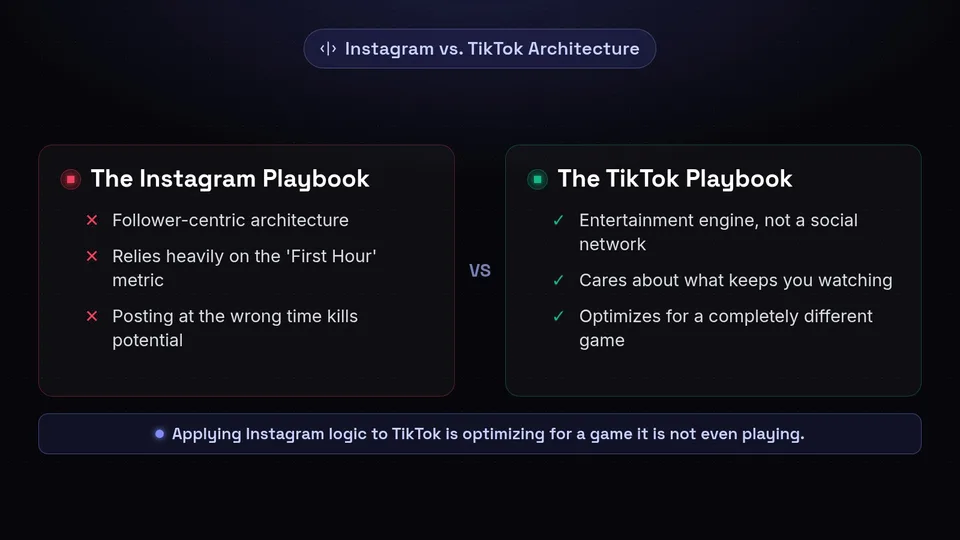
Even when Instagram transitioned to an algorithmic feed, the core architecture remained follower-centric. The algorithm prioritized showing your content to people who already followed you. More importantly, Instagram relied heavily on the "First Hour" metric. The algorithm would push your post to a small fraction of your followers. If those followers engaged with it heavily in the first 60 minutes, the algorithm deemed the post "good" and pushed it to the rest of your audience, and potentially to the Explore page.
Because of this architecture, posting time was critical. If you posted at 3:00 AM when your followers were asleep, your "First Hour" engagement would be abysmal. The algorithm would assume the post was low-quality and bury it, effectively capping your reach before the sun even came up. Posting at the wrong time genuinely killed your content's potential.
Applying the Wrong Playbook to TikTok
When TikTok exploded in popularity, marketers, creators, and social media managers panicked. They needed a strategy, so they reached for the only playbook they had: the Instagram playbook. They assumed TikTok worked the same way. They assumed that early engagement dictated total reach, and therefore, posting time was paramount.
But TikTok is not a social network; it is an entertainment engine. Its core architecture is fundamentally different from Instagram's legacy systems. TikTok does not care who you follow nearly as much as it cares about what keeps you watching. By applying Instagram logic to TikTok, creators have been optimizing for a game that TikTok is not even playing.
How the For You Page Actually Works: The Batch Testing Engine
To understand why timing matters so little on TikTok, you have to understand how the For You Page (FYP) evaluates and distributes content. The TikTok algorithm operates on a system of continuous batch testing, which is completely divorced from the concept of a "golden hour."
The Initial Test Batch
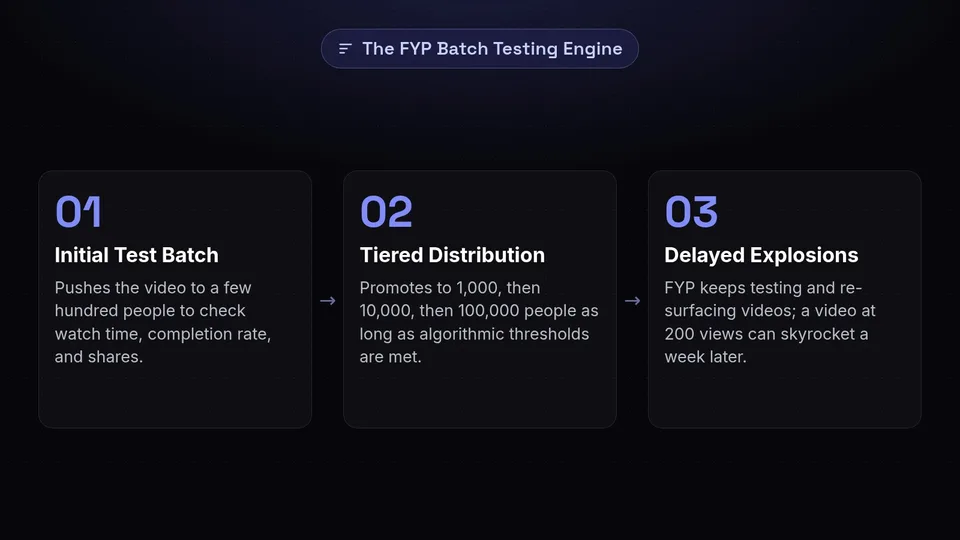
When you hit publish on a TikTok video, the algorithm does not immediately blast it to all your followers. Instead, it pushes the video to a small, highly targeted initial test batch. This batch usually consists of a few hundred people. Some of these people might be your followers, but many of them are simply users whose historical behavior suggests they might like the topic of your video.
The algorithm is not looking at how many likes you get in the first hour. It is looking at deep engagement metrics: watch time, completion rate, rewatches, shares, and favorites. It wants to know if this specific piece of content can hold human attention.
The Tiered Distribution System
If your video performs well with the initial test batch, the algorithm promotes it to a larger tier. It might push it to 1,000 people, then 10,000 people, then 100,000 people. At each tier, the algorithm evaluates the same metrics. As long as the video continues to meet the algorithmic thresholds for watch time and completion rate, it will continue to be pushed to larger and broader audiences.
The Phenomenon of Delayed Explosions
This batch testing system is why "delayed explosions" are incredibly common on TikTok. Have you ever posted a video that sat at 200 views for four days, only to suddenly skyrocket to 500,000 views a week later? That is the batch testing engine at work.
Perhaps your initial test batch yielded mediocre results, so the algorithm paused distribution. But a few days later, someone found your video via search or an audio page, watched it all the way through, and shared it. The algorithm noticed this new positive signal, decided to run another test batch, and this time, the audience resonated with it perfectly. The video was resurrected.
This continuous re-evaluation process proves that the FYP keeps testing and re-surfacing videos for days, weeks, or even months. A video's lifespan is not dictated by its first hour of life; it is dictated by its inherent ability to retain attention whenever it happens to be shown.
What Posting Time Actually Controls: The Initial Audience, Not the Ceiling
If the FYP tests videos over weeks, does posting time matter at all? The answer is: yes, but only slightly, and not in the way you think.
Your posting time does not dictate your video's viral ceiling. A great video will eventually find its audience, whether you post it at noon or midnight. However, your posting time does change the composition of your initial test audience.
The Insomniac vs. The Commuter
Imagine you post a highly technical video about B2B software sales at 3:00 AM on a Tuesday. The people awake and scrolling TikTok at that time are likely a mix of insomniacs, night shift workers, and people in entirely different time zones. This demographic may have zero interest in B2B software sales. As a result, your initial test batch might yield poor engagement metrics, causing the algorithm to temporarily shelve the video.
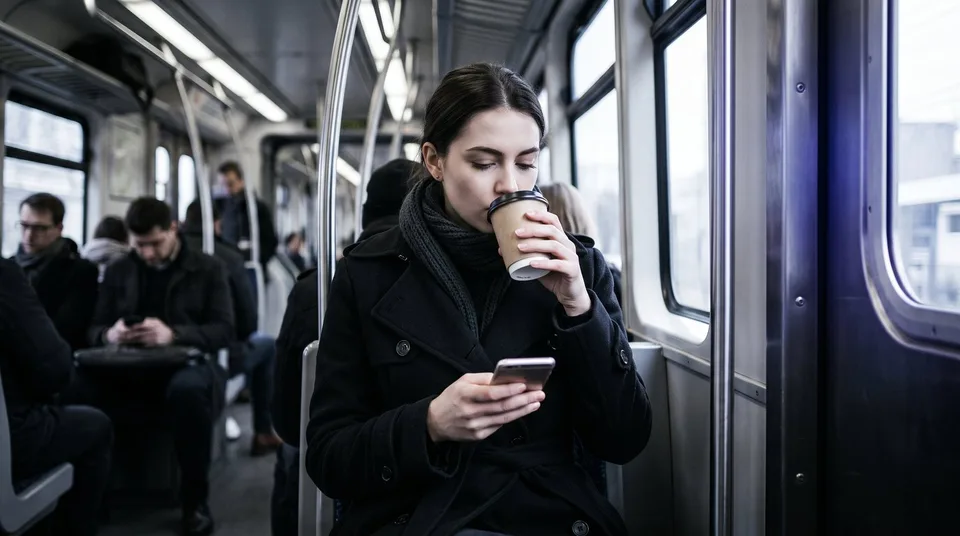
Conversely, if you post that same video at 8:00 AM, the initial test batch might include professionals commuting to work or scrolling while drinking their morning coffee. They are much more likely to engage with the content, sending positive signals to the algorithm immediately and accelerating the video's journey through the distribution tiers.
The Ceiling Remains Unchanged
The crucial takeaway is this: posting at a "bad" time might delay your video's success, but it will not permanently cap it. If the content is genuinely exceptional, the algorithm will eventually find the right audience through secondary testing phases. Posting at a "good" time simply removes a bit of friction from the initial test phase. It is a minor optimization, not a foundational strategy.
If you are still curious about general audience availability and want to align your initial tests with peak active hours, you can read our comprehensive guide on the best time to post on TikTok. Just remember to treat those time windows as gentle suggestions, not rigid rules.
Debunking Day-Specific Advice: Tuesdays, Saturdays, and Sundays
The internet is littered with articles claiming to have discovered the magical day of the week to post. Let us break down why searching for these specific micro-windows is a distraction from actual content creation.
The Tuesday Illusion
Many creators frantically search for the best time to post on tiktok tuesday, operating under the assumption that mid-week engagement drops off and they need a specific hour to compensate. The logic usually goes that people are busy at work, so you must post during their lunch break or evening commute.
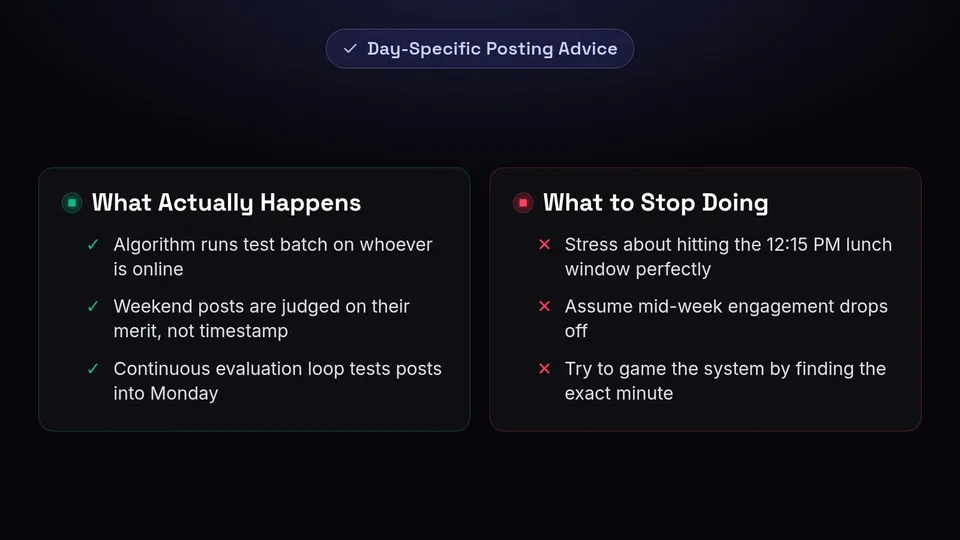
While it is true that overall app usage fluctuates during the workday, the FYP's batch testing model renders this largely irrelevant. If you post a brilliant video at 10:00 AM on a Tuesday when fewer people are online, the algorithm simply runs its test batch on the people who are online. If the metrics are good, it will hold the video and push it aggressively when the larger evening crowd logs on. You do not need to stress about hitting the 12:15 PM lunch window perfectly.
The Weekend Paradox
Similarly, creators agonize over the best time to post on tiktok saturday and the best time to post on tiktok sunday. The conventional wisdom is that people have more free time on weekends, so engagement should be higher. However, weekend behavior is highly unpredictable. People are running errands, attending events, or spending time outdoors. App usage can actually be spottier on weekends than during a structured workweek.
If you are trying to game the system by finding the exact minute your audience is sitting on the couch on a Sunday afternoon, you are overthinking it. A video posted on a Sunday morning will be tested throughout the day, into Sunday night, and well into Monday. The algorithm does not reset at midnight. The continuous evaluation loop ensures that your weekend posts are judged on their merit, not their timestamp.
The Real Metrics That Dictate Viral Ceilings
If we are discarding the clock, what should we be obsessing over instead? The answer lies in the specific metrics that TikTok's algorithm uses to evaluate content quality. If you want to increase your viral ceiling, you need to optimize for the signals that prove your video is holding human attention.
Watch Time and Completion Rate
TikTok's primary goal is to keep users on the app for as long as possible. Therefore, the algorithm heavily favors videos that contribute to this goal. Watch time (the average number of seconds a user spends on your video) and completion rate (the percentage of users who watch the video from start to finish) are the two most critical metrics on the platform.
A video with a 60% completion rate will almost always outperform a video with a 15% completion rate, regardless of when they were posted. The algorithm interprets a high completion rate as a definitive signal that the content is engaging, satisfying, and worth pushing to a broader audience.
Rewatches and the "Loop"
Even more powerful than a single completion is a rewatch. If a user finishes your video and immediately lets it loop to watch it again, it sends an incredibly strong positive signal to the algorithm. This is why short, tightly edited videos with seamless loops often perform exceptionally well. They artificially inflate the completion rate to over 100%, forcing the algorithm to take notice.
Shares and Saves (Favorites)
While likes and comments are nice, they are considered lower-tier engagement metrics. Shares and Saves (favoriting a video) are much more valuable. When someone shares your video, they are literally doing the algorithm's job for it—distributing the content to new users. When someone saves your video, they are signaling that the content is valuable enough to return to later. These actions indicate high-intent engagement, which the FYP rewards heavily.
To truly understand how your content is performing across all these vectors, you need to look beyond vanity metrics. We highly recommend using our engagement rate calculator to get a holistic view of your video's performance and identify areas for improvement.
Mastering the First Three Seconds: The Hook
If watch time and completion rate are the ultimate goals, how do you achieve them? It all starts with the hook. On TikTok, users swipe through content at lightning speed. You do not have 10 seconds to build an introduction; you have roughly three seconds to convince a user to stop scrolling.
The hook is the single most important element of your TikTok video. If you spend three hours editing a video but only three seconds thinking about the hook, you have your priorities backward. Your posting time does not matter if people scroll past your video before the fourth second.
The Anatomy of a Perfect Hook
A successful hook operates on multiple levels simultaneously. It needs to capture attention visually, auditorily, and psychologically.
- The Visual Hook: Movement is key. Do not start your video sitting perfectly still staring at the camera. Start with an action—walking into the frame, dropping something on a desk, zooming in quickly, or using a dynamic text overlay. The visual change interrupts the user's scrolling pattern.
- The Auditory Hook: High energy and clear audio are non-negotiable. Begin speaking immediately. Do not leave a one-second pause of silence at the beginning of the clip; users will swipe before you even open your mouth. Use a tone of voice that implies urgency or excitement.
- The Psychological Hook: This is the most crucial element. You must immediately establish the value proposition of the video. What is the viewer going to gain by watching? Curiosity gaps, bold claims, and relatable pain points are incredibly effective.
Examples of High-Converting Hooks
Instead of starting a video with, "Hi guys, today I want to talk about social media marketing..." (which will result in an immediate swipe), use a psychological hook:
"This one marketing mistake is costing your business thousands of dollars a month, and you are probably doing it right now."
This hook creates a massive curiosity gap. The viewer immediately wonders, "What is the mistake? Am I doing it? How much money am I losing?" They are compelled to watch the rest of the video to resolve the tension you just created.
Optimizing for Completion Rate and Retention
Getting someone to stop scrolling is only half the battle. Once you have hooked them, you have to retain their attention until the very end of the video to maximize your completion rate.
Pacing and Dead Space
TikTok users have zero tolerance for dead space. Every single frame of your video must serve a purpose. Cut out every "um," "uh," and breath. Remove long pauses between sentences. The pacing should be rapid and relentless. If there is a moment where the viewer's brain can wander, their thumb will swipe.
Visual Pattern Interrupts
You cannot rely on a static talking head to hold attention for 60 seconds. You need to use visual pattern interrupts to constantly re-engage the viewer's brain. This can include:
- Changing camera angles every 5-10 seconds.
- Adding b-roll footage or green screen images.
- Using pop-up text or sound effects to emphasize key points.
- Zooming in and out on your face to create dynamic movement.
These constant visual changes prevent the viewer from getting bored and keep them locked into the narrative flow of the video.
The Payoff and the Call to Action
If you promised a payoff in your hook, you must deliver it. Do not drag out the video unnecessarily just to artificially inflate watch time; users will realize what you are doing and swipe away, tanking your completion rate. Deliver the value efficiently.
Finally, end the video quickly. Once the core message is delivered, do not spend 10 seconds asking people to like, follow, and subscribe. The moment the value ends, the video should end. If you want to include a Call to Action (CTA), make it rapid-fire (e.g., "Follow for part two!") right before the video cuts off, encouraging a seamless loop.
Building a Repeatable Format for Long-Term Success
Chasing viral hits with random, disconnected videos is an exhausting and unsustainable strategy. If you want to build a loyal audience and consistently trigger the FYP's distribution engine, you need to focus on building repeatable formats, not obsessing over the best time to post on tiktok.
The Power of the Series
One of the most effective strategies on TikTok is creating a multi-part series. When you create a series (e.g., "Things I Wish I Knew Before Starting a Business: Part 4"), you create built-in bingeability. If a user discovers Part 4 on their FYP and enjoys it, they are highly likely to visit your profile to watch Parts 1, 2, and 3.
This behavior sends massive positive signals to the algorithm. The user is consuming multiple videos, spending extended time on your profile, and demonstrating high intent. The algorithm will then aggressively push your future content to that user, turning a casual viewer into a dedicated follower.
Consistency in Style, Not Just Timing
When we talk about consistency on TikTok, people often assume it means posting at the exact same time every day. In reality, algorithmic consistency is about style, topic, and format. You want the algorithm to know exactly what kind of content you make and exactly who to show it to.
If you post a cooking video on Monday, a dancing video on Wednesday, and a real estate tip on Friday, you are confusing the algorithm. It does not know who your target audience is, so its initial test batches will be wildly inaccurate, leading to poor performance.
Develop a signature format. Use the same text fonts, the same editing style, and focus on a specific niche. When your content is highly recognizable and consistent in its value delivery, the algorithm can easily categorize it and serve it to the exact right audience, regardless of whether you hit publish at 9:00 AM or 9:00 PM.
Stop Worrying About the Clock and Start Creating
The obsession with finding the perfect posting time is a symptom of a larger problem: the desire for a magic bullet. It is much easier to blame a poor-performing video on "the wrong time of day" than it is to admit that the hook was weak, the pacing was slow, or the content simply was not engaging.
TikTok's For You Page is a meritocracy of attention. It is a ruthless, highly efficient engine designed to surface the most captivating content on the internet. It does not care what day of the week it is. It does not care what time your alarm went off. It only cares about one thing: can you hold the viewer's attention?
It is time to stop playing the Instagram game on TikTok. Stop Googling for the perfect time window. Stop letting the clock dictate your creative process. Instead, pour all of that energy into mastering the first three seconds of your videos. Obsess over your completion rates. Build repeatable, bingeable formats that keep viewers coming back for more.
When you focus on creating undeniably excellent content, the algorithm will do the heavy lifting for you, testing and re-surfacing your videos until they find the massive audience they deserve.
And if you want to completely remove the stress of scheduling from your workflow so you can focus 100% on content creation, let SchedulifyX handle the logistics. Our AI-powered platform allows you to queue up your brilliant, highly-optimized videos in advance, ensuring a consistent presence on the platform without you ever having to stare at a clock again. Stop worrying about when to post, and start focusing on what matters: making content that people cannot stop watching.