The Complete Guide to Social Media Approval Workflows
Discover the complete guide to social media approval workflows. Streamline team collaboration, prevent errors, and speed up client approvals with SchedulifyX.
SchedulifyX is the AI-powered social media command center built for creators, businesses, and agencies. Schedule posts across 10+ platforms, generate content with 9 specialized AI agents, collaborate with your team using approval workflows, analyze performance with deep analytics, and manage all social engagement from a unified inbox. Trusted by professionals worldwide — free plan available, paid plans from
Managing a brand's digital presence requires more than just creativity; it demands precision, consistency, and rigorous quality control. When multiple stakeholders—from copywriters and graphic designers to legal advisors and external clients—are involved in the content creation process, the risk of miscommunication rises exponentially. Without a structured system in place, teams often find themselves buried in endless email threads, confusing spreadsheet updates, and frantic last-minute revisions. This article serves as the complete guide to social media approval workflows, providing you with the foundational knowledge and practical steps required to build a seamless, error-free content pipeline.
Whether you are managing an in-house marketing department or running an agency juggling multiple client accounts, implementing a formalised review process is the most effective mechanism for scaling your output without compromising on quality. By moving away from ad-hoc communication and embracing structured systems, you can ensure that every post aligns with your brand guidelines, regulatory requirements, and strategic objectives.
Core Concepts
What Constitutes a Social Media Approval Workflow?
At its core, a social media approval workflow is a predefined sequence of stages that a piece of content must pass through before it is published to the public. It acts as a systematic filter, ensuring that raw ideas are refined, fact-checked, and authorised by the appropriate personnel.
The Mechanism of Approval
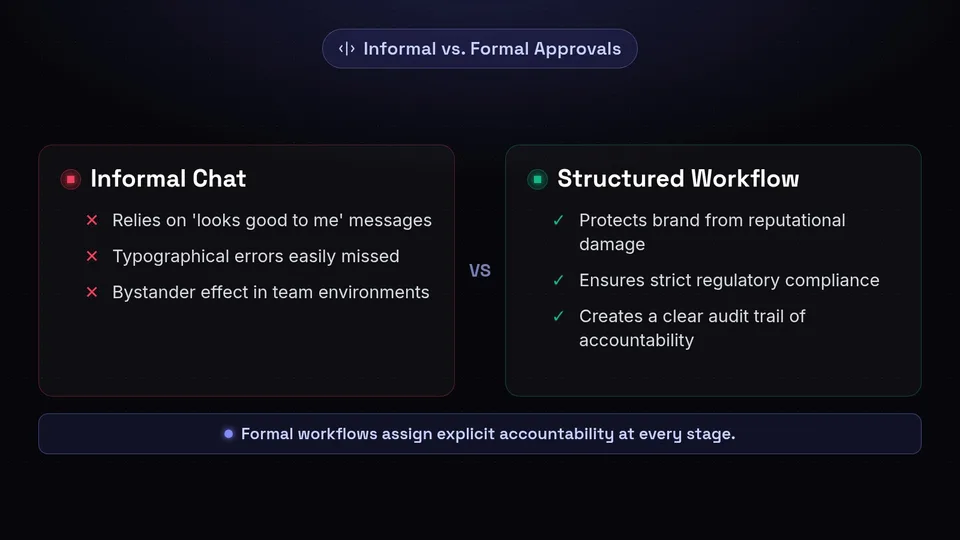
Rather than relying on informal "looks good to me" messages in a chat application, a formal workflow utilises strict stage gates. Content cannot progress to scheduling until the designated stakeholder has explicitly signed off on the current version, thereby creating a clear audit trail of accountability.
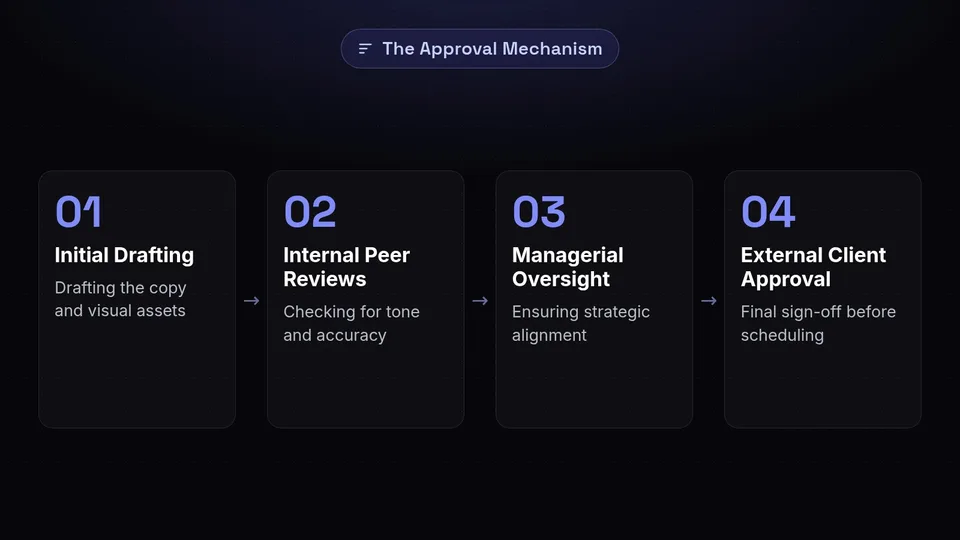
This process typically encompasses the initial drafting of the copy and visual assets, internal peer reviews for tone and accuracy, managerial oversight for strategic alignment, and, in many cases, external client approval. By standardising this journey, organisations can dramatically reduce the friction that typically slows down content production.
Strategic Advantages
Why Formalise Your Approval Process?
Transitioning from an informal review system to a structured workflow requires an initial investment of time and effort, but the operational benefits are substantial. A well-designed system addresses several critical vulnerabilities inherent in collaborative content creation.
Brand Protection
A single off-brand post or poorly judged joke can cause significant reputational damage. Workflows ensure that multiple sets of eyes review content for tone, political correctness, and brand alignment before it goes live.
Error Reduction
Typographical errors, broken links, and incorrect tagging are easily missed by the original creator. A dedicated review stage acts as a quality assurance mechanism, catching minor mistakes before they reach your audience.
Regulatory Compliance
For industries such as finance, healthcare, and law, social media posts must adhere to strict advertising regulations. Workflows allow compliance officers to review and archive approvals for auditing purposes.
Furthermore, a structured process eliminates the "bystander effect" in team environments. When responsibilities are unclear, team members may assume someone else has checked the content. A formal workflow assigns explicit accountability at every stage.
Team Dynamics
Defining Roles in the Approval Chain
The foundation of any successful workflow is clarity regarding who does what. In a robust team collaboration environment, assigning specific roles prevents bottlenecks and ensures that feedback is authoritative.
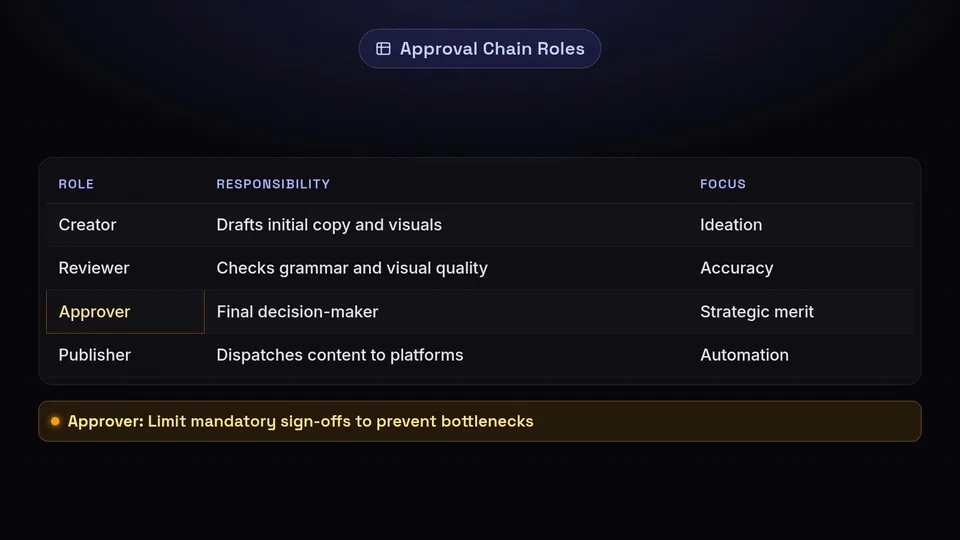
- The Creator: Responsible for drafting the initial copy, sourcing or designing visual assets, and proposing the publication date. Creators often utilise tools like an AI Studio to generate initial concepts before refining them for human review.
- The Reviewer: Typically a peer or a mid-level manager who checks the content for grammatical accuracy, visual quality, and adherence to the platform's best practices (e.g., ensuring image dimensions are correct for Instagram or LinkedIn).
- The Approver: The final decision-maker. This could be a Marketing Director, a Legal Officer, or an external client. The approver evaluates the content purely on its strategic merit and regulatory safety.
- The Publisher: Once approval is granted, this role (often automated by scheduling software) ensures the content is dispatched to the respective platforms at the designated time.
Pro Tip: Keep the approval chain as short as possible. While it is tempting to involve every stakeholder, requiring too many approvals leads to content stagnation. Limit mandatory sign-offs to essential personnel only.
Step-by-Step Implementation
Step 1: Mapping the Journey from Draft to Published

To implement the complete guide to social media approval workflows effectively, you must map out the specific stages your content will traverse. This journey should be logical, sequential, and transparent to all involved.
Ideation and Drafting
The process begins with the Creator drafting the post within a centralised content calendar. At this stage, the content is marked as a 'Draft'. It is visible to the team but isolated from any automated publishing mechanisms.
Internal Quality Assurance
The Creator submits the draft for review. The system notifies the Reviewer, who examines the copy, checks the media attachments, and verifies the selected tags. The Reviewer can either approve the content to move forward or send it back to the Creator with specific revision notes.
Stakeholder or Client Sign-Off
For high-stakes campaigns or agency environments, the internally vetted content is then presented to the final Approver. Using a dedicated client portal ensures that external stakeholders can view the content exactly as it will appear on platforms like Facebook or X/Twitter, without needing access to the backend of your scheduling software.
Final Scheduling and Automation
Upon final approval, the status changes to 'Approved'. The content is now locked to prevent unauthorised edits and is automatically queued for publication by the scheduling system.
Ready to Streamline Your Content Pipeline?
Stop chasing approvals through endless email chains. Build custom, automated workflows that keep your team aligned and your clients happy with SchedulifyX.
Start Your Free Trial →Tooling
Step 2: Transitioning from Spreadsheets to Dedicated Platforms
Many teams begin their social media journey using rudimentary tools: drafting copy in shared documents, passing images via cloud storage links, and tracking status via spreadsheets. While this may suffice for a solo practitioner, it quickly becomes a liability as the team grows.
Dedicated social media management platforms provide the infrastructure necessary to enforce workflows automatically. By centralising the creation, review, and scheduling processes in one environment, you eliminate the risk of version control errors and lost feedback.
| Workflow Capability | Spreadsheets & Email | Dedicated Platform (SchedulifyX) |
|---|---|---|
| Version Control | ✗ Confusing file names (v2_final_FINAL) | ✔ Centralised, immutable revision history |
| Visual Previews | ✗ Requires imagination to visualise the final post | ✔ Pixel-perfect previews for all major platforms |
| Audit Trails | ✗ Buried in individual email inboxes | ✔ Time-stamped logs of all approvals and edits |
| Automated Handoffs | ✗ Requires manual notification (pinging on Slack) | ✔ Automated notifications when status changes |
By integrating a central media library, your team can also ensure that only approved, brand-compliant assets are used in the drafting phase, solving many approval issues before they even arise.
Optimisation
Step 3: Establishing Clear Feedback Mechanisms
A workflow is only as effective as the communication within it. Vague feedback such as "make it pop" or "I don't like this" creates friction and endless revision cycles. To optimise your approval process, you must establish clear guidelines for how feedback should be delivered.
- Require Actionable Direction: Reviewers must specify exactly what needs changing. Instead of "this is too long," feedback should state, "cut the second paragraph to ensure the primary call-to-action is visible without expanding the text."
- Centralise Comments: All feedback must be left within the scheduling tool itself, attached directly to the specific post. Discussing revisions in external chat apps leads to lost context and forgotten instructions.
- Implement Time Limits: Workflows stall when approvers sit on content for days. Establish service level agreements (SLAs) for internal reviews—for example, requiring all drafts to be reviewed within 24 hours of submission.
Handling Rejections Constructively
When a post is rejected, the system should automatically revert its status to 'Draft' and notify the Creator. The workflow protocol must mandate that a rejection is always accompanied by a specific reason and a clear instruction on how to rectify the issue.
Risk Mitigation
Common Bottlenecks and How to Avoid Them
Even with a structured system, workflows can degrade over time if not properly maintained. Being aware of common pitfalls allows you to proactively adjust your processes.
✔ The Ideal Workflow
- Clear, linear progression from draft to published.
- Single point of final accountability.
- Feedback is specific and centralised.
- Approvals happen days in advance of the publication date.
✗ The Problematic Workflow
- "Design by committee" with too many mandatory reviewers.
- Feedback provided across multiple disconnected channels.
- Approvers frequently overriding brand guidelines based on personal preference.
- Rushed, same-day approvals leading to missed errors.
To avoid the "design by committee" trap, strictly enforce the roles defined earlier. If a stakeholder is not the designated Approver for a specific campaign, their feedback should be treated as advisory rather than mandatory.
Agency Focus
Adapting Workflows for Agency-Client Relationships
For marketing agencies, the approval workflow extends beyond internal teams to external clients. Client approvals introduce a unique set of challenges, primarily related to technical literacy and access control.
Clients typically do not want, nor should they have, full access to your agency's scheduling backend. Providing too much access risks accidental deletions or unauthorised publishing. Instead, agencies should utilise a secure client portal. This mechanism allows clients to view upcoming content in a clean, simplified interface where they can simply click "Approve" or "Reject" with a comment box.
Furthermore, presenting this portal under a white label setup enhances the agency's professionalism. When clients log into a portal branded with your agency's logo and colour scheme, it reinforces the value of your service and creates a more cohesive, trustworthy experience.
Internal Agency Review
Copywriters and designers collaborate, refine, and receive approval from the Account Manager. The content is polished and checked against the client's brief internally before any external presentation.
Post-Publication
Step 4: Reviewing Workflow Efficiency
Implementing a workflow is not a one-time task; it requires ongoing refinement. Periodically review your processes to identify where delays occur. Are drafts consistently held up at the legal review stage? Is the design team frequently asked to resize images because platform specifications were not checked early enough?
By analysing the time it takes for content to move from ideation to approval, you can identify structural bottlenecks. Perhaps the legal team needs a specific checklist to speed up their review, or perhaps the initial briefs provided to the Creators lack sufficient detail, leading to inevitable revisions.
Coupling your workflow data with your post-publication analytics and engagement metrics can also provide insights. For instance, if you notice that highly scrutinised, heavily revised posts perform worse than those with a streamlined approval process, it may indicate that over-editing is stripping the authenticity from your brand voice.
Conclusion: Taking Control of Your Content Pipeline
Mastering the complete guide to social media approval workflows is fundamentally about shifting from reactive chaos to proactive management. By defining clear roles, establishing strict stage gates, and utilising dedicated platforms to enforce these rules, teams can significantly increase their output volume while simultaneously improving the quality and safety of their content.
Whether you are publishing daily updates to X/Twitter or managing complex, multi-platform video campaigns, a structured approval process is the invisible scaffolding that supports sustainable, scalable social media success. Stop relying on hope and email threads; build a workflow that works for your team today.
Transform Your Team's Productivity
Experience seamless collaboration, automated handoffs, and secure client approvals with SchedulifyX's advanced workflow tools.
Start Your Free Trial →Get started free — no credit card required.