Why B2B Social Timing Is Radically Different From Consumer
SchedulifyX Team · October 14, 2026
Discover why B2B social timing differs from consumer habits, how to navigate global timezones, and the best scheduling patterns for your multi-region team.
When you are marketing a consumer product—be it a pair of sneakers, a new video game, or a streaming service—your audience is virtually always online. Consumer social media thrives on the fringes of the day: late-night scrolling, weekend binge-watching, and holiday downtime. But if you take that same "always-on" scheduling approach and apply it to a B2B SaaS company, a corporate consulting firm, or an enterprise software provider, your engagement metrics will flatline. Why? Because B2B social timing is an entirely different puzzle to solve.
For business-to-business marketers, social media is not just about catching someone's attention; it is about catching them in the right context. A Chief Technology Officer might idly scroll through Instagram on a Saturday afternoon, but they are not in the psychological headspace to evaluate a $50,000 cybersecurity software suite. To reach them effectively, you have to understand the rhythm of the modern working day.
In this comprehensive guide, we are going to explore exactly why B2B social timing diverges so sharply from consumer timing. We will dive into how platforms like LinkedIn and Facebook track the traditional working hours, what that means for businesses selling to other businesses, how to navigate the complex web of global timezones, and why the weekend collapse on professional networks is steeper than anywhere else. Finally, we will provide a practical, actionable scheduling pattern for teams covering multiple regions, ensuring your content lands exactly when your buyers are ready to read it.
The Fundamental Divide: Context and Intent
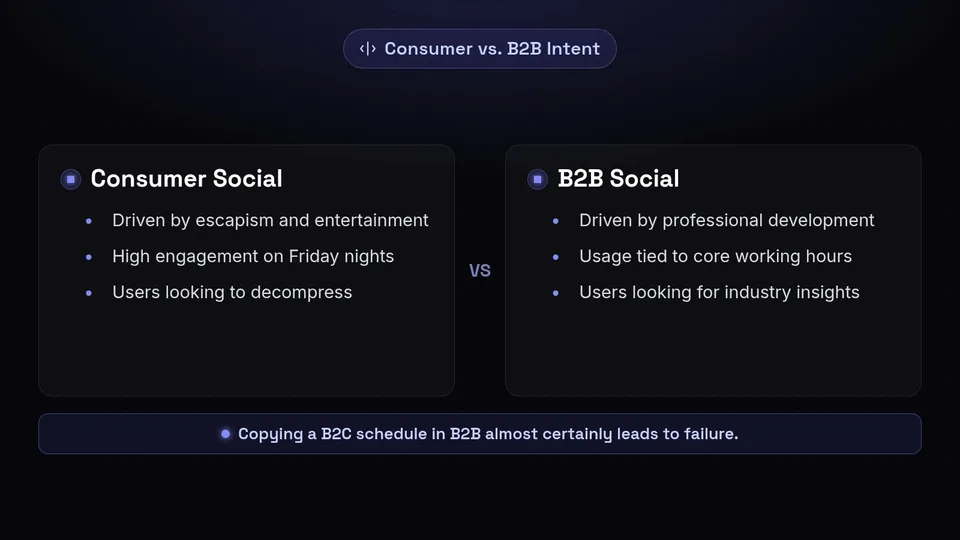
To understand the timing, we must first understand the user's intent. Consumer social media is largely driven by escapism, entertainment, and personal connection. Users log on to decompress after a long day, to see what their friends are doing on the weekend, or to kill time during a late-night bout of insomnia. This means that consumer brands can successfully post at 8:00 PM on a Friday or 10:00 AM on a Sunday and see massive engagement.
B2B social media, on the other hand, is driven by professional development, industry networking, and problem-solving. When a user logs into LinkedIn, they are metaphorically "putting on their suit." They are in work mode. They are looking for insights that will help them do their jobs better, news about their industry, or solutions to the bottlenecks their company is facing.
Because the intent is tied to their profession, their usage of the platform is inevitably tied to their working hours. If you want to capture a B2B buyer's attention, you have to intercept them while they are actively thinking about their business. This fundamental divide is why copying a successful B2C posting schedule will almost certainly lead to failure in the B2B space.
How LinkedIn and Facebook Track the Working Day
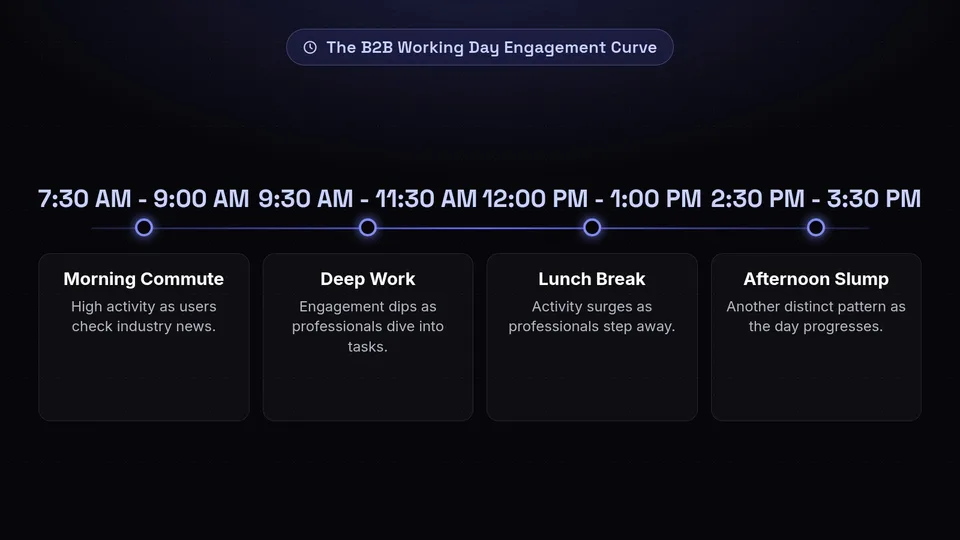
When we look at the data surrounding professional social media usage, a clear pattern emerges: engagement curves mirror the traditional 9-to-5 workday almost perfectly. This is not a coincidence. It is a direct reflection of how professionals integrate social media into their daily routines.
The Morning Commute and Coffee Routine
For most professionals, the workday begins before they actually sit down at their desks. Between 7:30 AM and 9:00 AM, there is a significant spike in professional social media activity. This is the "morning commute" or "morning coffee" window. Users are waking up, checking their emails, and scanning their feeds to see what happened overnight. They are looking for industry news, thought leadership, and quick, digestible insights to start their day.
When analyzing the best times to post on linkedin, this morning window consistently ranks as one of the highest-performing slots. A well-crafted, thought-provoking post published at 8:00 AM local time has the potential to catch decision-makers before they are pulled into back-to-back meetings.
The Mid-Morning Deep Work and Lunch Break
Between 9:30 AM and 11:30 AM, engagement typically dips slightly as professionals dive into their core tasks and morning meetings. However, as the clock approaches noon, activity begins to surge again. The lunch hour (12:00 PM to 1:00 PM) is a prime time for B2B engagement.
Interestingly, this is also where Facebook comes into play for B2B marketers. While Facebook is often viewed as a consumer platform, it has a massive dual-use user base. Many professionals use Facebook Groups for industry networking or follow business pages on their personal accounts. Finding the best time to post on facebook for a B2B audience often points directly to this midday break. Professionals are stepping away from their heavy tasks, eating lunch, and scrolling through a mix of personal and professional content. If you are targeting small business owners or entrepreneurs, the lunch hour is arguably the absolute best time to post facebook content.
The Afternoon Slump and End of Day
As the afternoon progresses, there is another distinct pattern. Around 2:30 PM to 3:30 PM, the "afternoon slump" hits. Professionals are looking for a quick mental break, leading to a temporary spike in social media scrolling. Content that is slightly more visual, entertaining, or easy to consume performs exceptionally well here.
Finally, the end of the traditional workday (4:30 PM to 5:30 PM) sees a final burst of activity as people wrap up their tasks, check their notifications one last time, and transition out of work mode. Once 6:00 PM hits, B2B engagement drops off a cliff. The professional suit comes off, and the user transitions back into consumer mode.
The Steep Weekend Collapse on LinkedIn

If there is one defining characteristic of B2B social timing, it is the "weekend collapse." On platforms like Instagram, TikTok, or X (formerly Twitter), the weekend is prime real estate. People have more free time, resulting in higher screen time and deeper engagement with consumer brands.
On LinkedIn, the exact opposite is true. The drop-off in engagement from Friday afternoon to Saturday morning is staggering. Why? Because LinkedIn is the digital equivalent of the office. Just as you wouldn't expect to see a crowd of employees hanging out in a corporate conference room on a Sunday afternoon, you shouldn't expect to see them active on professional networks.
For a business selling to other businesses, posting highly valuable, resource-intensive content on a Saturday is essentially throwing it into a black hole. While there is a small subset of "always-on" founders and executives who might check LinkedIn on the weekend, the vast majority of your target audience has muted their professional notifications to spend time with their families, pursue hobbies, and recharge.
This weekend collapse dictates a strict Monday-through-Friday content calendar for B2B brands. If you have a major product announcement, a new whitepaper, or a critical webinar registration push, it must be scheduled during the core working week. Tuesdays, Wednesdays, and Thursdays consistently prove to be the most reliable days for maximum reach, as Mondays are often bogged down with inbox-clearing and Fridays are plagued by early check-outs.
The Global Timezone Problem for B2B Sellers
Understanding that B2B engagement tracks the 9-to-5 working day is incredibly helpful—if all your buyers live in the same timezone. But what happens when you are a global SaaS company? What happens when your buyers span San Francisco, London, Dubai, and Sydney?
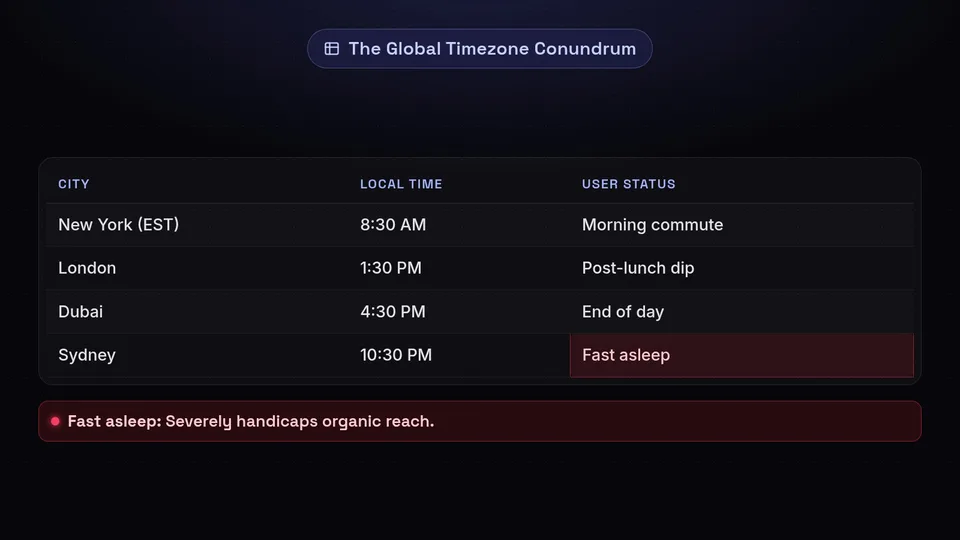
This is the great timezone conundrum of global B2B marketing. The "working day" is always happening somewhere, but it is never happening everywhere at once. If you optimize your post for 8:30 AM Eastern Standard Time (EST) to catch the New York morning commute, you are hitting London at 1:30 PM (post-lunch dip), Dubai at 4:30 PM (end of day), and Sydney at 10:30 PM (fast asleep).
Because algorithm lifespans on platforms like LinkedIn are heavily dependent on initial engagement velocity—meaning the platform measures how many likes and comments a post gets in the first hour to determine how widely to distribute it—posting at a time when half your audience is asleep will severely handicap your content's organic reach.
Consumer brands can sometimes brute-force their way through this by relying on the sheer volume of users online at any given time. B2B brands, with their smaller, more niche target audiences, cannot afford this luxury. You need a strategic approach to ensure your message reaches the right professionals in the right regions at the right time.
Practical Scheduling Patterns for Multi-Region Teams
So, how do you solve the global timezone problem without forcing your social media manager to stay awake 24 hours a day? The answer lies in intelligent, multi-region scheduling patterns. Here is a practical framework for a B2B team covering multiple regions.
1. The "Follow the Sun" Model
The most effective strategy for global B2B brands is the "Follow the Sun" model. Instead of publishing one post per day and hoping it reaches everyone, you break your content strategy into regional broadcasts. This involves publishing 2 to 3 times a day, timed specifically to the morning or midday peaks of your core regions.
- APAC Focus (Asia-Pacific): Schedule your first post around 8:00 PM EST. This translates to 8:00 AM in Singapore and 10:00 AM in Sydney, catching the APAC region right as their workday begins.
- EMEA Focus (Europe, Middle East, Africa): Schedule your second post around 3:00 AM EST. This hits London at 8:00 AM and Dubai at 11:00 AM, perfectly timed for the European morning commute.
- AMER Focus (Americas): Schedule your third post around 9:00 AM EST, capturing the East Coast morning and the West Coast early risers.
By using an intelligent scheduling platform, you can automate this process entirely, ensuring your brand maintains a steady, optimized presence across the globe.
2. Regional Page Segmentation
If your company is large enough, broadcasting global messages from a single corporate page might dilute your engagement. In this case, creating region-specific showcase pages or subsidiary pages (e.g., "SchedulifyX Europe" vs. "SchedulifyX APAC") allows you to tailor not only the timing but also the language and cultural context of the posts. This ensures that your specific linkedin posting times are hitting a hyper-targeted, localized audience.
3. Rotating Core Content
You do not need to create three entirely different pieces of content every single day to feed the "Follow the Sun" model. B2B content is often evergreen—a great guide on sales enablement is just as relevant in Tokyo as it is in Toronto.
- Day 1: Post Asset A to APAC, Asset B to EMEA, Asset C to AMER.
- Day 2: Post Asset C to APAC, Asset A to EMEA, Asset B to AMER.
- Day 3: Post Asset B to APAC, Asset C to EMEA, Asset A to AMER.
This rotational scheduling pattern ensures that all your global audiences see your best content at their optimal local times, without burning out your content creation team.
4. Differentiating Between Platforms
Remember that your multi-region strategy must also account for platform differences. While LinkedIn is universally accepted as the primary B2B network globally, Facebook's professional utility varies by region. In Southeast Asia, for example, Facebook is heavily utilized for business networking and B2B communication. Therefore, your strategy for the best time to post facebook content might need to heavily index on APAC hours, whereas your LinkedIn strategy might be more evenly distributed across EMEA and AMER.
Leveraging AI and Data for Your B2B Strategy
Managing the intricacies of B2B social timing—tracking the working day, avoiding the weekend collapse, and balancing global timezones—is virtually impossible to do manually. The sheer volume of data required to pinpoint the exact minute your specific audience is most active requires advanced analytics.
This is where AI-powered social media scheduling platforms become indispensable. Instead of guessing when your buyers are online based on generic industry averages, you need tools that analyze your historical account data, cross-reference it with global timezone maps, and automatically suggest the optimal posting windows.
By utilizing a best time to post tool, you can remove the guesswork from your global strategy. These tools can automatically implement the "Follow the Sun" model, adjust for daylight saving time changes across different continents, and ensure that your high-value B2B content is never wasted on an empty, weekend digital office.
Conclusion: Master Your B2B Timing with SchedulifyX
B2B social timing is fundamentally different from consumer timing because you are marketing to professionals in the context of their careers. You are bound by the rhythms of the working day, the necessity of the Monday-to-Friday window, and the complex reality of global timezones.
To succeed, you must stop treating your B2B audience like late-night consumers and start treating them like the busy, globally distributed professionals they are. By understanding the nuances of platform engagement—from the morning commute on LinkedIn to the midday check-in on Facebook—you can dramatically increase your organic reach, drive more qualified leads, and build a truly global brand presence.
"In B2B marketing, the right message at the wrong time is just as ineffective as the wrong message. Timing is the bridge between your content and your customer's context."
Ready to take control of your global B2B social media strategy? Stop guessing when your audience is online. With SchedulifyX, our AI-powered scheduling platform analyzes your unique audience data to determine the absolute best times to post across every timezone. Whether you are targeting CTOs in London or marketing managers in Sydney, SchedulifyX ensures your content lands right at the top of their feed when they sit down at their desks. Start your free trial today and master the art of B2B social timing.