Reply to Comments Strategy: Why First-Hour Replies Compound
SchedulifyX Team · November 27, 2026
The same reply is worth more an hour after posting than a day later. Here is why first-hour replies compound, and a routine for answering comments that lasts.
Post, put the phone down, come back after dinner and answer every comment in one sitting. It feels efficient, and it throws away a lot of what those comments could have done. The same reply is worth more when a post is an hour old than when it is a day old, for three reasons: the commenter is still around to answer back, the platform is still working out who else should see the post, and everyone scrolling past can see that this is an account that talks back.
That is what people mean by comment velocity: not how many comments a post collects, but how quickly a conversation gets going underneath it. This guide covers what the platforms themselves say about it, why early replies compound across one post and across the posts after it, and a reply to comments strategy that fits around a working day rather than taking it over.
What comment velocity measures
Two posts can finish the week with the same number of comments and have had very different lives. One gathered its comments in a burst in the first hour, as people answered each other and the account answered them. The other collected them one at a time over several days, each a separate remark that nobody replied to. The totals match; the velocity does not.
Timing matters because ranked feeds still weigh freshness: Instagram, for example, lists when a post was shared among its Feed signals. The hours after publishing are when a post is newest in followers' feeds and when the first wave of comments tends to arrive. The timestamps under your last few posts will show you your own pattern.
Platforms also look at speed directly. Instagram's ranking explainer lists, among the information it uses about a post, how quickly people are liking, commenting, sharing and saving it. It adds that these popularity signals count for much more in Explore than in Feed or Stories, so speed matters most where a post is trying to reach people who do not follow you yet.
Two caveats before going further. No platform publishes a "first hour" rule; the hour here is a working window, long enough to catch the first wave of comments and short enough to protect in a diary. And none of the official explainers say whether your own replies count towards a post's engagement, so reply to keep conversations going, not to push a number up.
Why first-hour replies compound
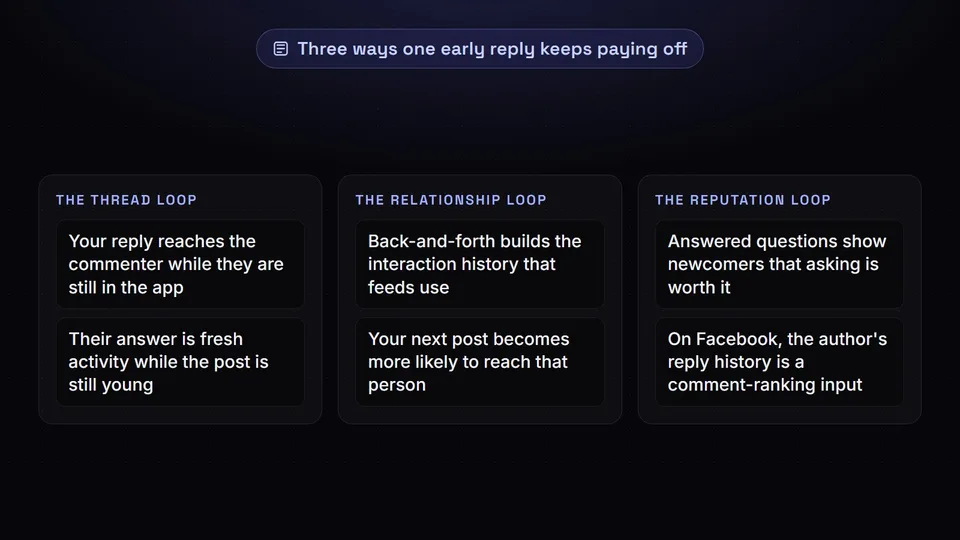
A reply does three jobs at once, and each one feeds the next.
The thread loop
Most apps let people know when someone replies to their comment. Reply within minutes and there is a fair chance the commenter is still in the app: they read your answer, reply again, and a single remark becomes a short thread. Their second comment is fresh activity from a real viewer while the post is still young. Reply the next morning and the same answer reaches someone who has long since moved on.
The relationship loop
Instagram says it uses your history of interacting with someone to judge how interested you are in seeing their posts, and gives commenting on each other's posts as its example. Meta's explainer for Facebook Feed likewise lists interactions between a viewer and a post's author among its signals. Every genuine exchange in your comments adds to that history with one specific person. The payoff is not on this post but on the next one, which becomes more likely to turn up in their feed. Today's reply is a small investment in next week's reach among the people who already care.
The reputation loop
People decide whether to comment partly by looking at what happened to the comments before theirs. A thread of answered questions tells a newcomer that asking is worth the effort; a column of unanswered ones says the opposite. On Facebook this is written into the ranking itself. Meta's explainer on how Facebook ranks comments names, among the inputs it uses to predict which comments will generate meaningful replies, how often the post's author has replied to comments in the past, how many different people have already replied to a comment, and whether a comment asks a question or invites a response. So a habit of replying shapes how your future comment sections are presented.
The same explainer lists whether a comment looks low-effort, repetitive or off-topic among its quality signals, which is a fair description of "Thanks!" pasted forty times. Velocity without substance is not the goal.
How comment engagement differs by platform
Comment engagement does not carry the same weight everywhere, so spend your effort where it counts.
- Instagram: comments appear in both the speed signals and the relationship signals described above, so early, genuine back-and-forth helps on two fronts.
- Facebook: comment ranking takes the author's reply habits into account, and Meta even lists the time between a post going up and a comment being written among its inputs.
- TikTok: TikTok has said its recommendations draw on user interactions, including the comments people post. A viewer who keeps talking with you under your videos is telling the app something about what they want to see.
- YouTube: YouTube's help page on recommendations lists watch and search history, subscriptions, likes, dislikes, "not interested" and "don't recommend channel" feedback, and satisfaction surveys. Comments are not on that list. Reply on YouTube for the people rather than the ranking: a viewer who gets a thoughtful answer has a reason to come back to the channel.
What to reply to first
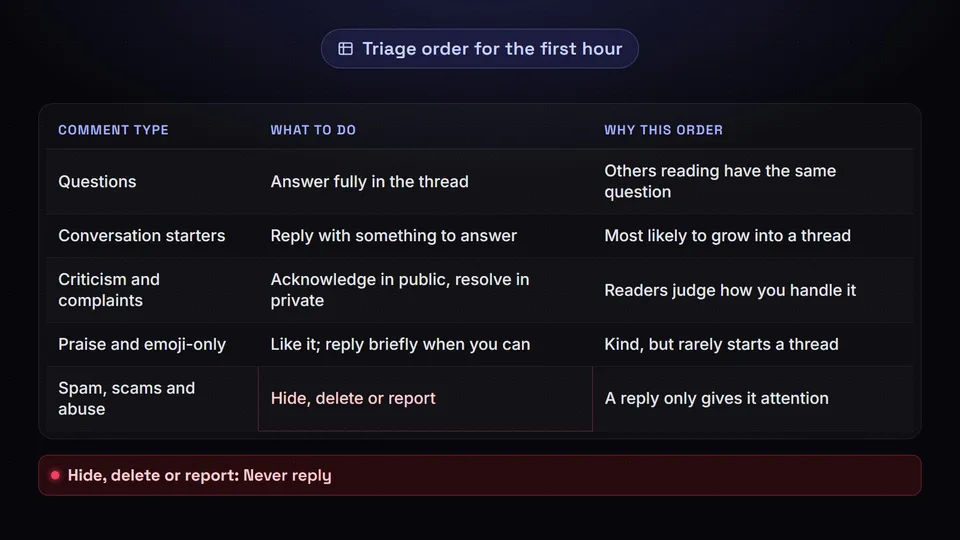
You will not always be able to answer everything in the first hour, and you do not need to. Work in this order:
- Questions. A question about sizing, a step in a tutorial or where to find something is rarely asked by one person alone. Answer it fully in the thread rather than with "check your DMs", so everyone reading benefits.
- Comments that open a conversation. A story, a disagreement made in good faith, an extra tip from someone who knows the subject. These are the most likely to grow into threads, so give them a considered reply with something in it to answer.
- Criticism and complaints. Acknowledge them in public, promptly and calmly, then move anything involving orders, accounts or personal details into private messages. Other readers judge you on how you handle these, not on whether they appear.
- Praise and emoji-only comments. Like them, and reply briefly when you have time. A short, specific thank-you beats a generic one.
- Spam, scams and abuse. Do not reply. Hide, delete or report them with the platform's own tools. A reply only gives them more attention.
How to write replies that keep the thread going
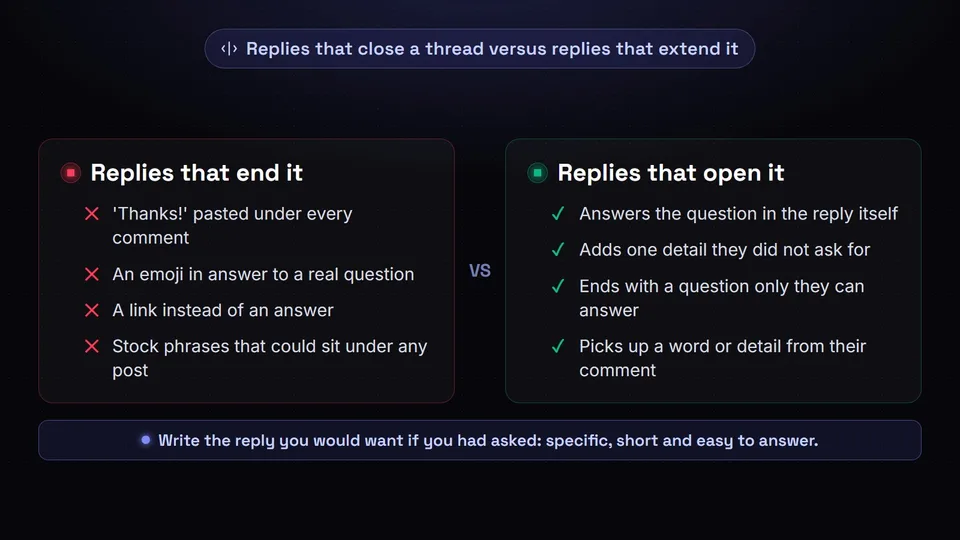
The difference between a reply that ends a conversation and one that extends it is usually a single sentence.
- Answer in the reply itself. If someone asks which setting you used, name it. A link on its own sends people away to find out.
- Add one thing they did not ask for. A related tip, the reason behind your choice, the mistake you made first. It gives them something to respond to.
- End with a question only they can answer. "Which step are you stuck on?" works; "Thoughts?" rarely does.
- Use their words, not a template. Picking up a detail from their comment shows you read it, and it is what stops a batch of replies reading like a batch.
- Keep it short. Two or three sentences is plenty in a comment thread. Longer answers deserve a post of their own.
Avoid fishing for comments. Meta's content distribution guidelines treat posts that explicitly ask for comments, votes, shares, tags or likes as engagement bait, which is on Meta's list of content it demotes on Facebook. Posts asking for help, advice or recommendations are not the target, Meta has said; "Comment YES if you agree" is. The same goes for replies: ask a question because you want the answer.
A first-hour routine you can keep
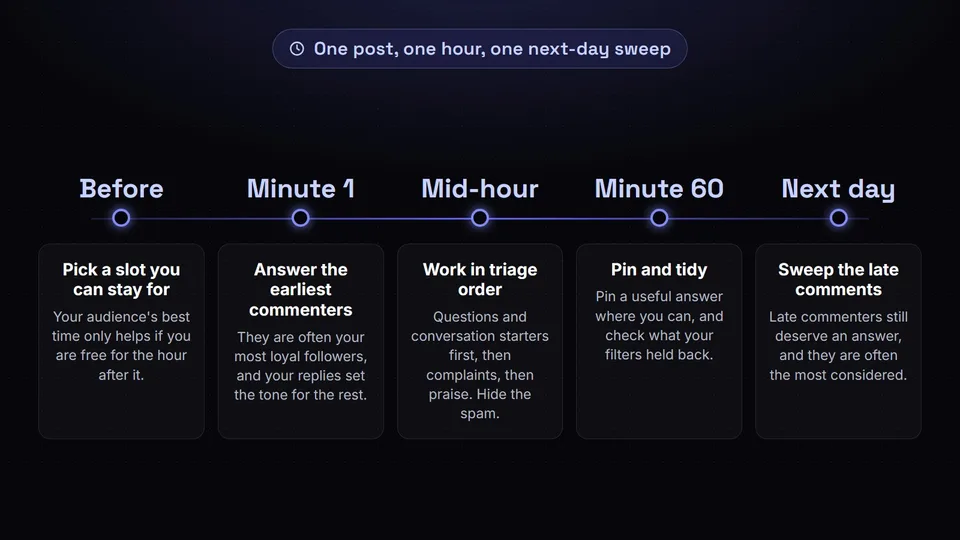
The best reply to comments strategy is one you can repeat on a tired Thursday, not just on launch day. A simple routine:
- Before posting, choose a time you can stay for. The ideal slot is when your audience is around and you are free for the hour after. If those rarely overlap, favour being present: a post with an absent author wastes its warmest audience. Our guide to working out posting times from your own engagement data covers the audience side.
- Stay for the first few minutes. The earliest commenters are often your most loyal followers, and how you answer them sets the tone for everyone who arrives after.
- Work through the hour in triage order. Questions and conversation starters first, then complaints, then praise. Spam gets hidden without a reply.
- Pin and tidy at the end. If one comment and your answer would help everyone, pin it where the platform allows (on YouTube, Pin sits in a comment's menu when you view a single video's comments). Check what your filters have held back, too; genuine comments sometimes get caught.
- Sweep the late comments the next day. Late commenters still deserve an answer, and they are often the most considered.
YouTube Studio makes that sweep quicker: its comment filters include a response status, so you can show only the comments you have not answered yet.
Community management tips for when it gets busy
Replying does not scale in a straight line. A handful of comments takes minutes; a post that takes off can fill an evening, and pretending otherwise is how people burn out. A few community management tips for the weeks when the comments outgrow you:
- Set up filters before you need them. Instagram's Hidden Words, YouTube's blocked words and TikTok's keyword filters can all hide or hold back comments containing words you choose, so the first hour goes on people rather than spam. Look at what they catch now and then.
- Prepare answers to predictable questions. If a post is bound to raise the same question, write the core answer before you publish, then adapt it for each person. A prepared answer is a starting point, not something to paste.
- Answer the hundredth question once, properly. When a question keeps coming back, fix the source: add the answer to the caption, pin it, or reply with a video. TikTok and Instagram Reels both let you answer a comment with a short video that can show the original comment as a sticker.
- Share the first hour, not the voice. If more than one person replies for an account, agree who covers which post and write down a few tone rules, so followers hear one consistent voice.
- Decide your hours. Being reliably responsive at set times beats being instant one week and silent the next. A predictable rhythm is easier to keep, and followers adjust to it.
Putting it into practice
Comment velocity is not about answering faster than everyone else. It is about being there while the conversation is still warm: reply to the first comments within the hour, answer properly, give people something to reply to, and keep the habit going from one post to the next, because that is where the compounding happens. Hide the spam, sweep the late comments the next day, and remember that every post inherits the reply habits of the ones before it.
If you plan your week in SchedulifyX, schedule each post for a time when you know you will be free for the hour after it goes live.