10 Copywriting Frameworks for High-Converting Captions
SchedulifyX Team · July 24, 2026
Discover 10 proven copywriting frameworks to write high-converting social media captions, boost engagement, and drive action for your brand today.
In the fast-paced digital arena, capturing your audience's attention is only half the battle; keeping it and driving them to action is where the real magic happens. This magic is fueled by masterful social media copywriting. While striking visuals and trending audio might stop the scroll, it is the words beneath the imagery that persuade, connect, and ultimately convert casual scrollers into loyal customers.
If you have ever stared at a blinking cursor, wondering how to summarize your brand's brilliance into a tiny text box, you are not alone. Crafting social media captions that convert requires more than just a passing thought; it demands strategy, psychology, and a deep understanding of human behavior. Fortunately, you do not need to reinvent the wheel every time you schedule a post. By leveraging proven copywriting frameworks, you can consistently produce engaging social posts that resonate with your target audience and drive measurable results.
In this comprehensive guide, we will explore 10 battle-tested copywriting frameworks, dive deep into Call-to-Action (CTA) optimization, and break down platform-specific character count strategies to elevate your social media presence. Whether you are a seasoned marketer or a small business owner, these caption writing tips will transform your content strategy.
Why Social Media Copywriting Matters More Than Ever

The social media landscape has evolved dramatically over the last decade. Gone are the days when a simple picture of your morning coffee with a one-word caption could garner hundreds of likes and meaningful engagement. Today, algorithms prioritize content that keeps users on the platform longer, sparking conversations and encouraging shares and saves.
This is where social media copywriting steps into the spotlight. A well-crafted caption provides context to your visuals, adds value to the user's feed, and gently guides them down your marketing funnel. When you master the art of writing social media captions that convert, you are effectively placing a 24/7 sales representative on your social feeds. Good copy builds trust, establishes authority, and creates an emotional bond with your audience. It transforms a passive viewer into an active participant in your brand's community.
Furthermore, effective copywriting is highly measurable. By experimenting with different copywriting frameworks, you can track which emotional triggers and structures yield the highest click-through rates (CTR), comments, and shares. This data-driven approach allows you to refine your voice and continuously improve your return on investment (ROI) for organic and paid social media efforts.
Framework 1: AIDA (Attention, Interest, Desire, Action)
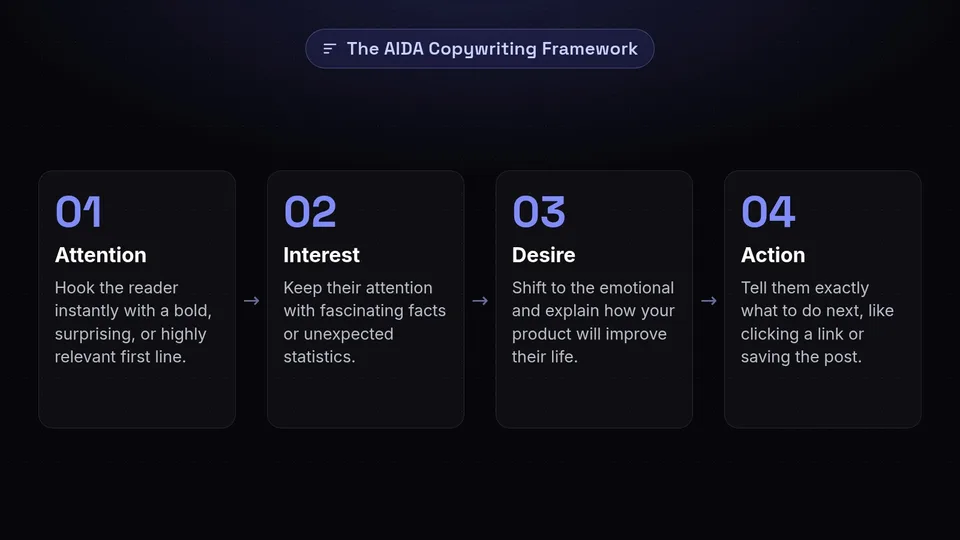
The AIDA model is arguably the most famous and widely used of all copywriting frameworks. Originating in the late 19th century, its principles remain incredibly relevant in today's digital age. AIDA is a linear progression that mimics the customer's psychological journey from discovering a product to making a purchase.
Breaking Down AIDA
- Attention: You must hook the reader instantly. On social media, this is the first line of your caption. It needs to be bold, surprising, or highly relevant to the reader's pain points.
- Interest: Once you have their attention, you need to keep it. Provide fascinating facts, unexpected statistics, or a compelling statement that makes them want to click 'Read more'.
- Desire: Shift the focus from the logical to the emotional. Explain how your product or service will improve their life. Paint a picture of the ideal future state.
- Action: Tell them exactly what to do next. Whether it is clicking a link in your bio, leaving a comment, or saving the post, be explicit.
AIDA in Action
Attention: Tired of spending 10 hours a week scheduling social media posts?
Interest: Most social media managers waste a full working day every week just copying and pasting content across different platforms.
Desire: Imagine reclaiming those 10 hours to focus on high-level strategy, community building, and creative campaign planning, all while an AI handles the repetitive tasks flawlessly.
Action: Start your 14-day free trial of SchedulifyX today at the link in our bio and get your time back!
Framework 2: PAS (Problem, Agitation, Solution)

If AIDA is the gold standard, PAS is the secret weapon for writing social media captions that convert. PAS relies on the psychological principle that human beings are more motivated to avoid pain than they are to seek pleasure. By highlighting a specific problem your audience faces, you immediately demonstrate empathy and understanding.
Breaking Down PAS
- Problem: Identify a specific, painful problem your target audience is currently experiencing. Be as specific as possible.
- Agitation: Pour a little salt in the wound. Remind them of the consequences of not solving this problem. How does it negatively impact their day-to-day life, their business, or their peace of mind?
- Solution: Introduce your product, service, or piece of advice as the ultimate remedy to their pain.
PAS in Action
Problem: Your organic reach on Instagram has plummeted to an all-time low.
Agitation: You are spending hours creating beautiful graphics and writing thoughtful content, only for it to be seen by 5% of your followers. It is frustrating, demoralizing, and making you question if social media marketing is even worth the effort anymore.
Solution: The secret isn't posting more; it's posting smarter. Our new guide breaks down the exact algorithm changes of 2026 and provides a step-by-step strategy to instantly boost your reach. Comment 'REACH' below, and we will DM you the free guide!
Framework 3: BAB (Before, After, Bridge)
The Before-After-Bridge framework is incredibly effective for creating engaging social posts because it relies heavily on contrast. It paints a vivid picture of the user's current, less-than-ideal situation, contrasts it with a utopian future, and then positions your offering as the vehicle to get them there.
Breaking Down BAB
- Before: Describe the reader's current world. Highlight the struggles, inefficiencies, or unhappiness they are facing.
- After: Describe the reader's world after the problem is solved. What does success look like? How do they feel?
- Bridge: Show them how to get from the 'Before' to the 'After'. This is where you introduce your brand.
BAB in Action
Before: Managing multiple client accounts used to mean endless spreadsheets, missed posting times, and constant anxiety about whether the right post went to the right platform.
After: Now, imagine a world where your entire month's content is approved, scheduled, and automatically published across all platforms in just one afternoon, leaving you stress-free and looking like a genius to your clients.
Bridge: That is exactly what SchedulifyX does for over 10,000 agencies. Click the link in our bio to see how we bridge the gap between chaos and total control.
Framework 4: Storytelling Hooks (The Micro-Narrative)
Humans are hardwired for stories. Long before the written word, we passed down knowledge through storytelling. When it comes to caption writing tips, incorporating micro-narratives is one of the most powerful ways to build a loyal community. Stories bypass the logical, cynical parts of the brain and appeal directly to emotion.
Crafting the Micro-Narrative
A social media story doesn't need to be a novel. It just needs a protagonist (often you or a client), a conflict, a climax, and a resolution. The key is to start in media res (in the middle of the action) to hook the reader instantly.
Storytelling in Action
Hook: I almost quit my marketing agency three years ago.
The Story: I was sitting on my living room floor at 2 AM, surrounded by post-it notes, manually publishing a client's launch campaign because my scheduling tool had crashed. I was exhausted, burnt out, and ready to throw in the towel. I realized that the tools meant to save me time were actually holding me hostage.
The Turn: So, instead of quitting, I decided to build something better. I partnered with a developer friend, and we spent 18 months creating a platform that actually understood the needs of social media managers.
The Resolution/CTA: Today, that platform is SchedulifyX. If you are tired of glitchy tools ruining your sleep schedule, you need to try this. Link in bio to start for free.
Framework 5: Question-Based Openers (The Curiosity Gap)
One of the simplest yet most effective copywriting frameworks involves opening your caption with a highly targeted question. This leverages a psychological concept known as the 'Curiosity Gap'—the space between what we know and what we want to know. When a user reads a question, their brain instinctively tries to answer it, which stops them from scrolling.
Mastering the Question Opener
The question must be highly relevant to your target audience. If the answer is an easy 'no' or if they don't care about the topic, they will keep scrolling. The best questions agitate a pain point or challenge a common belief.
Question-Based Openers in Action
Example 1 (B2B): Are you still using spreadsheets to track your social media analytics in 2026?
Example 2 (B2C): What if I told you that your morning skincare routine is actually causing your breakouts?
Follow-up: Once you ask the question, immediately transition into providing the answer, delivering value, and ending with a strong CTA that encourages them to share their own experiences in the comments.
Framework 6: FAB (Features, Advantages, Benefits)
When launching a new product or feature, it is incredibly easy to fall into the trap of just listing technical specifications. But as the old marketing adage goes, 'People don't buy a quarter-inch drill; they buy a quarter-inch hole.' The FAB framework ensures that your social media copywriting focuses on the user, not just the product.
Breaking Down FAB
- Features: What the product or service actually does or has (the factual data).
- Advantages: What the feature does better than the alternatives (the practical application).
- Benefits: Why the user should care (the emotional or ultimate life-improving result).
FAB in Action
Let's say you are promoting SchedulifyX's new AI caption generator.
Feature: Our platform now includes an integrated AI text generation tool trained on top-performing social posts.
Advantage: This means you can generate dozens of caption variations in seconds, without ever leaving the scheduling dashboard.
Benefit: Say goodbye to writer's block forever. You will save hours of agonizing over the perfect words, allowing you to log off early and enjoy your weekends again.
Framework 7: The 4 Cs (Clear, Concise, Compelling, Credible)
Not every post needs to be a long, emotional story. Sometimes, your audience just needs the facts, presented in the most digestible way possible. The 4 Cs framework is perfect for announcements, quick tips, or platforms like Twitter/X where brevity is key.
Breaking Down the 4 Cs
- Clear: Ensure the message is easily understood by a fifth-grader. Avoid industry jargon.
- Concise: Cut out any fluff. If a word doesn't add value, delete it.
- Compelling: Give the reader a strong reason to care or take action.
- Credible: Back up your claims with data, social proof, or authority.
The 4 Cs in Action
Caption: Want to double your engagement rate this week? (Clear & Compelling)
Stop posting at random times. (Concise)
Our latest study of 1.5 million posts shows that publishing between 8 AM and 10 AM on Tuesdays increases reach by 42%. (Credible)
Tap the link in our bio to download the full 2026 Best Times to Post report.
Framework 8: The How-To Educational Breakdown
Social media is increasingly being used as a search engine. Users turn to platforms like TikTok, Instagram, and LinkedIn to learn new skills. The 'How-To' framework positions your brand as an authority and provides immense upfront value, making it a staple for engaging social posts.
Structuring the How-To
Start with a clear, outcome-based headline. Then, break the process down into highly actionable, numbered steps. Use formatting (like emojis or bullet points) to make it skimmable. Finally, encourage users to save the post for later—a metric algorithms love.
How-To in Action
Headline: How to write a month's worth of social content in 60 minutes ⏱️
Body:
1️⃣ Brainstorm 4 Core Pillars: Choose 4 themes relevant to your niche (e.g., Education, Behind-the-Scenes, Testimonials, Actionable Tips).
2️⃣ Batch Create: Set a timer for 15 minutes per pillar. Write 4-5 short captions for each. Do not edit yet, just write!
3️⃣ Use Templates: Plug your raw text into proven copywriting frameworks like AIDA or PAS to polish them up.
4️⃣ Schedule: Load them all into SchedulifyX and set them to auto-publish.
CTA: Found this helpful? Bookmark this post for your next content creation day!
Framework 9: The Contrarian Viewpoint (Myth-Busting)
If you want to stop the scroll and spark a lively debate in your comments section, the Contrarian framework is your best friend. This involves taking a widely accepted industry 'truth' and turning it on its head. It shows thought leadership and confidence.
Using the Contrarian Framework Safely
You must be able to back up your controversial statement with logic, data, or strong personal experience. The goal is not to be offensive, but to be thought-provoking.
Contrarian in Action
The Hook: 'Consistency is key' is the worst advice in social media marketing.
The Explanation: Hear me out. We have all been told to post every single day to please the algorithm. But posting mediocre content 7 days a week just trains your audience to ignore you. It leads to burnout and brand dilution.
The Pivot: Quality always trumps frequency. Posting 2 highly researched, incredibly valuable, well-written posts a week will out-perform 7 rushed posts every single time.
The CTA: Do you agree or disagree? Let's debate in the comments below!
Framework 10: The Relatable Observation (Slice of Life)
Sometimes, the best social media copywriting doesn't feel like copywriting at all. The Relatable Observation framework relies on empathy and shared experiences. It is about articulating a feeling or situation that your target audience experiences regularly, making them feel seen and understood.
Crafting Relatable Content
Focus on the minutiae of your industry. What are the inside jokes? What are the minor annoyances everyone deals with? Humor and self-deprecation work incredibly well here.
Relatable Observation in Action
The Observation: There is a special kind of panic that sets in when you hit 'publish' on a post, close the app, and immediately realize you used the wrong 'their/there/they're' in the first sentence.
The Elaboration: Your heart drops, you scramble to reopen the app, and you pray no one saw it in those crucial 30 seconds. We have all been there.
The Tie-in: That is why we built a native grammar and spell-check directly into the SchedulifyX drafting window. Save your reputation (and your heart rate). Try it out at the link in bio.
CTA Optimization: How to Drive Action in Every Post
Even the most brilliant application of these copywriting frameworks will fall flat if you do not tell your audience what to do next. Call-to-Action (CTA) optimization is a critical component of writing social media captions that convert.
Soft CTAs vs. Hard CTAs
Not every post should ask for a sale. You must balance your asks to avoid fatiguing your audience.
- Soft CTAs: These are low-friction requests designed to boost engagement metrics. Examples include: 'Double tap if you agree,' 'Which option do you prefer? A or B?', 'Tag a friend who needs to hear this,' or 'Save this post for later.'
- Hard CTAs: These require the user to leave the platform or make a commitment. Examples include: 'Click the link in our bio to buy,' 'Sign up for our webinar,' or 'Download the free guide.'
Best Practices for CTA Optimization
- One CTA per post: Do not confuse your audience by asking them to like, comment, share, AND click a link. Pick one primary goal per post.
- Use action verbs: Start your CTA with strong verbs like Download, Discover, Join, Start, or Grab.
- Create urgency: When appropriate, use time-sensitive language like 'Offer ends tonight' or 'Only 5 spots left.'
- Make it visually distinct: Use emojis or line breaks to separate your CTA from the rest of the caption so it stands out to skimmers.
Platform-Specific Character Count Strategies
While human psychology remains consistent, user behavior varies wildly from platform to platform. A caption that goes viral on LinkedIn might flop entirely on TikTok. To truly master social media copywriting, you must adapt your frameworks to fit platform-specific nuances and character limits.
Instagram Caption Writing Tips
Instagram allows up to 2,200 characters, but the caption truncates after the first 125 characters. This makes your opening hook incredibly important. Use frameworks like AIDA or Question-based openers to force the 'Read more' click. Instagram is highly visual, so your copy should complement the image or video, not compete with it. Long-form micro-blogging works well here for educational or storytelling content.
LinkedIn's Professional Edge
LinkedIn gives you a generous 3,000 characters. The platform thrives on thought leadership, industry insights, and professional vulnerability. The BAB (Before, After, Bridge) and Contrarian frameworks perform exceptionally well here. Remember that LinkedIn truncates captions after about 140 characters (or roughly three lines). Use generous line breaks to make your post scannable, and always lead with a strong, definitive statement.
Twitter/X Brevity
With a standard limit of 280 characters (unless using Premium), Twitter requires ruthless editing. The 4 Cs framework is your best tool here. You must deliver your hook, value, and CTA in a single breath. Threads are a great way to bypass this limit, allowing you to use the How-To or Storytelling frameworks by breaking them down into tweet-sized chunks. Always ensure the first tweet of the thread functions as a powerful, standalone hook.
Facebook and TikTok
Facebook allows massive captions (over 63,000 characters), but brevity usually wins. Stick to 1-3 short paragraphs using the PAS framework to drive link clicks. TikTok, on the other hand, allows up to 2,200 characters, but the text overlays directly on the video. Keep TikTok captions extremely short, using them to provide context, add searchable SEO keywords, or direct viewers to the link in your bio.
Conclusion: Elevate Your Engaging Social Posts with SchedulifyX
Mastering social media copywriting is an ongoing journey of testing, tweaking, and learning about your audience. By utilizing these 10 proven copywriting frameworks—from the classic AIDA to the empathetic Relatable Observation—you can eliminate writer's block and consistently craft social media captions that convert.
Remember that the best copy in the world will not yield results if your publishing strategy is chaotic. To truly maximize your social media ROI, you need a system that allows you to plan, write, and schedule your content seamlessly. That is where SchedulifyX comes in.
With SchedulifyX, you can draft your brilliant new captions, utilize AI-assisted writing tools to refine your hooks, and schedule your posts across all major platforms at the optimal times for your specific audience. Stop wasting time on manual publishing and start focusing on what truly matters: connecting with your community through powerful words.
Ready to transform your social media strategy? Sign up for your free trial of SchedulifyX today and start turning your captions into conversions!