The Art of Social Media Copywriting: Hooks, CTAs & Formulas
SchedulifyX Team · April 10, 2026
Master social media copywriting with proven engagement formulas, scroll-stopping hooks, and irresistible CTAs to boost your brand's digital presence.
In today's hyper-connected digital landscape, your audience's attention span is the most valuable currency. With millions of posts published every minute, standing out requires more than just a pretty graphic or a trending audio track. It requires the mastery of social media copywriting. Whether you are a seasoned marketer, a startup founder, or a content creator, the words you use dictate whether a user scrolls past or stops to engage.
Social media copywriting is not just about writing; it is about human psychology, strategic communication, and measurable action. To truly succeed, you need to understand how to craft compelling hooks, deploy proven engagement formulas, and drive action through perfectly timed Calls to Action (CTAs). In this comprehensive guide, we will break down the science and art behind high-converting social media copy.
The Anatomy of Perfect Social Media Copywriting
Before diving into specific tactics, it is crucial to understand what makes social media copywriting fundamentally different from traditional copywriting. Traditional copywriting—think billboards, magazine ads, or even long-form sales pages—often relies on a captive audience. Social media, however, is an environment of constant distraction.
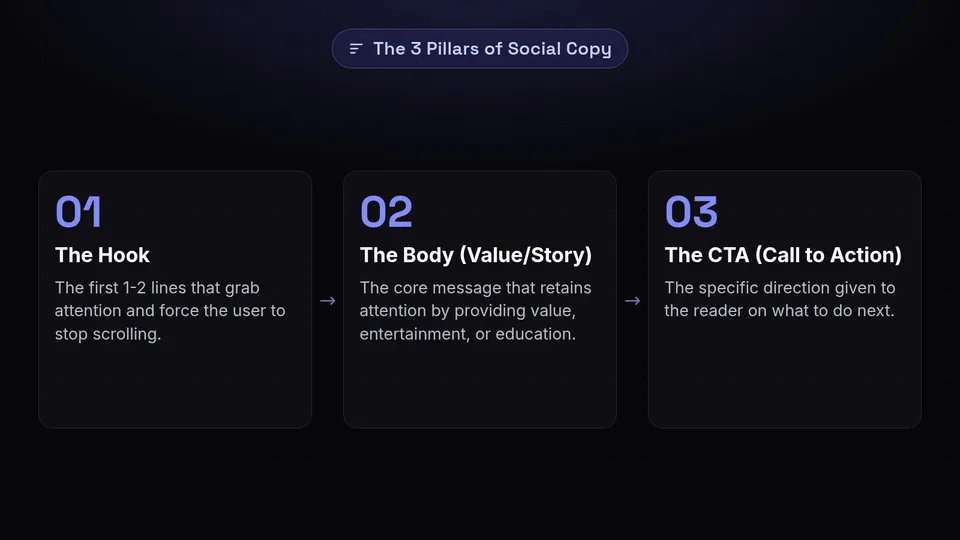
Effective social media copy consists of three non-negotiable elements:
- The Hook: The first 1-2 lines that grab attention and force the user to stop scrolling.
- The Body (Value/Story): The core message that retains the reader's attention by providing value, entertainment, or education.
- The CTA (Call to Action): The specific direction given to the reader on what to do next.
If any of these elements are weak, the entire post falls flat. A great hook with a weak body leads to bounce. A great body with no CTA leads to wasted engagement. Mastering social media copywriting means optimizing all three pillars simultaneously.
Mastering the Hook: How to Stop the Scroll

The hook is arguably the most critical component of your social media copywriting strategy. On platforms like X (formerly Twitter), LinkedIn, and Instagram, you have roughly 1.7 seconds to capture a user's attention. If your first sentence doesn't provoke curiosity, emotion, or immediate relevance, your post is invisible.
Why the Hook Matters
Algorithms across all major platforms prioritize "dwell time" (how long someone looks at your post) and early engagement. A strong hook increases dwell time by compelling the user to click "Read more." This signals to the algorithm that your content is valuable, pushing it to a wider audience.
7 Proven Hook Formulas
Here are seven highly effective hook formulas you can adapt for your brand:
- The Unpopular Opinion: "Stop trying to post 5 times a day. It's killing your reach. Here is why..." This creates immediate intrigue and challenges conventional wisdom.
- The Direct Question: "Are you making this critical mistake with your social media copywriting?" Questions naturally prompt the brain to seek an answer.
- The 'How-To' with a Twist: "How to double your engagement rate without spending a dime on ads." This promises a high-value outcome with a low barrier to entry.
- The Number Drop: "I analyzed 10,000 viral LinkedIn posts. Here are the 3 traits they all share." Data builds instant credibility and promises structured, easy-to-read insights.
- The Empathy Hook: "If you are feeling burnt out by content creation, read this." This connects on a deeply emotional level with your target audience's pain points.
- The Story Teaser: "Three years ago, my business was failing. Today, we just hit M in ARR. Here is the exact framework that saved us." Humans are hardwired for stories.
- The Negative Warning: "Do not launch your next social campaign until you've checked these 5 things." Fear of Missing Out (FOMO) and loss aversion are powerful psychological triggers.
Engagement Formulas That Drive Conversations
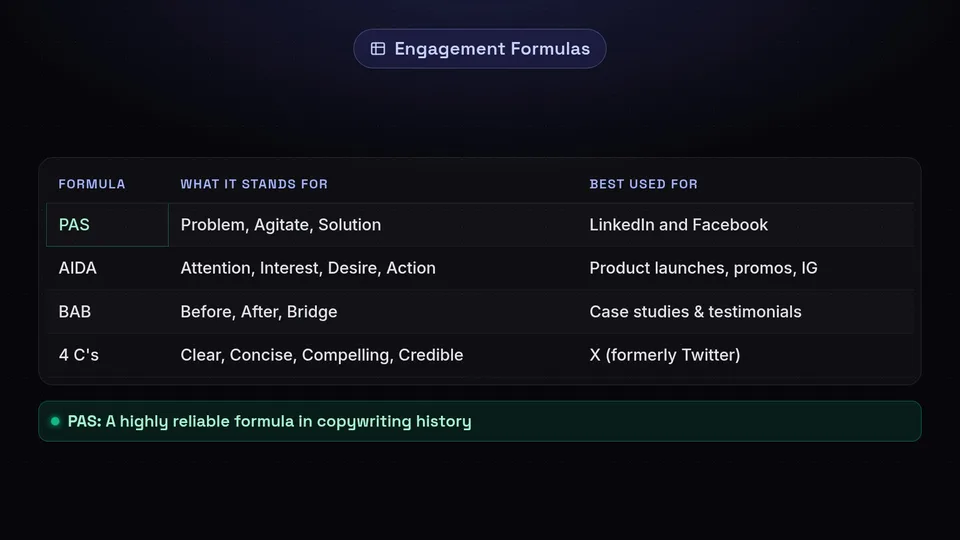
Proven psychological frameworks can help structure your copy and keep readers engaged. Once you have hooked your reader, you need to keep them engaged. This is where engagement formulas come into play. Instead of staring at a blank screen, you can use these proven psychological frameworks to structure your social media copywriting.
The PAS Formula (Problem, Agitate, Solution)
PAS is one of the most reliable formulas in copywriting history. It works exceptionally well on platforms like LinkedIn and Facebook.
- Problem: Identify a pain point your audience is experiencing. (e.g., "Struggling to get your social posts seen?")
- Agitate: Make the problem feel more urgent or emotional. (e.g., "You are spending hours creating content, only to get crickets. The algorithm feels impossible to beat, and your competitors are pulling ahead.")
- Solution: Introduce your product, service, or tip as the answer. (e.g., "The secret isn't posting more; it's posting smarter. Here is the 3-step strategy we use...")
The AIDA Model (Attention, Interest, Desire, Action)
AIDA is ideal for product launches, promotional posts, and Instagram captions.
- Attention: Your scroll-stopping hook.
- Interest: Fascinating facts, features, or stories that keep them reading.
- Desire: Explain the transformation or benefits. How will this make their life better?
- Action: Your clear CTA.
The BAB Framework (Before, After, Bridge)
BAB is perfect for case studies, testimonials, and demonstrating value.
- Before: Paint a picture of their current world (with its struggles).
- After: Describe the ideal world where the problem is solved.
- Bridge: Explain how your product or advice gets them from Before to After.
The 4 C's Formula
When you need to keep things short and punchy (like on X/Twitter), adhere to the 4 C's: Clear, Concise, Compelling, Credible. Strip away the fluff, get straight to the point, make it interesting, and back it up with facts or authority.
Crafting Irresistible Calls to Action (CTAs)

Your Call to Action is the crucial bridge between engagement and actual business results. A post without a CTA is a dead end. The CTA is the bridge between social media engagement and actual business results. However, simply slapping "Link in bio" at the end of a post is no longer enough.
The Psychology Behind a Great CTA
Effective CTAs reduce friction and clearly articulate the value of taking action. The reader should never have to guess what will happen when they click, comment, or share. You must also balance hard CTAs (direct requests for sales/clicks) with soft CTAs (requests for engagement/opinions).
Examples of High-Converting CTAs
Depending on your goal, your CTA should be tailored to drive a specific behavior:
- To Drive Comments (Soft CTA): "Which of these 3 strategies are you going to try first? Let me know in the comments!" or "Do you agree or disagree? Drop your thoughts below."
- To Drive Saves/Shares (Soft CTA): "Save this post for your next content planning session!" or "Tag a marketer who needs to hear this."
- To Drive Traffic (Hard CTA): "Want the full step-by-step guide? Click the link in our bio to download the free template."
- To Drive Sales (Hard CTA): "Ready to automate your social media? Start your 14-day free trial of SchedulifyX today—link in the comments."
Pro Tip: Use action-oriented verbs. Instead of "Click here," try "Unlock your free guide," "Transform your strategy," or "Join 10,000+ marketers."
The Psychology of Words in Social Copy
The best social media copywriting leverages the subtle psychology of language. The words you choose can drastically alter the emotional resonance of your post.
Power Words
Power words trigger emotional responses. Incorporate words like exclusive, proven, secret, effortless, skyrocket, guarantee, and instant to make your copy more persuasive. However, use them sparingly to avoid sounding like clickbait.
The Rule of "You"
The most important word in copywriting is "You." Social media copy should be inherently customer-centric. Instead of focusing on "we" or "I" (e.g., "We built a new scheduling feature"), flip it to focus on the user (e.g., "You can now schedule a month of content in 10 minutes with our new feature.")
Formatting for Scannability
No one likes reading giant walls of text. Good copywriting is also about visual formatting. Use line breaks, bullet points, and appropriate emojis to guide the reader's eye down the screen. A well-formatted post feels less intimidating and easier to consume.
Platform-Specific Copywriting Nuances
A critical mistake many brands make is cross-posting the exact same copy across all platforms. Social media copywriting must be contextualized to the platform's culture and constraints.
LinkedIn
LinkedIn is the hub for professional storytelling. Long-form copy works exceptionally well here. Focus on actionable business advice, vulnerable leadership stories, and industry insights. Use plenty of whitespace and leverage the PAS or Storytelling formulas.
X (Twitter)
X is about brevity, wit, and real-time relevance. You are constrained by character limits, so every word must earn its place. Threads are powerful for deep dives, while single posts should be punchy and highly opinionated. The 4 C's formula is your best friend here.
Instagram
Instagram is highly visual, so your copy must complement the media. The first sentence is crucial because Instagram truncates captions after the first few lines. Use emojis to add personality, and utilize the AIDA formula for product features. Always include a CTA directing users to your bio or stories.
TikTok & Short-Form Video
For platforms like TikTok, Reels, and YouTube Shorts, your copywriting happens in two places: the on-screen text (the hook) and the caption. The caption should be brief, SEO-rich (using keywords your audience searches for), and include a quick engagement CTA.
Common Copywriting Mistakes to Avoid
Even seasoned marketers can fall into copywriting traps. Here are a few pitfalls to watch out for:
- Being Too Formal: Social media is a conversational space. Ditch the corporate jargon and write like you speak.
- Burying the Lede: Don't save the best part of your post for the end. Put your most compelling thought right in the hook.
- Selling Constantly: If every post is a hard pitch, your audience will tune out. Follow the 80/20 rule: 80% value, education, and entertainment, and 20% promotion.
- Ignoring Analytics: Copywriting is an iterative process. You must A/B test different hooks, formulas, and CTAs to see what resonates with your specific audience.
Conclusion: Elevate Your Strategy with SchedulifyX
Mastering the art of social media copywriting is an ongoing journey of testing, tweaking, and learning. By implementing strong hooks, leveraging proven engagement formulas like PAS and AIDA, and crafting clear, irresistible CTAs, you will transform your social media presence from a static broadcasting channel into a dynamic engine for growth and community building.
But writing brilliant copy is only half the battle. To truly dominate your social media strategy, you need to deliver that copy consistently, at the optimal times, across all your platforms. That is where SchedulifyX comes in.
As an AI-powered social media scheduling platform, SchedulifyX not only helps you plan and automate your content calendar, but our built-in AI tools can also assist you in brainstorming hooks, refining your formulas, and generating high-converting CTAs. Stop letting your brilliant copywriting go to waste with poor distribution.
Ready to take your social media copywriting to the next level? Sign up for SchedulifyX today, streamline your workflow, and watch your engagement soar. Your audience is waiting.