Google's 2026 AI Content Guidelines: SEO & Authenticity
SchedulifyX Team · August 24, 2026
Explore Google's 2026 AI content guidelines, new mandatory AI disclosure rules for social media, and how marketers can maintain AI content authenticity.
The digital marketing landscape of 2026 is defined by a delicate balancing act: leveraging the unprecedented power of generative AI while navigating an increasingly complex web of regulations, search engine quality standards, and consumer demands for transparency. As we move through the third quarter of 2026, the rules of engagement for ai generated content google evaluates, indexes, and ranks have been fundamentally rewritten. For social media marketers, content creators, and enterprise brands, understanding these shifts is no longer optional—it is a critical requirement for survival and growth.
Over the past several months, we have witnessed a cascade of updates from major tech platforms and regulatory bodies. From the European Union's stringent AI Act enforcement to Google's massive algorithmic shifts and mandatory advertising disclosures, the ecosystem is demanding a higher standard of ai content authenticity. This comprehensive guide breaks down the verified research and announcements from 2025 and 2026, providing actionable insights into how you can align your strategies with the latest ai content guidelines and practice responsible ai marketing in this new era.
The Evolution of Google's AI Content Policies and Quality Signals
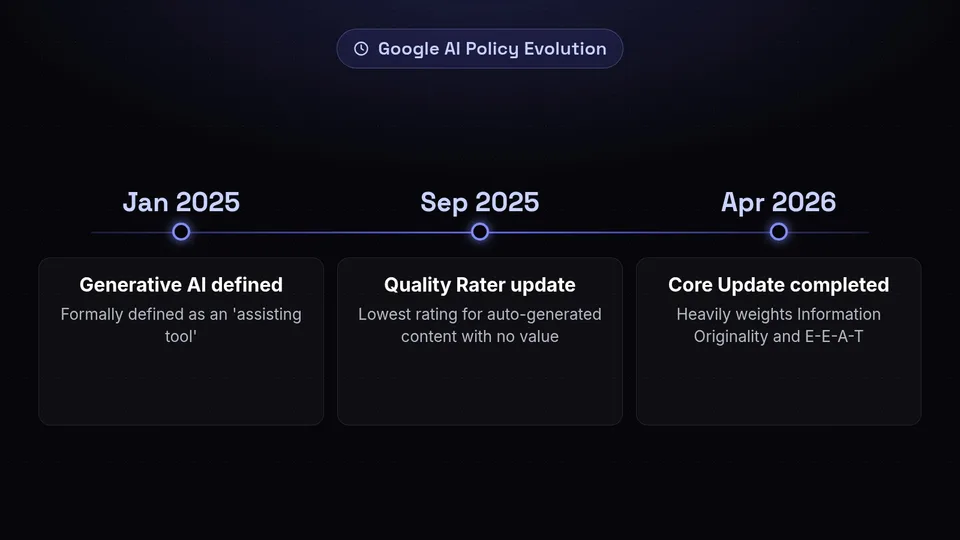
To understand Google's current stance on AI-generated material, we must look at the foundational updates that rolled out between late 2025 and the spring of 2026. The narrative that "Google penalizes all AI content" has been definitively debunked, but the reality is far more nuanced. Google's systems have evolved to become incredibly sophisticated at differentiating between high-value, AI-assisted content and low-effort, automated spam.
The 2025 Search Quality Rater Guidelines Foundations
The groundwork for the 2026 landscape was laid in the latter half of 2025. In September 2025, Google updated its Search Quality Rater Guidelines to expand the definition of generative AI, explicitly including AI Overviews. During this update, Google instructed its human raters to assign the "Lowest" quality rating to main content created with "little to no effort, little to no originality, and little to no added value." Crucially, this directive applied regardless of whether the content was generated by a human or an AI.
This was followed by a subsequent update in January 2025 (setting the stage for the year ahead), which formally defined generative AI as an "assisting tool." The guidelines mandated that if all or nearly all of a page's main content is auto-generated without any human value-add, it must receive the "Lowest" quality rating. This established a clear philosophical baseline: AI is a tool for enhancement, not a replacement for human insight.
The March-April 2026 Core Update
These philosophical guidelines were operationalized in the massive Google March 2026 Core Update, which officially completed its rollout in mid-April 2026. This update fundamentally re-weighted how Google's algorithms evaluate content quality, introducing strict new parameters for marketers to follow.
- Information Originality and Gain: The algorithm now heavily weights "Information Originality." This metric measures the "Information Gain" or unique insights a piece of content adds to the existing corpus of knowledge on the web. Regurgitating existing facts using an LLM without adding new data, perspectives, or analysis will result in poor performance.
- Author Expertise (E-E-A-T): There is a renewed emphasis on verifiable Author Expertise. The algorithm looks for a demonstrable track record of Experience, Expertise, Authoritativeness, and Trustworthiness (E-E-A-T). Anonymous, purely AI-generated blogs struggle to establish this verifiable track record.
- Topical Coherence: The update tightened the requirements for topical coherence, ensuring that sites stay within their lanes of established expertise.
"Google reconfirmed during the April 2026 wrap-up that it evaluates content based on quality, user intent, and value rather than the specific tool used to create it. There is no blanket 'AI penalty.' However, scaled low-effort AI content is aggressively demoted under the Scaled Content Abuse spam policies."
For brands relying on ai generated content google visibility, the mandate is clear: use AI to research, outline, and refine, but the core insights must stem from genuine human expertise and original thought.
Navigating AI Content Guidelines for Search Optimization

As generative AI features like AI Overviews, AI Mode, and agentic search became deeply integrated into the Google Search experience, a wave of misinformation spread regarding how to optimize for these new interfaces. Marketers scrambled to adopt unverified "Generative Engine Optimization" (GEO) tactics.
John Mueller's May 2026 Guidance
To quell the confusion, Google Search Advocate John Mueller published a definitive guide on May 15, 2026, titled "Optimizing your website for generative AI features on Google Search." This document serves as the ultimate source of truth for ai content guidelines in the current era.
In a dedicated "Mythbusting" section, Mueller addressed several pervasive AEO (Answer Engine Optimization) and GEO misconceptions. Most notably, he explicitly clarified that webmasters do not need to create specialized llms.txt files to feed data to Google's models. Furthermore, rewriting content specifically to sound more "AI-friendly" or adopting robotic, hyper-structured formats is neither required nor rewarded by Google's systems.
The guidance reinforced that optimizing for generative AI features is fundamentally the same as optimizing for traditional search: create comprehensive, highly original, well-structured content that directly answers user queries with authoritative backing. The AI models are trained to parse natural human language and extract value; attempting to reverse-engineer the parsing process with gimmicky technical files is a waste of marketing resources.
Mandatory AI Disclosure Social Media and Advertising Rules
While organic search guidelines focus on quality and value, the advertising and social media sectors have pivoted sharply toward transparency and user safety. By the summer of 2026, failing to disclose AI usage in paid campaigns became a compliance liability.
Google Ads' July 2026 Disclosure Policy
On July 9, 2026, Google announced a sweeping update that rolled out across its entire advertising ecosystem, including Google Ads, Display & Video 360, Campaign Manager 360, Merchant Center, and Ads Editor. This policy fundamentally changed how advertisers must handle ai disclosure social media and search campaigns.
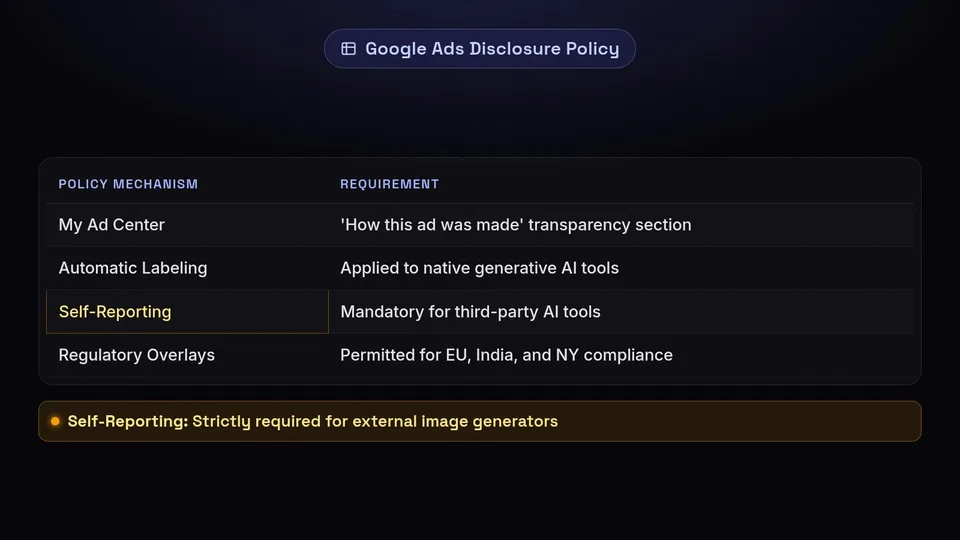
The policy introduced several critical mechanisms:
- My Ad Center Transparency: A new, user-facing "How this ad was made" section was added inside the My Ad Center panel across Google Search, YouTube, and Google Discover, allowing consumers to see exactly how generative tools were utilized.
- Automatic Labeling: Any ad created using Google's native generative AI advertising tools is now automatically labeled by the system, removing the burden from the advertiser for native creations.
- Mandatory Self-Reporting: Advertisers utilizing third-party AI tools (such as external image generators or copywriters) are strictly required to manually disclose AI usage via a new self-reporting setting in the campaign dashboard.
- Regulatory Overlays: To comply with stringent local laws, Google now permits direct text and visual overlay labels on ad creatives for jurisdictions like the European Union, India, and New York State. Previously, such overlays might have violated Google's ad formatting policies, but they are now explicitly permitted to ensure regulatory compliance.
The EU AI Act and Article 50 Enforcement
Google's ad policy update was perfectly timed to align with international law. On August 2, 2026, the transparency obligations under Article 50 of the European Union AI Act officially went into effect. This landmark enforcement requires all providers and deployers—which explicitly includes advertisers, social media marketers, and content creators—to label AI-generated or heavily modified content.
Crucially, Article 50 requires these labels to be both machine-readable (embedded in the metadata) and user-facing (visible to the average consumer). Ignoring these rules in the EU market now carries the risk of severe financial penalties and campaign suspensions.
The IAB's Warning on "Label Fatigue"
As the industry scrambled to comply with these overlapping rules, the Interactive Advertising Bureau (IAB) stepped in. On August 19, 2026, the IAB released version two of its AI Transparency and Disclosure Framework. This framework aims to establish a cohesive industry baseline for AI disclosures across the EU, the US (specifically addressing state-level laws in New York and California), and Asia.
Interestingly, the v2 update included a strong warning to marketers against the overuse of disclosures for minor, inconsequential AI edits (like basic color correction or spell-checking). The IAB cautioned that over-labeling could lead to "label fatigue," where consumers become so desensitized to AI warnings that they ignore them entirely, defeating the purpose of the transparency initiatives. Marketers must now walk a fine line between legal compliance and user experience.
AI Content Authenticity: SynthID, C2PA, and Watermarking
With text, image, video, and audio generation becoming indistinguishable from human creation, the tech industry has rallied around standardized technical solutions to maintain ai content authenticity. 2026 has been the year of SynthID and C2PA.
Google I/O 2026: The Expansion of SynthID and C2PA
At Google I/O on May 19, 2026, Laurie Richardson (VP of Trust and Safety at Google) and Pushmeet Kohli (Chief Scientist at Google Cloud & VP at Google DeepMind) took the stage to announce a massive expansion of content provenance technologies.
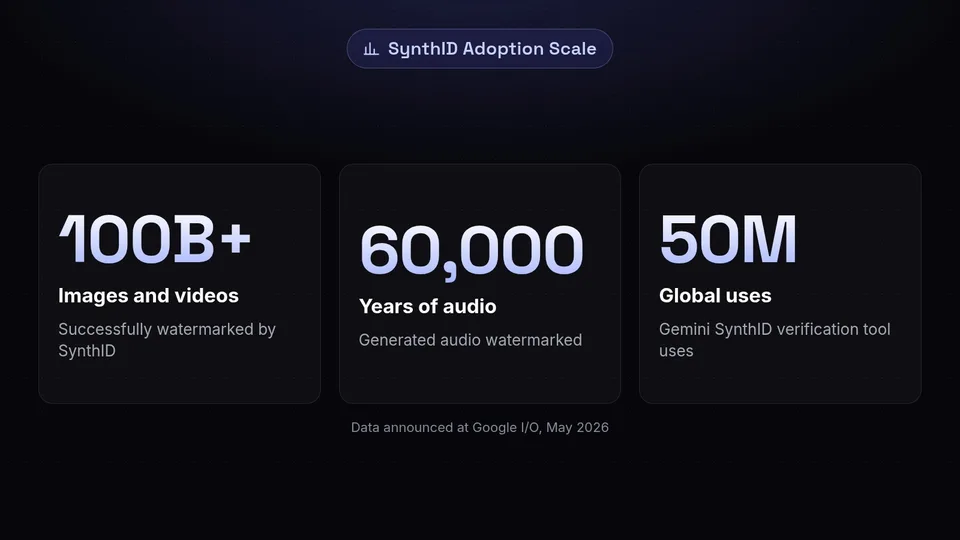
They revealed that SynthID (Google's invisible watermarking technology) and C2PA (Coalition for Content Provenance and Authenticity) Content Credentials had been deeply integrated across the Google ecosystem, including Google Search, Chrome, Circle to Search, Google Lens, and Gemini. The scale of this rollout was staggering: Google announced that SynthID had successfully watermarked over 100 billion images and videos, alongside 60,000 years' worth of generated audio.
Furthermore, the Gemini SynthID verification tool had already been used 50 million times globally by users seeking to verify the origins of media. In a massive win for industry standardization, Google confirmed that major players including OpenAI, Kakao, ElevenLabs, and Nvidia had adopted SynthID and/or C2PA standards into their own pipelines.
On the hardware side, Google pushed authenticity to the point of capture, adding native C2PA Content Credentials camera capture to the new Pixel 10 for images, and extending C2PA video capture capabilities across the Pixel 8, Pixel 9, and Pixel 10 devices.
Industry Adoption and User Controls
The push for C2PA standardization expanded beyond Google. On July 27, 2026, social media giant TikTok upgraded its status from a General Member to a Steering Committee Member of the C2PA, signaling a major commitment to enforcing content provenance on short-form video platforms.
However, platforms are also recognizing the need for user control over visible branding. On August 17, 2026, Josh Woodward, VP of Google Labs, Gemini app, and AI Studio, announced a significant update to the Gemini and Flow platforms. Users can now navigate to Settings > Media Watermark to toggle off visible watermarks on AI-generated media.
This toggle applies to content created by Google's latest specialized models: Nano Banana (for images), Omni (for video), and Lyria (for music). While users can disable the distracting visible watermarks for cleaner aesthetics in their marketing campaigns, Woodward emphasized that the invisible SynthID watermarks and the C2PA metadata remain permanently embedded in the files regardless of the user's settings, ensuring that authenticity can always be verified by platforms and regulators.
Responsible AI Marketing: Best Practices for 2026
Given the rigorous new standards for ai generated content google rankings, the strict disclosure laws, and the universal adoption of provenance metadata, how should social media managers and digital marketers adapt? Practicing responsible ai marketing in 2026 requires a strategic, compliance-first approach.
- Focus on Information Gain: Never publish raw LLM output as your main content. Use AI to aggregate data, brainstorm angles, or draft outlines, but ensure a human subject matter expert injects original insights, case studies, and unique perspectives to satisfy Google's Information Originality requirements.
- Audit Your Ad Stack for Compliance: Review all third-party AI tools used in your creative process. Ensure you are manually toggling the self-reporting disclosure settings in Google Ads and properly utilizing regional overlays for campaigns targeting the EU, India, and New York State.
- Preserve C2PA Metadata: When editing AI-generated images or videos (whether from Nano Banana, Omni, OpenAI, or others), ensure your editing software supports and preserves C2PA Content Credentials. Stripping this metadata could result in your content being flagged or suppressed by platforms like TikTok and Google Search.
- Avoid Label Fatigue: Follow the IAB v2 framework. Disclose AI usage clearly when it materially impacts the creation of the content (e.g., fully generated images, synthetic voiceovers via Lyria or ElevenLabs), but avoid slapping warning labels on content that merely used AI for basic spell-checking or minor contrast adjustments.
- Build Verifiable E-E-A-T: Ensure your content is tied to real human authors with verifiable digital footprints. Google's algorithms are looking for human expertise; AI should amplify that expertise, not mask a lack of it.
Conclusion and Next Steps with SchedulifyX
The transition through 2025 and 2026 has proven that AI is not a shortcut to bypass quality, nor is it a trend that will fade. Instead, it has become a foundational layer of the digital ecosystem, heavily regulated by laws like the EU AI Act and governed by strict algorithmic quality signals from Google. Maintaining ai content authenticity and adhering strictly to ai disclosure social media policies are now the baseline requirements for any successful digital strategy.
As you navigate these complex new ai content guidelines, having the right tools in your stack is more important than ever. You need platforms that understand the balance between powerful automation and responsible compliance.
SchedulifyX is built for the modern, compliance-conscious marketer. As an AI-powered social media scheduling platform, SchedulifyX helps you scale your content production responsibly. With built-in tools designed to streamline your workflow while keeping human oversight at the forefront, SchedulifyX ensures your brand remains authentic, engaging, and fully optimized for the future of digital marketing. Start scheduling smarter today with SchedulifyX, and take control of your responsible AI marketing strategy.
Sources
Facts checked against the sources below on August 24, 2026.
- c2pa.org
- support.google.com
- Google Ads Requires Disclosure For Ai Generated Content — searchenginejournal.com
- marketscale.com
- Google Ads Ai Disclosure Labels 2026 — incisivegrowth.com
- Identifying Ai Generated Media Online — blog.google
- Google Openai Synthid Google Io 2026 — mashable.com
- Ai Content Labels Synthid C2pa Google Search — capconvert.com
- Openai Google C2pa Synthid 2026 — c2paviewer.com
- A New Resource For Optimizing — developers.google.com