Hashtag Sets Manager: How to Build and Rotate Groups
SchedulifyX Team · October 15, 2026
Master social media reach with a hashtag sets manager. Learn to build, save hashtag groups, and master hashtag rotation for better engagement and visibility.
The Evolution of Content Discovery

In the early days of social media, hashtags were a novel way to categorise content. Today, they are the primary engine for discovery across platforms like Instagram, LinkedIn, and X. However, the manual process of selecting, copying, and pasting hashtags for every post is not only tedious but also prone to error. This is where a hashtag sets manager becomes an essential tool for any digital marketer or content creator. By moving away from a chaotic, ad-hoc approach to a structured system, you can ensure your content reaches the right audience without falling foul of platform algorithms that penalise repetitive behaviour.
Understanding how to build, rotate, and eventually retire these sets is a core skill in modern social media management. It is no longer enough to simply add a few popular tags to the end of a caption. The modern algorithm looks for relevance, variety, and engagement. If you use the exact same block of thirty hashtags on every single post, platforms may interpret this as automated or spammy behaviour, which can significantly limit your reach. By implementing a system of hashtag rotation, you keep your content fresh and signal to the platform that each post is a unique, high-quality contribution to the community.
Defining the Hashtag Sets Manager

A hashtag sets manager is a functional component within a social media scheduling platform that allows users to organise their hashtags into logical, reusable groups. Instead of maintaining a messy spreadsheet or a notes app full of various tags, a manager provides a centralised interface to curate and deploy these groups. The primary goal is to streamline the publishing workflow while maintaining a high standard of SEO for social media.
When you save hashtag groups, you are essentially creating a library of metadata that can be called upon whenever you are drafting a post. These groups are typically organised by theme, target audience, or content type. For example, a business might have a set for 'Product Launches', another for 'Behind the Scenes', and another for 'Industry News'. This level of organisation ensures that you are always using the most relevant tags for the specific context of your post, rather than relying on a generic list that may only be tangentially related to your content.
Strategic Building: How to Curate Effective Hashtag Sets
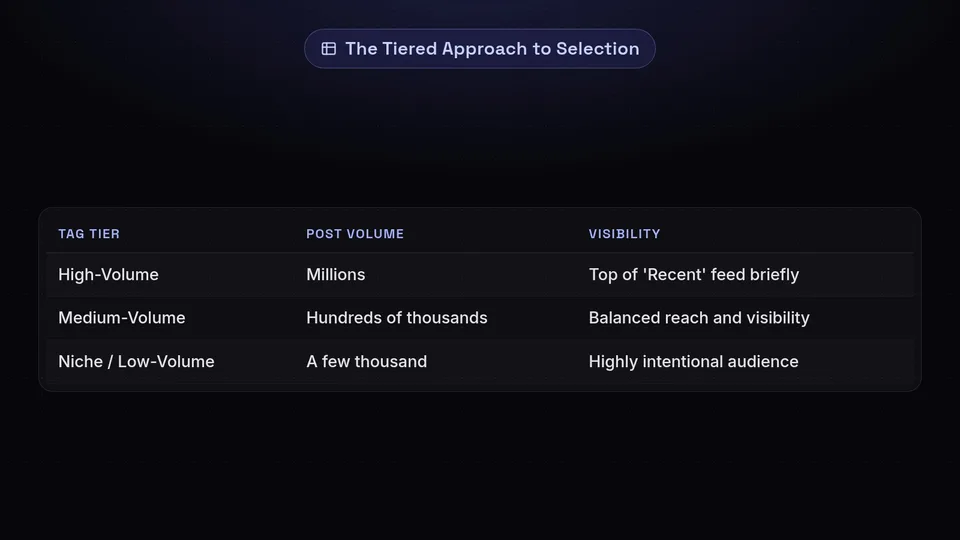
Building an effective hashtag set requires more than just picking the most popular words in your industry. In fact, relying solely on high-volume tags can often lead to your content being buried within seconds. A balanced set is the key to longevity and discovery. When building your sets, consider a tiered approach that incorporates different levels of competition and relevance.
The Tiered Approach to Selection
To build a robust set, you should categorise your tags into three distinct tiers:
- High-Volume Tags: These are broad terms with millions of posts. While they offer the highest potential reach, they also have the highest competition. Your content will likely stay at the top of the 'Recent' feed for only a few seconds.
- Medium-Volume Tags: These are more specific and usually have hundreds of thousands of posts. They offer a balance between reach and the ability to stay visible for a longer period.
- Niche or Low-Volume Tags: These are highly specific to your industry or location. They may only have a few thousand posts, but the audience searching for these tags is highly intentional and more likely to engage with your content.
By combining these tiers into a single group, you give your post the best chance of being seen by a broad audience while also securing a spot in the 'Top' posts for more specific, less competitive keywords. A hashtag sets manager allows you to build these balanced groups once and reuse them across multiple campaigns, ensuring consistency in your strategy.
The Importance of Saving Hashtag Groups for Efficiency
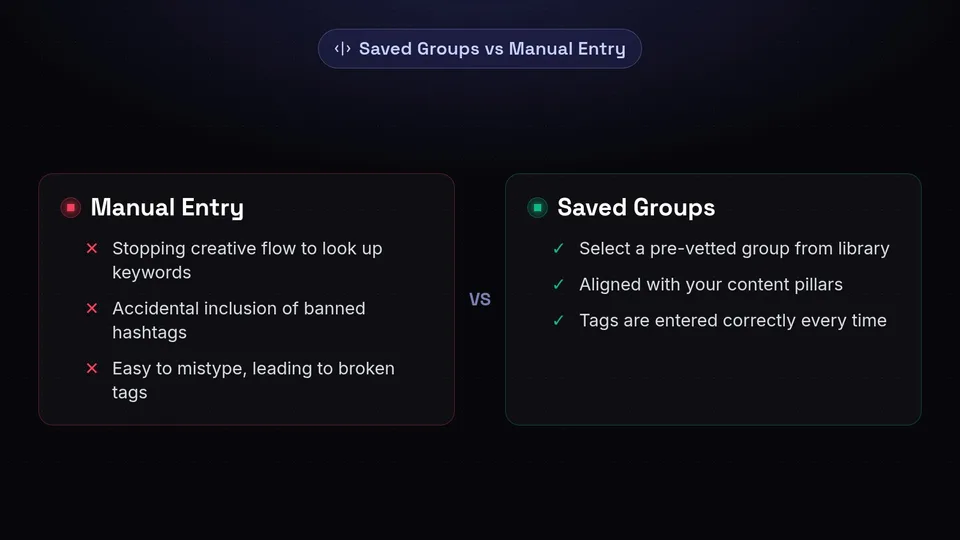
Efficiency is the cornerstone of professional social media management. When you save hashtag groups, you eliminate the friction of research during the content creation phase. Instead of stopping your creative flow to look up keywords, you can simply select a pre-vetted group from your library. This not only saves time but also prevents the accidental inclusion of 'banned' or 'shadowbanned' hashtags that could harm your account's reputation.
Organising by Content Pillars
One of the most effective ways to save your groups is by aligning them with your content pillars. Content pillars are the 3-5 core topics that your brand covers. By creating a specific hashtag set for each pillar, you ensure that your metadata is always perfectly aligned with the subject matter of your post. For instance, if one of your pillars is 'Sustainability', your saved group for that pillar would include tags related to eco-friendly practices, green living, and environmental awareness. This alignment helps the algorithm understand exactly who your content is for, leading to better placement in 'Explore' pages and 'Suggested' feeds.
Avoiding Manual Errors
Manual entry is the enemy of accuracy. It is easy to mistype a hashtag, which can lead to your post being associated with an entirely different topic or, worse, a broken tag that leads nowhere. By using a system to save hashtag groups, you ensure that the tags are entered correctly every time. You can also easily audit your groups to remove any tags that have become irrelevant or have been co-opted by unrelated communities.
The Science of Hashtag Rotation
One of the most common mistakes in social media marketing is 'hashtag stagnation'. This occurs when a user finds a set of tags that works once and continues to use that exact same set for every subsequent post. While it might seem efficient, it is a signal to platforms that the account is not providing unique value. Hashtag rotation is the practice of systematically changing the tags you use to avoid this stagnation and to reach different segments of your target audience.
Why Rotation Matters for the Algorithm
Social media algorithms are designed to promote fresh, engaging content. If you use the same tags repeatedly, the algorithm may stop showing your content to new people because it assumes you are targeting the same narrow slice of the audience every time. By implementing hashtag rotation, you are essentially casting a wider net. One day you might target a group interested in 'Digital Marketing', and the next you might pivot to 'Small Business Growth'. Both audiences are relevant to your brand, but they may follow different tags.
How to Implement a Rotation Schedule
Implementing rotation doesn't have to be complicated. If you have several saved groups for each content pillar, you can simply cycle through them. For a brand posting five times a week, a rotation might look like this:
- Monday: Group A (General Industry Tags)
- Tuesday: Group B (Niche Technical Tags)
- Wednesday: Group C (Location-Based Tags)
- Thursday: Group D (Community-Focused Tags)
- Friday: Group E (Branded and Campaign Tags)
This variety keeps the account's activity profile looking natural and dynamic. A hashtag sets manager makes this process seamless by allowing you to quickly swap groups during the scheduling process without having to remember which set you used last.
The Lifecycle of a Hashtag: When to Retire and Refresh
Hashtags are not permanent fixtures. Their popularity, relevance, and even their meaning can change over time. A critical part of managing your sets is knowing when to retire a hashtag and replace it with something more effective. This 'pruning' process ensures that your saved groups remain high-performing assets rather than outdated lists.
Identifying Underperforming Tags
You can identify tags that need to be retired by observing the engagement patterns on your posts. If posts using a specific group consistently underperform compared to others, it may be time to investigate the individual tags within that group. Sometimes, a tag that was once a thriving community hub can become oversaturated with spam, making it useless for genuine discovery. Other times, a tag may simply fall out of fashion as users migrate to new terms or slang.
The Danger of Banned Hashtags
Platforms occasionally 'ban' certain hashtags if they are frequently used in posts that violate community guidelines. These aren't always obvious; sometimes perfectly innocent words are restricted. Using a banned hashtag can result in your post not appearing in any hashtag feeds at all. Regularly checking your saved groups and refreshing them is the only way to ensure you aren't inadvertently using restricted terms. When you find a problematic tag, it should be retired immediately from all your saved groups.
Integrating Hashtag Management into Your Workflow
To get the most out of your hashtag sets manager, it should be integrated directly into your content planning and scheduling workflow. The goal is to make the addition of hashtags the final, easiest step in the process, rather than a secondary thought that gets rushed at the last minute.
Planning with Metadata in Mind
When you are planning your content calendar, you should already have an idea of which hashtag group will accompany each post. This allows you to tailor your caption to complement the tags. For example, if you know you are using a 'Tutorial' hashtag set, your caption should clearly state the value of the lesson provided. This synergy between the content, the caption, and the hashtags creates a cohesive experience for both the user and the algorithm.
Using SchedulifyX for Management
SchedulifyX provides a robust environment to save hashtag groups and manage them effectively. Within the platform, you can create distinct libraries for different accounts or campaigns. When you are scheduling a post, you can access your hashtag sets manager with a single click, allowing you to insert your pre-vetted groups directly into the caption or as a first comment. This level of integration ensures that your hashtag rotation strategy is executed perfectly every time, without the need for manual tracking.
Platform Specifics: Tailoring Sets for Instagram, LinkedIn, and X
While the concept of hashtag sets applies across all major platforms, the execution varies significantly. A hashtag sets manager should allow you to save groups tailored to the specific 'etiquette' and technical limits of each network.
Instagram: The Power of Volume
On Instagram, hashtags are a primary discovery tool. While the platform allows up to 30 tags, many experts suggest that a focused group of 10-15 highly relevant tags is often more effective. Instagram users frequently search for tags, so your groups here should be a mix of broad and niche terms. Using the 'first comment' feature to hide your hashtags is a popular aesthetic choice that a good manager should support.
LinkedIn: Professionalism and Precision
LinkedIn is much more conservative with hashtags. Using 30 tags here would look unprofessional and may even confuse the algorithm. Instead, focus on 3-5 very specific, professional tags. Your saved groups for LinkedIn should focus on industry terms, job titles, and specific business topics. Hashtag rotation is still important here to ensure you are appearing in different professional circles.
X (formerly Twitter): Context and Trends
On X, hashtags are often used to join broader conversations or trending topics. Because of the character limit, you usually only have room for 1-2 tags. Your hashtag sets for X should be very focused and often lean towards trending industry keywords or event-specific tags. A manager helps you keep these short, punchy tags ready for quick deployment.
Common Pitfalls in Hashtag Management
Even with the best tools, there are common mistakes that can undermine your hashtag strategy. Awareness of these pitfalls is the first step toward avoiding them.
- Over-Reliance on Branded Tags: While branded tags are great for community building, they don't help with discovery. If your sets only contain your company name, you won't reach anyone who isn't already following you.
- Ignoring Local Tags: If your business has a physical location or serves a specific region, failing to include local hashtags is a missed opportunity. Local tags often have lower competition and higher conversion rates.
- Neglecting the 'First Comment' Strategy: On platforms like Instagram, placing hashtags in the first comment keeps the caption clean and readable while still providing all the SEO benefits. A good workflow should accommodate this.
- Set-and-Forget Mentality: The digital landscape changes fast. A hashtag set that worked six months ago might be completely ineffective today. Regular audits are non-negotiable.
Conclusion
Mastering the use of hashtags is a journey from manual, repetitive tasks to a strategic, automated system. By using a hashtag sets manager, you can save hashtag groups that are balanced, relevant, and effective. Implementing a consistent hashtag rotation strategy ensures that your content remains fresh in the eyes of the algorithm and reaches a diverse audience. Furthermore, the discipline of retiring outdated or underperforming tags keeps your social media presence lean and high-performing.
As social media platforms continue to evolve, the importance of structured metadata will only grow. Tools like SchedulifyX are designed to simplify this complexity, giving you the power to manage your hashtags with the same precision you bring to your content creation. Start building your library today and see how a structured approach to hashtags can transform your social media reach and engagement. Ready to take control of your social media strategy? Optimise your workflow and master your hashtag management with SchedulifyX.