Define Content Pillars Properly and Make Them Usable
SchedulifyX Team · October 7, 2026
Learn what a content pillar actually is, how to derive themes from what your business sells, and see a worked example turning 4 pillars into a month of posts.
If you have ever stared at a blank screen wondering what to post on your company's Instagram, LinkedIn, or X account, you are experiencing a symptom of a much larger problem: a lack of foundational strategy. The cure for this blank-page anxiety is understanding and implementing social media content pillars. But if you search the internet for "what is a content pillar," you are likely to find a confusing mix of advice, much of which conflates social media strategy with search engine optimization (SEO).
In this comprehensive guide, we are going to define content pillars properly, clear up the industry confusion, and show you exactly how to make them usable. We will explore what a pillar actually is, how many your account should run, and how to derive these pillars from what your business actually sells rather than inventing random topics. Finally, we will walk through a detailed, worked example of turning four content pillars into a full month of highly engaging social media posts.
What is a Content Pillar in Social Media?

To answer the question of what is a content pillar, we must first look at how brands communicate consistently over time. A content pillar is a broad, recurring theme or topic bucket that your brand consistently returns to in its social media strategy. It is not a one-off campaign, a temporary promotion, or a fleeting trend. Instead, it is a foundational category that supports your overall brand messaging and business objectives.
Think of content pillars as the structural columns holding up your social media presence. If you only have one pillar (e.g., constantly pitching your product), the structure becomes unbalanced and your audience loses interest. If you have twenty pillars, the structure becomes a chaotic maze, and your audience never truly understands what your brand stands for. By grouping your content into three to five distinct pillars, you create a cohesive, predictable, and engaging experience for your followers.
For example, if you run a fitness apparel brand, your social media content pillars might include "Workout Tutorials," "Community Spotlights," "Product Education," and "Healthy Lifestyle Tips." Every single post you create should naturally slot into one of these four buckets. If a post idea doesn't fit into a pillar, it likely doesn't serve your overarching business strategy and should be discarded.
Social Media Content Pillars vs. SEO Pillar Pages
One of the biggest hurdles marketers face when researching content pillars is the collision of terminology between social media marketing and SEO. Because the terms overlap, readers often arrive confused about which concept they actually need. Let us draw a clear distinction between the two.
Social Media Content Pillars
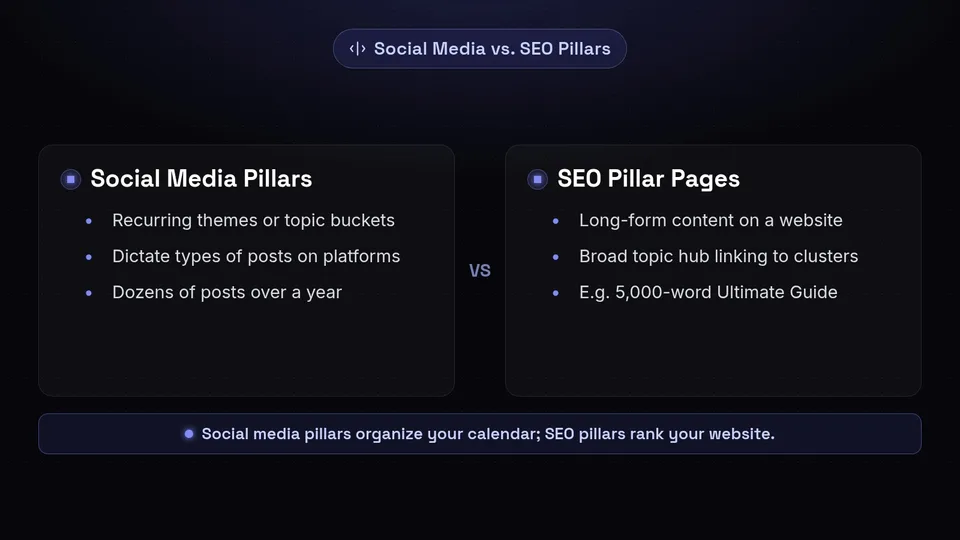
As defined above, social media content pillars are recurring themes or topic buckets used to organize a content calendar. They dictate the types of posts you publish on platforms like LinkedIn, Instagram, and TikTok. They are conceptual categories. You do not publish a "content pillar" as a single post; rather, you publish dozens of individual posts that belong to that pillar over the course of a year.
SEO Pillar Pages
In the world of search engine optimization, a "pillar page" (often referred to as SEO content pillars) is a specific, comprehensive piece of long-form content published on a website. An SEO pillar page covers a broad topic in depth and serves as a hub, linking out to smaller, more specific "cluster" articles. For example, a software company might write a 5,000-word SEO pillar page titled "The Ultimate Guide to Project Management" and link it to smaller blog posts about specific project management methodologies.
The Takeaway: If you are planning your website's blog architecture to rank on Google, you are building SEO pillar pages. If you are trying to organize what to post on Instagram this month so your brand looks cohesive, you are building social media content pillars. This article focuses entirely on the latter.
How Many Content Pillars Should an Account Run?
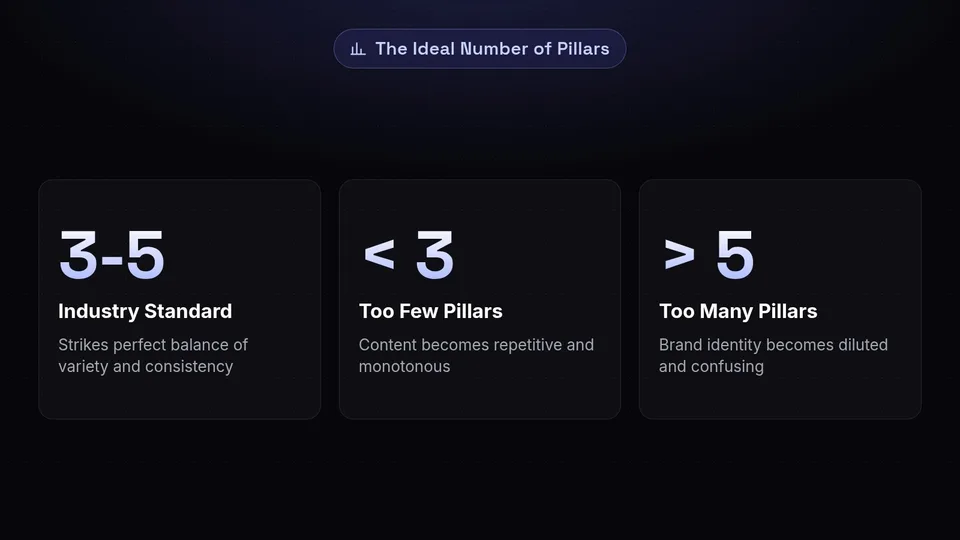
A common question when developing a strategy is: how many content pillars should we have? While there is no strict mathematical law, the industry standard and most effective range is three to five content pillars.
Why is this the magic number?
- Fewer than three pillars: Your content becomes repetitive and monotonous. If your only pillars are "Product Features" and "Company News," your audience will quickly tune out because the content lacks dimension, educational value, or entertainment. Social media is a two-way street; you must provide value to earn attention.
- More than five pillars: Your brand identity becomes diluted. If you are posting about product features, employee pets, industry news, motivational quotes, deep-dive tutorials, user-generated content, and random memes, your audience won't know what to expect from you. You become a jack-of-all-trades and a master of none, making it difficult to build a loyal, niche following.
By sticking to three to five content pillars, you strike the perfect balance between variety and consistency. It gives you enough room to be creative and engage different segments of your audience, while keeping your brand message laser-focused on your business objectives.
How to Derive Pillars From What You Actually Sell
One of the most fatal mistakes social media managers make is inventing content pillars out of thin air based on what they think is "trendy" or "fun." They look at successful influencers and try to mimic their pillars, resulting in disjointed content that gets likes but drives zero revenue.
Your social media content pillars must be derived from what your business actually sells and the problems your product or service solves. If your social media strategy is disconnected from your sales and marketing funnel, it is merely digital noise. Here is a framework for deriving your pillars logically.
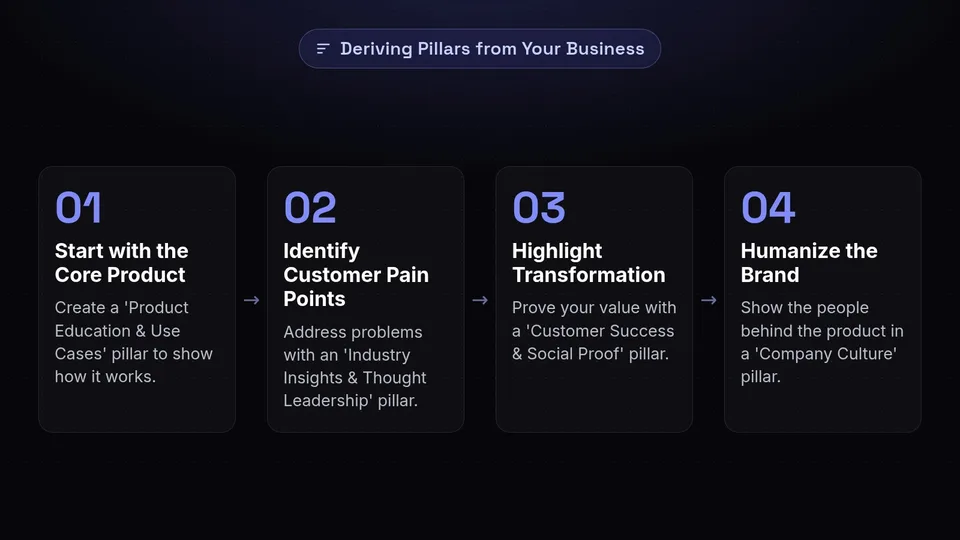
1. Start with the Core Product or Service
What is the primary thing you want people to buy? Let's say you sell a B2B project management software. Your first pillar must be directly related to the product itself. However, instead of calling it "Sales Pitches," reframe it as Product Education & Use Cases. This pillar will showcase how the software works, highlight specific features, and demonstrate how it solves real-world problems for users.
2. Identify the Customer's Pain Points
Why do people buy your product? In the case of project management software, they buy it because their teams are disorganized, deadlines are being missed, and communication is scattered. Your second pillar should address these pain points directly, without necessarily pitching the product. This becomes your Industry Insights & Thought Leadership pillar. Here, you share tips on team productivity, remote work best practices, and time management.
3. Highlight the Transformation and Proof
People don't buy products; they buy better versions of themselves or their businesses. You need a pillar that proves your product delivers on its promises. This becomes your Customer Success & Social Proof pillar. It includes case studies, testimonials, user-generated content, and before-and-after scenarios.
4. Humanize the Brand
Finally, people buy from people. A faceless corporation is hard to trust. Your final pillar should focus on the people behind the product. This becomes your Company Culture & Behind-the-Scenes pillar. It showcases your team, your company values, how the product is made, and what it's like to work at your organization.
By following this framework, you guarantee that your content pillars are inextricably linked to your business model. You aren't guessing what to post; you are strategically educating, proving, and humanizing your brand.
Content Pillar Examples by Industry
To further clarify what is a content pillar, let's look at a few content pillar examples across different industries to see how the derivation framework applies in the real world.
Example 1: E-Commerce (Skincare Brand)
- Pillar 1: Product Education. Detailed breakdowns of ingredients (e.g., "Why Vitamin C matters"), how to layer products, and routine tutorials.
- Pillar 2: Customer Transformations. Before-and-after photos, video testimonials from real users, and reposted user-generated content.
- Pillar 3: Skincare Science & Myths. Educational posts debunking common skincare myths, explaining dermatological terms, and establishing authority.
- Pillar 4: Brand Values. Posts highlighting cruelty-free testing, sustainable packaging efforts, and behind-the-scenes looks at the manufacturing process.
Example 2: Local Service Business (Plumbing Company)
- Pillar 1: Preventative Maintenance Tips. Educational content on how to avoid frozen pipes, what not to put down the garbage disposal, and seasonal checklists.
- Pillar 2: On-the-Job Reality. Photos and videos of the crew fixing complex problems, showing the dramatic "before and after" of a pipe replacement.
- Pillar 3: Local Community Involvement. Highlighting sponsorships of local Little League teams, community events, and showcasing local pride.
- Pillar 4: Customer Reviews. Highlighting five-star reviews from neighbors and offering special local promotions.
Example 3: B2B SaaS (SchedulifyX - Social Media Platform)
- Pillar 1: Social Media Strategy & Education. Deep dives into topics like content pillars, algorithm updates, and audience growth tactics.
- Pillar 2: Platform Features & Tutorials. Highlighting how to use the content calendar to save time, or how the AI helps generate captions.
- Pillar 3: Agency & Creator Success Stories. Case studies of how social media managers saved 10 hours a week using the tool.
- Pillar 4: Data & Industry Reports. Sharing proprietary data, such as finding the best time to post across different networks based on millions of analyzed posts.
Worked Example: Turning 4 Pillars Into a Month of Posts
Understanding the theory of social media content pillars is great, but the real magic happens in execution. Let's walk through a highly practical, worked example. We are going to take a fictional business—a boutique specialty coffee roaster called "Apex Roasters"—define their four pillars, and map out a realistic 4-week content plan.
Step 1: Define the 4 Pillars
Based on what Apex Roasters actually sells (high-quality, ethically sourced coffee beans), we derive the following four pillars:
- Coffee Education (Value/Inform): Teaching the audience how to brew better coffee at home (grind size, water temperature, pour-over techniques).
- Bean Origins & Ethics (Storytelling/Trust): Highlighting the farms where the beans are sourced, the fair-trade practices, and the flavor profiles of different regions.
- Behind the Roaster (Culture/Humanize): Showing the roasting process, introducing the team, and sharing the sights and sounds of the roastery.
- Product & Merchandise (Promote/Sell): Direct promotion of new coffee blends, brewing equipment, merchandise, and subscription boxes.
Step 2: Assign Proportions (The Content Mix)
You shouldn't post from every pillar equally. Promotional content should be the smallest percentage of your output to avoid fatiguing your audience. For Apex Roasters, we will use the following mix for a 12-post-per-month schedule (posting 3 times a week):
- Coffee Education: 30% (approx. 4 posts)
- Bean Origins & Ethics: 30% (approx. 4 posts)
- Behind the Roaster: 20% (approx. 2 posts)
- Product & Merchandise: 20% (approx. 2 posts)
Step 3: Brainstorm the Topics (The 4-Week Matrix)
Now, we sit down and brainstorm specific post ideas that fit neatly into these buckets. Notice how every single post serves a distinct purpose and returns to the core recurring themes.
Week 1
- Monday (Education): Carousel post: "The Ultimate Guide to Grind Sizes" (showing visual comparisons of fine vs. coarse grounds).
- Wednesday (Behind the Roaster): Reel: A 15-second aesthetic video of the roasting machine dropping a fresh batch of beans, with ASMR audio.
- Friday (Origins): Single image: A spotlight on the cooperative farm in Colombia where this month's featured bean was grown, focusing on the altitude and soil.
Week 2
- Monday (Product): Video: Unboxing the new "Winter Espresso Blend" and showing the beautiful packaging. Clear call-to-action to buy.
- Wednesday (Education): Reel: "Stop making this one mistake with your French Press" (explaining why boiling water burns the coffee).
- Friday (Origins): Carousel post: Flavor profile breakdown. "What does 'washed process' actually mean for the taste of your coffee?"
Week 3
- Monday (Education): Infographic: Water-to-coffee ratios for different brewing methods (Chemex, Aeropress, V60).
- Wednesday (Behind the Roaster): Photo: Meet the Head Roaster, Sarah. A short Q&A in the caption about her favorite morning routine.
- Friday (Product): Announcement: "Our new ceramic mugs just dropped!" High-quality lifestyle photo of the mug in use.
Week 4
- Monday (Origins): Reel: A montage of video clips from a recent sourcing trip to Ethiopia, highlighting the community.
- Wednesday (Education): Carousel: "How to properly store your coffee beans so they stay fresh for weeks."
- Friday (Product/Subscription): Video: "Never run out of coffee again." A walkthrough of how the monthly subscription box works, ending with a discount code.
Step 4: Schedule and Optimize
With the ideas mapped out, the final step is production and scheduling. Instead of logging in every day to post manually, you would load these 12 pieces of content into a content calendar. By visualizing the month, you can ensure that you don't accidentally post three "Product" posts in a row, maintaining the delicate balance of your pillars.
Furthermore, because you are organized, you can use data to determine the best time to post for your specific audience, ensuring that your highly educational "Grind Size" carousel reaches the maximum number of home baristas while they are scrolling during their morning commute.
Common Mistakes When Building Content Pillars
Even with a solid understanding of what is a content pillar, marketers often stumble during implementation. Here are the most common pitfalls to avoid:
1. Treating Pillars as Rigid Prisons
Content pillars are meant to guide you, not imprison you. If a massive industry news story breaks, or a highly relevant trend emerges that doesn't perfectly fit your four pillars, it is okay to participate occasionally. Pillars provide the recurring baseline, but social media still requires agility and real-time responsiveness. Use the 80/20 rule: 80% of your content should fit your pillars, leaving 20% for experimentation and timely trends.
2. Failing to Analyze and Adapt
Your content pillars are not set in stone forever. After running your strategy for three to six months, you must dive into your analytics. You might find that your "Behind the Scenes" pillar is generating massive engagement and driving profile visits, while your "Industry News" pillar is falling flat. A smart social media manager will adapt, perhaps replacing the underperforming pillar with a new concept derived from audience feedback.
3. Overcomplicating the Categories
If you have to write a paragraph to explain to your team what a specific content pillar means, it is too complicated. Pillars should be instantly understandable. "Product Education," "Customer Stories," and "Industry Tips" are clear. "Synergistic Paradigm Shifts in B2B Networking" is not a pillar; it's corporate jargon that will paralyze your content creators.
Conclusion: Streamline Your Strategy with SchedulifyX
Understanding what is a content pillar is the critical first step in transforming your social media presence from a chaotic afterthought into a strategic business asset. By defining three to five recurring themes, deriving them directly from the core problems your business solves, and mapping them out meticulously, you eliminate the daily stress of content creation. You replace guesswork with a predictable, scalable system.
As we saw in the worked example, turning four pillars into a month of posts is entirely achievable when you have a clear framework. But strategy is only half the battle; execution is where many teams fall behind. Managing assets, writing captions, collaborating with team members, and ensuring posts go out at the optimal times requires robust infrastructure.
That is where SchedulifyX comes in. Our AI-powered platform is designed specifically to help you execute your content pillar strategy flawlessly. With our visual content calendar, you can color-code your posts by pillar to ensure a perfect mix at a glance. Our advanced analytics will automatically calculate the best time to post for each specific network, maximizing the reach of every single piece of content you create.
Stop staring at a blank screen. Define your pillars, map your month, and let SchedulifyX handle the rest. Start your free trial today and take absolute control of your social media strategy.